




Abstract
Introduction:
Surveying oral health at the community level should be done at regular intervals. Dental health personnel must assess the oral health status and needs of the community through the collection and interpretation of reliable health information. Thus, the aims of this study were (1) to develop a mobile application for oral health surveys, (2) to analyze the oral status of school children in Bangkok using the newly developed application, and (3) to evaluate user satisfaction with using the Oral Health Survey Mobile Application (OHSMA).
Materials and Methods:
The OHSMA Android app was created to facilitate the collection and transfer of oral health status data. The survey data on the oral health status of Grades 1–6 Thai schoolchildren were collected and analyzed using the OHSMA. A 5-point Likert scale questionnaire was used to evaluate the satisfaction of 125 dental students when using this new application compared with using paper forms.
Results:
The prevalence of dental caries in 441 schoolchildren was 79.7%. The total mean decayed, missing, and filled for primary teeth (dmft) and decayed, missing, and filled for permanent teeth (DMFT) were 4.09 (d + D = 3.29, m + M = 0.15, and f + F = 0.65). Users indicated high satisfaction scores for three OHSMA features: font, color, and proper size. The results showed that paper forms were easier for inputting and recording the data compared with the OHSMA. However, the OHSMA was significantly easier for searching data and reporting data compared with paper forms (OHSMA 3.80, paper forms 3.35; p < 0.001, and OHSMA 3.80, paper forms 3.51; p < 0.001), respectively.
Conclusions:
Despite some limitations, this study suggests that the mobile application has the potential to collect valuable oral health survey data.
Introduction
Oral diseases in children remain a major public health problem in Thailand because of their high prevalence, severity, and impact on an individual's quality of life, including their physical, emotional, and social well-being. 1,2 The National Oral Health Survey (NOHS) is a source of epidemiological data on oral disease. The NOHS report focuses on the two most common oral diseases that affect many people–tooth decay (dental caries) and gum disease (periodontal disease). Oral health surveys provide a sound basis for assessing the current oral health status of a population and its future needs for oral healthcare. Surveys of oral health at the community level should to be done at regular intervals. This allows trends of each disease to be determined over time. Dental health personnel must assess the oral health status and needs of the community through the collection and interpretation of reliable health information. The high number of oral health measures and the complexity in measuring oral health status may result in errors when transferring survey data collected using paper forms into a computer.
Mobile devices are now available to assist healthcare professionals (HCPs) in performing many important tasks, such as information and time management, health record maintenance and access, communications and consulting, reference and information gathering, patient management and monitoring, clinical decision-making, and medical education and training. 3 –9 Mobile devices have become common in healthcare settings, leading to rapid growth in the development of medical software applications (apps) for these platforms. 10,11 HCPs need to minimize mistakes and time-consuming data recording. In addition, traditional data recording using paper forms is more expensive compared with using mobile devices. Moreover, telemedicine including mobile technology provides an excellent system for data collection, which can be used for assessing the current oral health status of a population and developing policies and strategies that support oral health programs. Therefore, this study used mobile technology to create a new app for making an efficient, high quality, and valuable oral health survey.
Materials and Methods
The Oral Health Survey Mobile Application (OHSMA) is a new app specifically designed for dentists and dental health personnel based on the 1997 World Health Organization (WHO) criteria. 12 The OHSMA can be installed on Android® system smartphones or mobile devices. The OHSMA composes of two elements: a phone app and web server. Trial systems were evaluated during development to add and fix components to solve problems and reduce the possibility of system failure. This app automatically sends the surveyed data and its summary in Microsoft Excel to the dentist by e-mail.
Phone APP
Dentists can easily install the OHSMA on their smart phones. The OHSMA has three functions: (1) Registration and log in. A new user has to register by inputting their information that is sent to the registered dentist via e-mail; (2) Input data composed of two parts. Part I—Patient personal information; name, age, sex, and birth date are saved in the database to gain access for recording the oral health status in the examination sheet. Part II—Examination sheet information; decayed, missing, and filled teeth for primary (dmft) and permanent (DMFT), decayed, missing, and filled surfaces for primary (dmfs) and permanent (DMFS), Community Periodontal Index (CPI), and Simplified Oral Hygiene Index (OHI-S); and (3) Oral status survey report. After recording the oral health status, all survey information and its summary can be retrieved through e-mail.
Web Server
The web browser (
Application
The goal of the newly developed OHSMA is to assist in surveys of dental caries and periodontal disease among populations. In the present study, 125 dental students, who were trained in the 1997 WHO survey criteria, gave oral examinations to Grades 1–6 schoolchildren in Bangkok Metropolitan Administration (BMA) public schools. Dental caries and periodontal status were clinically evaluated according to the DMFT/dmft index and CPI. The data were collected and consent for using data was obtained from the Department of Community Dentistry, Chulalongkorn University. The study protocol was approved by the Human Research Ethics Committee of the Faculty of Dentistry, Chulalongkorn University (HREC-DCU 2016-072).
Outcome Assessment
A self-administered questionnaire was used to evaluate the quality and satisfaction of the OHSMA with 125 dental students who had used OHSMA and paper forms for collecting and transferring the data. Part I: ten 5-point Likert scale questions concerning their satisfaction with the OHSMA's features, including satisfaction with the font style, color, font size, element layout, and searching data. The scores ranged from 1 to 5: 1 = highly not satisfied, 2 = not satisfied, 3 = neutral, 4 = satisfied, and 5 = highly satisfied. Part II: six questions comparing using the OHSMA and paper forms: inputting general data, searching the data, recording the data, reporting the data, convenience of use, and overall use. The scores ranged from 1 to 5: 1 = cannot evaluate, 2 = very difficult, 3 = difficult, 4 = easy, and 5 = very easy.
Statistical Analysis
Each questionnaire on the satisfaction of using the OHSMA or paper forms was separately assessed using descriptive statistics and then compared by the Pair t-test using the Statistical Package for Social Science program version 22.0 (IBM Corp., Armonk, NY).
Results
A total of 441 BMA schoolchildren were examined for dental caries and periodontal status. The prevalence of dental caries was 79.7% and the total mean dmft and DMFT was 4.09 (Table 1). The distribution of schoolchildren according to their dmft and DMFT value are shown in Figures 1 and 2. We found that 29.5% (130) of the children never had primary tooth decay. In contrast, 38.1% (168) had four or more teeth with decay experience (Fig. 1). The DMFT value of the children indicated that 32.4% were affected by permanent tooth decay experience (Fig. 2).
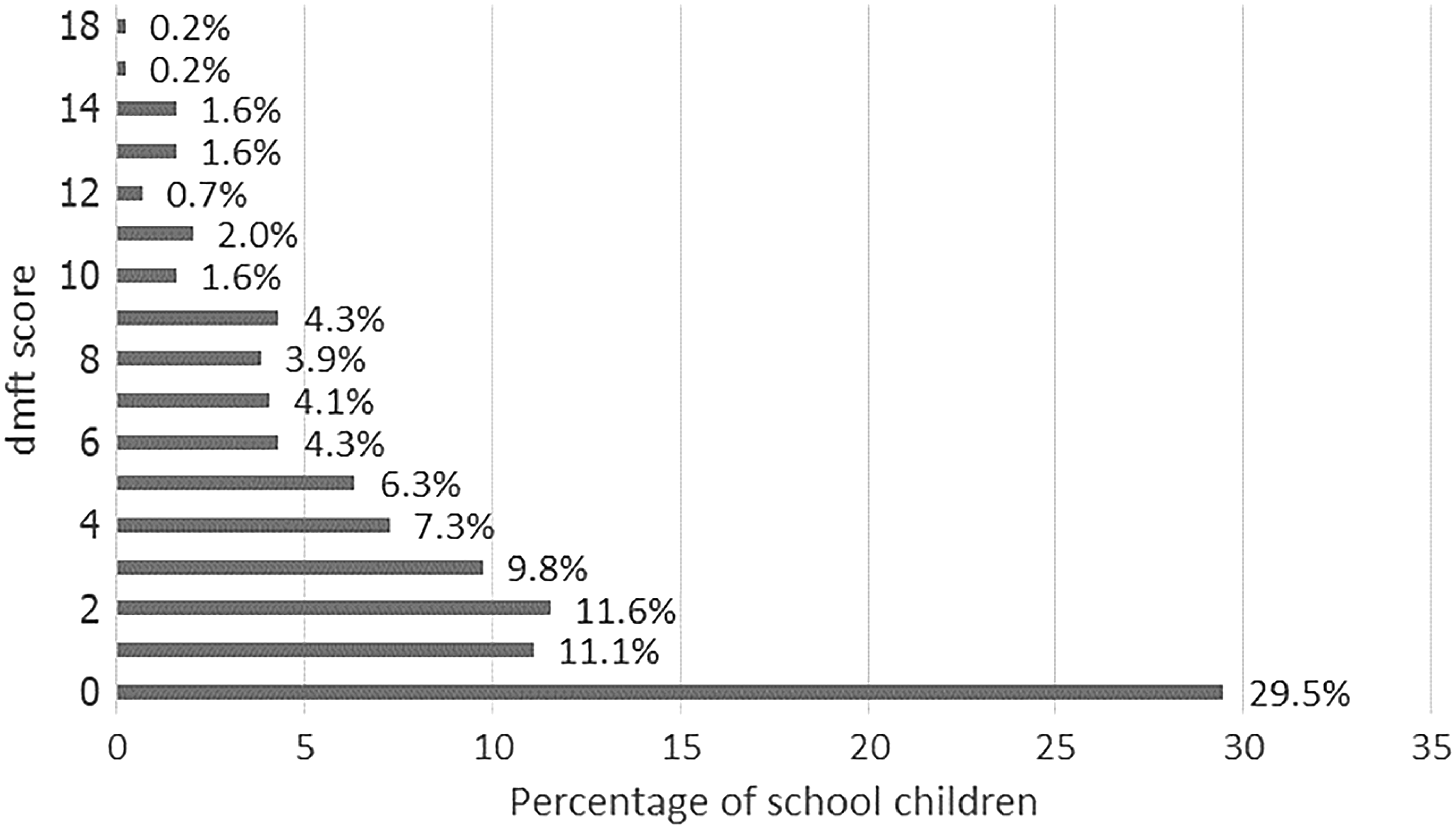
Distribution of schoolchildren according to decayed, missing, and filled for primary teeth (dmft) score.
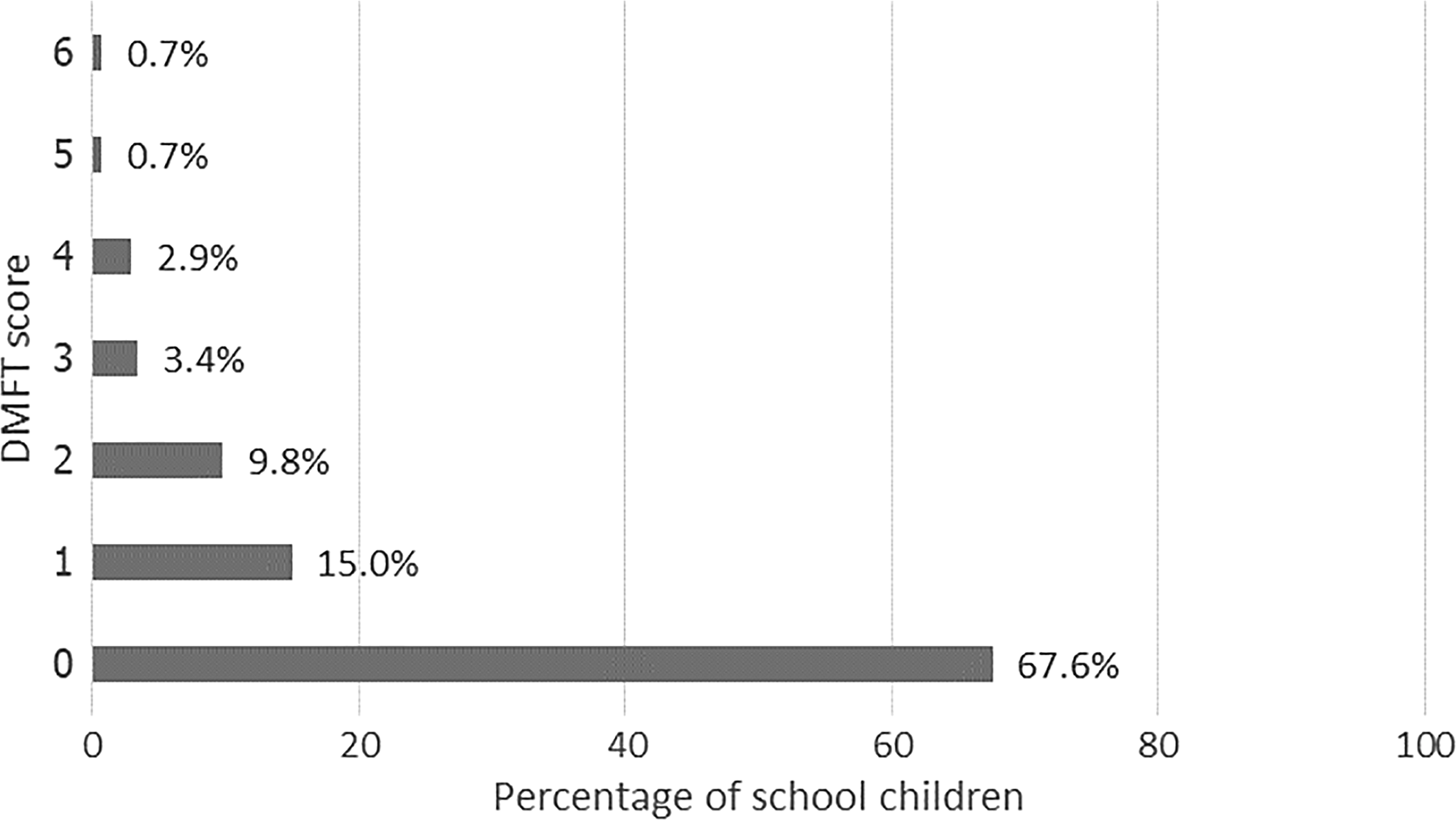
Distribution of schoolchildren according to DMFT score. DMFT, decayed, missing, and filled for permanent teeth.
Percentage and Mean of Children with Tooth Decay Experience
dmft, decayed, missing, and filled for primary teeth; DMFT, decayed, missing, and filled for permanent teeth.
The percentage of children with gum disease based on the CPI is shown in Table 2. Seventy-four children (16.8%) had healthy gingiva, 36.7% had bleeding on probing, and 46.3% had calculus present. The distribution of schoolchildren according to each school is shown in Table 3. Children from the Prathomnonsee School had a higher prevalence of dental caries compared with the other schools.
Percentage of Children with Gum Disease Based on the Community Periodontal Index
Mean dmft/DMFT According to Each School
dmft, decayed, missing and filled for primary teeth; DMFT, decayed, missing and filled for permanent teeth; SD, standard deviation.
The questionnaire results of the OHSMA satisfaction assessment indicated high satisfaction scores in three items; font, color, and proper size (Table 4). The mean duration for one session of examining and recording dental status using the OHSMA was 5.82 ± 6.8 min. The comparison between using the OHSMA or paper forms is presented in Figure 3. The inputting general data, recording the data, and convenience of use evaluation indicated that using paper forms was significantly easier compared with using the OHSMA. However, the OHSMA was determined to be significantly easier compared with paper forms on searching data (OHSMA 3.80, paper forms 3.35; p < 0.001) and reporting data (OHSMA 3.80, paper forms 3.51; p < 0.001). Overall, the participants felt that using paper forms was more practical compared with the OHSMA (paper forms 3.99, OHSMA 3.73; p < 0.001).
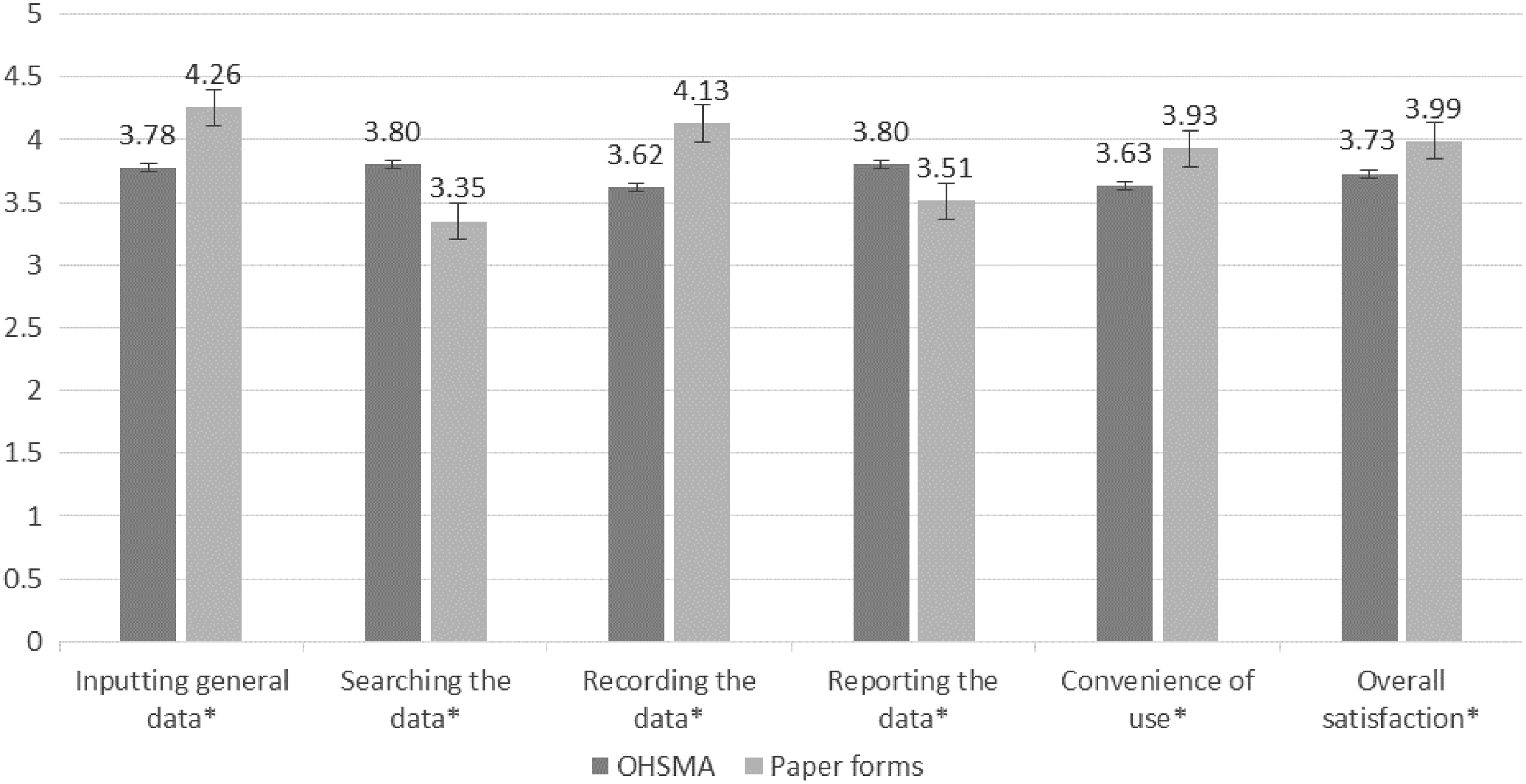
Comparison between using the OHSMA or paper forms. Six questions comparing using the OHSMA or the paper forms. The scores ranged from 1 to 5: 1 = cannot evaluate, 2 = very difficult, 3 = difficult, 4 = easy, and 5 = very easy. The pair t-test was used to compare the two methods, *indicates significant difference between methods. OHSMA, Oral Health Survey Mobile Application.
Satisfaction Scores of the Oral Health Survey Mobile Application from 119 Users
The scores ranged from 1 to 5: 1 = highly not satisfied, 2 = not satisfied, 3 = neutral, 4 = satisfied, and 5 = highly satisfied.
MAX, maximum; MIN, minimum.
Discussion and Conclusions
This study developed a mobile application (OHSMA) that enables a dentist to easily collect, transfer, and receive a summary of the oral health survey data. We found that users were satisfied with the features of the app. The app was found to be superior in searching and reporting the data compared with using paper forms.
The OHSMA can play an important role in performing valuable oral health surveys. The OHSMA allows the researcher to skip the step of transferring data recorded on paper forms into a computer. Thus, data analysis can be done immediately after finishing data collection. This will reduce the time and cost of the data-entering step, as well as possible errors that may occur during this step, especially when using large data sets. The OHSMA will also provide a summary of the surveyed data including dmft/DMFT, dmfs/DMFS, CPI, and OHI-S. Because the OHSMA was developed based on the 1997 WHO criteria, the surveyed data can be compared with those of previous studies.
We found that when dental students compared using paper forms or the OHSMA, they preferred inputting and recording data using paper forms. It is possible that the dental students were not familiar with recording data using the OHSMA examination sheet features, and their satisfaction was based more on familiarity with using paper forms rather than which method would be advantageous in a research context. Moreover, difficulties in accessing the Internet for online use might decrease the overall OHSMA satisfaction. However, the OHSMA was found to be easier when used for searching and reporting data compared with paper forms because the OHSMA can accommodate large databases and easily track patients according to their name. Moreover, when reporting the data, the surveyed data and its summary can be analyzed and sent using the user's e-mail.
Studies investigating patient record, maintenance and revision found that more patient information was documented when a mobile device was used because of ease of use compared with paper records. 7,11 Another study found a significant difference (p < 0.001) in the number of diagnoses documented with a mobile device compared with paper records. 13 Mobile apps can also increase productivity by improving professional and personal time and information management. 7 Indeed, the mobile teledentistry approach has shown the potential to detect occlusal caries from photographs taken by a smartphone camera with an acceptable diagnostic performance compared with traditional face-to-face screening. The use of this technology was suggested, because it can be an inexpensive and reliable screening tool. 14 Another study found that a mobile app, dental calendar, in combination with cloud services, provided efficient service to both dentists and patients, and helped establish a better relationship between them. Dental calendar also helped dentists arrange appointments for patients with sudden worsening of prosthesis function. 7
Despite some limitations, this study suggests that the new mobile application has the potential to manage valuable oral health survey data. To improve the oral health of a population, ongoing monitoring of oral health status is necessary in large epidemiological studies. It is possible that the OHSMA can potentially save time and cost in performing these studies. Further well-designed upgraded application software needs to be developed for both online and offline use and will include even larger databases that will provide public health surveillance, aid in community data collection, and improve dental care.
Footnotes
Acknowledgments
This project was supported by the Grants for Development of New Faculty Staff, Ratchadaphiseksomphot Endowment Fund, Chulalongkorn University. The authors wish to thank Dr. Kevin Tompkins for revising the article.
Disclosure Statement
No competing financial interests exist.