




Abstract
Background:
Although at least 1 in 10 veterans meet criteria for Posttraumatic Stress Disorder (PTSD) related to their military service, treatment seeking is strikingly low due to perceived stigma and other barriers. The National Center for PTSD produced AboutFace,* a web-based video gallery of veterans with PTSD who share their personal stories about PTSD and how treatment has turned their lives around.
Introduction:
We conducted a two-stage evaluation of AboutFace, which included (1) a usability testing phase and (2) a randomized, controlled trial phase to explore the feasibility of incorporating AboutFace into a specialized outpatient clinic for PTSD.
Materials and Methods:
Twenty veterans participated in the usability testing phase in which they answered moderator posed questions regarding AboutFace, while actively exploring the website. Sixty veterans participated in the study after completing a PTSD clinic evaluation and were randomized to receive an educational booklet about PTSD treatment or AboutFace before starting treatment. Stigma and attitudes about treatment seeking were assessed at baseline and 2 weeks later.
Results:
Veterans had positive attitudes about AboutFace and gave suggestions for improvement. Veterans in both conditions reported improved attitudes toward mental illness and treatment seeking from baseline to the 2-week follow-up.
Discussion:
AboutFace is a promising peer-to-peer approach that can be used to challenge stigma and promote help seeking.
Conclusions:
This use of an online peer approach is innovative, relevant to a wide range of healthcare conditions, and has the potential to increase access to care through trusted narratives that promote hope in recovery.
Introduction
Posttraumatic stress disorder (PTSD) occurs in approximately 17% of Vietnam veterans 1 and 13% of combat veterans returning from Iraq and Afghanistan. 2 PTSD is associated with high rates of psychiatric comorbidity, increased suicide risk, impairment in social/occupational functioning, poorer physical health and quality of life, and increased morbidity and mortality. 3 –5 Despite high levels of distress and impairment, rates of treatment seeking are surprisingly low among both civilians and veterans with PTSD and other mental health conditions. Fewer than half (45%) of individuals with a mental health problem seek treatment. 6 In a survey of over 47,000 soldiers, only 48% of those who screened positive for PTSD received any treatment in the 6 months before assessment, and 24% of those who initiated treatment dropped out prematurely. 7
Stigma is a major barrier to seeking mental health treatment. 8,9 Stigma is likely more salient among service members than civilians due to concerns that disclosing a mental illness could negatively impact their military career. Among those who met screening criteria for a mental illness in a survey of four US combat infantry units, 65% were concerned that others would see them as weak, 63% were concerned that leadership would treat them differently, and 59% were concerned that members of their unit might have less confidence in them. Those most in need of care also were most concerned about stigmatization. 7
Education and contact with people who have mental illness are two recommended strategies to reduce stigma. 10 Peers, in particular those with the same psychiatric condition, may be especially well-suited to deliver educational interventions targeting stigma. They can provide accurate information (i.e., education) through interaction (i.e., contact) and can challenge public misperceptions about mental illness in a nonthreatening and lay-friendly way. A growing body of evidence supports the effectiveness of peer educators in reducing stigma and improving treatment seeking. Peer educators have been shown to improve knowledge and self-efficacy in people with HIV, 11,12 reduce drinking in college students, 13 and reduce stigma in depressed older adults. 14
Most peer education approaches use live, trained peers. However, the use of live, trained peers can be costly, require significant resources to manage, and be difficult to scale and sustain. In contrast, scalable, technology-based approaches may add value by increasing the accessibility and cost-efficiency of peer education. Online support groups provide the opportunity for people with similar characteristics to share information, but do not allow for adequate control regarding the quality or accuracy of information that is shared. AboutFace * offers an alternative approach using a web-based video gallery of veterans with PTSD sharing their personal stories about PTSD, the treatment process, and how treatment has turned their lives around. Developed by the National Center for PTSD, this award-winning resource has reached tens of thousands of veterans. Despite its reach, AboutFace had yet to be formally evaluated or integrated into VA clinical practice. In this study, we conducted a two-stage evaluation of AboutFace, which included (1) usability testing of AboutFace and (2) a randomized controlled trial to explore the feasibility of implementing AboutFace into VA PTSD clinical practice.
Phase 1: Usability Testing
Usability testing explores a user's experience with a product by having consumers from the target population use the product, while being observed by an evaluator. Observations are systematically recorded and are later analyzed and interpreted to gain a unique depth of understanding around user experiences with the product. One of the main purposes for this type of testing is to obtain objective usability metrics and identify opportunities to strengthen the quality of a product. Common usability issues include anything that prevents task completion, takes the user off course from the task, creates confusion, or decreases satisfaction with the product. 15 Several studies have examined how usability testing can improve user experiences with direct-to-consumer online products targeting a range of health conditions. 16 –18 To this end, we completed usability testing with 20 veterans who completed a PTSD evaluation and were recommended for treatment in a PTSD Clinical Team (see Bunnell et al., 2017 for more on methods). 19
Materials and Methods
Participants
The sample included 17 male (85%) and 3 female (15%) veterans, 26–69 years old (M = 42.2; SD = 12.6), and half (n = 10; 50%) self-identified as Caucasian and half (n = 10; 50%) as African American. Of these, two (10%) identified with Latino or Hispanic ethnicity. A little over half (55%) of veterans reported being married or living with a significant other, 30% reported being divorced or separated, 5% reported being widowed, and 10% reported never being married. Finally, 60% reported having previously looked online for information about depression, anxiety, stress, or mental health issues.
Intervention
AboutFace is a web-based educational campaign to reduce stigma and increase help seeking in veterans with PTSD (Fig. 1). It introduces viewers to a community of 77 veterans, diverse with regard to military experience, age, gender, and race/ethnicity, who have experienced PTSD and subsequently received treatment. Visitors to the site can ‘meet’ veterans by watching their individual videos and hear how PTSD has affected them through unscripted, authentic personal stories. Veterans in AboutFace are filmed in natural settings looking directly at the camera. The eye contact is intimate, as if the veterans are peers who have invited the viewer into their homes and are sharing personal details of their lives.
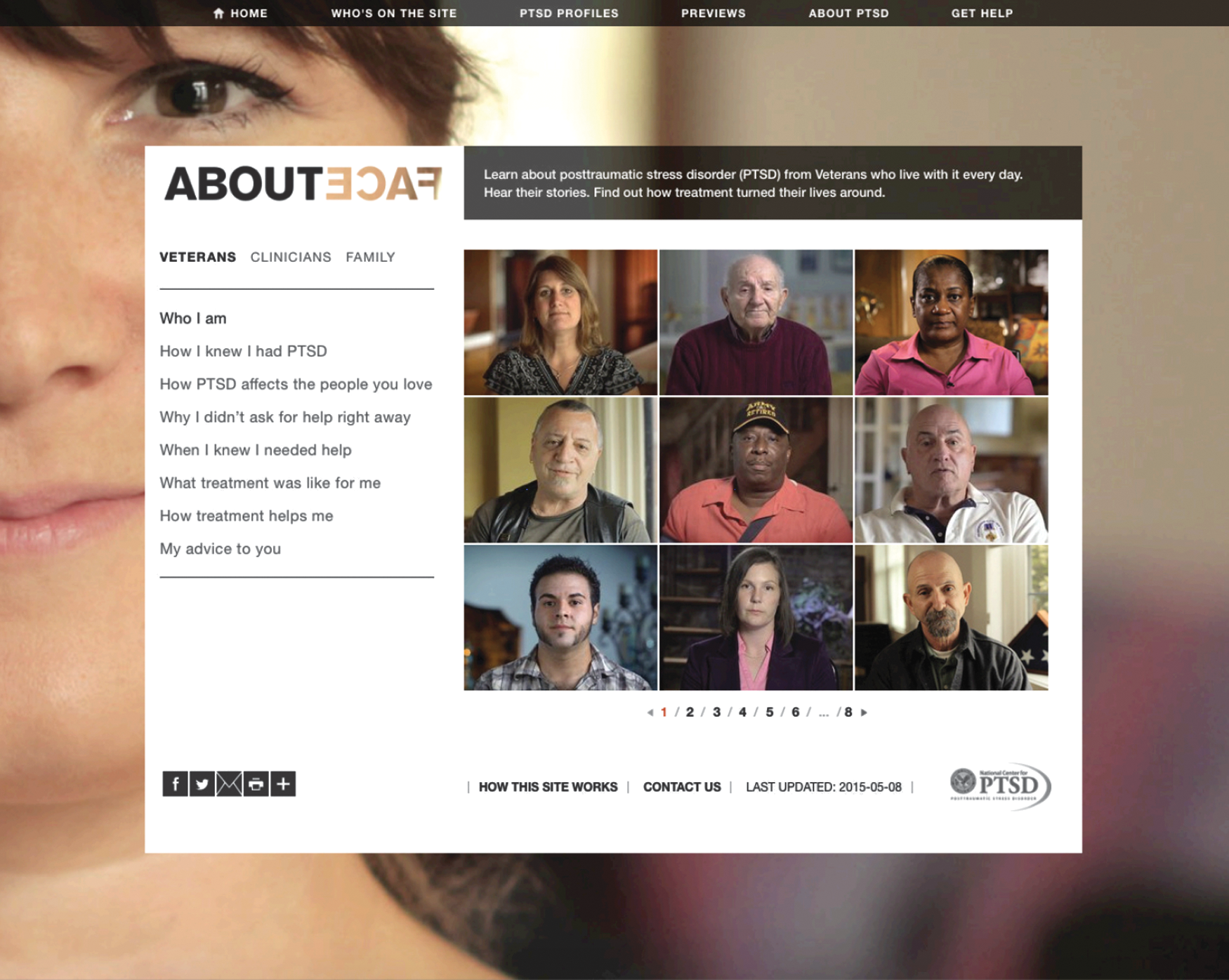
AboutFace (image used with permission).
Veterans who access AboutFace can learn about other veterans' military histories, the common symptoms of PTSD, treatment options, the struggles of other veterans regarding decisions to seek care, as well as detailed descriptions about what treatment was like for them. There is even a section where veterans give advice on what they think veterans with PTSD should know about seeking help. Thus, through honest and open testimonials, the veterans of AboutFace serve as encouraging peer supports to other veterans as they consider their own need for mental healthcare and what the process of PTSD treatment might look like. Veterans also can receive advice from expert clinicians and hear how PTSD affects family members through videoclips on the site. Topics addressed in the brief (1–3 min) videoclips are included in Table 1.
Topics Discussed by Veterans, Clinicians, and Family Members
PTSD, posttraumatic stress disorder.
Procedure
We recruited 20 veterans who presented for an evaluation at a VA PTSD specialized outpatient clinic. Veterans were approached for study participation immediately after their evaluation session, completed informed consent, and were given access to AboutFace. During the initial introductory observation period, veterans were encouraged to freely navigate the site, while a moderator observed their use. Specifically, the moderator stated, “Here is the website we would like you to evaluate. Take some time to use the site. Please walk me through what you are thinking step by step out loud, while you check it out and use it.” The moderator took notes during the session to record any behavioral observations, impressions, and relevant quotes from veterans. Following this introductory phase, the moderator used a general interview guide to ask questions such as “What do you think about the layout of the site?,” “Why did you choose to click on that veteran?,” and “What characteristics are you looking for as you look at the images of veterans on the screen?” Veterans were also asked questions about perceived changes in knowledge about the nature of PTSD treatment and perceived changes in attitudes toward seeking mental health treatment. All interviews were audio-recorded for later transcription. The Medical University of South Carolina Institutional Review Board approved the study.
Analysis
Audio-taped interviews were de-identified and transcribed verbatim, by a local medical transcription company. A constructivist grounded theory approach 20 was used for coding data and to identify consistent themes from the interview data. First, a content analysis of the interview responses was conducted through multiple close readings of the transcriptions by three independent coders. Each coder then generated an independent list of thematic categories and subcategories based on their review of the data. These themes were then further developed and ordered by the first author and reviewed and edited by the others. The coders then met in a consensus conference to discuss, refine, and finalize the thematic categories. The authors have previously used similar data analytic approaches to qualitative research with a range of trauma-affected populations. 21 –24
Results
Overall, AboutFace was perceived favorably with regard to its features and content. There was a general consensus by participants that the website was helpful to them and should be viewed by other veterans. One participant said, “It's a great, great resource…real people talking about their experiences.” Another said, “if I had seen this sooner, I probably would have been here sooner,” suggesting viewing the site would have led them to seek treatment sooner. Veterans also frequently noted that AboutFace helped normalize their personal and family experiences. Likely related to this, participants often chose to explore tabs that featured veterans who were perceived as being more similar. Similarity was generally defined by branch of military, role in military, deployment experiences, gender, and age.
Content Feedback
With regard to specific content, participants viewed the veteran videos as the most valuable. Common topics that veterans gravitated toward included How I knew I had PTSD, When I knew I needed help, and How PTSD affects the people you love. Again, veterans appeared to look for relevance and comments focused on how the narratives were helpful because they normalized their experiences. One veteran said, “It's pretty relatable. A lot of people [are] like me…it's pretty insightful.” Another said “I thought it was just me.” The family topic How PTSD affects people you love was also described as particularly valuable. Participants commented on how this topic increased their awareness of and empathy toward their own family members. Several made statements like “I just wanted to see it from my wife's side” or that it was helpful “seeing the other side of the spectrum.” Veterans wanted to see more diversity in family members (e.g., brothers and sisters, children), again indicating personal relevance with regard to content.
Design/Feature Recommendations
A few participants were confused by some of the navigation features and did not recognize that there were features in addition to the topic questions that were accessible from the top navigation. Some did not immediately recognize that the images of veterans on the main screen were connected to videos, and only noticed the rollover quotes.
Participants offered several recommendations for improving the layout of the site, including adding a greater diversity of veteran and family profiles, and more search options. They wanted more content describing what PTSD is and how it can be treated. This likely stemmed from a lack of initial recognition that there was a “Clinicians” tab on the site that provides this information.
Implementation/Dissemination
With regard to future implementation and dissemination, participants believed the site would be most beneficial to veterans who were ambivalent about seeking help and that it should be viewed as soon as possible (i.e., immediately after returning from deployment or when first accessing VA healthcare). Importantly, when asked directly, more than half of participants (60%) reported an increase in knowledge regarding PTSD symptoms and diagnosis, the impact of their symptoms on family members, and a greater understanding of PTSD and what PTSD treatment involves after visiting the site.
Discussion
Results indicated that AboutFace was perceived as highly relevant by our veteran sample and important information was conveyed in an engaging and accessible format. Despite largely favorable comments, a number of recommendations were provided by veterans to further strengthen the appeal of AboutFace. Based on this feedback, more veterans' videos were added to the site to increase diversity and broaden relevance (especially more women who experienced military sexual trauma). A new Therapies page was created to provide more basic information on PTSD and PTSD treatment. A searchable video directory was also added that includes veteran, clinician, and family videos, with obvious play buttons on each video.
Phase 2: Randomized Controlled Pilot of AboutFace
In phase two, we conducted a small-scale feasibility trial to demonstrate the methodology and inform research design decisions in preparation for a future randomized controlled trial, to examine the impact of AboutFace on stigma, attitudes toward seeking mental health services, and PTSD mental health service use.
Materials and Methods
Participants
The sample included 60 veteran participants: 26 were randomized to the experimental condition, 23 to the control condition, and 11 were never randomized because they did not access the site after the baseline assessment. Participants were mostly male (n = 42; 70%), and ranged in age between 22 and 80 years (M = 42.2, SD = 12.6). Thirty-two participants (53.3%) self-identified as Caucasian, 22 (36.7%) as African American, two (3.3%) as Native Hawaiian or Other Pacific Islander, one (1.7%) as Asian American, one (5.9%) as Multiracial, and two (3.3%) as Other. Of these, 5% self-identified as being of Latino or Hispanic ethnicity. The majority of participants (68.3%) reported being married or living with a significant other. Almost half (48.3%) reported serving in more than one theater: 21 (35%) during Iraq or Afghanistan, three (5%) during the Persian Gulf era, and seven (11.7%) during the Vietnam era. Finally, 57.6% reported having previously looked online for information about depression, anxiety, stress, or mental health issues.
Measures
A trained evaluator blinded to the study condition administered all interviews. Participants completed a basic demographic questionnaire and the Endorsed and Anticipated Stigma Inventory (EASI), 25 a 40-item measure designed to assess different dimensions of stigma-related beliefs and mental health in veteran populations (e.g., “I would think less of myself if I were to seek mental health treatment”; “If I had a mental health problem and friends and family knew about it, they would see me as weak.”). Responses were ranked on a 5-point Likert scale: (1) strongly disagree, (2) somewhat disagree, (3) neutral, (4) somewhat agree, and (5) strongly agree. This measure has demonstrated good internal consistency reliability and content, convergent, and discriminant validity. The EASI was completed at baseline and at 2 weeks post-baseline.
Procedure
The recruitment and eligibility protocol for the feasibility trial closely approximated that which was used during usability testing. Veterans were referred to the study following completion of their PTSD evaluation. Study staff initially contacted eligible participants through telephone to provide details about study procedures and an overview of human subject issues, and to complete a brief baseline assessment. Participants were also provided with a web link and unique access code to enter the study portal. Once veterans accessed the study web portal, they received additional information about the web-based portion of the study and were asked to indicate their consent with the study procedures before proceeding to the web content. After entering their unique access code, veterans were randomized to usual care (i.e., education material in the form of downloadable booklet about PTSD Treatment) or AboutFace. Participants in both conditions completed a telephone interview 2 weeks post-baseline to assess stigma, attitudes toward seeking treatment, and, for participants in the AboutFace condition, reactions to AboutFace. All participants randomized to the usual care condition were asked about general online health information seeking. The Medical University of South Carolina Institutional Review Board approved the study.
Analysis
We examined the feasibility of the study design by assessing rate of recruitment into the study, number and percentage of veterans in the AboutFace condition who used the site, and variability in data relating to stigma and attitudes toward seeking mental health services.
Results
The majority (92%) of participants in the experimental condition used AboutFace as directed. Sixty-eight percent of veterans in the usual care condition initiated mental health treatment compared to 79% of veterans in the AboutFace condition. All veterans reported nonsignificantly improved attitudes toward mental illness from baseline (M = 59.5, SD = 27.9) to the 2-week follow-up (M = 56.0, SD = 31.7) (F(46) = 2.56, p = 0.12). There were no significant between-group differences (F(45) = 2.14, p = 0.15), although the feasibility trial was not powered for this analysis.
Discussion
Findings from the small-scale randomized trial supported the feasibility and acceptability of the methodology and recruitment plan. A large percentage of participants accessed the site as directed—nearly double the access rate reported for research with disaster-affected populations that shared some recruitment and evaluation strategies with this study. 26,27 Moreover, participants accessed the site as directed and 85% were retained from baseline to follow-up. All participants had fairly positive attitudes toward treatment seeking at baseline. This was not surprising though, given that all had already made the decision to be assessed to determine if PTSD treatment was appropriate for them. Veterans in both conditions reported somewhat improved attitudes toward mental illness from baseline to the 2-week follow-up, suggesting that stigma toward mental health can be reduced through education. Findings were consistent with another pilot study in which patients watched short videos of individuals sharing information about HIV-related health issues. 28 Patients were able to use the technology, reported interest in viewing the videos, and said the videos “hit home,” although the sample size was too small to determine change in attitudes.
General Discussion
PTSD is a prevalent, but undertreated mental health problem among our nation's veterans. Many veterans in need of services are reluctant to seek care because PTSD is a stigmatized condition. Education may assist in preparing and motivating veterans to access treatment for PTSD, and it may help to address stigma, 29,30 knowledge, and attitudes toward seeking mental health treatment, as well as utilization of services. 10,31,32 Education that is easily accessible and delivered by peers who give first-hand accounts of their experiences represents such an approach by providing information from credible sources, demystifying PTSD and the treatment process, and decreasing stigma.
Although the study was not powered to determine whether AboutFace was more effective than a PTSD treatment brochure, data from the feasibility and usability phases of this study suggest that AboutFace is a promising approach that can challenge stigma and promote mental health treatment seeking. By sharing the personal experiences of peers, veterans viewing the site can challenge misconceptions about treatment and stigma. Although there are initial costs in developing the AboutFace program, it is potentially much less costly than training, supervising, and paying peer educators around the country. This online peer approach is innovative, relevant to a wide range of healthcare conditions, and has the potential to increase access to care through trusted narratives that promote hope in recovery. The next step is to conduct a large-scale, randomized controlled trial to evaluate the impact of AboutFace on treatment initiation, dosage, stigma, and attitudes toward mental health treatment.
Footnotes
Acknowledgments
This study was conducted with support from a US Department of Veterans Affairs Merit Award to Dr. Ruggiero (PPO 14-360). The
Disclosure Statement
No competing financial interests exist.
*
*