




Abstract
Introduction
Pelvic floor exercises have proved to be effective to improve muscle strength and urinary incontinence symptoms. 1 –3 Studies have shown that pelvic floor exercise training improves the structure and function of pelvic floor muscles, and also reduces symptoms of stress urinary incontinence. 1 The most effective methods for preventing urinary incontinence include correct use of pelvic floor muscle training and weight loss. Vaginal delivery is an independent risk factor for stress urinary incontinence symptoms later in life, regardless of maternal age at delivery or number of deliveries. 4 Since up to one third of women can have urinary incontinence after childbirth, pelvic floor muscle training is commonly recommended in the postpartum period. 2 A Cochrane review examined trials assessing intensive antenatal pelvic floor muscle training during pregnancy, and found that muscle training decreased urinary incontinence symptoms up to 6 months after delivery by about 30%. 2 Pelvic floor exercises continue to have an important preventive effect past middle age, as increased fiber length, decreased predicted muscle force production, and fibrosis of muscles occur with aging and as a consequence of vaginal delivery. 5
There are many ways to teach pelvic floor exercises. These exercises have traditionally been taught to patients by verbal and written instructions. 6 –10 Moreover short supervised demonstrations in the office are often implemented as the patient attempts Kegel exercises with the practitioner's guidance. Patients are first instructed to identify the correct muscles, tighten those muscles for 5 s, then relax for 5 s, and to perform these exercises 10 times in a row. 6,7 A randomized control trial demonstrated that supervised training sessions three times a week for 22 weeks were more effective in preventing urinary leakage symptoms than traditional pamphlets and verbal instruction. 8 However, not all studies demonstrate this, as some trials show that supervised exercises are not superior to written instructions in reducing urinary incontinence. 9
Mobile applications can be an additional creative way to educate women on pelvic floor health. This study aims to assess the overall satisfaction, ease of use, organization, layout, and actionability of a mobile application called “Bwom©.” 11 Bwom was designed as a personal tool for women's intimate health, including care for the pelvic floor at every stage of life from youth to pregnancy to postpartum to menopause. Bwom educates women on pelvic floor exercises using an interactive, user-controlled interface, which includes many short videos. The use of the app begins with a survey that assesses current urine loss symptoms, and risk factors for pelvic floor weakness. Based on the user's answers to this initial survey, the app creates personalized content to best meet her particular needs. Bwom creates a list of exercise plans, each with 6–12 exercises, with a new exercise each week. The app overall has more than 200 exercises, with audio which are each about 3 min in length.
Materials and Methods
Study Design
A descriptive cross sectional study was conducted using a survey of patients and providers affiliated with the University of California, Los Angeles (UCLA). The study was approved by the Institutional Review Board (IRB#16-001290).
Participants
Female patients were eligible to participate if they were older than the age of 18 years, had smart phones, and were interested in downloading and using the mobile application Bwom. There were no restrictions on weight, existing urinary incontinence, or existing prolapse. Exclusion criteria included significant physical or medical conditions that would prevent them from doing basic exercises such as Kegels, leg lifts, sit ups, and kneeling. We excluded women if they had scheduling conflicts that would prevent them from using the mobile application for 2 weeks. Women were screened for eligibility by their clinical providers at the obstetrics and gynecology clinics, and those who were interested in the study provided their email addresses to the study coordinator. Participants were also recruited by paper flyers placed in the UCLA clinics with contact information for the study coordinator. The mobile application could be easily downloaded and used free of charge. Once they showed interest in the study, they were sent instructions and the survey via e-mail.
Providers were eligible for the study if they were gynecologists, urogynecologists, pelvic floor physical therapy specialists, women's health nurse practitioners, or midwives. Providers were recruited for the study via e-mail through UCLA's obstetrics and gynecology list serves. The instructions for using mobile application as well as the links to the survey were sent via these list serves.
Data Measurement
The patients had an initial demographic survey, including questions to assess age, educational status, and ethnicity, which they were instructed to take before using the mobile application. They were then instructed to download Bwom on their mobile phones and use the application daily for 2 weeks. The patients were then sent an evaluation survey via email, which included the Patient Education Materials Assessment Tool (PEMAT). 12 The PEMAT is a validated survey scoring system developed by the U.S. Department of Health and Human Services to assess understandability and actionability for audiovisual or printed patient education materials.
Understandability pertains to the application's content, word choice, layout, design, organization, and use of visual aids. Actionability pertains to the application's ability to create clearly defined actions and steps the user can take. There were a total of 19 questions assessing understandability and 4 questions assessing actionability. For each question, 1 point is given for each topic the application does well, and zero points for those it does not. Points are averaged for a total score in each category. Scores range from 0% to 100% for understandability as well as for actionability. Survey responses were not connected to individual email addresses. After completing the survey, subject participation in the study was concluded. Thus, study duration was about 2 weeks.
With regard to the providers, they only needed to take one survey. They were instructed to download Bwom onto their mobile phones and use the application daily for 2 weeks. They were then sent a survey with the PEMAT, as well as a few demographic questions. These included questions about profession type, and how often they recommend pelvic floor exercises to patients per week.
The primary outcomes for this study were the PEMAT scores of user understandability and actionability of the mobile application for patients and for providers.
Statistical Methods
For this study, we enrolled a convenient sample of patients and providers. All eligible providers affiliated with the UCLA Department of Obstetrics and Gynecology were invited to be a part of the study. Baseline characteristics of the participants were collected by demographic questions in the survey, and categorical variables were analyzed with univariate analysis. Mean PEMAT scores for understandability and actionability of the mobile application were performed for the provider group and patient group combined.
Results
Participants
We had 25 women and 22 providers complete both surveys for a total of 47 participants. Fifty four patients were invited to the study, with a 59% response rate. Thirty three patients submitted the initial demographic survey, and 25 submitted the PEMAT survey after using the mobile application. Sixty UCLA-affiliated providers were e-mailed the instructions and survey, and there was a 37% response rate. Twenty two providers submitted the PEMAT survey. Figure 1 shows the flow diagram for study subjects.
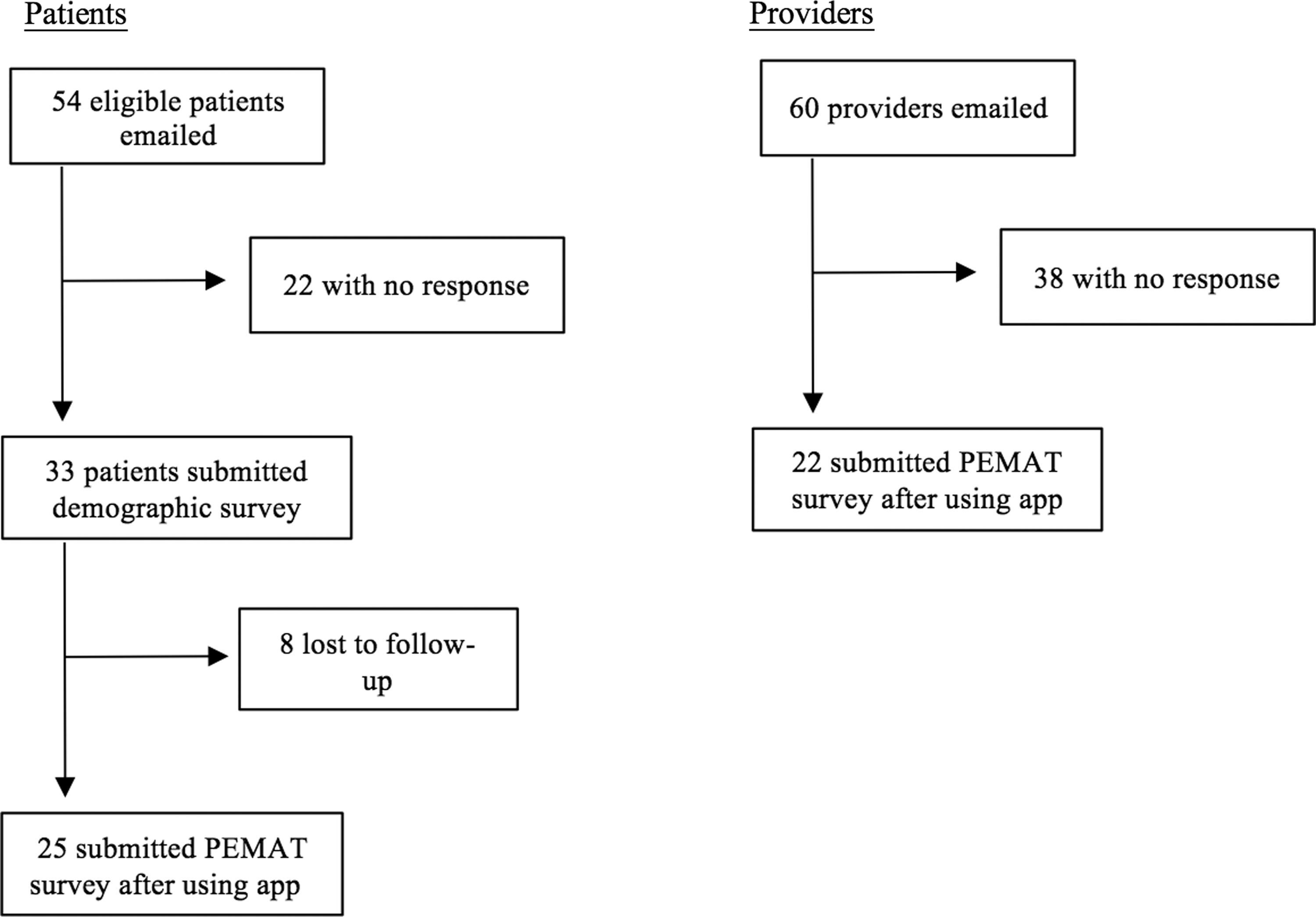
Flowcharts of patient and provider survey response.
Descriptive/Outcome Data
Demographic information was collected for patients (Table 1). The majority of patients (68%) were aged 31–40, and 56% were Caucasian. No patient was older than the age of 50 years. Most of the patients (94%), had a bachelor's degree or higher. All the patients had attended college. The majority had done pelvic floor exercises in some form before downloading the mobile application (59%), but 42% had not. Eighteen percent were not sure what pelvic floor exercises were.
Patient Demographic Information
Results from patient demographic survey before downloading and using “Bwom”.
Some provider characteristics were also analyzed (Table 2). Most of the providers who participated in the survey were obstetrics and gynecology or urogynecology attendings and residents (91%). All providers regularly educated patients on pelvic floor exercises, and 77% of them recommended pelvic floor exercises to patients 1–2 times a week.
Provider Characteristic Information
PFE, pelvic floor exercises; OBGYN, obstetrics and gynecology.
In regard to the primary outcome (Table 3), the mean understandability score was 93.8% (±11.7), and the mean actionability score was 91.7% (±16.3). These scores were calculated according to the PEMAT 12 algorithm.
Primary Outcome Measures
SD, standard deviation.
Discussion
This study is a first step toward establishing the usefulness of mobile application Bwom in teaching pelvic floor exercises. This cross sectional survey study suggests that the mobile application can be a valuable tool in educating women about pelvic floor health. The strength of our study was the use of a validated questionnaire (PEMAT) to assess understandability and actionability of Bwom. Any application with audiovisual educational tools could be tested with such validated surveys to ensure that they are user-friendly. The PEMAT scores for understandability and actionability were very high and were over 90%. These scores give valuable insight into mobile application design and emphasize the importance of including the input of both patients and providers when evaluating education tools.
The main limitation of our study was the small sample size and unique demographics. Most of our patients with smartphones who agreed to participate in the study had reached a high educational level, were Caucasians, and a large percentage had previous knowledge of pelvic floor exercises. In addition, the majority of the participants were either gynecologists or recruited from gynecology clinics rather than general primary care clinics. The generalizability of the results is limited given the nature of participants who completed both surveys. Due to 2 weeks commitment and the type of participant recruitment (online survey via e-mail), we had anticipated lost to follow-up. In addition, this is a study that mainly assessed user thoughts on the understandability and actionability of Bwom; our next step is to evaluate if the application actually helps to strengthen pelvic floor musculature or alleviate urinary incontinence symptoms. We also plan to test the application using a more diverse group of women with a range demographic characteristics.
Mobile applications have recently become a way to promote health and preventive healthcare. Various apps have been created to provide support for healthy gestational weight gain, promote weight loss, record blood sugars, and track asthma symptoms, to name a few. 13 –16 These apps are targeted to encourage healthy lifestyle changes. While limited evidence suggests that these applications likely do not affect long-term outcomes in preventive care, 17,18 user satisfaction is generally high. There have been limited studies on mobile applications for pelvic floor exercises. A recent randomized control trial 19 in Sweden in 2017 evaluated the effect of a mobile app for stress urinary incontinence symptoms and yielded promising results. The group who underwent mobile app treatment had improvements in symptom severity of stress urinary incontinence and condition-specific quality of life. Another study 20 evaluated the cost effectiveness of the aforementioned randomized control trial and found that the app was an economical treatment for incontinence, with greater gains in quality-adjusted life years at a similar cost to the control group.
Our study highlights the evolving role of mobile apps in healthcare. These apps cannot just deliver information in the same way a health brochure does, but rather need to be formatted in a visually appealing and culturally relevant way to be effective. Delivery, design, and social relevance are all important considerations in designing an effective phone app.
In conclusion, our study demonstrates that Bwom shows promise as a mobile application to educate women about pelvic floor exercises by providing user-friendly actions in an understandable way.
Footnotes
Acknowledgments
We acknowledge our contact and the founder of Bwom, Veronica Torras, for providing us with unlimited use of and technical support of the mobile application.
Disclosure Statement
No competing financial interests exist for any of the authors. The authors report no conflicts of interest.
These data were presented, in part, as a poster presentation at the 2017 AUGS meeting in Providence, Rhode Island, October 3–7, 2017.
There was no funding.