




Abstract
Background:
Emotional management is very important for patients with chronic diseases, such as diabetes. Since these patients may experience strong negative emotions, it is highly desirable to develop an information technology solution for the relief of negative emotions. Recently, online health communities introduced a new design element called the virtual mood wall, which allows patients to express their emotions. We are interested in determining the association between the use of virtual mood wall and the relief of patients' negative emotions.
Objective:
The main purpose of this work is to evaluate whether sharing one's emotions on the virtual mood wall is associated with the relief of the patient's negative emotions.
Methods:
We used a secondary econometric analysis using transaction data from 2013 obtained from a leading online diabetes community in China, Sweet Home. A total of 572 patients were included. We compared the change in negative emotion from 1 month before to 1 month after the patient's initial post on the virtual mood wall. Multivariate regression and propensity score matching were used to estimate the effect of the virtual mood wall on the relief of patients' negative emotions.
Results:
Posting on the virtual mood wall is significantly associated with the decrease of patients' negative emotions (p < 0.001). The control variables included the initial negative emotion (p < 0.001), the summer (p < 0.05) and autumn (p < 0.05) season, and the volume of homepage visitors (p < 0.05), all of which are significantly associated with the relief of negative emotions.
Conclusions:
This study empirically validated the positive association between the online sharing of emotions and the relief of negative emotions. We demonstrated that information technology provided a channel for sharing emotions. The virtual mood wall is an effective design element to help patients with chronic disease to recover from their negative emotions.
Introduction
Emotion management is very important for patients with chronic diseases, such as diabetes. Since diabetes cannot be cured by medication, patients may face tremendous ongoing emotional stress. Emotional stress not only harms the patient's psychological health but also threatens their physical health. Some researchers have found that negative emotions, such as fear, depression, sorrow, and anxiety, are consistently associated with poor conditions in diabetic patients. 1 –3 For example, depression was related to impaired glucose control, 4 functional disability, 5 end-organ complications, 6 and even mortality. 7 Similarly, diabetes patients often suffer from tremendous stress caused by negative emotions, while a series of adverse hormones increase; they gradually reduce the sensitivity of insulin and even induce resistance to insulin. 8 Negative emotions can also cause harm to the glucose control or quality of life and should be detected early to be intervened. 9 Furthermore, a definite relationship between psychological stressors and lipid peroxide, as well as fasting blood sugar, was also established by the researchers. 10 In addition, a similar study also suggested that psychological stress, including depression, anxiety, fear, and so on, played important roles in the etiopathogenesis of diabetes. 11
Likewise, studies have corroborated definite roles of psychological stress, lifestyle changes, lack of exercise, and irregular dietary habits in raising the disease incidence of diabetes mellitus. 12 Substantial evidences were also verified that diabetes complications are usually associated with unhealthy diet and lifestyle choices, reduced physical activity, as well as psychological stressors and depressive disorders. 13 –15 However, some other studies assessing the relationship between negative emotions and diabetes have shown somewhat inconsistent and conflicting results. For example, 2 studies, one investigating 4,597 subjects in Germany and the other, including 4,747 participants, in the Netherlands both demonstrated no association between type 2 diabetes and depressive symptoms. 16,17 Similarly, a recent study showed that there were no significant differences for those psychological variables tested (i.e., anxiety, locus of control, self-concept, and various personality traits) between high and low HbA1c groups. 18 Those previous inconsistent results suggest the importance of emotion management, especially negative emotion in diabetes. Therefore, the technology for negative emotion management is worth further exploration.
In China, the management of chronic diseases, especially diabetes, is not centered on patients nor does it attach great importance to the core role of the patient's self-management based on their conditions. 19 Furthermore, patients are often dissatisfied with the medical services they receive, while doctors often focus on providing medications to treat chronic diseases, instead of moderating or controlling these diseases by facilitating behavior change of patients. 20,21 Doctors and nurses in China usually have not received special psychology training, and their skills are often limited in the counseling and behavior changing techniques, which have been recognized as an effective management way for diabetes to help patients adhere to the lifestyle changes. 22 What is worse, the means of relieving immediate negative emotions for patients are too limited. Therefore, finding means to help patients with chronic disease to recover from negative emotions is an important and valuable research objective.
In recent years, online health communities (OHCs) are more and more popular among chronic disease patients because they are not only one of the major sources for health information but also serve as “emotional support” by connecting patients with those who share similar conditions. 23 OHCs offer an important channel for chronic disease patients to provide and receive emotional support, especially for those who are physically lonely in their day-to-day lives. In this study, we focused on a newly introduced design element of OHCs called the virtual mood wall. It is a virtual wall that displays the patient's mood. Anyone can post a message with emotion icons on the virtual wall. The mood message is immediately displayed on the wall and remains for about 1 month. Compared to the traditional forum that usually contains many informational or social messages, the virtual mood wall only allows users to express their emotions. In addition, the virtual mood wall is designed to show short messages with a sticky note as the symbol. The messages posted by different users are shown in different colors. Therefore, the virtual mood wall is designed as a clear and effective way for patients to share and exchange their emotions. An illustration of the virtual mood wall is shown in Figure 1. In this study, we wanted to determine whether or not the virtual mood wall could help patients relieve their negative emotions. See Table 1.
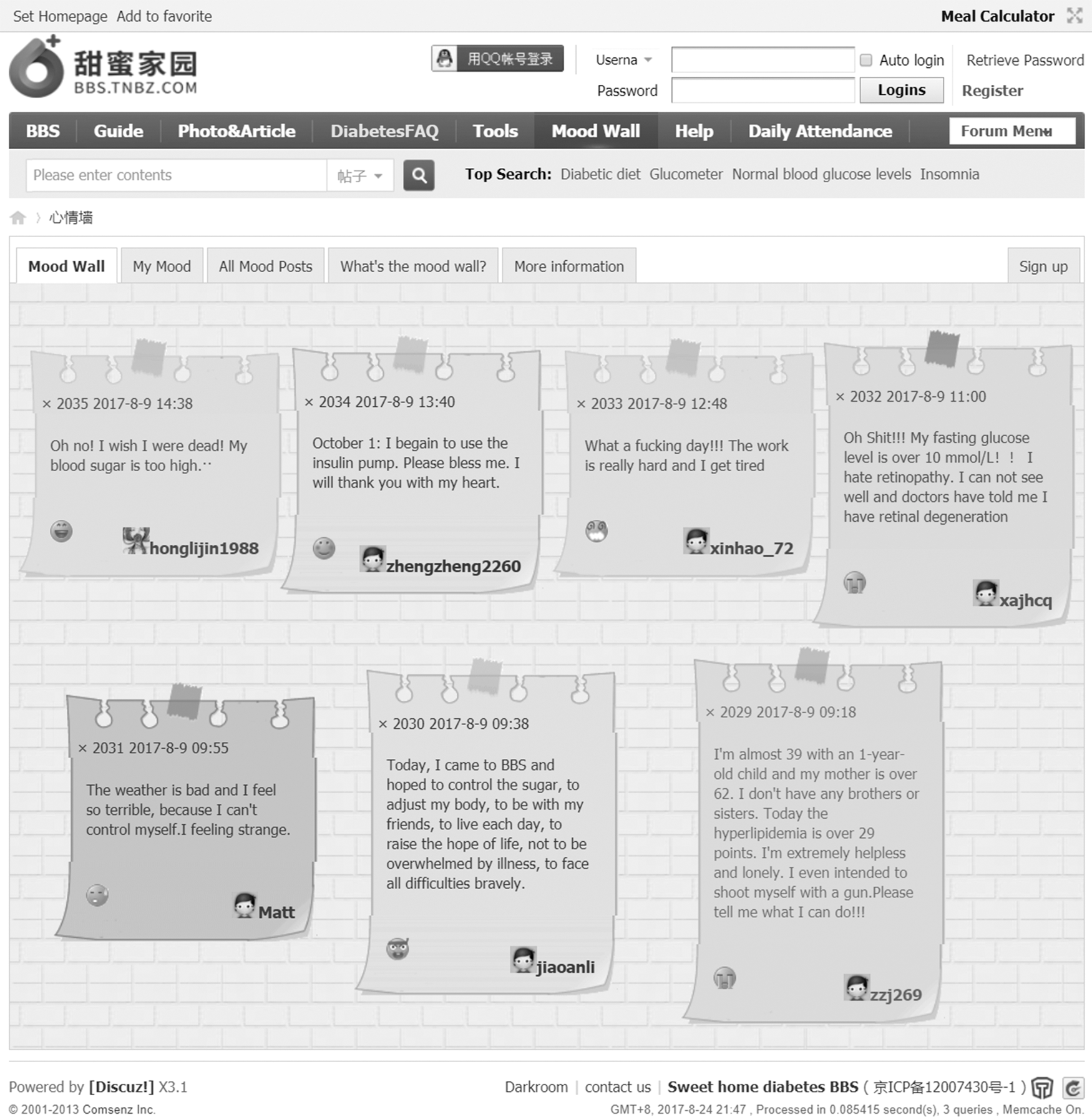
An illustration of the virtual mood wall.
The Details of Some Posts on the Mood Wall
Research that is related to this study investigated the impact of OHCs on patients' well-being. For example, Yan and Tan 24 investigated whether social support exchanged in an online health care community benefitted patients' mental health. They found that patients' participation in an online community helped them to improve their health and to become more engaged in the self-management process of their disease. Compared to informational support, emotional support plays the most significant role in helping patients move to a healthier state. Wang et al. 25 explored the short-term effects of social encouragement on exercise behavior in China. They found that three types of social interactions (number of thumbs-up, the number of comments, and the number of posts) had positive effects on the level of exercise performed the following day. However, these studies focused only on the effect of social support or social encouragement, and the explained variables were physical health condition or health behavior. We are not aware of any studies that have investigated the impact of online emotion sharing on the relief of negative emotion.
The social sharing of an emotional experience is an integral part of emotional processes. 26 First, sharing one's emotions contributes to emotional recovery from past emotional experience. A statistic survey that was conducted on a large sample showed that over 90% of the respondents approved of the belief that sharing an emotional experience with someone else could relieve negative emotions. 27 Psychological research also provides a wealth of theoretical knowledge that is consistent with the above belief: simple emotion venting leads to relief through the process of catharsis. 28,29 Besides, many studies have proved that emotional expression is not only an adaptive coping strategy 30,31 but also a basic step of effective psychotherapeutic interventions for patients. 32 Sharing emotions with others provides a sense of understanding, clarity, and validation, 33 and through emotional expression in psychotherapeutic interventions patients can decrease negative feelings such as frightening, inner struggles 34 –36 ; thus, these psychotherapeutic interventions are effective in the treatment of depression, 37 trauma, 38 and marital distress. 39 We expected that sharing emotion or expressing oneself on the virtual mood wall may help the patients to relieve negative emotions. Therefore, the research question in this study was as follows: Is the use of virtual mood wall associated with the relief of the patients' negative emotions? In other words, is sharing emotion on the virtual mood wall associated with the relief of negative emotions?
To answer the research question, this study collected data from a diabetes community in China Sweet Home. * We compared the users' emotional change before and after their first post on the virtual mood wall. Multivariate regression and propensity score matching (PSM) were used to estimate the effect of the use of the virtual mood wall on the patients' relief of negative emotions.
Materials and Methods
Research Context and Data Collection
In this study, we investigated the research question using transaction data collected from Sweet Home. Sweet Home is one of the biggest online diabetes communities in China and was founded in 2005. As of August 2017, the site had 180,000 registered users and over 3,000,000 posts. The forum includes many subforums on different topics. Similar to other forums, patients can post messages and receive answers from the other patients. The users' profile information (e.g., friend list, registration time, experience level, and so on), as well as the posting record in the forums and virtual mood wall (e.g., posting time, posting content, posters, and so on), from 2013 was all collected by a network spider program.
Variables and Empirical Model
The virtual mood wall was first introduced to Sweet Home in January 2013. However, not every user made use of it as a new design feature in January 2013 because some may not have been aware of its existence. Therefore, we collected the emotion data 1 month before and after the user's first post on the virtual mood wall and examined the change in negative emotion to estimate the effect of the virtual mood wall on negative emotion relief. For example, if a user posted her first message on the virtual mood wall in February 2013, we collected her emotion data from January to March 2013 to determine if the negative emotion in March 2013 was significantly relieved compared to January 2013.
To estimate the effect of virtual mood wall usage, we randomly chose 109 users who posted at least one message on the virtual mood wall as the treatment group. In contrast, we randomly selected 463 other users who never posted on the virtual mood wall as the control group. Therefore, we created a dummy variable called Treat, with 1 indicating the treatment group and 0 indicating the control group.
The negative emotion was measured by the negative sentiment of the messages the user posted in the forum. The Chinese language psychological analysis system (TextMind) 40 was used to evaluate the negative sentiment of a message. TextMind is a Chinese language psychological analysis platform developed by the Computational Cyber-Psychology Laboratory, Institute of Psychology, Chinese Academy of Sciences based on Linguistic Inquiry and Word Count (LIWC). LIWC is a transparent text analysis program, which has been used in many studies to explore the relationship between psychological processes and word categories in the words people used in daily life over the past 20 years. 41,42 It has been demonstrated that the linguistic features included in LIWC could reflect the user's emotionality, attention focus, social relationships, thinking styles, and individual differences in language use. 43 TextMind provides users with simplified Chinese automatic word segmentation and language psychoanalysis package solution. In addition, the lexical classification system of TextMind is also consistently compatible with LIWC. In our study, TextMind was used to receive the messages as input and provides a negative sentiment score as the output. If the user posted multiple messages in a month, the average negative sentiment score was used to measure the negative emotion for that month.
The control variables included the users' initial negative emotion, the emotional impact from others, the season in which the post occurred, and the number of visits to each user's homepage. The initial negative emotion was the negative emotion score 1 month before the first post on the virtual mood wall. The initial emotion was included because the future emotion is most likely to be affected by the previous emotion. The emotional impact from other posters is the sentiment of the thread to which the user replied at least once during the observation period. The sentiment of the thread in which the user participated was included because the user's emotion may be affected by the others in the forum and may be affected by the thread in which he/she participated by replying to others. All the threads in which the user participated were collected as input to TextMind to estimate the emotional impacts the user experienced from others in the forum. The season of the post was included because the health of diabetic patients may be affected by seasonal factors, 44 and their health condition may have some impact on the patients' emotion. The number of homepage visitors was included because it measured the density of social connectivity. Social connectivity may have some positive effects on patients' emotions. 45 Previous studies indicate that happiness is related to the number of social links in social networks. 46 The descriptive statistics for the variables used in this analysis is presented in Table 1 or is it Table 2?.
Descriptive Statistics
To model the patients' negative emotion relief as a function of independent variables, our empirical model is shown as follows:
Empirical Results
Correlation Analysis
The correlations among all the independent variables were examined to help identify potential multicollinearity and redundancy issues. The correlation results are shown in Table 2, and the collinearity diagnostics are shown in Table 3. The results in Tables 2 and 3 show that all correlations are low (<0.5), and the Variance Inflation Factor (VIF) is smaller than 10, which means multicollinearity may not be a major issue for this study.
Correlation Matrix
Initial negative emotion.
Positive impact from others.
Negative impact from others.
Spring (postseason).
Summer (postseason).
Autumn (postseason).
Medium visit (homepage visitors numbers).
High visit (homepage visitors).
* p < 0.01; ** p < 0.05.
Multivariate Regression Analysis
STATA Version 11 was used to perform the multivariate regression analysis. The regression results are shown in Table 4. The results suggest that Treat (whether the participant ever used the virtual mood wall) is significantly and positively associated with negative emotion relief (β = 0.146, p < 0.001). This result suggests that use of the virtual mood wall is positively associated with the relief of negative emotions.
Collinearity Diagnostics
VIF, Variance Inflation Factor.
Among the control variables, the initial negative emotion (β = 0.235, p < 0.001), the summer (β = 0.086, p < 0.05) and autumn (β = 0.094, p < 0.05) seasons, as well as the high volume of visitors (β = 0.084, p < 0.05), are significantly associated with the relief of negative emotions. The initial strength of the negative emotion had a positive impact on the relief of negative emotions because there was greater room for improvement in users who experienced stronger negative emotions. The summer and autumn seasons are also positively associated with the relief of negative emotions. This finding was due to the temperature. During seasons with high temperatures, particularly in summer and autumn, diabetic patients usually experience a decrease in appetite and do not consume large amounts of sweet food, which helps to control their blood sugar level. This finding is consistent with previous study results. 44 Social connectivity may also be positively associated with the relief of negative emotions. If the user who posts a mood message receives many homepage visitors, it is implied that the person receives sufficient attention and care from the community. This support may help the user recover from negative emotions.
Our further in-depth analysis confirmed that the mood wall not only provides an effective way for patients to share emotions and express themselves but also facilitates interactions of OHC users. The users who share their emotions on the virtual mood wall tend to attract more homepage visitors. This is because, in most cases, users post on the virtual mood wall to depict their miserable disease state or life experiences. When a new message appears on the virtual mood wall, it receives attention from many other patients. Those patients may leave messages on the mood poster's homepage to comfort and encourage him/her (Table 5).
Multivariate Regression Results
Initial negative impact.
Positive impact from others.
Negative impact from others.
p < 0.001, ** p < 0.1, *** p < 0.05.
PSM Analysis
Because this was a nonrandomized observational study, the patients may be subject to self-selection bias when they decide whether or not to use the virtual mood wall. For example, a diabetes patient with stronger negative emotions may be more likely to share his/her emotions or express his/her feelings on the virtual mood wall. Therefore, the estimated effect of the virtual mood wall will be biased if the impact of confounding factors is not ruled out.
To rule out other individual difference factors and provide much more persuasive results, this study used the PSM approach to further estimate the relationship between virtual mood wall and the negative emotion relief. PSM attempts to reduce the bias due to confounding variables that could be found in an estimate of the treatment effect obtained from simply comparing outcomes among units that received the treatment versus those that did not.
The authors randomly chose 109 patients as the control group. A package in Stata, psmatch2, was used to locate another 109 patients from the remaining patients. A set of exogenous variables (the initial negative emotion, the social impacts from the others, the season, and the number of homepage visitors) were used as the criteria for matching. After matching, each pair of patients across the control and treatment groups was essentially identical to one another in terms of the matching criteria. Consequently, the self-selection at the patient level based on these observed attributes was controlled.
The PSM results are shown in Table 6. The results indicate that there is a significant difference between the treatment group and the control group (t = 2.95, p < 0.01). This finding is consistent with the results from the multivariate regression analysis in the previous section.
Propensity Score Matching Results
p < 0.01.
Discussion
Principle Result
The research results show that posting messages on the virtual mood wall has significant positive association with the patients' negative emotion relief. This finding indicates that online social emotion sharing is an effective way to relieve negative emotions, which is very important for patients with chronic disease. Compared with a traditional thread-based web forum, the virtual mood wall is more focused on emotional catharsis and emotional sharing. Therefore, the virtual mood wall is a more effective design element than a web forum for negative emotion relief.
Practical Implications
This study indicates that online sharing of emotions helps to relieve negative emotions. Therefore, web forums or health care website designers should provide an emotion sharing channel such as the virtual mood wall. The channel should focus on emotional sharing, and the sticky note metaphor has been proven as an effective design. Because the management of negative emotions is very important for patients with chronic disease, this study provides an example on how information technology can help patients recover from negative emotions.
Conclusions
In this study, we investigated the relationship between a virtual mood wall and patients' negative emotion relief. We used a secondary econometric analysis using transaction data obtained from a leading online diabetes community, China Sweet Home. We compared the users' change in negative emotion 1 month before and after their first post on the virtual mood wall. Multivariate regression and PSM were used to estimate the relationship between the virtual mood wall and patients' negative emotion relief. The results indicate that posting on the virtual mood wall has significantly positive association with patients' negative emotion relief.
This study has several limitations. First, data were only collected from a single website in China because the virtual mood wall is a relatively new design feature that appears in only a few web forums. Therefore, the conclusions derived from this study should be applied cautiously to other contexts. Second, we only investigated the relationship of virtual mood wall and negative emotion relief. The virtual mood wall may impact positive emotion as well. We intend to explore its effects on positive emotions in the future.
This study empirically validated the positive association between the online sharing of emotions and the relief of negative emotions. We demonstrated that an information technology-enabled emotion sharing channel, such as the virtual mood wall, is an effective design element to help patients with chronic disease to recover from negative emotions.
Footnotes
Acknowledgment
This research was supported by the National Natural Science Foundation of China (grants 71471064, 71371005, and 91646205).
Disclosure Statement
No competing financial interests exist.