




Abstract
Most infantile hemangiomas (IHs), the most common vascular tumors of childhood, evolve without complications; however 10% to 12% require specialty referral for treatment. To emphasize the complications of late referral, we present a case of necrotizing infection within a segmental IH leading to sepsis. Early evaluation by a pediatric dermatologist could have prevented this life-threatening and disfiguring complication. We discuss how teledermatology would enable rapid triage of such critical cases in underserved areas, increasing access to high-value care and optimizing outcomes for our most vulnerable patients.
Report of a Case
A five-week-old infant with an enlarging vascular birthmark presented with fever, tachycardia, and respiratory distress. The patient was previously denied a referral to pediatric dermatology when she was two weeks old. Two siblings at home were receiving oral antibiotics for impetigo. Parental photographs at four days and four weeks of life (Fig. 1A and B) demonstrated an enlarging segmental vascular plaque. On examination, the child was ill appearing, with central vesiculation of the tumor (Fig. 1C). Laboratory findings included leukocytosis and coagulopathy. Broad-spectrum intravenous antibiotics were initiated, and work-up confirmed bacteremia with Group A beta-hemolytic streptococcus (GABHS), which also grew from the wound culture. The lesion became rapidly necrotic within 12 h (Fig. 1D). Skin biopsy demonstrated septic vasculitis within an infantile hemangioma (IH). Oral propranolol was initiated within 24 h, after imaging evaluation for PHACE syndrome was negative. At seven months, the patient has severe hypertrophic scarring with ectropion (Fig. 1E). Her healthcare costs now exceed $325,000 and will increase with future procedures to address the scarring.
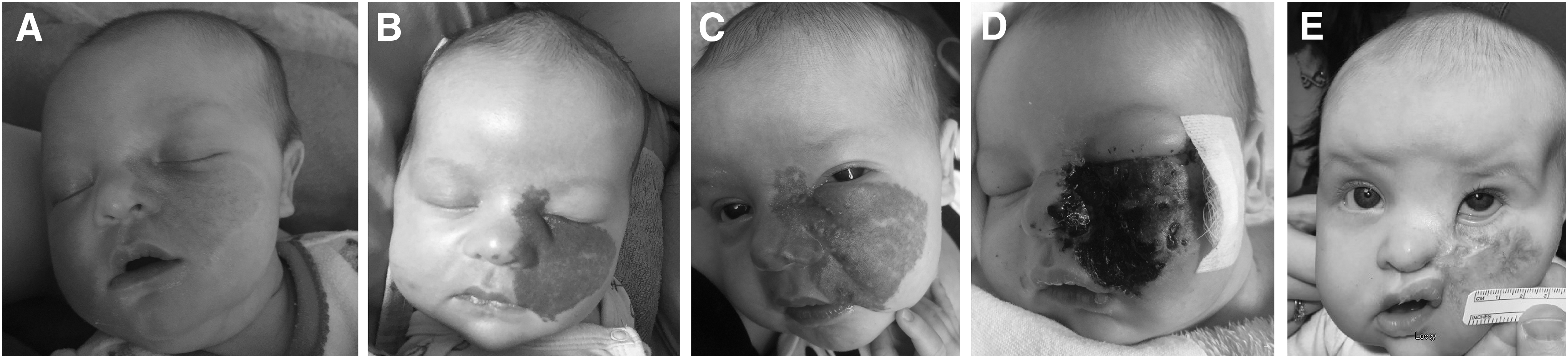
Development of a necrotizing GAS infection complicating a segmental infantile hemangioma in the S2 (maxillary) distribution.
Discussion
The changing insurance landscape has impacted the ability of physicians to provide timely and appropriate care, particularly in resource-poor settings. Teledermatology has been utilized successfully to increase valuable access to subspecialty care in underserved areas. 1 A recent study found that the number of patients receiving care from a dermatologist doubled after the introduction of teledermatology as a covered service within California Medicaid. 1 Telemedicine has been shown to reduce wait times and treatment costs, deliver services to low access regions, and triage the most critical patients to specialty services. 1,2 Live-video teledermatology is reimbursed by nearly every state Medicaid program in the United States. There are only 13 state Medicaid programs that reimburse for store-and-forward (S&F) teledermatology services, where patient data and photographs can be sent by general practitioners, stored electronically, and reviewed by consultants for assistance or coordination of care. This low implementation rate of S&F teledermatology has been the rule despite clear evidence of success in implementation areas. 2
Oral propranolol is FDA approved as first-line treatment for proliferating IHs and has been shown to prevent complications including ulceration, infection, and scarring, thereby improving outcomes. 3 Earlier referral to specialty care, resulting in diagnosis and prompt initiation of propranolol, would have decreased this infant's risk for sepsis and scarring. The clinical aspects of this case may be rare, but the poor outcomes due to lack of specialty services and delay in treatment in resource-limited settings unfortunately are not.
The establishment of telemedicine triage centers in resource-poor areas has been shown to risk-stratify patients, enable rapid referral to outpatient subspecialists, and decrease emergency room visits. 4 Particularly in rural states, telemedicine triage centers can serve as a valuable triage tool, ensuring the most critical patients receive expedited care. However, barriers remain for reimbursement, and some institutions, including our own, have been slow to invest in the infrastructure to support implementation across rural areas. However, as Medicaid reimburses in almost all states for video conferences (and in some states for S&F), a telemedicine triage center is a feasible way to increase access to pediatric subspecialists. Telemedicine systems can now be set up with minimal initial investment, given the capability of electronic medical records already integrated into medical practice. With the current demand to reduce health system costs, improve outcomes, and provide equitable quality care for patients despite physical location, telemedicine should be included in the healthcare portfolio. 4,5
Footnotes
Disclosure Statement
No competing financial interests exist.