




Abstract
Background:
Every year about three million Muslims visit the Holy City of Makkah in Saudi Arabia to perform the Hajj. Because of the large number of people present during this period, pilgrims can be subjected to many health hazards. An adequate system to minimize these health hazards is needed to support the pilgrims who attend the Hajj. This study justifies the need for developing a large data-based m-Health application to identify the health hazards encountered during the Hajj.
Materials and Methods:
In developing a big data-based m-Health application, this study follows the framework suggested by Hevner. The design of the science framework allows the development of a technological solution (i.e., design artifact) of the problem through a series of actions. The design involves rigorous knowledge of the environmental factors, including knowledge of the construction and evaluation of technological solutions, that are important and relevant to an existing problem.
Results:
Based on the design science framework, the process of artifact development can be classified into Artifact Design, Artifact Implementation, and Artifact Evaluation. This paper presents the Artifact Design step for the design of the big data-based m-Health application, which has an Environmental Relevance Cycle, a Knowledge-based rigor Cycle, and an Artifice development and design cycle. The big data-based m-Health application is a prototype and must be evaluated using the evaluation-and-feedback loop process until the optimum artifact is completely built and integrated into the system.
Conclusion:
Development of a big data-based m-Health application using a design science framework can support the effective and comprehensive plan of the government of Saudi Arabia for preventing and managing Hajj-related health issues. Our proposed model for developing and designing a big data-based m-Health application could provide direction for developing the most advanced solution for dealing with the Hajj-related health issues in the future.
Introduction
Every year around three million Muslims visit the Holy city of Makkah in Saudi Arabia to perform the Hajj. * ,1 Because of the large number of visitors, pilgrims can be subjected to many health hazards, including risks of outbreaks of communicable diseases and their subsequent global spread. Generally, such mass gatherings pose multiple challenges to the public health system in the host country including the possibility of an epidemic, increased risk of inadvertent injuries and accidents, failure of the public health system's ability to cope with the health issues of a large visiting population, lack of knowledge of the health issues of the pilgrims, and the risk of aggravating pre-existing health issues of the pilgrims. As a result, a very highly reliable and well-constructed health delivery plan is a prerequisite for managing the sudden large number of health issues resulting from the massive influx of pilgrims.
Before the Hajj, local health authorities of the nations from which the pilgrims embark to perform the Hajj need proper strategies for the prevention and management of infectious diseases before and after the completion of the Hajj. 2 On the other hand, during the Hajj, the pilgrims generally experience physical and mental stress and encounter multiple threats to their health, such as scorching hot sun, sweating and blistering, low intravascular volume, and disturbance in electrolyte composition as well as many communicable and noncommunicable diseases and inadvertent accidents. 3 However, because the pilgrims have to perform certain rituals at different religious places in a stipulated timeframe, they generally avoid seeking timely medical advice. In addition, providing proper patient healthcare to the elder pilgrims is an even bigger challenge because often the elderly do not know their medical history or even their current medications.
The pilgrims' health situations also depend on their health knowledge, attitude, and health practices. Studies show that their biomedical, environmental, and psychosocial knowledge interplay in mass gatherings. 4 For this reason, more emphasis needs to be placed on educating pilgrims before they perform the Hajj pilgrims. Since the period of the Hajj each year changes, based on the lunar calendar, public-health policy planners have to be prepared to deal with a moving target. There is also a need for epidemic surveillance and intelligence activities from the beginning to the end of Hajj period and also after the Hajj to identify potential events and activities posing a health threat to the public.
Managing these issues for the Hajj is a mammoth task to arrange and accomplish at the national level. As a massive gathering like Hajj can potentially impact international public health, international healthcare professionals generally collaborate in planning for vaccination campaigns. 5 Based on the study of Alotaibi et al. 6 , the authors advocate for international cooperation in considering global health security, which can strengthen the capacity of Saudi Arabia for dealing with Hajj-related health issues. During the Hajj, clinicians and doctors must be made aware of health risks and must have the strategies to tackle them. To this end, the international community could collaborate on vaccination campaigns and work together to manage the health hazards during the Hajj. 7 For example, to perform the Hajj, the pilgrims would be required to get a health certificate for various diseases, such as yellow fever, influenza, dengue, and so forth, from their respective countries. 8
Internationally, for the containment of dangerous infectious diseases, the World Health Organization (WHO) closely works with the Saudi Arabian government. WHO collaboration involves providing guidelines to the respective governments and healthcare bodies and developing and maintaining a distributed database on the demographics and related health information of pilgrims. The international collaboration involves creating health preparedness functions to address public health threats, such as emergency disease outbreaks in the Kingdom of Saudi Arabia and the pilgrims' respective countries. To this end, and in consideration of the growing threats of emerging new disease (e.g., ebola), public health experts from Saudi Arabia, the United Kingdom, and Australia have formed the Health at Hajj and Umrah (HAHU) research group. 9 The main function of HAHU is to study patterns of diseases that can cause epidemic disasters, such as the prevalence of respiratory diseases. HAHU engages in research and regularly notifies member countries of recent updates of research findings.
The government of Saudi Arabia is eager to work with other countries to continue to maintain and reinforce global health security. The government has collaborated with different national and international healthcare bodies for a long time, especially for health surveillance, disease prevention, and vaccination programs for new and emerging infectious diseases. For example, during the outbreak of the influenza A (H1N1) virus in 2009, the United States collaborated with the Saudi Ministry of Health in deploying data monitoring systems to detect disease in real time. 10 Such bilateral and multinational approaches for confronting health challenges during Hajj are beneficial for Saudi Arabia and partner countries both for global health diplomacy and for security issues.
According to the Saudi Arabia's Vision 2030, the Saudi Arabian government is keen to improve its public health knowledge. In this process, more studies are needed to enhance the country's strategic preparedness for massive congregational events like the Hajj and to evaluate and focus on the minimization and control of frequent types of diseases to guarantee the optimal delivery of health services to pilgrims. It is also important to increase the effectiveness of public health service provisions through implementing state-of-the-art strategies, surveillance methods, and effective communications and operations in moments of distressing and emergency situations during and after the Hajj. 11 Based on a design science framework, this paper proposes a big data-based m-Health application for educating, minimizing and tracking common diseases and health hazards during the Hajj to enhance the continual vigilance process.
Materials and Methods
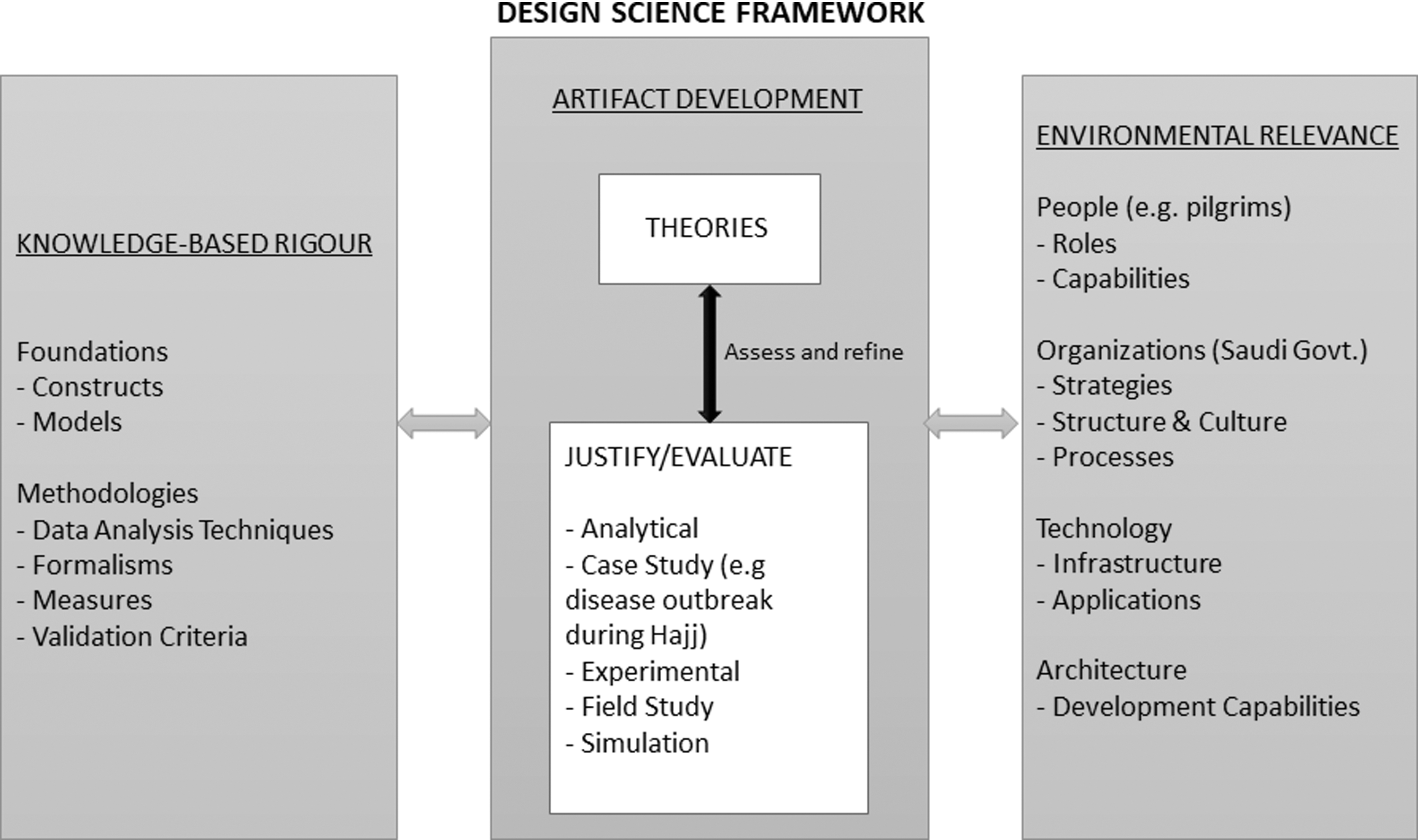
To develop a big data-based m-Health application, this study follows a framework suggested by Hevner et al. 12 The design science framework enables the development of a technological solution (i.e., design artifact) of the problem through a series of actions using the skill and knowledge of experts in the field. The framework takes into account the interplay of people, system configurations, technologies, and the work environment. Knowledge of the interaction among components of a system is important for developing optimum technological solutions to systemic problems. This design science framework 12,13 consists of a rigorous knowledge base that is relevant to the environment (Fig. 1). The knowledge-based rigor involves the construction and evaluation of an artifact using the appropriate method and data analysis techniques. The environmental relevance ensures that the development of that particular artifact is important and relevant to an existing problem that will, develop a big data-based m-Health application for minimizing and tracking health hazards during the Hajj.
Results
Upon the development of the artifact (i.e., m-Health application), it is evaluated and feedback is provided. A systematic process aids in understanding how to improve the quality of the artifact. The evaluation and feedback process continues as a loop until the optimum artifact is achieved. 14 Based on the above design science framework, the process of artifact development can be classified into three steps: (1) Artifact Design, (2) Artifact Implementation, and (3) Artifact Evaluation. However, this paper presents only the Artifact Design step for the big data-based m-Health application, which has three iteration cycles, namely (1) Environmental Relevance Cycle, (2) Knowledge-based rigor Cycle, and (3) Artifice development and design cycle.
Environmental Relevance Cycle
The environmental relevance cycle connects the uses of the artifact to its intended environment. Based on the related literature, the relevant issues of disease and health hazards encountered during the Hajj are discussed below. The Hajj poses some risks, which, unexpectedly, may lead to disease and even death in the worse case. According to the literature, the most common health issues that appear during the Hajj can be divided into two categories: noninfectious diseases (62.5%) and infectious diseases (37.5%). 15 Among the noninfectious diseases, diabetes, cardiovascular disease, electrolyte imbalance, hypertension, dehydration, musculoskeletal issues, and urinary tract problems are very common along with common health hazards such as heat exhaustion, heat stroke, stampede trauma, other trauma, and traffic accidents. 3,15 Studies show that respiratory diseases (e.g., pneumonia, influenza, and asthma) are the most common infectious diseases (73.33%) during Hajj followed by skin disease. 3,15 Therefore, preHajj education is required to protect pilgrims against infectious and communicable diseases and chronic diseases as well as hygiene and general cleanliness issues, accidental shaving and haircutting injuries, food poisoning, heat exhaustion, and crowd management problems. 16
In recent years, new and emerging communicable diseases, such as the influenza H1N1 virus and Zika virus, have been identified as default threats to mass gatherings during the Hajj. 6 The Saudi Arabian government collaborates throughout the year to collect data to assure the uninterrupted performance of Hajj. For example, the government works with The Center of Excellence in Hajj and Omrah Research (CEHOR) and HAHU research groups. 1 Together, these organization have formulated evaluation and prevention plans to identify how infectious diseases spread among pilgrims. While studying in the context of Hajj, Al-Tawfiq and Memish 8 focused on and recommended vaccination against emerging diseases such as Middle East Respiratory Syndrome (MERS) and viral hemorrhagic fevers (VHFs) such as ebola in West Africa.
Among the common diseases prevalent during Hajj, Saudi authorities periodically and specifically report epidemiologically prone diseases to WHO. These diseases include severe acute respiratory syndrome (SARS), meningitis, influenza, yellow fever, polio, cholera, plague, and viral hemorrhagic syndromes. 11 Tuberculosis is also often reported among the pilgrims, especially as it is the major cause for community-acquired pneumonia among pilgrims. 9 On the other hand, inadequate food hygiene and poorly stored meals exacerbate the number of diarrheal incidents—the third most frequent reason of hospitalization in the period of the Hajj. 8 Meningococcal disease also poses a greater risk during the Hajj because of the large number of carriers. This fact has spurred the Saudi Ministry of Health to make recommendations since 2001 for vaccinating pilgrims against meningococcal disease before performing the Hajj.
Among noninfectious diseases, cardiovascular disease is the most common disease, accounting for 43% of deaths during the period of the Hajj. 7 Cardiac patients are encouraged to consult their doctors before embarking on the Hajj. On the other hand, sunstroke, heat exhaustion, trauma, and incidents such as stampede injuries are commonly feared health hazards during the Hajj. One of the biggest stampedes happened in 2006, causing 380 deaths and injuring 289 people. 7 Finally, the large number of traffic accidents during Hajj result in many casualties and deaths during the Hajj.
Rigorous Knowledge-Based Cycle
The rigorous knowledge-based cycle keeps us informed about the related development activities of an intended artifact that aligns with the existing knowledge in the relevant field. According to the literature today, numerous mobile applications related to the Hajj are available. For example, there are applications for live Hajj streaming, Hajj player, virtual Hajj guide, and assisting pilgrims to comfortably perform their Islamic rituals. However, a study shows that most of the Hajj-related applications are related to ‘‘Hajj ritual” service (68.7%), where more than 87% of studied applications were released in only one language. 17
PreHajj education can help the pilgrims fight infectious and other diseases. Thus, there is increasing availability of technology geared to the education, prevention, and management of Hajj-related health issues. Today, different studies recommend the adoption of technology for disease management and surveillance systems that minimize and track the common diseases and health hazards encountered during the Hajj. There is also a recent surge of studies by healthcare researchers on Hajj-related health issues, especially in the context of technology and public communication programs. For example, Ibrahim et al. 18 have proposed a model of Hajj and Umrah Mobile Healthcare (HUMH) systems to maintain the medical history records and assist the medical staff by helping pilgrims access their electronic health records (EHRs) to improve the staff's ability to provide accurate and quality services. Similarly, Nafea et al. 19 proposed that the EHR system improve patients' access to adequate health information and knowledge of the health issues that are related to the Hajj. 18 Also, according to study of Alshareef, 20 a cloud-based m-Health system is faster and cheaper delivery of healthcare service during emergencies in the Hajj areas. Such a system effectively provides directions for pilgrims to medical centers at their vicinity. Similarly, as part of surveillance systems, the big data-based m-Health system can help doctors and patients located each other in the crowd. However, Myers et al., 21 highlighted the challenges, such as privacy concerns, when using m-Health to support the health issues of pilgrims.
For local and global health security, it is crucial to avoid both the importation and exportation of infectious diseases during the Hajj. The application of proper surveillance systems during massive congregational events can provide timely collection, analysis, and interpretation of health data for comprehensive preparation and response against the threats of infectious diseases. For example, studies show that the Infectious Diseases Surveillance System (IDSS) at the sites of the Hajj can effectively detect infectious diseases in a timely manner and minimize subsequent threats. Alotaibi et al. 6 advocated international engagement in health surveillance considering the global health security. He proposed the integration of surveillance data management systems and syndromic surveillance systems, which are important for detection of the early warning signs of infectious diseases. For this purpose, since 2016, the Ministry of Hajj introduced an electronic wrist bracelet with a specially designed global positioning system (GPS) that collects relevant demographic information on the pilgrim. The pilgrims are required to wear the electronic wrist bracelets at all times during the Hajj period. 6
As a part of public health protection, the Saudi government has allocated substantial resources. In 2017, there were 30,000 healthcare professionals who worked in 15 hospitals and 93 healthcare centers across Hajj sites to provide health services to the pilgrims. 22 More than 5,000 security cameras were installed in the process of surveillance by the authorities. During the period between 2012 and 2015, the surveillance teams, using two electronic surveillance systems known as HESN and CITREX, effectively detected and responded to outbreaks of measles and scabies. 20 At that time, hospital-based surveillance teams operated in the Hajj areas using clear guidelines to identify suspected cases of infectious diseases.
Artifice Development and Design Cycle
The artifice development and design cycle involves the evaluation-and-feedback loop process and includes a continuous assessment and refinement process. In this cycle, the artifact is repetitively constructed and assessed until an optimum solution to the problem is found. Therefore, we propose a conceptual model (Fig. 2) for developing an artifact, that is, an m-Health application using a big data-based interactive health communication.

A conceptual design of a big data-based interactive m-Health application.
In this model, we propose a big data-based interactive m-Health application, which will transmit its sensor-generated (e.g., accelerometer, GPS) data to a big data center. The m-Health application will be available in multiple languages with adequate graphic instructions in which the pilgrims will be able to find many options for reporting general issues and health issues by simply clicking on a button. Upon clicking a specific application button, specific data will be sent to the big data center, and specific message will be sent to the health service, providing teams about information about specific problems corresponding to the specific button pressed. The m-Health application will also communicate via the radio frequency identification embedded wrist tags which will permits the tracking of each pilgrim in real time when an emergency request via the m-Health application has been received. The big data-based m-Health application can be used to personalize care, for early warning and disease pattern analysis, real-time data collection and analysis, patient-reported outcomes, effective and interactive communication during crowd and emergency, to identify risk factors for patients, increase workforce quality and satisfaction, and provide technical assistance for health professionals in the field.
Discussion
A need was identified to improve the health services to prevent/mitigate health hazards during the Hajj. In the environmental relevance cycle, we discussed in detail how the need for developing an artifact is relevant to the Hajj season. This study justified the need for relevant artifact development directed at the protection of the mass gathering of 2–3 million pilgrims for 10–30 days during the Hajj. The large number of pilgrims indeed escalates the possibility of an epidemic spread of communicable diseases to the highest level and also increases the danger of accidental injury and also the worsening of pre-existing chronic diseases. Mass gatherings during the Hajj have been associated with many deaths caused by disease and accidents such as tragic stampedes and collapse of venues. Statistics shows that respiratory diseases and cardiac diseases are the most prominent health issues among the lists of communicable and noncommunicable diseases. Therefore, pilgrims require preHajj education as their health conditions significantly depend on their health knowledge.
The current m-Health applications for the Hajj and the health intelligence system are not adequate for managing the occurrence of sudden and very frequent health issues during the Hajj. Therefore there is a need for a comprehensive health delivery plan and collaboration with interdisciplinary branches of the public health and disaster management sectors. This study is based on the premise that a big data-based interactive m-Health application enables pilgrims, as well as the health service providers and health researchers, to become more aware and empowered in the process of preventing and managing the health hazards during the Hajj. To provide this type of big data-based interactive m-Health application, we need to start with a design science framework.
Based on the above discussion, and understanding the newer scope of m-Health, this paper has attempted to develop a big data-based interactive m-Health application which will be useful for both the service providers (e.g., health surveillance team, health professionals and researchers, and the governmental and international healthcare bodies) as a source of big data analysis and also for the pilgrims as a means of providing interactive communication and for keeping records of their health data. The big data-based m-Health application will also be a multilanguage application for ease of use by the pilgrims from different countries.
Conclusion
As there exist only few applications related to healthcare during the Hajj, and since the m-Health application can assist healthcare professionals in finding and communicating information and making clinical decisions, there is a need for governmental cooperation to develop multiple m-Health interventions for preventing and managing the common diseases and health hazards as well as gathering health-intelligence related to the Hajj. The Saudi Arabian government can aid this process by working to modernize the country's current capacity to ensure effective provision of healthcare services for pilgrims by establishing policies and by developing modern surveillance techniques and strategies to be used before, during, and after the period of the Hajj. A big data-based interactive m-Health application might assist the Saudi authorities to formulate even better plans and solutions for preventing and managing Hajj-related health issues.
Footnotes
Disclosure Statement
No competing financial interests exist.
*
The Hajj is an annual Islamic pilgrimage to Mecca, the holiest city for Muslims, and a mandatory religious duty for Muslims that must be carried out at least once in their lifetime by all adult Muslims who are physically and financially capable of undertaking the journey and who can support their family during their absence.