




Abstract
Materials and Methods: This study has combined the
Technology Acceptance Model and Theory of Planned Behavior frameworks to evaluate the factors influencing the patient acceptance of e-health services in Saudi Arabia. Data were collected from patients at various private and public hospitals in Saudi Arabia. The partial least square technique based on structural equation modeling was applied to analyze the survey data.
Results: The study shows the significant influence of perceived usefulness and perceived ease of use on the attitude. Furthermore, attitude and subjective norm (
p < 0.05) significantly influence patient behavioral intention (BI) to use e-health services. However, perceived behavioral control (p > 0.05) had no significant influence on patient BI to use e-health services.
Introduction
In the past two decades, the rapid development of information and communication technology (ICT) has caused significant advancement in the healthcare sector around the world. Numerous studies have shown that ICT-based e-health services noticeably affect the development of healthcare sector. 1,2 The World Health Organization describes e-health as “… the leveraging of the information and communication technology (ICT) to connect providers and patients and governments; to educate and inform healthcare professionals, managers, and consumers; to stimulate innovation in care delivery and health system management; and to improve our healthcare system.” 3
Global Observatory for Health studied the needs for e-health tools (a survey conducted on 96 nations). This study revealed that e-health tools are extremely useful for >70% of non-OECD countries. 4 Many developed countries have invested, and continue to invest, a substantial amount of resources to continue implementing e-health systems to lower their costs and to improve the quality of care. 5,6 Similarly, governments in many developing countries emphasize on e-health service because of its contribution in increasing healthcare quality, accessibility, and affordability. The benefits of e-health that are commonly observed include enhanced access to healthcare facilities and letting patients, physicians, and other allied health professionals provide improved healthcare services and improve collaboration among themselves. 7 In addition, e-health facilitates patient safety, care coordination, improved diagnosis and treatment, disease prevention, reduction of waiting times, and treatment errors by exchanging data. 8
Although e-health has strong prospects for providing improved health services to people at a lower cost, its adoption and acceptance processes are not equally straightforward in different contexts. In reality, understanding the acceptance or rejection of new information systems is regarded as a challenge in the field of information system. 9 In most cases, the acceptance of e-health services is governed by the users' willingness to adopt new technology. Nevertheless, many countries (especially developing countries) are facing difficulties in adopting e-health systems. 10 Hence, further empirical studies on e-health adoption are required to help policymakers and service providers in developing countries to understand the issues that affect user's adoption of e-health services.
Saudi Arabia is a rich and fast-growing country with a population of 28,288,000 and a growth rate of 3.2%. 11 As per the United Nations, Saudi Arabia is predicted to reach a population of 39.8 million by 2025. 12 This population growth increasingly creates demand for basic healthcare services. At present, Saudi Arabia has ∼244 hospitals and 2,037 primary healthcare centers. The ministry of health of the government mainly provides and finances these healthcare services. 13 In addition, other public and private sectors also provide health services to the Saudi citizen, comprising 40% of health services in Saudi Arabia.
In Saudi Arabia, the government has given priority to healthcare services at tertiary, primary, and secondary levels. Saudi Arabia's health system is ranked 26th among 190 countries worldwide. 14 However, a number of issues pose challenges to the healthcare sector in Saudi Arabia. The most important challenge is the acute scarcity of healthcare professionals (e.g., the numbers of doctors, nurses, and midwives are <0.94 per 1,000 people) and hospital beds (the number of beds is 2.1 per 1,000 people). 15 Other challenges are patterns of disease, limited financial resources, high demand, poor accessibility, and lack of proper utilization of e-health strategies. Under the circumstance discussed previously, the government is keen to start a new age of ICT-based e-health services.
In fact, the e-health system in the Kingdom of Saudi Arabia is not new. In 2000, the Saudi government established a committee for health reform. This committee conducted a comprehensive review of healthcare and recommended the formation of a special taskforce. The special taskforce developed an information technology (IT) strategic plan for healthcare and deployed e-health applications within the country. 16 The objective of e-health applications was to provide better patient care, improve public health, and increase the efficiency of healthcare organizations. From 2008 to 2011, the government allocated SR 4 billion (US$ 1.1 billion) to improve e-health systems in the country. 17 Moreover, the Health Information Association of Saudi Arabia has taken initiatives to improve the quality of healthcare through the process of developing various policies, strategies, and applications. 18 However, e-health is still in its infancy in Saudi Arabia.
e-Health, as a means of providing infrastructure, has shown strong prospects on the supply side, but little has been done on the demand side in Saudi healthcare sector. For example, despite the importance of e-health in improving healthcare efficiency, users' adoption and use of and drivers and barriers to e-health are little studied. 19 Therefore, there is a need to investigate the perceptions of the patient toward e-health applications. This study is an attempt to fill this gap by analyzing the perceptions of the patient toward e-health applications in Saudi Arabia.
Materials and Methods
Theoretical Framework and Hypothesis
This study integrated the Technology Acceptance Model (TAM) and Theory of Planned Behavior (TPB) frameworks (Fig. 1) to evaluate patient acceptance of e-health services. The TAM and TPB frameworks were developed based on the theory of reasoned action (TRA). 20 The basic proposition of the TAM model is that perceived usefulness (PU) and perceived ease of use (PEU) have combined influences on attitude that sequentially influence the behavioral intention (BI). 21 TAM also proposes that PEU influences the PU of the technology. PU is defined as “the degree to which a person believes that using a particular technology will enhance his performance,” and PEU is defined as “the degree to which person believes that using a particular system would be free of effort.” 20 Hoque et al. adopted the TAM model to investigate the adoption of e-health services and found that PU and PEU are the main determinants of the patient's intention to use e-health services. 22 Jung and Loria 23 revealed that PU and PEU influence older people in Sweden to use e-health services. Therefore, we propose the following hypotheses:
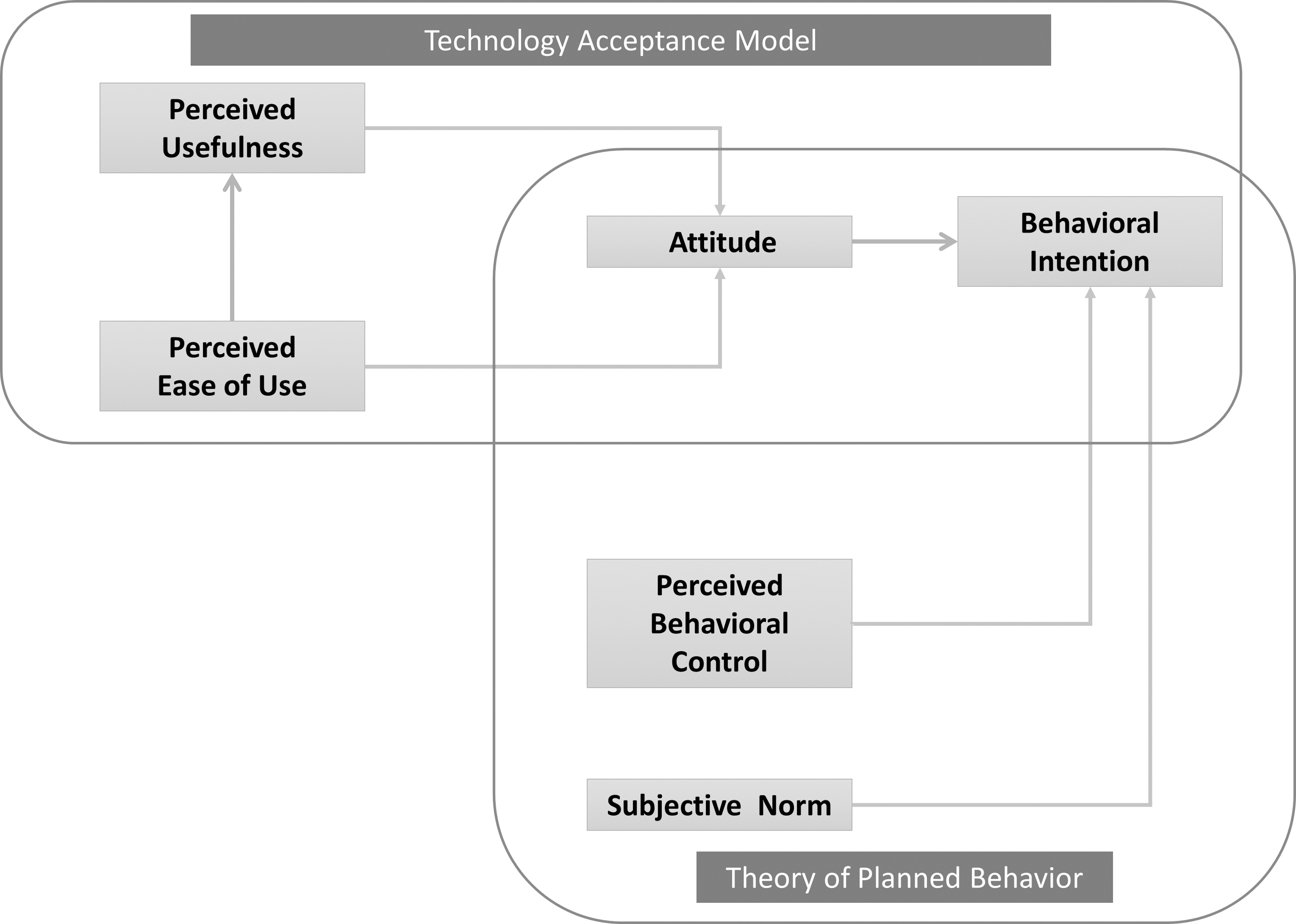
Theoretical framework.
H1: PU will have a positive impact on patient attitudes toward using e-health services in Saudi Arabia.
H2: PEU will have a positive impact on patient attitudes toward using e-health services in Saudi Arabia.
H3: PEU will have a positive impact on PU for e-health services in Saudi Arabia.
H4: Attitudes will have a positive impact on patient BI to use e-health services in Saudi Arabia.
The TPB is one of the most prominent theories that measure the influencing factors of an individual's decision-making process. According to TPB, attitude, perceived behavioral control (PBC), and subjective norm (SN) independently determine the BI. Attitude refers to “the degree of a person's favorable or unfavorable evaluation or appraisal of the behavior in question.”
24
SN is defined as “perceived social pressure to perform or not to perform the behavior.” PBC refers to “a person's perception of ease or difficulty in performing the behavior of interest.”
24
Previous studies found positive influence of PBC and SN on IT adoption in healthcare sectors. Hence, we proposed the following hypotheses: H5: PBC will have a positive impact on patient BI to use e-health services in Saudi Arabia. H6: SN will have a positive impact on patient BI to use e-health services in Saudi Arabia.
Questionnaire Development and Data Collection
The target population for this study comprised patients from different private and public hospitals in Jeddah, Saudi Arabia. The purpose of the study was explained to participants in detail to ensure that they understood the project, and consent was sought from them before the commencement of the survey. The structured questionnaire survey method was used to gather pertinent data, and subsequently to determine the latent variables in the research hypotheses.
The questionnaire contained two parts. The first part included basic demographic information, such as age, gender, marital status, educational qualifications, and IT usage experience of respondents. The second part included questionnaires to measure all the constructs used in the research model. Every measure in the latent construct within the proposed framework was derived from previous studies and changed accordingly to fit the context of Saudi Arabia. The items used to measure the PU, PEU, and BI were developed based on the studies of Davis, 21 Chau and Hu, 25 and Venkatesh and Davis. 26 On the contrary, the items used to measure the SNs, attitudes, and perceived behavior control were obtained from the studies of Taylor and Todd, 27 Venkatesh et al., 28 and Wu et al. 29
Before finalizing the questionnaires, a pilot study was conducted to receive useful feedback on the effectiveness of the questionnaire and necessary modification was made. A total of 150 questionnaires were received from participants, and there were 16 incomplete questionnaires that were not included in the analysis. This study used structural equation modeling (SEM) technique using partial least squares (PLS) method. The SEM-PLS is prominently used for path modeling for testing different proposed models and hypotheses. 30 We used SmartPLS software for analysis of the data. The software is widely used among the researchers since it was launched in 2005. 31
Results
The Measurement Model
Before testing the hypothesis, the reliability and validity of the questionnaire were evaluated. 32 The Cronbach's alpha and composite reliability were measured for reliability where values of 0.70 or more were acceptable. In Table 1 is given that the value of Cronbach's alpha for every construct was >0.78 and composite reliability values were >0.87, which is greater than the recommended value. Thus, all constructs have adequate reliability.
Measurement Model
ATT, attitude; AVE, average variance extracted; BI, behavioral intention; PBC, perceived behavioral control; PEU, perceived ease of use; PU, perceived usefulness; SN, subjective norm.
The validity was evaluated by considering convergent and discriminant validity where the value of item loadings and average variance extracted (AVE) had to be >0.5 to achieve the convergent validity. 33 In Table 2 is given that the value of item loading was >0.71 and in Table 1 that AVEs were >0.70. Hence, conditions of convergent validity were fulfilled.
Cross-Loading
In this study, the discriminant validity was evaluated using the square root of the AVE and cross-loading matrix. The square root of the AVE of a construct required to be more than its correlational value with other constructs. 34 In Table 3 it is given that the square roots of AVE were greater than their corresponding correlation value among other latent constructs. It means that the collected data have a good discriminant validity.
Square Root of the Average Variance Extracted and Cross-Loading Matrix
The Structural Model
The structural model was postulated to investigate path relationships among the constructs in the model, and the bootstrap technique was applied to investigate the hypothesis. The study examines the relationship among dependent and independent variables using the path coefficient (β) and t-statistics (Table 4). The findings showed that PU (t = 5.383, β = 0.4497) and PEU (t = 6.605, β = 0.5183) have significant influence on attitude toward e-health service. Hence, H1 and H2 were supported. Attitude (t = 9.4329, β = 0.7071) and SN (t = 4.1521, β = 0.2136) also showed significant influence on patient intention to use e-health services. However, PBC (t = 0.2372, β = 0.0140) had no significant influence on the intention to use e-health services. Therefore, hypothesis H5 was rejected, whereas hypotheses H4 and H6 were supported.
Structural Model
Discussion
This study integrated TAM and TPB models in the context of e-health adoption in Saudi Arabia. With regard to TAM-related variables, the result confirms that the PU and PEU significantly affect the attitudes toward e-health services. This finding also supports the existing literature on adoption of e-health services. 35 According to Hoque et al., 22 independent variables such as PU and PEU also significantly influence the attitudes toward using e-health. This study revealed that PEU has a more positive influence than PU on patient attitudes toward using e-health services in Saudi Arabia. The user-friendly and easy to use technologies are critically important to achieving a wider adoption of e-health services.
With regard to the TPB-related variables, the result confirms that both attitude and SN significantly influence the BI to use e-health services. Attitude is the most significant variable to use e-health services in Saudi Arabia. Many existing literatures also revealed that attitude and SN significantly affects the intention to use e-health. 36 Besides, the study shows that friends and family members' opinions also affect the decision to adopt e-health services in Saudi Arabia.
One of the interesting findings of this study is that, unlike other studies, it did not find any significant relationship between PBC and BI to use e-health. As this study has identified the factors that can influence patient intention to use e-health services, this study will be useful to policymakers and service providers for developing strategies and policies to improve e-health services in Saudi Arabia.
Conclusion
e-Health, although seems promising in Saudi Arabia, adopting and availing its benefits are challenging, unless the factors influencing the demand side are not understood well. Effective adoption of e-health depends on the engagement of end users, that is, patients. However, it is clear that there is little research carried out to reveal the patients' attitude to the acceptance and use of e-health, especially in Saudi Arabia. This article reveals some attitudinal determinants to adopt e-health services in Saudi Arabia from the patient perspective. Our empirical findings provide practical guidelines for the successful implementation of e-health services in Saudi Arabia. This finding is significantly important to the Government of Saudi Arabia and policymakers for the formulation of effective strategies and supportive policies to enhance e-health services in Saudi Arabia.
Footnotes
Acknowledgments
Authors are grateful for the help and support they received from their colleagues at both department and colleges for proof reading and sharing some thoughtful comments.
Disclosure Statement
No competing financial interests exist.