




Abstract
Background:
Due to a double stigma against HIV/AIDS and homosexuality, gay men living with HIV/AIDS (GMLHA) have used social media to exchange social support. The current study aims to examine the influence of perceived threat on seeking social support on social media among Chinese GMLHA.
Methods:
First, Weibo posts from 133 GMLHA were content analyzed to identify the perceived severity of HIV infection and perceived severity of stigma, as well as their social support seeking on Weibo. Then, a 2 × 2 (perceived severity of HIV infection [present, absent] × perceived severity of stigma [present, absent]) between-subject multivariate analysis of variance with social support seeking as the dependent variable was performed.
Results:
Perceived severity of HIV infection and perceived severity of stigma had main effects on different kinds of social support seeking. Moreover, GMLHA who expressed both perceived severity of HIV infection and perceived severity of stigma on Weibo posted the greatest number of emotional support-seeking messages.
Conclusions:
This study revealed that perceived threat was one of the motivations of GMLHA to seek online social support.
Introduction
According to the latest report from the Chinese Center for Disease Control and Prevention, 1 the number of people infected with HIV/AIDS reached ∼718,270 in China at the end of June 2017. Gay men are the most severely affected population, that is, 27.5% of people diagnosed with HIV in 2016 were men who have sex with men. 1
Since AIDS cannot be completely curable and may lead to death, people living with HIV/AIDS (PLWHA) experience not only deterioration of physical health but also various psychological distress symptoms. 2 To address physical issues and buffer psychological stress, PLWHA usually request support from their friends or families. 3 However, due to a double stigma against HIV/AIDS and homosexuality, gay men living with HIV/AIDS (GMLHA) have always been judged and even morally discriminated against in China. 4 Stigmatization and discrimination could impede them from seeking social support in the offline context.
With widespread use of information and communication technologies, social media has become an alternative place that provides GMLHA with an anonymous and safe environment to exchange social support. 5 Some support groups on social media have been created to offer social support to GMLHA. 6 Many gay men with concern about HIV/AIDS have used these online support groups to exchange various types of social support, including informational support, emotional support, network support, and esteem support. Besides, Horvath et al. 7 indicated that online social support was at work on improving antiretroviral therapy adherence among GMLHA, which could help them keep the disease under control and reduce mortality.
While extant studies have examined the nature and effectiveness of online social support messages for GMLHA, the antecedents of online social support seeking have seldom been studied. The current study seeks to examine how perceived threat—perceived severity of HIV infection and perceived severity of stigma—motivates social support seeking by GLMHA on social media.
Literature Review
Social Support Seeking on Social Media
Social support refers to an interpersonal transaction involving one or more of the following: emotional concerns, instrumental aid, information, or appraisal. 8 Many studies have indicated that social support could help PLWHA reduce stress, balance emotions, and manage physical and psychological distress. 3,9 However, due to the double stigma of HIV/AIDS and homosexuality, GMLHA are usually marginalized in China. 10 Many GMLHA refuse to disclose their conditions to others, even to people in their primary social networks, such as close friends and family in China. 11 As such, it is difficult for them to obtain social support in the offline context. 12
Over the past decade, social media has become an essential part of our lives, which has also become an alternative source of social support. 11 Social media offer a relatively anonymous environment and the ability to easily link with others in similar health conditions, which allows discussion of embarrassing topics and taboo subjects, increases possibilities for self-disclosure, and encourages honesty and intimacy. 11 A number of studies have suggested that individuals, especially people with stigmatizing disorders such as AIDS or breast cancer, have used social media to seek social support. 11,13,14 Peterson examined an online support group for men living with HIV and found that many members send messages to seek support directly or indirectly. 6 Shi and Chen explored the nature of social support on Chinese social media for PLWHA. They found that PLWHA sought informational support most frequently. 11 Furthermore, online social support has been shown to be effective in encouraging PLWHA to bolster their coping skills, improving their HIV medication treatment adherence, and lowering their negative psychological emotions, which in turn improve their quality of life. 15 Although online social support is valuable for PLWHA, little is known about the antecedents of online social support seeking among PLWHA, especially GMLHA. Extant research has revealed that perceived threat is a major factor that facilitates individuals to seek information about preventive behaviors and coping methods. 16 In fact, social supportive information could be one type of information and coping method that individuals with high perceived threat would request.
Perceived Threat
Perceived threat has long been an important factor in health message design to promote preventive behaviors. 17 According to theories about fear appeals—the protection motivation theory and the extended parallel process model (EPPM)—perceived threat includes two components: perceived severity and perceived susceptibility. 17,18 Perceived severity refers to individuals' perceived magnitude or seriousness of the threat, while perceived susceptibility refers to individuals' perceived vulnerability to the threat. A high level of perceived threat is necessary for an individual to process the fear appeal message and adopt the recommended behavior. 18 Based on the EPPM, Rimal and Real 16 proposed the risk perception attitude framework, which explained how individuals' perceived threat affects behavioral outcomes, including information-seeking behavior. Online social support seeking can be considered as social supportive information seeking. Thus, perceived threat can be a critical predictor of social support seeking.
Although perceived threat has been conceptualized as a two-dimensional concept, including perceived susceptibility and severity of the disease, only one aspect, perceived severity, is applicable to the current examination of GMLHA. Given that this group of people are infected with HIV, their main concern might be only about how serious the infection is likely to be and how to control it. However, in addition to perceived severity caused by negative health outcomes of HIV infection, GMLHA may feel threatened by the negative social outcomes caused by the stigma of HIV/AIDS and homosexuality as well. 19 DeFleur and Goffman 20 indicated that stigma is a discrediting attribute that creates a spoiled identity, which cuts the stigmatized person off from society and from himself. Yang and Kleinman 21 believed that the double stigma against GMLHA might lead to social death in Chinese culture, which subjects people to humiliation and places where individuals, and even his or her whole family, will be socially isolated. Thus, perceived severity of HIV infection and perceived severity of stigma are two dimensions of perceived severity. Furthermore, some studies have suggested that social support is important to address HIV stigma-induced anxiety and depression. 19 However, as mentioned above, it is difficult for GMLHA to obtain offline social support. Thus, it can be expected that to address the perception of severity caused by negative health and social outcomes of HIV infection, GMLHA would seek social support on social media. We posit the following hypotheses and research questions.
H1: GMLHA who express perceived severity of HIV infection will post more (a) emotional, (b) informational, and (c) instrumental support-seeking messages on social media than those who do not express the severity perception of HIV infection.
H2: GMLHA who express perceived severity of stigma will post more (a) emotional, (b) informational, and (c) instrumental support-seeking messages on social media than those who do not express the severity perception of HIV infection.
RQ1: How do the severity perception of HIV infection and the severity perception of stigma interact to influence (a) emotional, (b) informational, and (c) instrumental support-seeking message posting on social media?
Methods
Data
In this study, snowball sampling was first used to recruit 133 Weibo users who are GMLHA. Snowball sampling has been recommended to recruit participants from subgroups, such as members of gay, lesbian, or transgender communities, and often employed to recruit participants with HIV/AIDS. 22 Then, the 133 users' posts on Weibo from November 2016 to January 2017 were collected in January 2017. Weibo, a Chinese version of Twitter launched in 2009, has become one of the most popular social media sites in China. The registered users have exceeded 500 million by the first quarter of 2013. 23 The unit of analysis for the current study was a single post/message generated on Weibo. Messages containing only emoticons, punctuation, interjections, or a single hyperlink were excluded from the sample. If a person repeatedly posted an identical support request within 1 day, it was counted only once. Hence, the final sample size was 4,649.
Coding Scheme
The posts/messages were coded with five predetermined categories, including three categories of social support seeking and two kinds of perceived severity. Each message was coded as 1 (present) or 0 (absent) for these five categories. Specifically, the three categories of social support seeking comprise (1) emotional support: expressing negative emotional states or seeking empathy, reassurance, encouragement, or support; (2) informational support: inquiring information about homosexuality or HIV/AIDS; and (3) instrumental support: seeking tangible resources or services that have been widely used in relevant studies. In addition, two kinds of perceived threat were coded: (1) perceived severity of HIV infection: expressing concerns about negative health outcomes caused by HIV infection; and (2) perceived severity of stigma: expressing concerns about negative social outcomes caused by HIV stigma.
Coding Procedure
A total of 1,000 (21.51%) messages were coded to establish intercoder reliability. Krippendorff's alpha test was reported as 0.91 (emotional support seeking), 0.90 (informational support seeking), 0.91 (instrumental support seeking), 0.89 (perceived severity of HIV infection), and 0.93 (perceived severity of stigma), which are well acceptable. 24 The discrepancy was then addressed, and coding rules were established to avoid ambiguities in word meanings and category definitions. Finally, the remaining messages were split in half and separately coded by the two coders.
Results
First, the results revealed that more than one-tenth of the total messages (n = 531, 11.42%) involved social support seeking (M = 3.96, standard deviation [SD] = 3.82). Among them, emotional support-seeking messages (n = 422, 9.08%) were most common (M = 3.17, SD = 3.30), followed by informational support-seeking messages (n = 94, 2.02%; M = 0.71, SD = 1.68), whereas only 0.32% (n = 15) of all social support-seeking messages were instrumental (M = 0.11, SD = 0.40). In terms of perceived severity, 38 individuals posted a total of 2.52% (n = 117) messages to express their perceived severity of HIV infection (M = 0.88, SD = 1.13), whereas 15 individuals posted a total of 22 messages, 0.47% (n = 22), to express their perceived severity of stigma.
Additionally, a 2 × 2 (perceived severity of HIV infection [present, absent] × perceived severity of stigma [present, absent]) between-subject multivariate analysis of variance was performed to test the hypotheses and address research questions. The results revealed significant main effects for perceived severity of HIV infection on emotional and information support seeking, where GMLHA who expressed perceived severity of HIV infection posted a greater number of emotional [F(1, 129) = 11.48, p < 0.001,
Last, the results revealed a significant interaction effect between perceived severity of HIV infection and perceived severity of stigma on emotional support seeking. According to Figure 1, individuals who expressed both perceived severity of HIV infection and perceived severity of stigma posted the greatest number of emotional support-seeking messages [F(1, 129) = 4.49, p < 0.05,
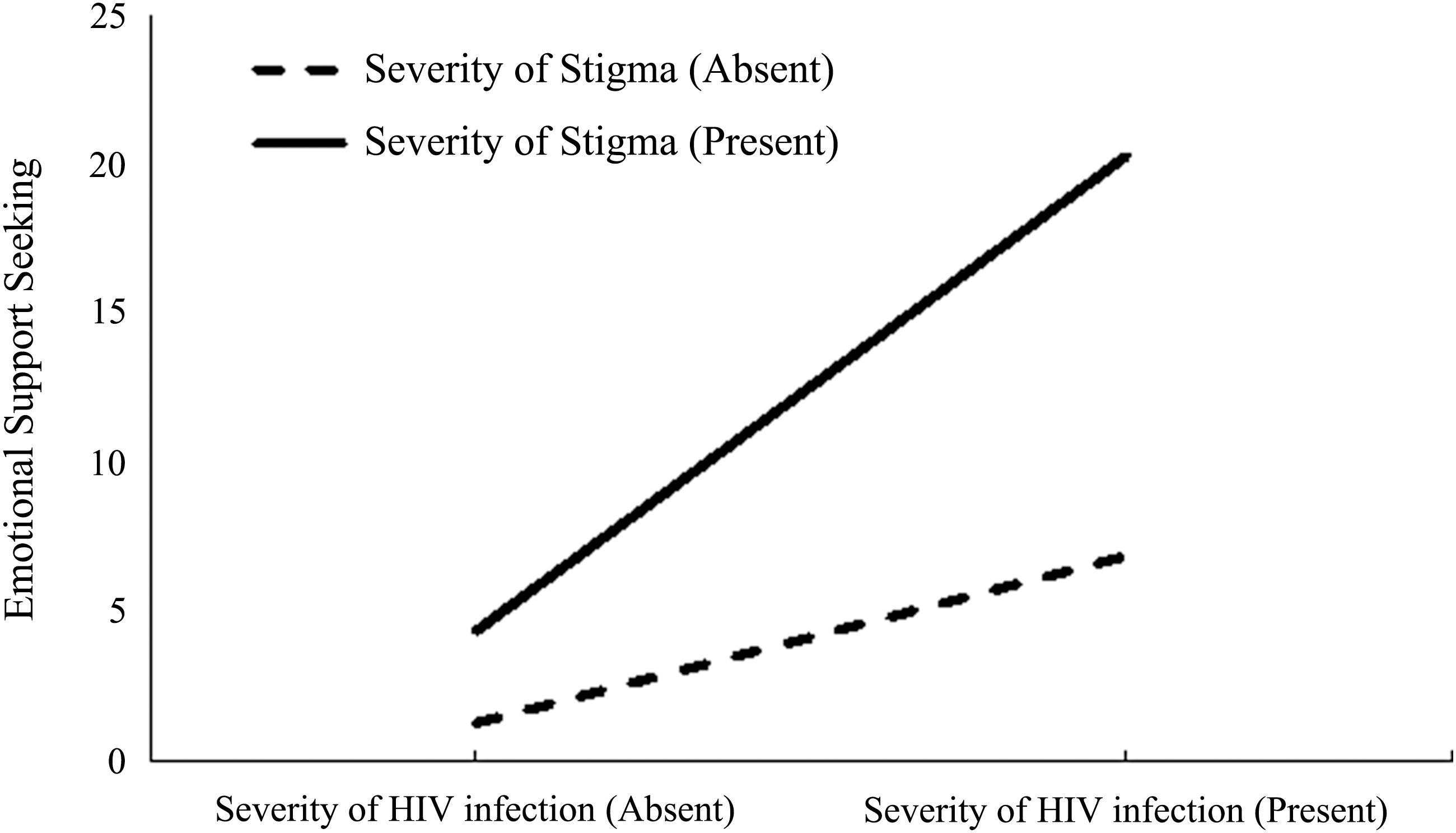
Interactive effect between perceived severity of HIV infection and perceived emotional support seeking.
Discussion
This study explored the roles of perceived threat in social support seeking on social media among GMLHA. First, we refined the construct of perceived threat in the context of GMLHA by developing the concept of perceived severity with two dimensions: (1) health and (2) social outcomes. Moreover, by revealing the positive relationship between perceived threat and social support seeking on social media, this study suggested that teleinterventions of HIV/AIDS should not only provide social support but also reduce GMLHA's perceived threat from both health and social consequences to improve their well-being and life quality.
First, we found that GMLHA posted a greater number of emotional support-seeking messages than informational and instrumental seeking messages. It can be explained by the optimal matching model of social support 25 ; individuals will request more emotion-focused coping when the event is not controllable, such as disability. While there are medications and treatments to fight HIV, the double stigma of HIV/AIDS and homosexuality cannot be removed. Thus, GMLHA sought more emotional support than other types of social support on social media.
In addition, the results suggested that perceived severity of stigma had main effects on three kinds of social support seeking. However, the main effect for perceived severity of HIV infection is not significant on instrumental support. According to the content analysis, the instrumental support that GMLHA sought on Weibo was not financial assistance or material goods for HIV treatment, but help or companionship from others. For example, some GMLHA sought their peers to remind them to take medicines regularly or to join social activities together. Thus, this might be why instrumental support seeking was affected by perceived severity of stigma instead of perceived severity of HIV infection.
Last, the interaction effects between perceived severity of HIV infection and perceived severity of stigma are only significant on emotional support seeking, but not on informational and instrumental seeking. It is possible that GMLHA who expressed both perceived severity of HIV infection and perceived severity of stigma have a higher perceived threat than those who expressed only one perceived severity. Studies have indicated that individuals high in threat tend to need more comfort and emotional help. 13 Thus, GMLHA who expressed two kinds of perceived severity tend to post more emotional support-seeking messages on social media.
Limitations
First, the current study used snowball sampling for recruiting GMLHA on Weibo. This method may induce selection bias and affect generalizability of the current findings. However, given that it is difficult to reach this group, snowball sampling has often been employed in previous research on GMLHA. Future research may try to replicate the current research on a larger sample size or a more representative sample. Second, this study focused on social support seeking, but did not take into account social support provision, which could be investigated in the future. Third, this study examined the antecedents of social support seeking on social media from the perspective of fear appeals. Future studies could explore other influencing factors such as online network position and psychological characteristics.
Footnotes
Acknowledgment
This work was partially supported by Faculty Research Grants (General Research Grants, GRFs) of Macau University of Science and Technology (FRG-17-043-FA).
Disclosure Statement
No competing financial interests exist.