




Abstract
Background:
Although a number of studies have examined social support needs among women with breast cancer, little attention has been paid to the burden and needs for social support among their family caregivers, who often report mental and physical problems associated with caregiving.
Objective:
This study aims to examine the role of social media in providing social support for offspring caregivers of breast cancer patients.
Methods:
A peer support group, “Having a breast cancer patient in my family,” was created on Douban (
Results:
The results revealed that the majority of messages (n = 690, 88.0%) provided or requested social support, and more than 64.5% of these messages (n = 445) were posted by caregivers who were offspring of the cancer patients. The results also suggested that these caregivers requested and provided informational support more frequently than they did emotional and instrumental support.
Conclusions:
This study suggests that social media could be a plausible platform for offspring caregivers of breast cancer patients to share caregiving experiences, access informational resources for their care recipients, gain knowledge about breast cancer prevention, and obtain emotional encouragement. Theoretical as well as practical implications are discussed.
Introduction
Breast cancer has become one of the most common cancers and is the sixth leading cause of cancer-related deaths among Chinese women. 1 Since the 1990s, the incidence of breast cancer in China has increased more than twice as fast as has the global rate. Women with breast cancer suffer from both physical and psychological distress. During breast cancer treatment, they need help from not only healthcare professionals, such as physicians and nurses, but also from family caregivers, particularly spouses and adult children.
Although a number of studies have examined the social support needs among women with breast cancer, 2 little attention has been paid to the burden and need for social support among their family caregivers. However, family cancer caregivers often report problems such as depression, diminishing physical health, and lack of information about cancer. 3 Scholars have concluded that cancer caregivers experience as much, if not more, psychological distress and burden as the patients they care for. 4
The role of social support in cancer treatment has been well documented in the literature. Moreover, extant research has suggested that social support and support groups could help family cancer caregivers buffer emotional pain as well as provide them with solid solutions for medical and treatment problems. 5 However, little research to date has investigated social support for caregivers, especially offspring caregivers, of women with breast cancer. In this study, we intend to examine the presence of social support requests as well as provisions from one social media group for family caregivers of women with breast cancer in China. Furthermore, this study seeks to identify the type of kinship relationship between the caregiver and care recipient from the content to further discuss the role of social media in providing social support for offspring caregivers of breast cancer patients.
Online Social Support
Social support refers to “an interpersonal transaction involving one or more of the following: emotional concerns, instrumental aid, information, or appraisal.” 6 Many computer-mediated support groups have been created for people with a variety of health issues as well as those who need or seek help. 7 These online support groups have been found to provide an anonymous environment to reduce users' shame and stigma, unite users who have the same needs and similar health concerns, and offer users opportunities to maintain and expand their social networks. 7 Wright et al. classified online social support messages into three categories: (1) emotional, (2) informational, and (3) instrumental support. Previous studies have investigated the presence and types of social support messages existing across social media platforms in Western as well as Chinese contexts and validated this categorization. 7 –10
Methodologically, most previous studies that used Wright et al.'s typology of online social support employed a mutually exclusive coding scheme in analyzing social support. In these studies, one unit of analysis, usually a single online message or post, was categorized into one of three types of social support. In fact, previous research on social support, especially in the offline context, has documented that individuals tend to seek and provide multiple types of social support simultaneously. 7,11,12 However, the coding practice employed in studying text-based online social support has often identified the type of social support according to the predominant theme in a single message, which ignored the possibility of identifying multiple types of social support that may exist in one message. 10 Therefore, to overcome this limitation, we intended to employ a nonmutually exclusive coding scheme in this study to identify all the types of support presented in a single support message exchanged by offspring caregivers of breast cancer patients.
Offspring Caregivers of Breast Cancer Patients and Social Support
Family cancer caregivers' stresses and burdens have been well documented in the literature. Specifically, several problems have been identified for families coping with breast cancer, such as seeking information for the patient's treatment, coping with financial difficulties, and managing emotional distress. 3 Some recent studies have indicated that social support for caregivers is important to reduce their burdens and biopsychosocial stress. 13 Moreover, receiving social support has been found to increase family caregivers' ability to take care of dependent patients. 14,15 However, previous research has documented that compared with women with advanced breast cancer, their caregivers reported more depression and anxiety, but received a lower level of support from family and friends. 16
According to the optimal matching model of social support, 17,18 the context in which social support is received is critical, given that the needs for support as well as the effectiveness of the support received vary across different contexts. In fact, these differences have been documented in research on social support for family caregivers. Scholars have found that the responsibilities of caregiving, as well as the needs for social support, are different among family caregivers, mainly due to the nature of the kinship relationship between the caregiver and the care recipient. In general, compared with spouse caregivers who are the primary caregivers, adult offspring caregivers often have a less salient role as caregivers and must contend with competing social roles, such as multiple family and work roles. 19 Accordingly, the needs and effects of social support on family caregivers are not uniform, but instead depend on their roles. 19 Therefore, in this study, we aim to identify the type of kinship relationship and to focus on offspring caregivers to better understand their social support requests and provisions on social media.
Recent research about social support in social media has mainly focused on the nature and outcomes of online social support for breast cancer patients, but not for their caregivers. 20,21 However, online support groups have been reported as a popular platform from which cancer patients, as well as their caregivers, intend to seek social support. 22 Such support groups for breast cancer patients' caregivers have been observed on Facebook and other social media platforms. 23,24 On the other hand, although some studies have investigated online support groups for cancer caregivers, they have focused on the support groups for parent caregivers of children with cancer. 15,25 Nevertheless, for breast cancer patients, their family caregivers are more likely to be adult children, rather than parents.
Moreover, more attention should be directed to offspring caregivers of breast cancer patients in the Chinese context. First, filial piety is the dominant value in Chinese society, which prescribes that adult children have the responsibility of taking care of their aging parents. 26,27 Also, filial norms have been found as a crucial shared family value in the Chinese society and significantly accounted for intergeneration support from adult children to their parents. 26 In addition, in 1980, China adopted a nationwide family planning policy, the “one-child policy,” which called families to have one child each. This policy was implemented for 35 years and was abolished in 2015. It is highly likely that some of the offspring caregivers of breast cancer patients are the only child in their families and lack help or support from siblings. Compared with other caregivers, this generation may face more difficulties when they provide healthcare for their elderly mothers with breast cancer and request extra social support from others. According to the theoretical framework and empirical findings reviewed above, we intend to investigate social support messages exchanged by offspring caregivers of breast cancer patients on social media. We raise the research questions as follows:
RQ1: What are the (a) number and (b) percentage of supportive messages posted by offspring caregivers of breast cancer patients in a social media group?
RQ2: What are the (a) number and (b) percentage of each type of support request message (emotional, informational, and instrumental) posted by offspring caregivers of breast cancer patients in a social media group?
RQ3: What are the (a) number and (b) percentage of each type of support provision message (emotional, informational, and instrumental) posted by offspring caregivers of breast cancer patients in a social media group?
Methods
Study Site: Douban.Com
First, we searched for online support groups for caregivers of breast cancer patients on several popular Chinese social media sites. The group “Having a breast cancer patient in my family (我家有位乳腺癌)” on
Unlike other social media whose content is accessible only to registered users, Douban is open to both registered and unregistered users, which makes its content widely available to all internet users. Since its launch in 2005, Douban had attracted more than 150 million users as of the end of 2016, and the average monthly active users has reached 300 million. 29
Data Collection
The messages where the latest update date fell between January 1, 2017, and July 29, 2017, were crawled from the Douban group using Python web crawler. The final sample comprised 784 messages. Douban is a social media platform on which information is publicly accessible. To minimize potential harm to the group members, all usernames were replaced by pseudonyms to maintain confidentiality. Moreover, the messages published in this article have been paraphrased to avoid the identification or matching of specific users by reference to the original messages on the internet.
Coding Scheme
The unit of analysis was a single message generated by a group member. The messages were coded with the following variables (Table 1):
Coding Variables, Definitions, and Examples from the Group
Note: The definitions were adapted from Shi and Chen. 10
emotional support request, which expresses negative emotional states or seeks empathy, reassurance, encouragement, or support;
informational support request, which inquiries about information on breast cancer;
instrumental support request, which seeks tangible resources or services;
emotional support provision, which expresses empathy, reassurance, or encouragement;
informational support provision, which offers guidance or information about solutions, including explanations, the sharing of personal experiences, suggestions, advice, or information about helpful resources;
instrumental support provision, which is associated with physical assistance, including directly offering tangible resources or services or expressing a willingness to provide them; and
irrelevant messages, which are messages unrelated to breast cancer.
This part of coding is not mutually exclusive as a message might contain several types of social support requests and provisions.
Furthermore, the users were coded into three types according to the content of their posting messages. This coding scheme on user type is mutually exclusive. In detail, the types of users were as follows: caregivers, whose post(s) indicated that one of his or her family members is a breast cancer patient; breast cancer patients, whose post(s) identified himself/herself as a breast cancer patient; not identifiable, whose role could not be identified due to the ambiguous content of the posting message.
Furthermore, once a message is identified as posting by a caregiver, the type of kinship is further determined according to the message content.
Coding Procedure
To establish intercoder reliability, two native Chinese-speaker coders independently coded 10.20% (n = 80) of the messages. The values of Krippendorff's alpha were 0.90 for emotional support provision, 30 0.82 for information support provision, 1.00 for instrumental support provision, 0.85 for emotional support requests, 0.89 for informational support requests, 1.00 for instrumental support requests, and 1.00 for irrelevant messages. For the user types, the value of Krippendorff's alpha was 0.82. 28 After solving any discrepancy, the coding rules were established to avoid ambiguities in word meanings, category definitions, and coding instructions. The remaining 704 messages were split in half and separately coded by the 2 coders.
Results
In general, the vast majority of messages (n = 690, 88.0%) in the Douban group provided or requested social support. Specifically, support provisions accounted for 86.7% of the total social support messages (n = 598), whereas support requests accounted for around one-quarter of them (n = 162, 23.5%) (Table 2). Among all the social support messages, more than half (n = 454, 65.8%) were posted by breast cancer caregivers, followed by breast cancer patients (n = 115, 16.7%) and unidentifiable users (n = 121, 17.5%).
Frequencies and Percentages of Social Support Provisions and Requests Posted by All Users (n = 690), by All Caregivers (n = 454), and by Offspring Caregivers (n = 445)
Given that some messages included both support request and provision, the total number does not equal the sum of the numbers for support requests and support provisions.
The total number does not equal the sum of the numbers for each type of requests/provisions because some messages contain more than one type of social support request/provision.
RQ1 asked the number and percentage of the social support messages posted by offspring caregivers. The results showed that among all the messages posted by caregivers, more than 95% of them (n = 445, 98.0%) could be identified as messages posted by offspring caregivers taking care of their mothers with breast cancer. Among the nine remaining messages, seven were posted by caregivers who were nephews, cousins, or children-in-law of the care recipient, and the nature of kinship was not identifiable in two of the remaining messages. Thus, in general, this Douban group is a peer-support group mainly for offspring caregivers of women with breast cancer.
Among all the social support messages posted by offspring caregivers, messages with support provisions (n = 384) were much more prevalent than were messages with support requests (n = 114). RQ2 asked the numbers and percentages of three types of social support request messages, including emotional, informational, and instrumental support. The analysis revealed that, for the social support requests, the most requests from offspring caregivers were information support requests (n = 89, 78.1%) and emotional support requests (n = 34, 29.8%). Instrumental support requests, however, only accounted for 2.6% (n = 3) of them (see Fig. 1). A closer examination of the informational support requests showed that these requests were mainly about medical treatment and rehabilitation, such as, “Do radiotherapy and chemotherapy really have considerable side effects?” and “Are there any recommended rehabilitative recipes?” Also, these offspring caregivers often expressed their fear, anxiety, and uncertainty of their mothers' illness and survival to seek emotional support and assurance. For instance, several group members wrote messages such as, “How do you overcome these difficulties again and again? I feel so helpless.”
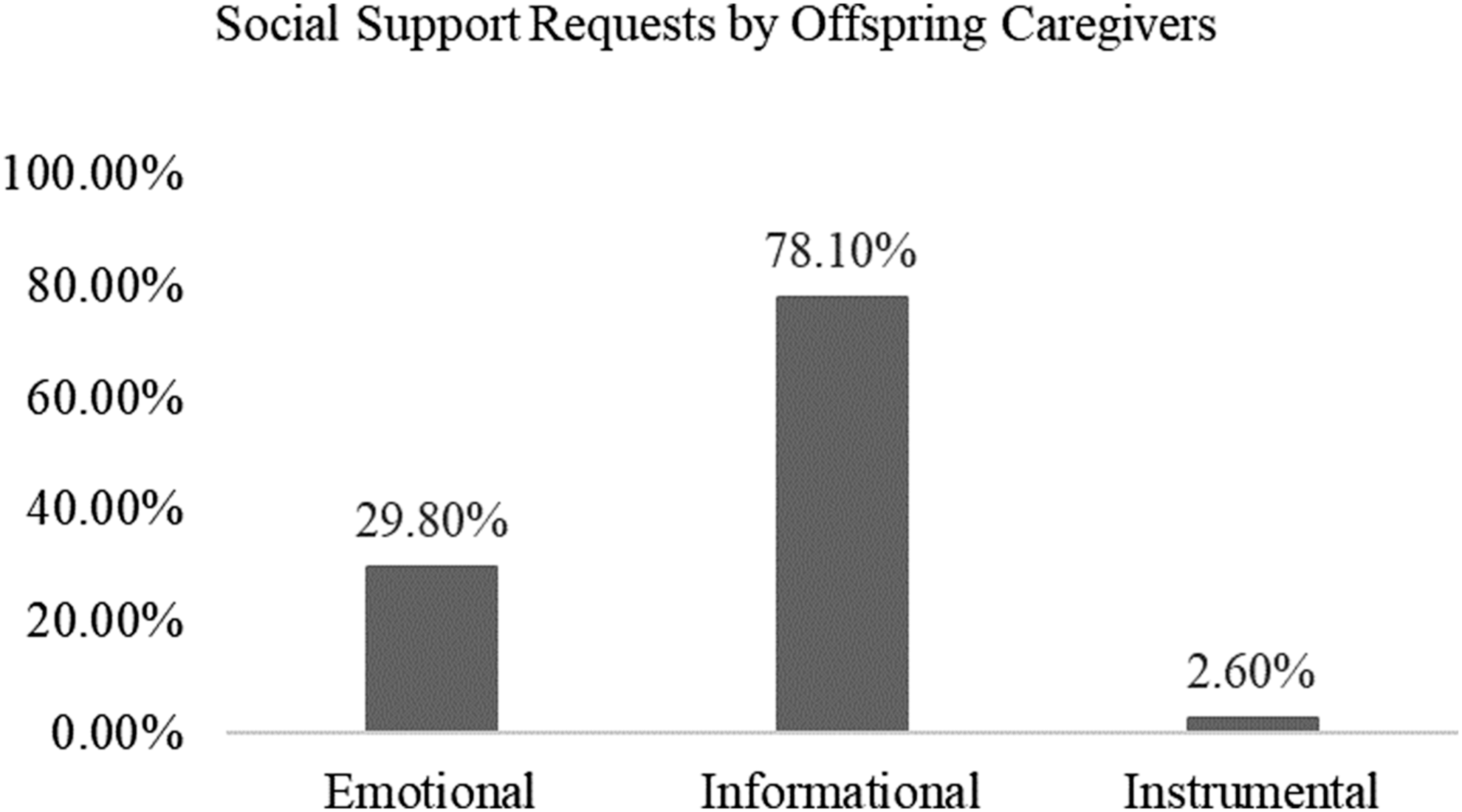
The percentage of each type of support request message posted by offspring caregivers. The total percentage does not equal to 100% because some messages contain more than one type of social support request.
RQ3 asked the numbers and frequencies of informational, emotional, and instrumental support provisions. The analysis showed that regarding social support provisions posted by offspring caregivers, informational support provision was most frequently presented in this group (n = 312, 81.3%), followed by emotional support provision (n = 143, 37.2%). However, only one message posted by the offspring caregivers provided instrumental support (n = 1, 0.3%) (see Fig. 2). In detail, informational support provisions mainly involve information about breast cancer symptoms, treatment, and personal experience of caregiving, such as, “My mom was also diagnosed with invasive breast cancer at this age, and she just finished her first chemotherapy.”

The percentage of each type of support provision message posted by offspring caregivers. The total percentage does not equal to 100% because some messages contain more than one type of social support provision.
Moreover, it is worth noting that the informational support provisions exchanged in the group were not only about caring for breast cancer patients but also about preventing breast cancer for the offspring caregivers themselves, since they were all with a family history of breast cancer. For instance, one message stated, “The original poster should be aware of breast cancer because with a family history, your own risk for developing the cancer doubles.” The other example message was, “You should inform the doctor about your family history of breast cancer, so he/she can recommend you a suitable gene examination.” On the other hand, a great number of messages with emotional support provisions expressed caring, comfort, and encouragement, such as, “Don't worry. It will be okay,” and “Cheer up.” Furthermore, approximately half of the emotional of support provisions were presented along with informational support provisions in a single message to the group (n = 72).
Discussion
Major Findings and Implications
This research effort provides a considerable body of knowledge in understanding offspring caregivers of women with breast cancer in the Chinese context through content-analyzing messages in a social media support group for breast cancer caregivers. These findings revealed these offspring caregivers exchanged informational resources and emotional encouragement with peers most frequently. Moreover, the prevalence of informational and emotional support provisions exceeded the prevalence of the requests, which indicated that this social media support group was adequate in providing breast cancer caregivers informational as well as emotional, social support.
These findings revealed that informational support was the most common type of support request as well as support provisions posted by offspring caregivers in the group. This prevalence of informal social support is expectable. As suggested by the optimal matching model, the needs for social support largely depend on the disease's controllability. Uncontrollable events require more emotional coping, whereas controllable diseases require more problem-focused coping. 17,18 Given that breast cancer is highly treatable, especially at the early stage, caregivers need professional medical information about such topics as breast cancer treatment, medicine use, and rehabilitation, to assist their caregiving. Such information received from peers could be a useful informational resource addition to medical professionals. However, it should be noted that the quality of medical information from informal caregivers, instead of health professionals, cannot be guaranteed. Also, as reported in the findings, the informational support was not only for caregiving purposes but also for preventing breast cancer. The findings indicated that besides being caregivers for their mothers with breast cancer, they are individuals with high risks of developing breast cancer due to their family histories. The unique and various identities of offspring caregivers, as well as the information on preventing breast cancer they exchanged, revealed the importance of social context when investigating social support for cancer caregivers.
The second prevalent type of social support in the group, including both support requests and provisions, is emotional support. As documented in previous research, offspring caregivers of breast cancer patients suffer from psychological distress, but are able to release the emotional burden through social participation. 19 These findings indicated that social interactions in the online context provide offspring caregivers of breast cancer patients a space to interact with others, express negative emotions, and receive psychological encouragement. Moreover, this emotional support could be especially important for the offspring caregivers who near adulthood face transitioning social roles and have a greater risk of mental health problems than other age groups. 31,32 In addition, these findings revealed that more than half of the emotional support provision messages concurrently presented informational support provisions. As documented in the literature, social support is a multidimensional concept, 17,18 and individuals tend to seek and provide more than one type of social support simultaneously. 11,12 As such, multiple types of social support were found to exist in a single message delivered by support seekers or providers.
With regard to instrumental support, it seldom presented in the group. This is consistent with many studies about online social support, 9,33,34 which have documented that limited instrumental support requests, as well as provision of support, were observed in online support groups. In fact, limited instrumental support could be explained by weak tie theory, 35 given that networks built on social media are usually considered weak tie networks. 36 Scholars have documented that weak tie networks effectively help individuals exchange varied and useful information with each other. 31 However, weak ties usually exhibit less emotional attachment and instrumental aids than strong ties, such as close kinship or friendship. 37 In other words, individuals in weak tie networks are less likely to provide instrumental support to each other. However, a long-term exchange of informational and emotional support may strengthen ties among offspring caregivers in this peer support group. 38 Thus, these offspring caregivers may provide tangible support to each other offline, which cannot be detected from analyzing the message content. On the other hand, the very limited number of messages involving instrumental support may not mean that this group is unable to assist in the exchange of tangible resources. These offspring caregivers' initial reason for joining the group may not have been about seeking tangible resources, given that children often do not take on major caregiving responsibilities and have less financial as well as physical burdens. 39 If this is the case, participating in the social media group may well satisfy their needs in information-seeking and stress management. Yet, this explanation needs further examination.
Practical Applications
These findings are valuable for Chinese government and healthcare professionals to improve social support for breast cancer caregivers. First, more online caregiver peer support groups on social media could be created as a means to communicate informational and emotional support to assist in caregiving for family caregivers of breast cancer patients. Also, health professionals or health organizations may participate in these support groups for family caregivers as well as guide their caregiving practices. Furthermore, besides providing informational support on breast cancer treatment and rehabilitation, health professionals could deliver knowledge about breast cancer prevention to the offspring caregivers in the group, since they are at relatively high risk of breast cancer. Stated differently, the social media groups for offspring caregivers of women with breast cancer should be an important target audience for breast cancer prevention education and campaigns, especially in the online context.
Limitations
First, although this study thoroughly investigated social support messages for offspring caregivers of breast cancer patients, it may have limited generalizability to other online support groups for breast cancer caregivers. However, the Douban group studied is the only public online group for breast cancer caregivers we could find on Chinese social media platforms. Furthermore, given that this group is open to all internet users, regardless if they are registered users of Douban, we believe that information presented in this group has a relatively greater chance of reaching a broad audience and wielding greater influence than the supportive messages exchanged in other private online groups for breast cancer caregivers. Future research should try to replicate this study in other online groups for breast cancer caregivers and for different cancer types. Second, caring for a family member with breast cancer may occur over an extended period that requires continuous efforts. Caregivers experience changes in expectations and responsibilities over time, and their psychological distress and needs for support also vary along the cancer patients' illness trajectories. 40 These changes, however, have not been captured in this study. Future research could employ a dynamic perspective to explore the changing role of online social support in cancer family caregiving during the patient's illness trajectory. Third, caregivers may not access social media to seek social support, but receive help from offline supportive others. This study focused only on online social support. Thus, future research could examine how caregivers seek and receive social support in the offline context.
Conclusions
This study performed an advanced investigation of a social media group for offspring caregivers of people with breast cancer. By focusing on offspring caregivers of cancer patients, this study considered the social context in examining social support requests and provisions and extended previous research on online social support for cancer caregivers. The results show that in this social media support group, offspring caregivers requested and provided informational and emotional support. This suggests that social media could be a plausible platform for offspring caregivers of breast cancer patients to share caregiving experiences, access informational resources for their care recipients, gain knowledge about breast cancer prevention, and obtain emotional encouragement.
Footnotes
Disclosure Statement
No competing financial interests exist.