




Abstract
Background:
Sleep is related to various kinds of health outcomes. Many studies traditionally collect data on sleep using questionnaires or sleep diaries. An increasing popular alternative is a wrist-worn device. The accuracy of these devices is uncertain, and assessment of this accuracy is important.
Introduction:
The purpose of this study is to compare consensus sleep diary (CSD) and an actigraphy-based wrist-worn device (Fitbit Alta™ [Fitbit, San Francisco, CA]) measurements of total sleep time (TST), sleep onset latency, wake time after sleep onset, number of awakenings, and sleep efficiency.
Materials and Methods:
Ten healthy young adults (50% female, 100% Asian) in the age range between 20 to 24 years old wore a Fitbit Alta around their nondominated hand during seven consecutive nights. The participants also filled in a CSD every day.
Results:
On average, the wrist-worn device (Fitbit Alta) recorded a TST per night of 437.15 min, which is 5.46 min shorter on average than the CSD recorded (442.61 min). Bland–Altman plots indicate that there is large variance in the sleep recorded between Fitbit™ (Fitbit, San Francisco, CA) and CSD. For example, Fitbit recorded 2.15 more awakenings per night than CSD, which is equal to 13.09 min on average longer wake time after sleep onset.
Conclusion:
Fitbit and CSD show significant differences in recording sleep. We find that for most sleep metrics, the level of disagreement is small enough for the devices to be interchangeably used except for recording wakes during the night.
Introduction
People sleep about one-third of their life and good sleep is one of the key aspects of good health. Recent studies have shown sleep duration is related to various kinds of health outcomes. 1 For example, Taheri et al. observed that short sleep duration is associated with increased body mass index, possibly through reduced leptin and elevated ghrelin, in their population study. 2 Gangwisch et al. 3 found that short sleep duration is a significant risk factor for hypertension. Sleep assessment plays an important role in these studies and provides essential information about a person's sleep pattern.
There are mainly three ways to acquire sleep information: (1) polysomnography (PSG), (2) self-reported diaries and questionnaires, and (3) actigraphy devices. PSG is a multifacets test recording biophysiological features executed in a sleep laboratory. PSG is treated as the “gold standard” of sleep assessment, but it is very expensive, intrusive, and has high requirements for monitoring. As a low-cost and easy-to-administer alternative to PSG, self-reported tools are often used in epidemiology studies. Self-reported sleep questionnaires normally are used for habitual sleep pattern collection. Self-reported sleep diaries can keep track of detailed sleep-related timing and duration with moderate accuracy. 4 Another trend is the use of actigraphy-based wearable devices. The wearable-sensing market is growing rapidly; in 2014, ∼17 million wearable bands were sold and this number will grow to an expected 99 million in 2019. 5 Actigraphy generally is based on an accelerometer to track the movements for sleep–wake cycles or circadian rhythm assessment. It provides a more objective measurement of sleep than self-reported tools and is more affordable than PSG.
There is research comparing these various methods to quantify their accuracy. Silva et al. 6 evaluated the relationship between PSG and self-reported sleep measurements using 2,113 subjects. They found that next-morning self-reports and habitual sleep questionnaires all overestimated the total sleep time (TST) and have relatively weak correlation with PSG on overall TST.
Mantua et al. 7 and Montgomery-Downs et al. 8 investigated the validity and reliability of actigraphy devices and showed commercial wearable devices and research-based actigraphy both have a high sensitivity but a low specificity than PSG sleep measurements.
Comparisons of sleep measurements by research-based actigraphy and self-reports questionnaire were performed by Lauderdale et al. in nonelderly population, 9 Van Den Berg et al. 10 in elderly population, and Girschik et al. 11 in women. They all reported that postsleep self-reports recorded longer TST on average than actigraphy. Van Den Berg et al. 10 also suggested that perceived sleep duration might be influenced by cognitive deficit, in that it results in significantly longer retrospective self-reported sleep duration. This is less relevant to our study as our participants are not cognitively impaired. 10
However, detailed sleep diary, like consensus sleep diary (CSD), was not in use in these studies. CSD, unlike retrospective questionnaire, requires participants to walk through the steps to calculate TST and, therefore, has the potential to acquire more precise data on sleep time. 12 Matthews et al. 13 compared sleep duration measured by PSG, research-based actigraphy, sleep diary, and a self-reported questionnaire. They found that these methods yield different results in estimating sleep duration.
To our knowledge, the association between sleep measurements from commercial wrist-worn devices and detailed self-reported sleep diary has not been thoroughly and publicly investigated. Therefore, in this study, we aim to assess the difference between a commercial wrist-worn device and CSD on sleep measures in a normal population for a preliminary exploration. We choose the Fitbit Alta™ (Fitbit, San Francisco, CA) because of its widespread use as a commercial wearable device. Fitbit™ (Fitbit, San Francisco, CA) leads the wrist-worn device market share 14 and there are 682 research publications, which use data collected with a Fitbit. 15 We conduct an experiment with 10 participants for 7 days and compare sleep measurements from actigraphy devices and sleep diaries.
Materials and Methods
In this section, we elaborate on the experimental setup. First, we introduce the participants of our study. Next, we introduce the wearable device and the CSD; followed by our experimental setup and a discussion of the data processing and cleaning; and finally, we discuss the employed comparison metrics.
Participants
A total of 10 participants, all Asian and current students at the City University of Hong Kong, were invited to participate in this study based on convenient sampling. The participant's age ranged from 20 to 24 years, with a mean of 21.8 years. Five participants (50%) were female and none (0%) of the participants reported that they suffer from insomnia. All participants provided written consent.
Measurement of Sleep
We use two methods to measure sleep: a wrist-worn device and self-reported sleep diary.
Wrist-worn device
For this study, we use the Fitbit Alta * as the wrist-worn device for monitoring sleep using actigraphy. The Fitbit device is installed with a triaxial accelerometer to track the wearers' movements and speed as well as their heart rate. Based on a combination of heart rate and movement, Fitbit automatically assigns one of seven sleep states. These data are obtained on a minute level. We reclassify these seven states into awake and sleeping (see Table 1 for an overview).
Sleep/Awake Categorization as Applied to Fitbit™'s Sleep Classes
Sleep diary
Various formats of sleep diaries exist, for an overview see table 3 in Ibáñez et al. 4 In our study, we use a widely applied diary called the CSD. Originally documented by Carney et al., 16 it was configured by a committee of experts with the aim of proposing a new improved and standardized sleep diary. We use the format of the CSD and modify it slightly by leaving out all the subjective questions regarding sleep quality. Hence, we gather daily data concerning, time to go to bed and time to go out of bed, time to fall asleep and time to wake up, and number of awakening and their respective time and duration. Sleep diary exists both in digital form (through the use of an app) and in paper and pencil versions. Tonetti et al. 17 showed that both versions are comparable in performance. In this study, we used the CSD, as displayed in Figure 1, which is a paper and pencil diary.

Modified consensus sleep diary used in this experimental study.
Experimental Setup and Data Collection
In our experiment, each of the 10 participants measured their sleep by wearing a Fitbit Alta and filling in CSD for 7 consecutive days during the period from November 2017 to January 2018. Participants were instructed to wear the device 1 h before going to bed on their left wrist and to take it off after getting out of bed in the morning. Participants were reminded to tightly fit the wearable device on the wrist and to fill in the sleep diary (CSD) each morning. In total, five different Fitbit Altas were used in this experiment. Each participant used only one.
Before this experiment was conducted, three trial runs were performed to test the experimental setup. These trial runs resulted in some modifications to the instructions of the CSD.
Data Processing and Cleaning
After each participant completed their 7 days of data collection, we extracted start time, end time of each sleep period, and combined with the sleep diary recorded times. We investigated the first night effect. Agnes et al. were the first to find that people tend to sleep differently on the first night in a laboratory environment. 18 To see whether this was the case in home environment using Fitbit and CSD in our study, we performed a Kruskal–Wallis rank sum test on TST between first night and nonfirst night. We did not find any statistical evidence of the first night effect and hence all days of the data can be included and treated as comparable.
After combining the processed wearable and sleep diary data, some anomalous values were discovered, and data cleaning was performed. This final validated data set consists of 67 measured nights and is given in Appendix Table A1.
Performance Measurement
For the purpose of comparison of Fitbit's and CSD performance, we follow the literature 19 and study that TST, sleep onset latency (SOL), wake after sleep onset (WASO), and sleep efficiency (SE) are measured and calculated. The bedtime and leave bedtime are determined from sleep diary. TST is the time from sleep start to sleep end excluding the total wake duration. SOL is the time from bedtime to sleep start. WASO is the wake duration after sleep onset. SE is defined as the percentage of TST of the total time spent in bed. Table 2 displays the list of abbreviations and definitions.
List of Nomenclature
Results
To understand the general sleep habits, we studied habitual bedtime, sleep start time, sleep end time, and leave bedtime, where habitual time is computed as the average time over the measured nights. Table 3 gives the results. The participants tend to go to bed between 22:30 and 02:30 and leave bed between 06:32 and 11:21. It is apparent from Table 3 that there is disagreement between the sleep recorded by Fitbit Alta and CSD.
Habitual Sleep Pattern and Demographic Information
CSD, consensus sleep diary.
Next, we focus on the sleep metrics TST, SOL, WASO, and SE. We computed the overall score by combining the data of all participants, Table 4 gives the results. Habits, as recorded by the actigraphy, show an average TST of 437.15 (standard deviation [SD] ±89.80) min, an average SOL of 20.60 (SD ±24.33) min, an average WASO of 23.94 (SD ±19.25) min, and an overall SE of 90.25% (SD ±6.10%). In comparison, metrics based on the CSD show a longer average TST of 442.61 (SD ±86.05) min, a longer average SOL of 25.58 (SD ±26.04) min, a shorter average WASO of 10.85 (SD ±16.46) min, and a higher overall SE of 91.60% (SD ±6.13%). Moreover, Fitbit detected 2.91 (SD ±1.82) wake-ups per night while sleep diary recorded 0.76 (SD ±0.72) wake-up periods. The Pearson correlation on TST is 0.957 between CSD and Fitbit.
Comparison of Sleep Metrics Total Sleep Time, Sleep Onset Latency, Wake After Sleep Onset, Sleep Efficiency, and Number of Awakenings
CSD, consensus sleep diary; IQR, interquartile range; MAE, mean absolute error; MSD, mean signed difference; SD, standard deviation; SE, sleep efficiency; SOL, sleep onset latency; TST, total sleep time; WASO, wake after sleep onset; WSR, Wilcoxon signed rank.
Wilcoxon signed rank (WSR) tests showed that the disagreements between Fitbit and CSD on TST, SOL, WASO, and SE are all significant at a 5% level. We applied the WSR tests because this nonparametric test is designed to deal with data showing non-normality as some of the sleep metrics did not pass the Shapira–Wilk test for normality. In terms of mean signed difference (MSD), Fitbit underestimate TST by an average of 5.46 (SD ±26.05) min, overestimate SOL by 4.99 (SD ±11.93) min, overestimate WASO by 13.09 (SD ±16.17) min, and underestimate SE by 1.35% (SD ±5.30%) in comparison with the CSD recordings. The mean absolute error is reported in Table 4 along with the MSD values. Furthermore, Fitbit differs significantly from the CSD in the number of recorded awakenings during the night (p < 0.001); the actigraphy reports an average of 2.15 (SD ±1.77) times more awakenings relative to the CSD.
The Bland and Altman plots shown in Figure 2 also support the results from WSR test and MSD. Bland and Altman plots 20 contrast the difference between these two methods on the measurements against the mean of the two measurements. They are useful tools to graphically evaluate agreement if it is unknown which measurement represents the “truth.” For TST, the Fitbit and CSD show difference up to ±50 min. The variability of difference in SOL and WASO increases in the middle of the mean value and decreases in the head and tail. The SE is relatively stable. The colors correspond to different participants. Figure 2 hints that different participants may have their own bias; as participant F and participant C always overestimate their SOL as all their dots are above the average line (Fig. 2b), whereas participants F and B seem to overestimate their TST (Fig. 2a).
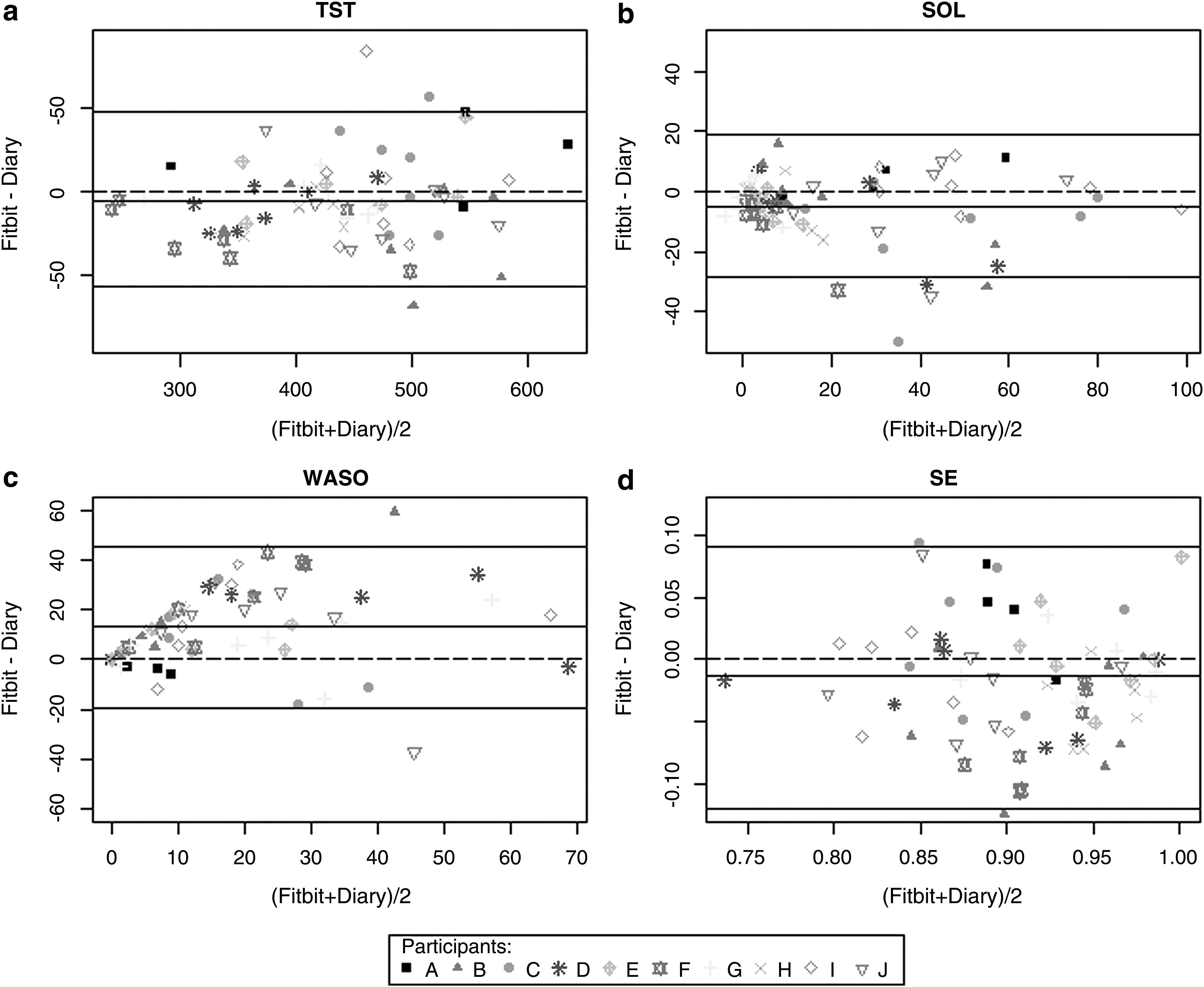
Bland–Altman plots for Fitbit™ and consensus sleep diary measurements.
Discussion and Conclusions
This study aims to compare the sleep measurements from a commercial wrist-worn device, Fitbit Alta, and CSD to see whether and to what extent they agree with each other. We found that there are significant differences. From our analysis, CSD disagrees with Fitbit Alta in measuring sleep. The average difference is small; however, the variation can be large depending on the participant. For long-term monitoring, Fitbit and sleep diary can be interchangeably used to obtain an overview of the sleep habitual using TST and SOL metrics. However, we do not recommend the use of WASO and number of awakenings. We would recommend to treat these measurements critically.
Similar to the comparison on TST between research-based actigraphy and postsleep self-reports, 7,9 Fitbit underestimates the TST relative to the sleep diary. However, from the Bland and Altman plots and MSD, we can observe that difference on TST can be negative or positive in a large scale and results in a minor average difference with negative sign. It is better to interpret it with levels of disagreement rather than MSD merely.
For the other metrics, Fitbit tends to overestimate WASO and underestimate SOL in general compared with sleep diary. The levels of disagreement on SOL are <10 min on average, which is an acceptable level in practice and hence we can use the Fitbit and CSD interchangeably. Nevertheless, the WASO seems difficult to quantify precisely for both of them. Fitbit can detect more awakenings than sleep diary; however, it has a low detection rate compared with the gold standard PSG as shown by Montgomery-Downs et al. 8 The possible reason for this difference can be a participant's low perception of short awakenings. To our knowledge, previous studies did not include the detailed comparisons on WASO and SOL for sleep diary and Fitbit.
The main strength of our study, apart from the inclusion of WASO and SOL comparison to decompose the difference on TST, is that we use CSD rather than postsleep self-reports to record self-reported sleep. In addition, we conducted the study in the home environment, which is as important as the normal laboratory environment for testing. 21 It is even closer to the evaluation situation using sleep diary or commercial wearables in daily life or large population studies.
We admit that there are some limitations in our study. First, the sample size of our study is relatively small, and the selected group is homogeneous. The overall agreement across different populations may not be concluded yet. Second, the study is a take-home experiment, Fitbit sometimes will misclassify the nonwearing to sleep, which may introduce continuous sleep after taken off.
Further exploration may be focused on testing the agreement on different population groups of larger sample size for the utilization of both sleep-tracking methods. Other commercial wrist-worn devices will also be considered in the comparison to offer a more comprehensive view on the relationship between wrist-worn devices and sleep diary.
Footnotes
Acknowledgments
This work was supported, in part, by the RGC Theme-Based Research Scheme T32-102/14N. We would like to thank all participants of the biweekly elder care meetings for their helpful discussions and advice.
Disclosure Statement
No competing financial interests exist.
The Sleep Diary and Fitbit Recordings
| SLEEP START TIME | TOTAL WAKE DURATION (MINUTES) | NUMBER OF AWAKENINGS | SLEEP END TIME | ||||||||
|---|---|---|---|---|---|---|---|---|---|---|---|
| ID | DATE | BEDTIME | FITBIT | CSD | FITBIT | CSD | FITBIT | CSD | FITBIT | CSD | LEAVE BEDTIME |
| A | August 11, 2017 | 0:36 | 1:06 | 1:05 | 6 | 12 | 2 | 2 | 10:42 | 10:00 | 10:51 |
| A | September 11, 2017 | 1:06 | 1:14 | 1:16 | 5 | 9 | 2 | 1 | 10:20 | 10:36 | 10:54 |
| A | November 11, 2017 | 1:12 | 2:17 | 2:06 | 1 | 4 | 1 | 1 | 13:07 | 12:31 | 12:54 |
| A | December 11, 2017 | 1:15 | 1:51 | 1:44 | 0 | 0 | 0 | 0 | 6:52 | 6:30 | 6:45 |
| B | November 13, 2017 | 2:09 | 2:25 | 2:09 | 5 | 0 | 1 | 0 | 7:57 | 8:00 | 8:00 |
| B | November 14, 2017 | 2:08 | 2:16 | 2:20 | 9 | 0 | 5 | 0 | 11:14 | 11:08 | 11:08 |
| B | November 15, 2017 | 3:16 | 3:25 | 3:25 | 72 | 13 | 7 | 2 | 12:24 | 12:34 | 12:34 |
| B | November 16, 2017 | 2:33 | 2:42 | 2:33 | 4 | 0 | 3 | 0 | 11:57 | 12:36 | 12:36 |
| B | November 17, 2017 | 3:24 | 4:12 | 4:30 | 15 | 0 | 2 | 0 | 11:04 | 11:03 | 11:03 |
| B | November 18, 2017 | 2:21 | 2:38 | 2:40 | 9 | 4 | 5 | 1 | 12:16 | 12:16 | 12:16 |
| B | November 19, 2017 | 2:22 | 3:01 | 3:33 | 2 | 0 | 2 | 0 | 10:48 | 11:53 | 11:53 |
| C | November 15, 2017 | 0:03 | 0:25 | 0:44 | 33 | 44 | 3 | 1 | 9:04 | 9:09 | 9:09 |
| C | November 16, 2017 | 22:54 | 0:13 | 0:15 | 19 | 37 | 3 | 2 | 9:35 | 8:58 | 9:00 |
| C | November 17, 2017 | 0:21 | 0:32 | 0:38 | 0 | 0 | 0 | 0 | 9:02 | 8:47 | 8:57 |
| C | November 18, 2017 | 23:40 | 0:27 | 0:36 | 32 | 0 | 6 | 0 | 8:46 | 8:49 | 8:49 |
| C | November 19, 2017 | 23:35 | 23:45 | 0:35 | 17 | 0 | 4 | 0 | 7:38 | 7:35 | 7:45 |
| C | November 20, 2017 | 23:15 | 0:27 | 0:35 | 13 | 4 | 2 | 1 | 8:57 | 8:59 | 9:06 |
| C | November 21, 2017 | 0:07 | 0:38 | 0:35 | 34 | 8 | 4 | 1 | 9:42 | 9:39 | 9:41 |
| D | November 19, 2017 | 0:37 | 1:22 | 1:47 | 72 | 38 | 3 | 2 | 7:43 | 7:41 | 7:41 |
| D | November 20, 2017 | 0:51 | 0:56 | 1:00 | 67 | 70 | 4 | 1 | 9:58 | 9:56 | 9:57 |
| D | November 21, 2017 | 3:40 | 3:43 | 3:46 | 31 | 5 | 4 | 1 | 9:28 | 9:30 | 9:34 |
| D | November 22, 2017 | 2:00 | 2:07 | 2:00 | 0 | 0 | 0 | 0 | 8:57 | 8:50 | 8:55 |
| D | November 23, 2017 | 1:00 | 1:26 | 1:57 | 30 | 0 | 4 | 0 | 8:02 | 8:00 | 8:02 |
| D | November 24, 2017 | 0:01 | 0:31 | 0:28 | 50 | 25 | 4 | 1 | 7:27 | 7:15 | 7:29 |
| D | November 25, 2017 | 1:39 | 1:45 | 1:48 | 29 | 0 | 6 | 0 | 7:52 | 7:50 | 7:51 |
| E | November 19, 2017 | 1:30 | 1:36 | 1:35 | 14 | 10 | 1 | 1 | 7:53 | 7:30 | 7:55 |
| E | November 20, 2017 | 21:32 | 21:32 | 21:40 | 4 | 0 | 1 | 0 | 6:20 | 6:24 | 6:24 |
| E | November 21, 2017 | 21:20 | 21:28 | 21:39 | 34 | 20 | 2 | 1 | 7:00 | 7:00 | 7:01 |
| E | November 22, 2017 | 22:30 | 22:32 | 22:32 | 28 | 24 | 1 | 1 | 6:09 | 6:00 | 6:20 |
| E | November 23, 2017 | 0:50 | 0:51 | 0:56 | 19 | 0 | 2 | 0 | 6:58 | 7:03 | 7:06 |
| E | November 24, 2017 | 21:27 | 21:30 | 21:32 | 12 | 0 | 1 | 0 | 5:32 | 5:30 | 5:35 |
| E | November 25, 2017 | 21:24 | 21:26 | 21:36 | 0 | 0 | 0 | 0 | 6:55 | 6:20 | 6:30 |
| F | November 27, 2017 | 23:00 | 23:05 | 23:10 | 20 | 0 | 3 | 0 | 6:44 | 6:40 | 6:50 |
| F | November 28, 2017 | 2:59 | 2:58 | 3:05 | 5 | 0 | 2 | 0 | 6:59 | 7:12 | 7:15 |
| F | November 29, 2017 | 1:35 | 1:32 | 1:40 | 48 | 10 | 5 | 1 | 7:44 | 7:43 | 7:48 |
| F | November 30, 2017 | 0:36 | 0:36 | 0:40 | 48 | 9 | 6 | 2 | 6:48 | 6:53 | 6:55 |
| F | January 12, 2017 | 1:10 | 1:09 | 1:20 | 45 | 2 | 5 | 1 | 6:33 | 6:35 | 6:36 |
| F | February 12, 2017 | 22:15 | 22:20 | 22:53 | 34 | 9 | 7 | 1 | 6:49 | 7:45 | 7:45 |
| F | March 12, 2017 | 2:33 | 2:32 | 2:35 | 15 | 10 | 2 | 1 | 6:53 | 6:56 | 6:56 |
| G | November 27, 2017 | 22:00 | 22:03 | 22:15 | 69 | 45 | 4 | 1 | 6:58 | 6:55 | 6:59 |
| G | November 28, 2017 | 23:31 | 23:23 | 23:31 | 22 | 16 | 1 | 1 | 6:34 | 6:33 | 6:34 |
| G | November 29, 2017 | 1:13 | 1:11 | 1:13 | 42 | 27 | 3 | 2 | 6:20 | 6:11 | 6:21 |
| G | November 30, 2017 | 22:54 | 22:50 | 22:56 | 24 | 40 | 1 | 2 | 6:24 | 6:30 | 6:31 |
| G | January 12, 2017 | 22:33 | 22:38 | 22:33 | 6 | 0 | 1 | 0 | 6:19 | 6:22 | 6:23 |
| G | February 12, 2017 | 22:44 | 22:50 | 22:44 | 28 | 19 | 2 | 1 | 6:34 | 6:35 | 6:36 |
| G | March 12, 2017 | 23:10 | 23:13 | 23:10 | 0 | 3 | 0 | 1 | 6:19 | 6:23 | 6:24 |
| H | January 1, 2018 | 0:30 | 0:32 | 0:38 | 30 | 0 | 3 | 0 | 6:20 | 6:21 | 6:20 |
| H | February 1, 2018 | 0:16 | 0:17 | 0:16 | 11 | 0 | 2 | 0 | 7:06 | 7:04 | 7:10 |
| H | March 1, 2018 | 0:40 | 0:53 | 0:46 | 20 | 0 | 2 | 0 | 6:55 | 6:55 | 6:59 |
| H | April 1, 2018 | 23:22 | 23:31 | 23:44 | 3 | 0 | 1 | 0 | 6:33 | 6:40 | 6:42 |
| H | May 1, 2018 | 23:30 | 23:40 | 23:56 | 21 | 1 | 3 | 1 | 6:40 | 6:45 | 6:47 |
| H | June 1, 2018 | 23:46 | 23:48 | 23:47 | 21 | 0 | 2 | 0 | 7:20 | 7:19 | 7:19 |
| H | July 1, 2018 | 23:20 | 23:22 | 23:25 | 12 | 0 | 2 | 0 | 6:43 | 6:41 | 6:44 |
| I | January 13, 2018 | 23:54 | 0:39 | 0:47 | 75 | 57 | 5 | 2 | 11:42 | 11:25 | 11:45 |
| I | January 14, 2018 | 23:28 | 0:22 | 0:10 | 13 | 7 | 2 | 2 | 8:21 | 8:22 | 8:35 |
| I | January 15, 2018 | 22:37 | 23:56 | 23:55 | 31 | 0 | 5 | 0 | 7:29 | 7:30 | 7:34 |
| I | January 16, 2018 | 22:40 | 0:16 | 0:22 | 17 | 4 | 3 | 1 | 8:35 | 8:20 | 8:35 |
| I | January 17, 2018 | 23:50 | 0:25 | 0:17 | 38 | 0 | 5 | 0 | 8:15 | 7:18 | 8:15 |
| I | January 18, 2018 | 23:37 | 0:08 | 0:08 | 33 | 3 | 4 | 1 | 8:43 | 8:45 | 8:50 |
| I | January 19, 2018 | 23:37 | 0:25 | 0:23 | 1 | 13 | 1 | 1 | 8:50 | 7:35 | 7:35 |
| J | January 20, 2018 | 22:35 | 23:50 | 23:46 | 42 | 25 | 3 | 1 | 9:57 | 9:56 | 10:37 |
| J | January 21, 2018 | 23:57 | 0:43 | 0:37 | 34 | 9 | 5 | 1 | 8:27 | 8:31 | 8:31 |
| J | January 22, 2018 | 23:57 | 0:21 | 0:34 | 30 | 10 | 5 | 1 | 7:45 | 7:45 | 7:45 |
| J | January 23, 2018 | 23:45 | 0:10 | 0:45 | 39 | 12 | 6 | 2 | 9:30 | 9:37 | 9:37 |
| J | January 24, 2018 | 23:45 | 0:35 | 0:25 | 21 | 3 | 4 | 1 | 8:37 | 8:37 | 8:37 |
| J | January 25, 2018 | 1:00 | 1:08 | 1:15 | 13 | 2 | 2 | 1 | 10:08 | 10:07 | 10:07 |
| J | January 26, 2018 | 0:15 | 0:32 | 0:30 | 27 | 64 | 3 | 2 | 7:32 | 7:30 | 7:35 |
CSD, consensus sleep diary.
*