




Abstract
Introduction
Physicians and internet health information are two main sources where patients obtain medical information. Patients prefer to go to the hospital to see their physicians first, when they were asked in the interview, whereas 48.6% go online first actually and only 10.9% of them go to see their physicians. 1,2 Most physicians suggest special websites to their patients. 3 Generally, patients and their relatives have tendencies to have increased level of depression or anxiety related to the risk of diseases, and gaining access to internet health information is associated with a reduction of negative emotion. 4,5 Most patients, who are internet users, reported that internet health information helped them cope with operative procedures. 6 Therefore, internet health information plays an important role in the self-management of patients and is particularly important for rehabilitation and adjustment of emotion.
With the precondition that users are willing to take action as a result of internet health information, it could be actually playing a part. Holding a strong perception of the internet increases the likelihood of frequent visits, which is related to the use of information. 7 Consequently, perceived quality of internet health information is essential for health and emotion.
A health website is an important platform for users to seek internet health information, discuss health problems, and resolve medical problems. For example, “39 Health Website” is used to seek disease symptoms, learn the function of medicines, and browse health knowledge. “Family Doctor Online” is another well-known health website in China, and users can ask an online doctor about the treatment of related diseases in “Diagnosis and Treatment” section, seek self-management information in “Healthy and Care” section, or interact with others in “Interactive” section. Web-based information on disease, medication, nutrition, and exercise is frequently sought. 3 Individuals' attitudes toward health websites are related to their online behavior, and their seeking behavior affects the decision about treatment. 8
Users' satisfaction motivates them to search treatment information and make them think that online therapy could help them and that health website is a reliable information source. 9 Positive attitudes allow patients to control their rate of learning, and even affect the improvement of online service. 10,11 On the contrary, negative attitudes might impede the uptake and efficient use of following treatment-related online health information, 12 which reduces patients' confidence in dealing with physicians and provides limited health choices and decision making. 13 Therefore, website operators probably could manage health websites to make users be more positive toward them.
Treatment-related online health information takes up the main section of health websites. From the perspective of content, treatment information could be divided into emerging and conservative. Emerging treatment information, which involves new medicines, instruments, and operation, is scarcely used in real cases. Potential adverse events, unknown success rate to physicians, and additional complications remain limitations of it. 14 –16 Oppositely, conservative treatment with low complication rate 17,18 is a prior option, whereas it is difficult to cope with new diseases. By mediating seeking behavior of treatment information, this study explores how attitudes toward health websites affect perceived quality of internet health information by employing regulatory focus theory.
Regulatory focus theory, proposed by Crowe and Higgins, 19 distinguishes self-regulation with two types of regulatory focus: (1) promotion and (2) prevention focus. From the perspective of motivation, the regulation of promotion focus is characterized by the approach motivation that focuses on personal development and self-realization. People with promotion focus attempt to achieve their personal ideals and aspirations, and they expect positive results when they pursue success. By contrast, the regulation of prevention focus is driven by avoidance motivation, which aims to avoid failures and mistakes, fulfill responsibilities and obligations, and meet expectations without obtaining negative results. 20
A substantial amount of research has explored the relationship of internet health information quality with its corresponding influencing factors and consequences, and the research is generally concerned with the assessment of internet health information quality 21,22 and the influence of this quality. 1 Nonetheless, few studies have focused on the driving factors of internet health information quality from the perspective of seeking behavior and selected users' attitudes toward health websites as an independent variable. This new theoretical lens is important for the improvement of the quality of health websites and is useful for webmasters to aim at enhancing trust or expectancy and increase the usefulness of internet health information. Individuals' attitudes toward health websites influence the perceived quality of internet health information, which further influence the efficiency of treatments and relieve the negative emotion of patients and their relatives.
Materials and Methods
Model and Hypotheses
Trust in health websites
Trust is an important overall judgment of users toward health websites and is previously subjective and heuristic. 7 Hung et al. 23 have examined the indirect influence that interpersonal trust could increase brand variety seeking behavior. Moreover, trust has been previously proposed to have a direct impact on service adoption. 24 Therefore, we can infer that trust in health websites has a positive impact on the treatment-related online health information seeking behavior of patients.
Treatment-related online health information seeking
Information seeking behavior refers to a human behavior that is defined by Wilson
25
as a purposive activity to satisfy individuals' perceived need. It is the main aspect of online behavior, and different seeking behaviors have different user profiles.
26
From the perspective of the character of content, emerging treatment indicates certain therapies on the basis of new technologies or discoveries, which are scarcely used. Conversely, conservative treatment is more common in the medical field. Regulatory focus theory supports that nurturance, growth, and advancement are related to the promotion focus, whereas safety, security, and maintenance of the status quo are related to the prevention focus.
27
Thus, we suggested the following hypotheses:
Expectancy of health websites
Expectancy appears as a key attitude toward health websites and was previously divided into performance expectancy and effort expectancy on the basis of the Unified Theory of Acceptance and Use of Technology.
28
–31
Quaosar et al.
32
have reported that the intention to use m-health services is positively influenced by performance expectancy and effort expectancy. Arif et al.
31
have shown that two kinds of expectancy are significant antecedents of students' intention to use services on websites. The expectancy-value theory, which assumes that expectancy and value combine multiplicatively to influence the motivation of a goal,
32
performs differently according to regulatory focus. Expectancy has a positive impact on goal commitment. Moreover, the positive interactive effect of value and expectancy shows with the promotion focus, whereas the negative interactive effect of value and expectancy shows with the prevention focus.
17
The above discussion prompts us to derive the following hypotheses:
Internet health information quality
It is often utilized
1
for the description of information fitness for use and information reliability from users' perception.
33
This quality comprises four dimensions: (1) relevance, (2) understandability, (3) adequacy, and (4) usefulness.
1
Previous studies have suggested that a significant negative relationship exists between information quality and the level of information asymmetry in the accounting and financial domains.
34,35
Moreover, the low levels of information asymmetry are related to huge information sources provided by websites.
1,36
Therefore, high information quality originates from increased awareness. Considering the “emerging” feature, emerging treatment information has little analogue that presents similar meanings. With poor information, perceived quality of internet health information may be reduced. Consequently, risk-loving users with a promotion focus, who are inclined toward emerging treatment information seeking behavior, possibly have low perceived quality of information. By contrast, conservative treatment information is indicated roundly on health websites. Therefore, we propose the following hypotheses:
Based on the preceding hypotheses, we built our research model (Fig. 1). Trust in health websites and expectancy of health websites are the independent variables; both emerging and conservative treatment-related online health information seeking are mediators; and internet health information quality is the dependent variable.
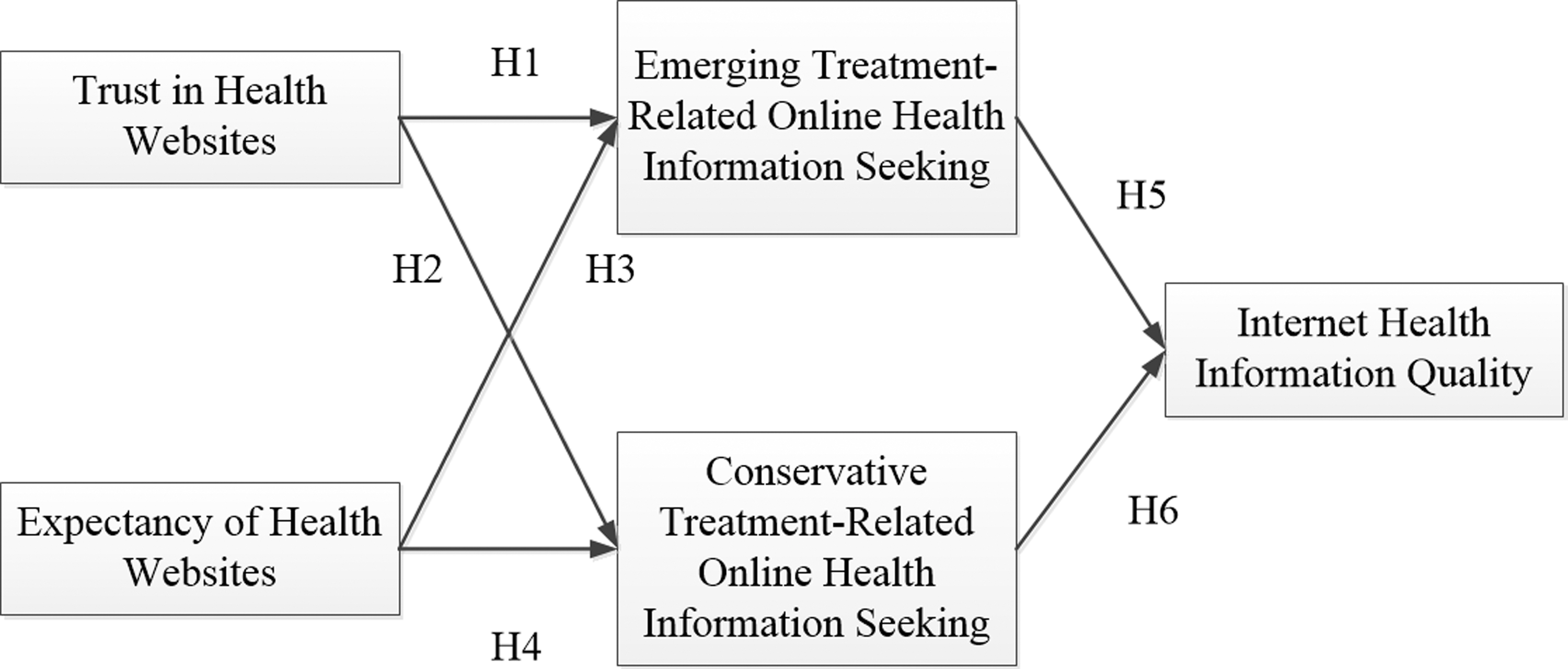
Research Model.
Instrument Development and Analysis Tool
We used instruments that were validated by published quantitative works to ensure reliability and validity. This study collected data through the survey, using a multiple-item measurement scale, in which the constructs from the model were measured. A seven-point Likert scale that ranged from “strongly disagree” to “strongly agree” was employed to obtain responses from participants. The five factors from the research model (Fig. 1) were covered by the survey instruments. Trust in health websites and treatment-related online health information seeking were all mentioned by Lemire et al. 37 Expectancy of health websites was mentioned by Martín and Herrero. 30 Internet health information quality consisting of the factors of relevance, understandability, adequacy, and usefulness was measured using a 16-item scale from Laugesen et al. 1
Structural equation modeling (SEM) 1,38 is a linear statistical modeling technique 39 used as a research method in previous studies for the analysis of relationships between variables and testing of hypotheses. Confirmatory factor analysis 40 is a statistical analysis technique described for confirming hypothesized factor structures. It has become increasingly popular in psychology 39 to fit with the data sets and concept model and test the degree of support on the two. 41 Pearson's chi-square, degrees of freedom (df), probability level (p), root mean square error of approximation (RMSEA), comparative fit index (CFI), incremental fit index (IFI), and Tucker-Lewis index (TLI) are some fit indices to evaluate the hypothesized factor structures. The higher the value of the first four indices and the lower the value of the last three indices, the better the effect.
We selected SEM as an analysis tool, given its capacity to present the detected effects, for the observational error with permission to be incorporated and for possible improvement by combining it with confirmatory factor analysis. As a parameter estimator, the path coefficients in SEM would make the strength of relationships assessable. A positive value means a positive effect, and the larger the value, the stronger the relationship. 42 This study also used IBM's Statistic Package for Social Science (SPSS) 20.0 and AMOS 22.0. Efficient and unbiased analysis could be achieved, and it can evaluate the latent variable interactions.
Data Collection and Respondent Profile
With the translation process performed in the previous works, 43,44 a few native Chinese speakers with high proficiency in English translated our scales into Chinese, considering the cross-cultural adaptation. 45
The formal investigation was anonymously conducted through an online questionnaire survey in June 2017. Only individuals who had received medical therapies within the previous month and had sought health information online were allowed to participate in the present study. We assured the respondents that their privacy was protected and their informed consent was secured.
The online survey actually involved 336 valid participants, achieving a response rate of 77.16% and validity rate of 89.6% through a medical association in China. According to Kass and Tinsley, 46 the ratio of the number of items and sample size should be from 1:5 to 1:10, and 300 is a good sample size. According to Bagozzi and Yi, 47 sample sizes from 100 to 200 or more are suitable. Our study had 51 items, so 336 was a reasonable sample size. Table 1 presents the demographics of the research sample. Over half of this sample was 20–40, female, and highly educated. Meanwhile, internet health information users are likely to be young, female, and educated. 48 Our study aimed to research people's perception of internet health information, and the investigative channel was the internet. Therefore, the sample met our requirements.
Sample Demographics (N = 336)
Results
Statistical Analysis
Based on previous studies, the validity and reliabilities for the scale items of the constructs are the appropriate measurement instrument for the fitting degree of the model. 1,49 Consequently, we used the SPSS 20.0 software to analyze the validity and reliability of the data. The Cronbach's alpha, of which the accepted level was 0.700, 50 was utilized for assessing reliability. Table 2 presents the results. The Cronbach's alpha of each construct ranged from 0.807 to 0.933. The Cronbach's alpha of the total model was 0.937, which showed that the scale in this study had good reliability. The Kaiser-Meyer-Olkin value (weak = 0.500; medium = 0.600; good = 0.700; very good = 0.800; perfect = 0.900) 51 –54 was equal to 0.912 (p < 0.001, significant), which was above the cut-off value of 0.900. Thus, the construct met the conditions for validity that it was fully acceptable.
Cronbach's Alpha of the Constructs
In accordance with Wu et al., 55 we evaluated the discriminant validities of the constructs and determined whether trust in health websites, expectancy of health websites, emerging and conservative treatment-related online health information seeking, and internet health information quality were distinct from one another. Then, the indicators were loaded onto their intended latent variables by nested confirmatory factor analytic models. We established and compared six nested models on the basis of the research model (Fig. 1). A good model fit could provide evidence by the model-fit indices for the model (χ 2 /df < 3, CFI > 0.90, TLI > 0.90, IFI > 0.90, RMSEA < 0.050). All of the models are shown in Table 3, with the five-factor model being the best.
Comparison of Measurement Models in Confirmatory Factor Analysis
CFI, comparative fit index; df, degrees of freedom; IFI, incremental fit index; RMSEA, root mean square error of approximation; TLI, Tucker-Lewis index.
Hypothesis Testing
We used the demographical statistics to identify any significant relationship between the demographic factors and variables of the research model. 1 Age, gender, resident status, and education level were used as control variables in the previous study. 56 –59 We included these variables in the final structural model to ensure their effects were considered.
Figure 2 indicates the SEM results, and Table 4 shows the magnitude and significance of path coefficients. The three hypotheses were supported (H3, H4, and H6), but H1, H2, and H5 were not supported. It means that expectancy of health has a significant and positive impact on treatment-related online health information seeking, and conservative treatment seeking has the same impact on internet health information quality. However, trust in health websites has no significant impact on treatment-related online health information seeking, and emerging treatment-related online health information seeking has a negative impact on internet health information quality.
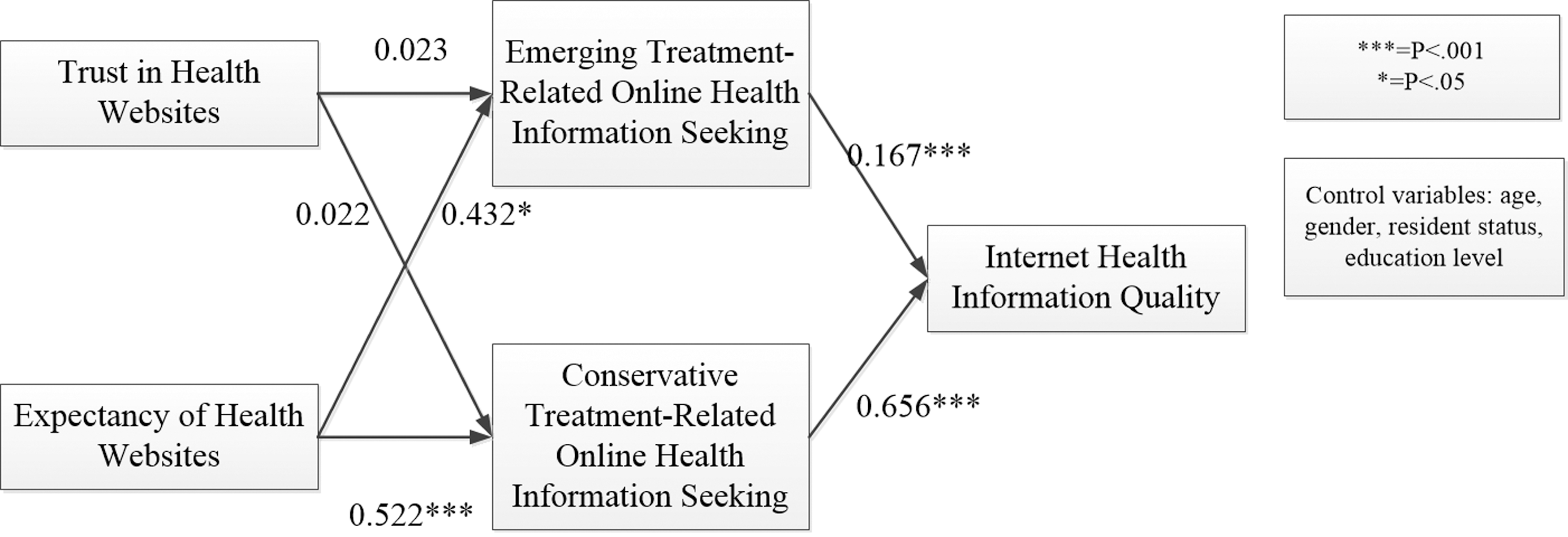
Research model with path coefficients.
Hypothesis Testinga
* P < .000
Principal Results
We constructed a research model to identify the relationship between individuals' attitudes toward health websites (trust and expectancy) and perceived quality of internet health information mediated by seeking behavior. Emerging and conservative treatment-related online health information seeking used to be seen as the mediators. In terms of expectancy of health websites, it directly impacts emerging treatment-related online health information seeking and indirectly impacts internet information quality. Therefore, the perceived quality of internet health information can be improved by strengthening the expectancy of health websites. The path coefficient from the expectancy of health websites to conservative treatment information online health seeking (0.522) is larger than that from the expectancy of health websites to emerging treatment information online health seeking (0.432). By contrast, trust in health websites has no significant influence on treatment information online health seeking. The path coefficient from conservative treatment online health information seeking to internet health information quality (0.656) is substantially larger than that from emerging treatment online health information seeking to internet health information quality (0.167).
Discussion
This study is the first to discuss the impact of individuals' attitudes toward health websites on perceived quality of health information from the perspective of psychology. This study has several theoretical contributions and practical implications regarding users' perceived quality of internet health information. Furthermore, it can be used by website operators for the improvement of the quality of health websites and may prompt the quality of patients' self-management. In this section, we provide the possible reasons for these insignificant relationships and opposite impact.
Zhou 60 has demonstrated that trust in mobile payment has a positive impact on performance expectancy. Chaouali et al. 61 have shown a similar relationship, in which trust in internet banking services promotes customers' performance expectancy. Kurfalı et al. 62 have found that trust in the internet positively affects performance expectancy of e-government services. Thus, we added an arrow from trust in health websites to expectancy of health websites. Eventually, we found that trust in health websites strongly affected the expectancy of health websites, and the path coefficient was 0.645. Overall, conservative treatment-related online health information seeking was more affected than emerging treatment by attitudes toward health websites.
Health is the most important aspect for people. No matter which focus individuals have, they are cautious of their health. Generally, the effectiveness and cost-efficiency of treatment are the two main aspects of people's concern. 63,64 Although emerging treatment is effective via numerous experiments, cases wherein patients adopt emerging treatment and recover are few. Cost efficiency is related to patients' outcomes and the current standard of care. 65 Therefore, a certain risk exists that the condition has not improved while a significant amount of money has been spent.
In general, individual's online health information seeking behavior tendency toward conservative treatment information can be improved by strengthening the positive attitudes toward health websites. For instance, health website operators should improve the quality of health websites by further clarifying the aims, increasing the relevance of the information to the aims, and providing details regarding the additional sources of support and information as much as possible to facilitate users' nurturance of positive attitudes toward the health websites. 66
Moreover, conservative treatment-related online health information seeking of the prevention focus has a positive impact on internet health information quality, and emerging treatment-related online health information seeking of the promotion focus has a positive impact on internet health information quality. This finding indicated that individuals' perceived quality of internet information could be improved by seeking online health information.
In contrast, health website operators are advised to cooperate with certain public hospitals or propagandize the websites on certain high-traffic websites to enable patients who formerly visited the hospitals to seek treatment information on the websites. The path coefficient from conservative treatment-related online health information seeking to internet health information quality (0.656) was substantially larger than that from emerging treatment-related online health information seeking to internet health information quality (0.167). Thus, providing a conservative and reliable treatment information is a sensible approach for health website operators to increase page views.
However, this study also has some limitations. First, only two dimensions of individuals' attitudes toward health websites received considerable attention, namely, trust and expectancy. Other dimensions such as levels of perceived design aesthetics, perceived informativeness, and perceived visual informativeness may also be worthy of investigation. 67 Second, all concepts and relationships were measured only once, so an in-depth research of the purpose of using health websites could not be conducted, failing to capture the dynamic changes in users' attitudes. Third, internet health care is actively promoted in China currently. The demographics of internet users may change after a few years, tending to a complete range, different with the current characteristics that are young and highly educated. Therefore, research will be going on, and after several decades, we will use a different sample to validate this model. Finally, although our sample met the characteristics of typical internet health information seekers, we did not consider the large population and unbalanced health care development in China, and the sample size a little small.
Conclusion
Attitudes toward health websites significantly impact perceived quality of internet health information through the mediations of emerging treatment-related online health information seeking and conservative treatment-related online health information seeking. In our research model, trust in health websites strongly affected the expectancy of websites, and both had a stronger effect on conservative than emerging information seeking. In terms of seeking behavior, conservative information seeking appeared to have a stronger effect. Consequently, an individual's positive attitudes toward health websites indirectly affected perceived quality of internet health information.
According to the findings, we speculate that (1) health website operators could pay equal attention to the improvement of trust and expectancy of users. Improvement is worth trying to do by conducting online surveys, using convincing evidence (research literature and pictures), providing the details of information, improving the guidance of the web module, providing clear explanations of medical terms, and constructing a concise and clear user interface. Such focus probably can enhance the trustworthiness of websites, the efficiency of users, and the sense of ease in achieving the goal. (2) It might be a good choice for health website operators to cooperate with public hospitals or propagandize the websites on certain high-traffic websites to attract patients who previously visited the hospitals to seek treatment information through the websites. (3) Providing other conservative and reliable treatment information may be a sensible approach for health website operators to increase page views.
Footnotes
Acknowledgments
This paper was partially supported by a key project of the National Natural Science Foundation of China with grant number 71532002, and a major project of the National Social Science Foundation of China with grant number 18ZDA086.
Disclosure Statement
No competing financial interests exist.