




Abstract
Background:
The need for neurologists has been steadily increasing over the past few years. The implementation of teleneurology networks could serve as a potential solution to this need.
Methods:
A retrospective review of the Medical University of South Carolina (MUSC) Teleneurology records for all consults performed between August 2014 and July 2018 was conducted. Collected data included number of consults, baseline characteristics, final diagnosis, and number of providers and hospitals over the study period.
Results:
A total of 4,542 Teleneurology consults were performed during the study period. The most common diagnosis was cerebrovascular disease, followed by seizure disorders. The number of consults per month increased throughout the study period from three in August 2014 to 257 in July 2018. The number of community hospitals covered has increased from 3 hospitals in August 2014 to 14 hospitals throughout the state of South Carolina in July 2018.
Conclusion:
Over 4 years, the MUSC teleneurology program has evolved into a robust partnership with 14 partner hospitals, and is now delivering more than 250 expert neurology consultations monthly to patients throughout the state of South Carolina.
Introduction
Neurologists provide care to some of the most vulnerable patients. 1 Unfortunately, there is mounting evidence showing inadequate access to neurologists worldwide. 1 With the exponential growth in the elderly population over the next two decades in the United States, the incidence of neurological diseases is expected to grow, and the shortage of neurologists will continue to grow. 2 –4 While increasing the number of trained neurologists is the key solution for this shortage, better access to neurology consultation for patients with neurological disorders, particularly in rural areas, is urgently needed. 5 One promising solution is teleneurology networks, which provides access to neurology experts for patients presenting to small community hospitals that do not have a neurologist. 6,7 The current evidence supports that neurological examination can be done reliably using telemedicine, 8 and real-time video teleneurology consults have been shown to be effective tools to reduce hospital stay for patients in medical centers that do not have an on-site neurologist. 9 While telestroke networks have shown promising results for stroke patients, there is still an unmet need for neurologists who can provide care to patients with neurological disorders other than emergent stroke consults. 10 –12
At the Medical University of South Carolina (MUSC), a telestroke program was established in 2008 as a response to the persistently high rates of acute stroke incidence in South Carolina. 13 –15 With the accumulating experience in the telestroke field and the increased need for a separate inpatient teleneurology program for neurological disorders other than emergent stroke consults, the MUSC Teleneurology program was established as a partner program to the telestroke program in August 2014. In this study, we describe our experience with establishing a teleneurology network.
Methods
We performed a chart review of the prospectively collected registry of patients who were evaluated through the MUSC Teleneurology network. The Teleneurology consults are done using a videoconferencing platform with a wireless mobile camera unit operated by a nurse at the remote hospital bedside. This approach provides the neurologist with the ability to interact with the patient in real-time. We extracted teleneurology registry data from August 2014 to July 2018. Variables included baseline characteristics (age, sex, race, and medical comorbidities), final diagnosis/diagnoses (as reported in the consult note), and whether the patient was transferred to a tertiary medical center. All included patients were evaluated in the inpatient setting and were followed up until discharge. The frequency of follow-up was determined on case by case basis depending on the diagnosis, severity of illness, and whether or not tests were recommended by the consultant.
Results
During the 4-year study period, 4,542 teleneurology consults were performed on 3,847 unique patients. Mean patient age was 63.8 (SD 17.4) years, 1,981 patients (51.5%) were females, and 2,504 (65.1%) were white. The most common consult diagnosis was cerebrovascular accident (1,495 or 32.9%), followed by seizure disorders (1,213 or 26.7%). Neurodegenerative diseases were third (599 or 13.2%), followed by neuroinflammatory disorders (132 or 2.9%), and a total of 1,103 (24.3%) consults for a nonspecific neurological disorder (e.g., dizziness, pain, and paresthesia among others) (Table 1). The number of consults per month increased from three in August 2014 to 257 in July 2018 (Fig. 1). The program initially covered 3 community hospitals in August 2014 and expanded to cover 14 partner hospitals throughout South Carolina in July 2018 (Fig. 2). The number of consultant physicians has increased from one physician per day covering only daytime hours to four and sometimes five consultant physicians every day covering 24 h. Decision to transfer to a tertiary medical center for a higher level of care was made in 298 (6.6%) consults. Of those, 98 patients were transferred because of the need for continuous electroencephalography (EEG) and 54 patients were transferred because of the need for a dedicated neurological intensive care unit (neuro-ICU).
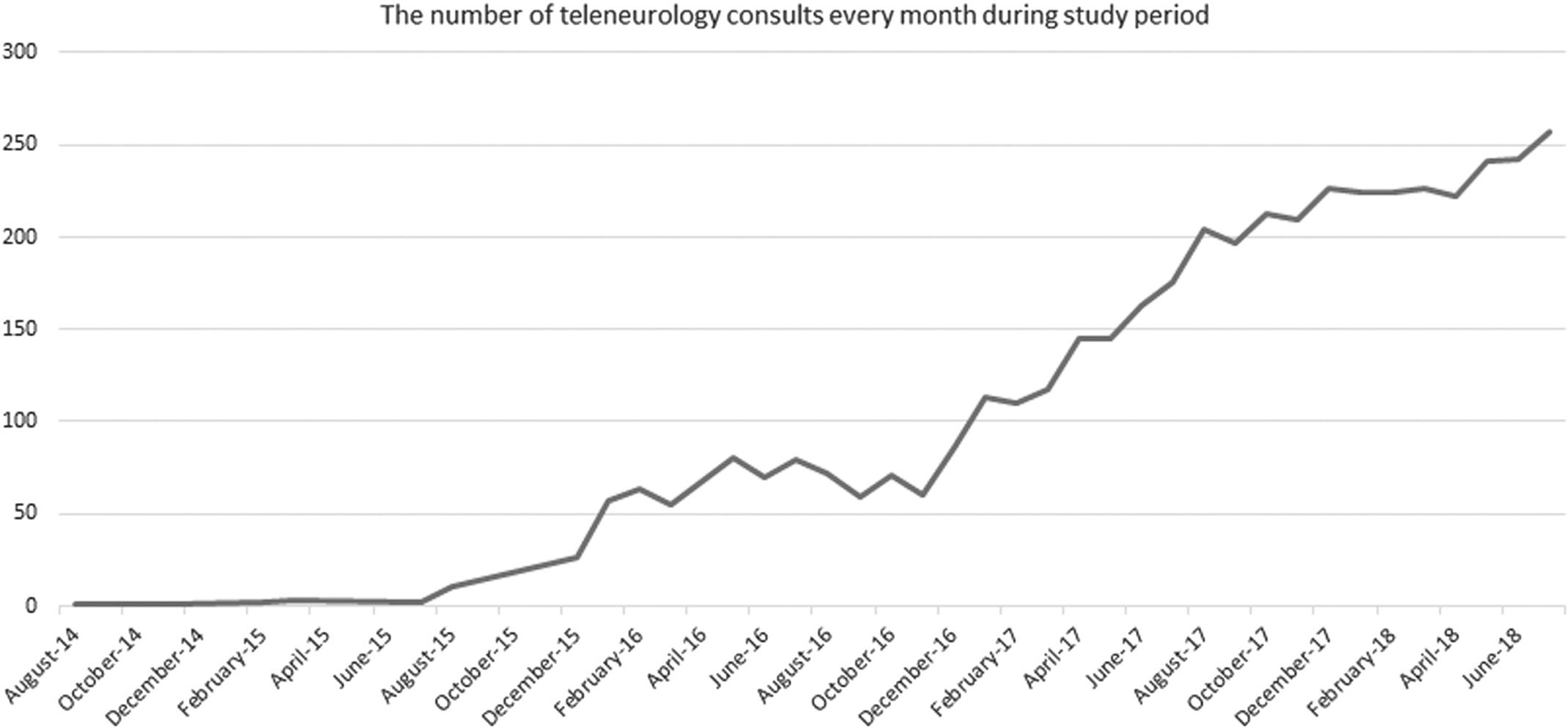
The number of teleneurology consults every month during the study period.
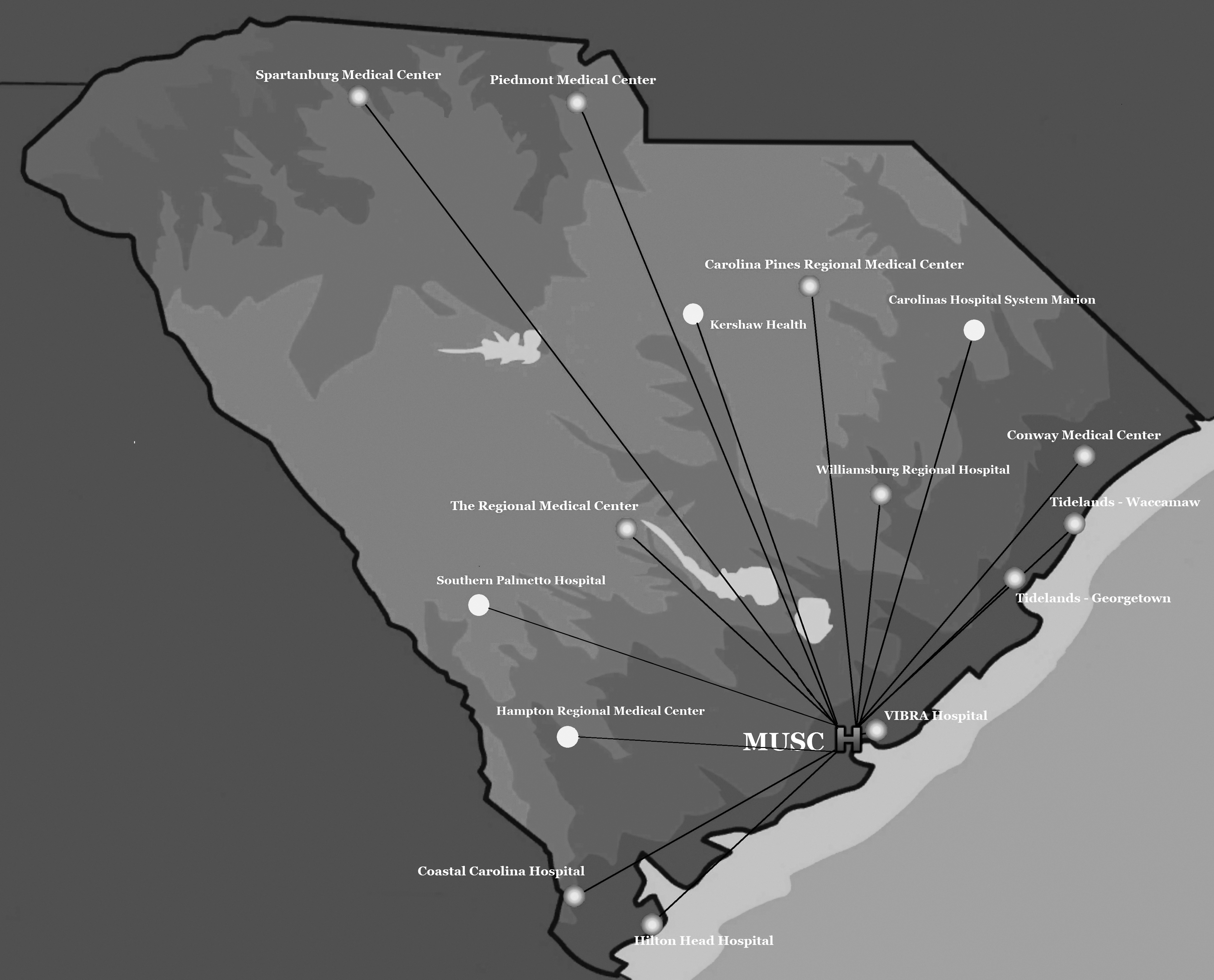
The MUSC Teleneurology sites. MUSC, Medical University of South Carolina.
Diagnoses Seen Through Teleneurology Consultations
CVAs, Cerebrovascular accidents; NMO, neuromyelitis optica.
Discussion
In this study, we describe the initial experience of our dedicated inpatient teleneurology program. The number of consults has steadily increased since the inception of the network. The consultants covered a broad spectrum of neurological diagnoses with cerebrovascular accidents and seizure disorders being the most common diagnoses encountered.
While previous studies have reported the benefits of Teleneurology consultations in outpatient settings, our study provides insight into a real-life experience of a teleneurology network that aims at providing care for patients with acute neurologic illnesses in inpatient settings. 16,17 The availability of neurology experts in rural hospitals through teleneurology networks can potentially decrease the need to transfer to a tertiary medical center that allows patients and families to stay closer to home and preserves beds at the tertiary medical center for use by the sickest patients. Other states with large rural areas should consider establishing similar teleneurology programs. An important part of the process of establishing our program was the need to spend time and efforts to increase the awareness of the importance of teleneurology among physicians, and the importance of ensuring support from state policymakers. This was especially important to issue the proper legislation for reimbursement mechanisms.
The future plans for the MUSC teleneurology include adding more sites to cover a larger catchment area. Other opportunities for improvement include offering outpatient teleneurology clinics, adding more neurology subspecialties, exploring the use of tele-continuous-EEG and tele-neuro-ICU coverage.
Footnotes
Acknowledgments
This research was conducted at the Medical University of South Carolina, Charleston, SC. Authors confirm that the study is observational minimal risk study and no consent is required per the Medical University of South Carolina institute policy. Our study was approved by the Institutional Review Board of the Medical University of South Carolina.
Disclosure Statement
No competing financial interests exist.