




Abstract
Background:
Personal trust tendency is an individual characteristic that can affect one's evaluation of others, behavior and its related outcomes. It may significantly affect one's health information seeking behavior and compliance. Therefore, this article aims at figuring out how personal trust tendency influences patient compliance through the internet health information seeking and patient satisfaction with it.
Methods:
Data were collected from 336 valid participants through an online survey in China. There are two independent variables: (1) cognition-based trust tendency and (2) affect-based trust tendency, three intervening variables (emerging internet health information seeking, conservative internet health information seeking, and satisfaction with internet health information), one dependent variable (patient compliance), and control variables. We performed confirmative factor analysis and structural equation modeling to test the hypotheses.
Results:
The cognition- and affect-based trust tendency positively affects patient compliance through the mediation of emerging and conservative internet health information seeking and satisfaction with internet health information. Surprisingly, strong positive relationships between affect-based trust tendency and emerging and conservative internet health information seeking were found, which are contrary to our initial hypothesis.
Conclusions:
Health information is considerably important when regarding health-related issues for individuals with cognition- and affect-based trust tendency. Physicians should encourage patients to seek health information on the internet and guide them to use internet health information that suits them. Information exchange and correlations should be involved in doctor–patient interactions. By following the suggestions just cited, better patient compliance can likely be obtained.
Introduction
Patient compliance refers to the degree to which a patient's behavior is consistent with the medical or health instructions given to him/her 1 ; it can be reflected in everything from taking medicines to complex medications, appointment checking, and even lifestyle change. 2 Patient compliance plays an important role in health management and disease treatment, as prior studies have shown that patients with high compliance can obtain better health outcomes and quality of life. 3 To be more specific, medical diagnoses and treatments can be performed more effectively if patients follow their physicians' instructions. 4 Noncompliance, however, can endanger the health and well-being of patients, interfere with the treatment of doctors, and lead to a waste of health resources. 2 To improve patient compliance, factors that influence it need to be understood, one of which is the patient–physician relationship. 5,6
As a key part of the patient–physician relationship, trust can promote excellent health care. 7 Many studies focused on the relationship between trust and patient compliance and found that the more patients trust their physicians, the higher patient compliance can be achieved. 8 –10 Besides trust, trust tendency is another important term in trust literature. Personal trust tendency (or propensity) is a stable individual characteristic that represents a dispositional willingness to trust others 11 ; it can affect one's interpretation and evaluation of others and determine trust building in addition to past experience and any information about others' trustworthiness. 11 –13 For example, individuals with low trust tendencies are less likely to trust others owing to their suspicious attitudes toward the behaviors of other parties, whereas individuals with high trust tendencies often think others are trustworthy. 14 The stable individual trait of trust tendency makes it distinct from trust and stands out as an independent factor. 14,15 Moreover, trust tendency is also shown to be a significant factor as Colquitt et al. found that trust tendency has a significant and unique effect on behavior and its related outcomes even when trust was included simultaneously. 14 However, little literature tied trust tendency to health-related behaviors and outcomes.
Therefore, we aim at examining the mechanisms behind personal trust tendency and patient compliance through internet health information seeking behavior. According to different trust foundations, previous studies divided trust into two types: (1) cognition-based trust, grounded in an individual's confidence in the reliability on related skill, knowledge, and competence; (2) affect-based trust, grounded in interpersonal ties and emotional care. 16 For instance, in the patient–physician relationship, the patient's trust in a physician includes both trust in medical ability and emotional dependence. 17 Patients with cognition-based trust in their physicians are likely to think that their physicians have high levels of expertise and knowledge, whereas those with affect-based trust expect to obtain empathy from physicians. 18 Accordingly, our study investigated trust tendency also from the perspectives of cognition and affect. Cognition-based trust tendency refers to the extent of one's dispositional trust based on the reliability on knowledge and expertise, whereas affect-based trust tendency refers to the extent of one's dispositional willingness to trust others depending on mutual respect and interpersonal care.
Health information on the internet can serve as a valuable supplement to the information from professionals and affect individuals' health care behaviors and outcomes. 19,20 Currently, individuals are increasingly turning to the internet to seek health information. 21 The information they use mainly includes advice and information regarding conditions, symptoms, and treatment options. 22 Aside from the general topics, individuals show personal preferences in health information seeking. 23,24 For example, when seeking information about treatment options, some have a special interest in new therapies emerging in recent years whereas others prefer to seek information about standard and mature treatment that has been proven safe; such differences on information seeking can ultimately lead to different health behaviors and decisions. 25 Thus, internet health information was divided into two categories in our study: (1) emerging health information, which refers to the information about new opinions, treatments, and health briefs that emerged in recent years and have not been fully accepted yet and (2) conservative health information, which refers to information about mature treatments and evidence-based information that have been proven reliable through years of clinical practice.
Personal trust tendency, as a personality-based factor, 11 may affect the selection of emerging and conservative health information seeking, with the formation of a different extent of satisfaction and finally may influence patient compliance. Hence, this article chose personal trust tendency as the characteristic motivation for internet health information seeking and used the information processing theory as a basis to explore how personal trust tendency influences patient compliance through the mediation of internet health information seeking and satisfaction with it.
Research Model and Hypothesis
Information seeking is defined as an active effort, in which an individual searches for information to satisfy an informational need or goal. 26 With the wide accessibility of online health resources and the improved awareness of health self-management, internet health information seeking has become a more and more common behavior. Individuals are more likely to search for health information on the internet under the following circumstances: (1) Patients want to identify their new health condition or prevent disease 27,28 ; (2) patients are dissatisfied with the health information provided by physicians 29 ; and (3) patients want to understand specific diagnosis, treatment options, and alternative views of mainstream medicine. 27,30 Internet health information seeking could affect a number of health-related behaviors. 28 It has been found that patients more actively engage in behaviors that are beneficial to their health by using internet health information. 28 Other benefits that health information seeking can bring are improved patients' abilities to solve health-related problems, increased eHealth literacy, and health outcomes. 31,32 Despite the benefits, individuals' health information seeking on the internet could cause problems, one of which is the misuse of health information. For instance, if patients lack the necessary skills to identify and evaluate health information, improper use and/or misunderstanding of health information may increase health risks and worsen existing health conditions. 33
According to the information processing theory, the procedure of information processing in human psychology deserves much more attention than the received information. 34 Individuals might process the internet health information in a biased way. 35 Thus, in internet health information seeking, patients' perceptions such as satisfaction, which is formed through an individual's processing of information, are worthy of attention. Satisfaction with internet health information is a second-order construct comprising perceived information quality, ease of use, and perceived usefulness of the internet health information. 27 Different from the quality of health information, this factor highlights patients' processing and perception of the information and it can be affected by the quality of the information seeking process. 36 To be specific, individuals with different cognitions may have different extents of satisfaction with the same information. Satisfaction with internet health information can influence an individual's decision of reusing internet health information. 36 For instance, online health information seekers tend to use Wikipedia because it provides easy-to-use information, especially for categories that are difficult to understand. 23 In addition, satisfaction with internet health information has also been suggested to be an important indicator in achieving positive health-related outcomes. 37,38 However, less work has examined the role that it plays in health information seeking and patient compliance. Our study filled this gap.
The research model is presented in Figure 1. Our model involves six factors and describes how cognition- and affect-based trust tendency influences patient compliance through the mediations of conservative and emerging internet health information seeking and satisfaction with internet health information.
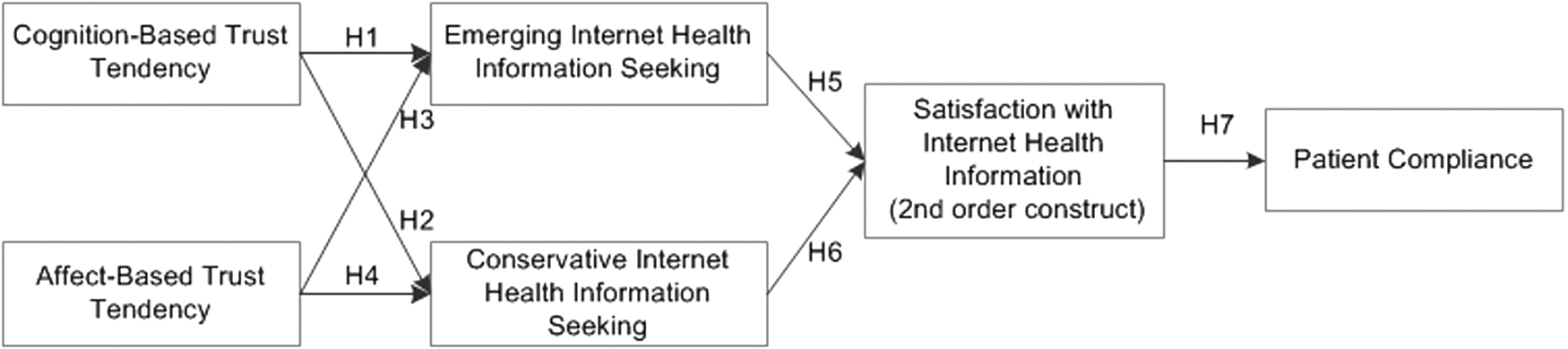
Research model.
The information processing theory states that people driven by high cognition will search and collect extra information to make informed and qualitative decisions. 39 Thus, patients with high cognition-based trust tendency who generally form their trust or make decisions based on knowledge 16 are inclined to check the information provided by physicians and seek supplementary information from the internet to make sure their physicians are reliable. In addition, a previous research has shown that the cognitive component of physician empathy on patients leads to better exchanges of cognitive information, whereas the affective aspect of physician empathy leads to partnership. 18 Thus, it is logical to think from the patients' perspectives that patients with cognition-based trust tendency may desire to obtain relevant health information to decide whether or not to trust their physicians, whereas those with affect-based trust tendency are more likely to achieve trust by establishing physician–patient relations rather than acquiring health-related knowledge. As patients with affect-based trust tendency more easily feel the affective aspect of physician empathy and translate it into a part of trust, 16 they are less likely to seek second suggestions from other sources. 40 Therefore, we derived the following hypotheses:
The quality of the information seeking process has been found to have influences on individuals' satisfaction with health information and quality of health outcomes. 36 According to the information processing theory, when collecting information, not all of the information received is relevant to the needs and motivation of the receiver; thus, the information is filtered, and only the part that catches the receiver's attention is retained. 41 Therefore, patients with emerging and conservative internet health information seeking may filter the information in different ways and thus obtain and process the part of information that meets their own needs. As for the emerging internet health information seeking, the internet provides access to relevant emerging health information about the rarest health conditions and experimental or alternative therapies, but rapid advances in medical technology can sometimes give patients unrealistic expectations for medical technology. 42 Moreover, patients cannot easily identify information providing unproven or potentially harmful treatments. Therefore, emerging information seeking may disappoint patients, resulting in a decrease in quality and usefulness of internet health information perceived by patients, which, in turn, leads to the low satisfaction with internet health information. Conservative internet health information seeking, however, is more reliable and safer compared with the emerging one. It has been noted that patients are most likely to access medical knowledge and standard treatments from health websites that provide information that is mostly imparted by physicians. 43 Thus, much of the information gained from these general access websites is reliable and consistent with the opinions of physicians, 43 which, therefore, can lead to good patient satisfaction with the information they have obtained. Therefore, we hypothesized the following:
Patient satisfaction with internet health information can play an important role in achieving positive health-related outcomes. 37,38 Several studies have found that obtaining and using clinically relevant, accurate, and effective health information through the internet can motivate beneficial health-related behaviors and improve outcomes. 28,44 Thus, if patients think that the health information they use is easy-to-use, of high quality, and useful to them, then they are likely to be affected by this information and be more actively involved in beneficial behaviors that are very likely to be consistent with professionals' instructions. In addition, it has been proved that the quality of internet health information can have a significant positive impact on patient compliance. 43 Thus, we hypothesized the following:
Materials and Methods
Instrument Development
The instrument used in this study was adapted from previous studies to ensure reliability and validity. Each item in our instrument was measured on a 7-point Likert-type scale ranging from 1 (strongly disagree) to 7 (strongly agree). Patient compliance was measured by using a 5-item scale according to a previous study by Laugesen et al. 43 Cognition- and affect-based trust tendencies were developed based on a 6-item and 5-item scale in Mcallister's study, respectively, 40 the scales of which have been modified for measuring cognition- and affect-based trust tendencies of patients in physicians. Emerging and conservative internet health information seeking behaviors were measured by using the same 5-item scale developed by Lemire et al. 27 Satisfaction with internet health information was measured by using a 10-item scale adopted from Lemire et al. 27
Analysis Tool Selection
Previous studies have widely used structural equation modeling (SEM) to test the hypotheses. 35,43 It is an effective way of evaluating variable interactions, and the measurement error can be incorporated. 45 As the research model in our study is somewhat complex, with more than one mediating variable involved, SEM can serve to find the potential but important influences that they produced and bring a more complete picture of the mechanism of the research model. Thus, in this study, we also used SEM to explore the interactions between variables and test research hypotheses; we improved the research model by combining it with confirmative factor analysis. 46 We used IBM's Statistical Package for Social Science (SPSS) 22.0 and AMOS 22.0 for the data analysis.
Data Collection and Respondent Profile
The scales developed in English had to be translated into Chinese because our survey was conducted in China. Our translation work was conducted according to previous works, 47,48 with cross-cultural adaptation being considered. 49 A back translation of the scale was performed by English translation professionals to ensure the standardization of items. The formal investigation was carried out through an online questionnaire survey in June 2017.
Chinese individuals who have been under professionals' treatment within the previous month and have searched health information related to this situation on the internet are an ideal sample for our study. The participants must have (1) a clear recall of their experience in seeking internet health information regarding the specific health condition and (2) a clear recall of their recent experience in seeing a doctor, including doctor–patient interactions and feelings. The exclusion criteria included (1) participants who answered all the questions with the same option (because they may answer the questions untruthfully) and (2) participants whose completion time of the questionnaire was obviously less than the normal completion time (we determined the approximate normal completion time of our questionnaire in the pretest, and participants without a clear recall of relevant events were likely to hurry through the questionnaire and leave).
A total of 375 completed questionnaires were obtained out of 486 questionnaires distributed with the assistance of a medical association in China. From the 375 sets of questionnaires returned, 336 responses were valid according to inclusion and exclusion criteria. The demographics of the research sample are listed in Table 1. The demographics among these participants matched well with the national trend; previous findings indicate that internet health information users tend to be younger, employed, and well educated. 28,50 Therefore, the sample is suitable for our study.
Sample Demographics (N = 336)
Results
Data Analysis
To assess the measurement models of reflective constructs, we used SPSS 22.0 software to evaluate the reliability and validity of the measurements. The reliability of all constructs assessed by Cronbach's α is presented in Table 2, the values of which are all >0.7, indicating a good level of reliability. 51 With regard to validity, the Kaiser–Meyer–Olkin value was equal to 0.882 (p < 0.001, significant) in the range of 0.800 and 0.900; thus, the construct validity was good.
Cronbach's α of the Constructs
The discriminant validity was evaluated by using AMOS 22.0 software. According to the nested confirmatory factor analytic models by Wu et al., 52 we established and compared six nested models based on the research model (Fig. 1) and ensured whether the six factors were distinct from each other. The indicators were loaded onto their intended latent variables. They were as follows: (1) a six-factor model treating each of the variables as separate factors; (2) a five-factor model treating cognition-based trust tendency and affect-based trust tendency as one factor; (3) a five-factor model treating cognition-based trust tendency as one factor; (4) a four-factor model treating cognition- and affect-based trust tendency as one factor, emerging and conservative internet health information as one factor; (5) a two-factor model treating cognition- and affect-based trust tendency and emerging and conservative internet health information seeking as one factor; and (6) a one-factor model treating all six factors as one factor. As shown in Table 3, there was a good fit between the data and the six-factor model (model 1; χ 2 = 660.06, degrees of freedom [df] = 578, χ 2 /df = 1.14 < 3, comparative fit index [CFI] = 0.99 > 0.90, Tucker-Lewis index [TLI] = 0.98 > 0.90, incremental fit index [IFI] = 0.99 > 0.90, root mean square error of approximation [RMSEA] = 0.021 < 0.050). According to all fit indices, model 1 had the best performance than the other five nested models (models 2–6) when fitted to the data. Therefore, we can conclude that the six factors were distinct from each other.
Comparison of Measurement Models in Confirmatory Factor Analysis
χ 2 , Pearson's Chi-square; CFI, comparative fit index; df, degrees of freedom; IFI, incremental fit index; RMSEA, root mean square error of approximation; TLI, Tucker-Lewis index.
Hypothesis Testing
A complete control variable analysis was completed before the analysis of the research model. This analysis showed that four of the control variables (i.e., age, gender, education, and resident status) had significant relationships with one or more of the endogenous constructs in the model; therefore, these control variables were added into the research model to ensure that the effects of these extraneous variables were taken into account.
We used SPSS 22.0 and AMOS 22.0 to test the hypotheses. Figure 2 shows the SEM results. The magnitude and significance of the path coefficients are shown in Table 4. Four out of seven hypotheses (

Research model with path coefficients.
Hypothesis Testing
Discussion
Our research is the first empirical study to investigate the relationships between personal trust tendency and patient compliance based on internet health information seeking and patient satisfaction with it. This study has provided a number of insights into the ways of improving patient compliance and outcomes from the perspective of individuals' characteristics and individuals' perceptions of health information.
First, we found that cognition- and affect-based trust tendency has significant positive impacts directly on conservative and emerging internet health information seeking and indirectly on satisfaction with internet health information and compliance. This result is somewhat in accordance with the suggestion that information seeking behavior includes both affective and cognitive components. 53 However, the affect-based trust tendency, surprisingly, turned out to have a much stronger positive impact on internet health information seeking than cognition-based trust tendency, which is completely contrary to the supposition.
This finding indicates that although patients with affect-based trust tendency tend to form their trust based on empathy, mutual respect, attachment, and bonding, they still have a strong desire to seek health information. One possible explanation is that cognition and affect are strongly linked, and affect-based trust is difficult to establish compared with cognition-based trust. 54,55 When patients cannot obtain genuine care from their physicians or establish good patient–physician relationships, the affect-based trust on physicians is hard to shape. Then, the cognition-based trust tendency and a rather strong desire to seek health information begin to prevail, and, consequently, patients may turn to the internet to search for information under this poor patient–physician relationship. 4,56 As such, in communicating with patients, although the affective part can improve patient satisfaction and compliance, 18 findings from our study suggest that physicians should not disregard the exchanges of relevant information because of the patients' strong desires for information seeking.
In terms of the preference of health information seeking types, the result shows that patients with affect- and cognition-based trust tendency prefer to seek emerging health information slightly more than conservative information. Previous studies have also noted that individuals prefer health information that was previously unavailable. 57 Thus, we should pay more attention to the supervision of emerging online health information as potential damage can happen if patients obtain and follow the wrong information. Physicians should talk more about emerging information, such as possible treatments, which patients are more concerned about.
Second, our findings also provide evidence that emerging and conservative internet health information seeking behavior has direct significant positive effects on satisfaction with internet health information and indirect effects on patient compliance. The positive effect of internet health information seeking on patient compliance was also supported by a previous finding that patients who seek health information online show better adherence. 30 Contrary to our assumption is the positive effect of emerging internet health information seeking on the satisfaction with internet health information. A potential explanation for this finding could be that internet health information seekers tend to be individuals with high educational levels, 58 which affects the degree of health literacy and internet health information seeking. 59 When seeking health information through the internet, patients are more likely to selectively use information returned by search engines instead of indiscriminately using the top-ranked items. 60 Thus, we suggest that physicians do not need to worry about the negative effects of online health information, which has been recommended also by Laugesen et al. 43 Instead, they ought to encourage patients to search for health information online.
In addition, the path coefficient of the relationship between conservative internet health information seeking and satisfaction with internet health information is larger than that between emerging internet health information seeking and satisfaction with internet health information. Thus, there is a need to supervise and improve the quality, readability, and usefulness of the conservative online health information to satisfy patients and then promote health outcomes. Also, physicians should guide patients to credible health information websites that can satisfy most patients' conservative information needs to improve their satisfaction with health information and allow them to have effective health-related behavior.
Third, as expected, we found that satisfaction with internet health information has a significant positive impact on patient compliance directly. Previous studies have found a significant positive indirect relationship between internet health information quality and compliance. 43,61 As individuals prefer to make decisions regarding their health based on the information they have obtained, the relevance, adequacy, and accuracy of information matters greatly. 57 Our findings supported previous opinions and complemented existing research on the influence of online health information on patient compliance by highlighting the factor of patients' satisfaction. That is, except for the quality of information itself, patients' perception of the information is very remarkable. Online health information is expected to be more suitable for most patients to read and better satisfy their information seeking needs. 32 According to the information processing theory, what patients perceived is the information that had been processed by themselves instead of the original information. 41,62 For instance, patients without a medical education probably cannot understand medical professional information in an effective way, although the information is of high quality. Also, there are situations when people who look for health information online cannot determine credible sources and correctly use information. 63
As suggested earlier, online information quality is important, but a rather considerable important implication delivered by this finding is the significance of increasing patients' abilities to obtain, process, and understand health information to make informed health-related decisions, which can be named health literacy. 64 Thus, while using high-quality health information, patients should also upgrade their own health literacy by using credible information and communicating their uncertainness with professionals. For physicians, they are supposed to be more patient when communicating medical problems with their patients, especially those with low health literacy, and correct their misconceptions.
It should be noted that this study has limitations. First, the number of samples in this study is relatively small and only consists of people in China. Considering the differences in health care development among countries, further research may wish to examine the relationships we found with a larger sample in other areas and countries. Second, a cross-sectional survey was used in this study that can only collect data at one point in time. We failed to gain deep insights into how patient compliance changed with the internet health information seeking behavior. Future experiments could use a longitudinal study to test our model. Third, the scales we used to measure personal trust tendency in our study are more inclined to measure one's personal trust tendency on physicians. In future studies, to reflect individuals' trust tendency characteristics in general situations, a more general scale should be developed to measure this indicator without targeted trust objects. Fourth, this study used self-reporting compliance, which may not fully correspond with the actual compliance. Future studies can improve this by using actual compliance. Finally, we divided internet health information seeking into conservative and emerging health information seeking according to the characteristics of information. Actually, health information seeking can also be divided from other perspectives, such as health topics, cognitive and effective, as well as different sources. Future studies could refine and investigate internet health information seeking behavior from the perspectives mentioned earlier or other perspectives and examine how it influences patient compliance.
Conclusions
All the relationships that proved to be existent in our research model are significant and positive. Results of our study imply the following: (1) Physicians ought to provide sufficient health information, especially emerging information, in communicating with patients, including those who show more needs for affection; (2) physicians should encourage patients to seek internet health information and guide them to credible, high-quality, and suitable information sources; (3) the discussions of online health information should be involved in physicians' communications with patients, which ask for physicians to solve patients' misunderstandings and uncertainness; and (4) emerging and conservative information on the internet needs to be supervised and improved in quality, usefulness, ease of use, and other aspects to improve the satisfaction with online health information.
Footnotes
Acknowledgments
This work was supported by the National Natural Science Foundation of China (key program) with grant number 71532002 and a key project of Beijing Social Science Foundation Research Base with grant number 18JDGLA017.
Disclosure Statement
No competing financial interests exist.