




Abstract
Background:
The medical alliance and telemedicine are considered to be important means to solve the imbalance between regions and shortage of professionals and promote the homogenization of medical services. Sichuan Provincial People's Hospital Group (SPPHG) is a network of hospitals with different levels of expertise, and all the members with radiotherapy form a radiotherapy network (RTN). Addressing the inadequacy and imbalance of radiotherapy services of Sichuan Province, China, a tele-radiotherapy system for RTN-SPPHG is designed, which includes the business model and corresponding technical implementation of an information system.
Materials and Methods:
In the RTN-SPPHG, a distributed remote collaboration business model is explored and a tele-radiotherapy information system is customized for this telemedicine model. Both the business model and tailored information system were evaluated in actual use.
Results:
Based on the tele-radiotherapy system of RTN-SPPHG, multitype hospitals are linked together and serve as a whole. Through the internet, the experience of experts of Sichuan Provincial People's Hospital is effectively deployed to member hospitals at the grassroot level.
Conclusions:
A close-knit medical alliance based on a tele-radiotherapy system should be a way to rapidly improve radiotherapy services and promote the homogenization of service in a region.
Introduction
Radiation therapy as a very economical and effective treatment model plays a key role in cancer treatment (about 70% of cancer patients in the world need radiotherapy). Cancer patients who live in low- and middle-income countries (LMICs) have fewer opportunities to receive radiation therapy, because of the shortage of equipment and well-trained professionals. 1,2 Telemedicine, as a form of comprehensive application of computer network and communication technology to provide medical services, has a very important role in solving regional imbalances and shortage of professionals and promoting homogenization of medical services. 3,4 Naturally, the combination of telemedicine and radiation therapy (tele-radiotherapy) will become a breakthrough to further promote the development of radiation therapy in LMICs and regions. 5,6
Tele-radiotherapy inherently contains two aspects, one is the business model and the other is the technical realization. 7 Consultation is one of the most common forms of telemedicine. The technical implementations corresponding to this model mainly include data file sharing 8,9 and commercial videoconferencing system. 10 –12
As for tele-radiotherapy, the only consultation is far from meeting needs. Real-time remote operation is the core requirement of tele-radiotherapy, so the staff in different geographical locations can achieve effective collaboration in the same workflow. Remote desktop application embedded on the operating system brings the basic remote operation ability to tele-radiotherapy. 13 –15 Sometimes the videoconferencing system will be applied at the same time for better results as one combined solution. 13
One of the biggest challenges of remote operation is network bandwidth. Independent computing architecture (ICA) protocol is the proprietary network transmission protocol of Citrix Systems, Inc. It is optimized for internet transmission and works on an incremental transmission mode with high data compression ratio. In a low-bandwidth network environment, remote operation with Citrix products through ICA protocol has obvious fluency advantages. Some hospitals have applied Citrix products to achieve remote radiotherapy solutions. 16,17
A web-based application is deployed on the server, and the client terminal directly calls the application through a common web browser. The server is responsible for executing business-related logic, and the client only processes the mouse clicks and the keyboard inputs. Some researchers have developed radiotherapy related applications based on this new browser/server architecture. 18 –22 These applications have demonstrated advantages in supporting the tele-radiotherapy.
As a developing country, China has similar difficulties as in other LMICs. The development of radiotherapy is extremely unbalanced and seriously inadequate in China. All kinds of professionals gather in the major radiotherapy centers in big cities. 23 To promote the homogenization of medical standards in various regions, the Chinese government has developed a strategy of internet plus graded diagnosis and treatment system. The medical alliance is the organizational form fitting the new policy, in which a lead hospital plays the core role and interacts with different levels of hospitals.
This study explores the tele-radiotherapy system under the background of medical alliance, which mainly includes the following two aspects: (1) exploring the business model of the tele-radiotherapy within a medical alliance to ensure that all the participants can benefit from it, thus forming a long-term mechanism to achieve homogenization of inter-regional radiotherapy levels; and (2) developing an information system of tele-radiotherapy to support routine work. Furthermore, this study demonstrates the primary experience of the tele-radiotherapy system in a real-life situation.
Materials and Methods
Sichuan Provincial People's Hospital Group
Sichuan Provincial People's Hospital (SPPH) is a regional leader located in Chengdu, Sichuan Province. It is a clinical-research type hospital integrating clinical scientific research and teaching. Since 2009, SPPH has taken the lead to construct a medical alliance combined with many other different levels of hospitals and practice the graded diagnosis and treatment model appropriate for the capacity and level of a member hospital in the network. As of December 2017, there were 176 member hospitals, and the alliance is known as Sichuan Provincial People's Hospital Group (SPPHG). Graded diagnosis and treatment system and telemedicine are the two main lines of medical collaboration in SPPHG. As shown in Figure 1, under this new organization structure, SPPH serves as an intelligence reservoir and sends management teams and medical teams to the primary members of SPPHG. A radiotherapy network (RTN) consisting of all the hospitals with radiotherapy service in SPPHG (RTN-SPPHG) acts as a unit in collaborating around radiation therapy.
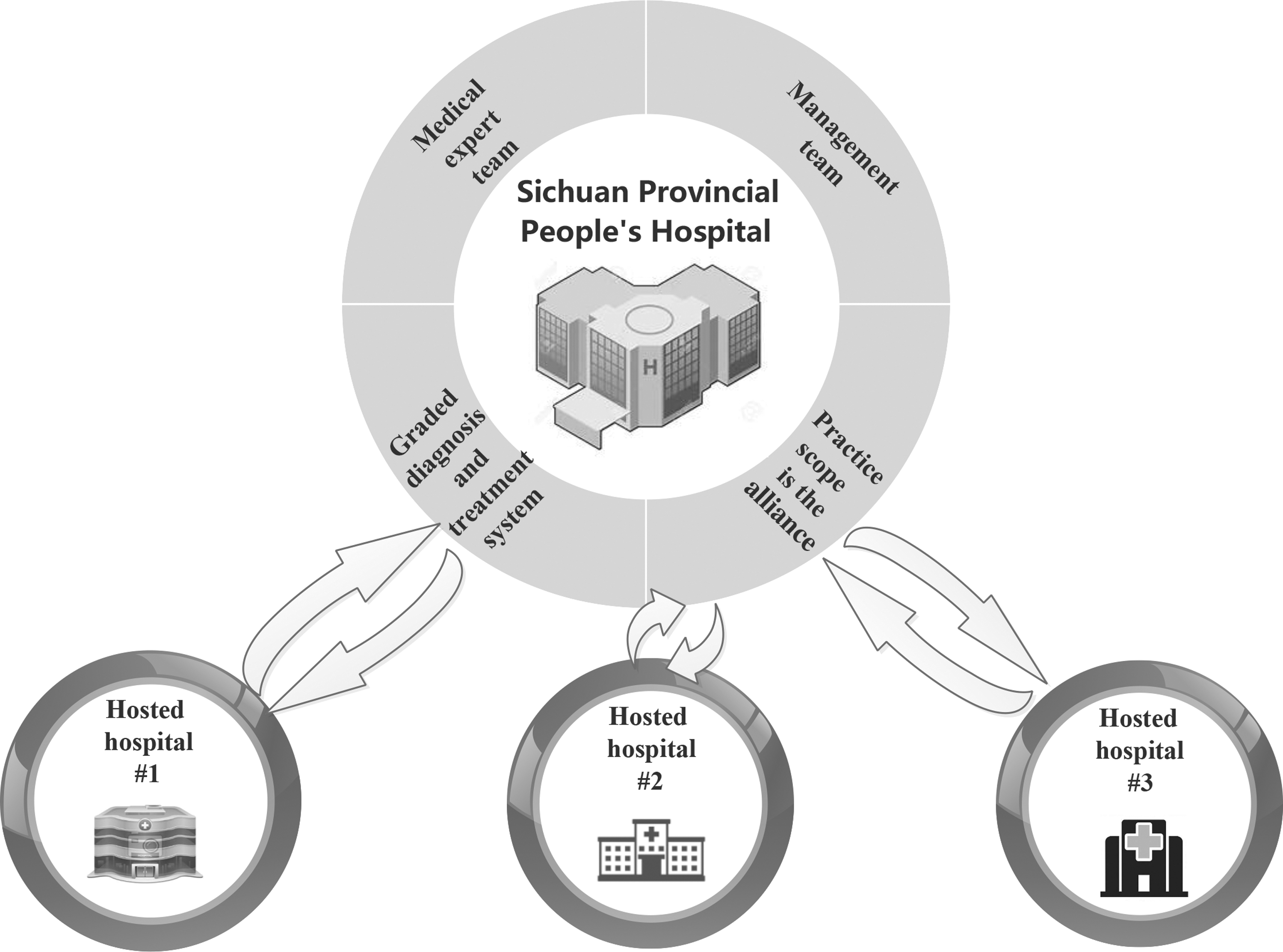
Organization of Sichuan Provincial People's Hospital Group.
Tele-Radiotherapy Model
The goal of tele-radiotherapy for RTN-SPPHG is to enable patients to have good radiation therapy nearby. To achieve this goal, the responsibilities of members of RTN-SPPHG are listed as follows:
SPPH: Developing standards and guideline for constructing a new radiotherapy center. Customizing the standard workflow and the quality control specifications for tele-radiotherapy. Providing on-site guidance to collaborative primary hospitals. Remotely executing the routine jobs such as contouring and evaluation of the treatment plan.
Primary member hospitals:
Building the radiotherapy infrastructure.
Setting up the tele-radiotherapy information system (TRIS).
Recruiting qualified general medical staffs.
Handling clinical matters in accordance with standard procedures.
The tele-radiotherapy business model of RTN-SPPHG, shown in Figure 2, as a whole provides radiotherapy services to the population in its coverage region. According to the condition of radiotherapy facility, all the member hospitals are classified into three types: (1) type A, (2) type B, and (3) type C. SPPH is the only one type A hospital in RTN-SPPHG, which possesses advanced level equipment and focuses on providing advanced and special radiotherapy service. Type B primary hospitals with medium level equipment meet the hardware prerequisite for providing advanced radiotherapy service. Type C primary hospitals with basic level equipment can provide all the regular treatment services.

Tele-radiotherapy mode for radiotherapy network of Sichuan Provincial People's Hospital Group.
Patients with different conditions are divided into three types as follows: (1) requiring regular technology, (2) requiring advanced technology, and (3) requiring special technology. Through the grading diagnosis and treatment mechanism, patients will be recommended to member hospitals that meet their conditions, based on geographic location. All patients can receive appropriate treatments near their homes.
Experts from SPPH regularly visit their linked member primary hospitals and provide their diagnosis and treatment advice to outpatients and inpatients. This kind of face-to-face communication allows patients to be willing to receive radiotherapy in a primary hospital near their homes. All the key stages of radiotherapy workflow are operated by a professional team of SPPH through a TRIS. These stages include target delineation, treatment plan design, evaluation of treatment plan, and review of quality control data.
Functions of TRIS
The function entries for the TRIS of RTN-SPPHG, listed in Table 1, can be classified into four categories as follows: (1) the core, (2) integrated information management, (3) integrated social network, and (4) client optimization. The core can enable a professional team of SPPH to access a wide range of medical information of patients and remotely operate treatment planning system (TPS) through different network conditions. The integrated information management can provide a uniform information management tool for many kinds of data source. The integrated social network can meet the requirement of the communication between staffs of RTN-SPPHG. Considering the compatibility of the work environment, TRIS should support cross operating system and adapt to mobile devices.
Functional Items of Tele-Radiotherapy Information System
Implementation of TRIS
To achieve the functions of TRIS, the flexibility of the web-based application and the compatibility of Citrix products to the hospital's existing desktop medical software are fully utilized in the technology implementation. Python 24 is the development language of TRIS. TRIS adopts service-oriented architecture and can be enriched by adding function plug-ins.
The schematic diagram of the TRIS is shown in Figure 3. The TRIS system consists of two parts: (1) the server side and (2) the client side. Four components of the server side are as follows: (1) Data server, which provides structured query language database and file service for the entire system. All the structured data and files are managed by this server; (2) Authorization server, which manages user accounts and provides single sign-on service; (3) Web server, which responds to HTTP requests from clients and in turn calls other servers to complete the corresponding tasks. Several modules are deployed on it, including portal website, patient management, knowledge management, social network, medical application container, and system configuration. It is worth emphasizing that the medical application container is developed based on Citrix Receiver for HTML5 SDK, which bridges the technology gap between desktop application and web-based application. So the users of TRIS can access desktop applications through a browser similar to the web-based application; and (4) Distributed application servers, which are set up in each member hospital to provide backend services for medical application container through a virtual private network. The application server carries all the existing medical information systems in the hospital and plays as the core engine of the TRIS. These medical information systems include health information system (HIS), laboratory information system, picture archiving and communication system (PACS), TPS, and quality assurance tool kits for radiotherapy.
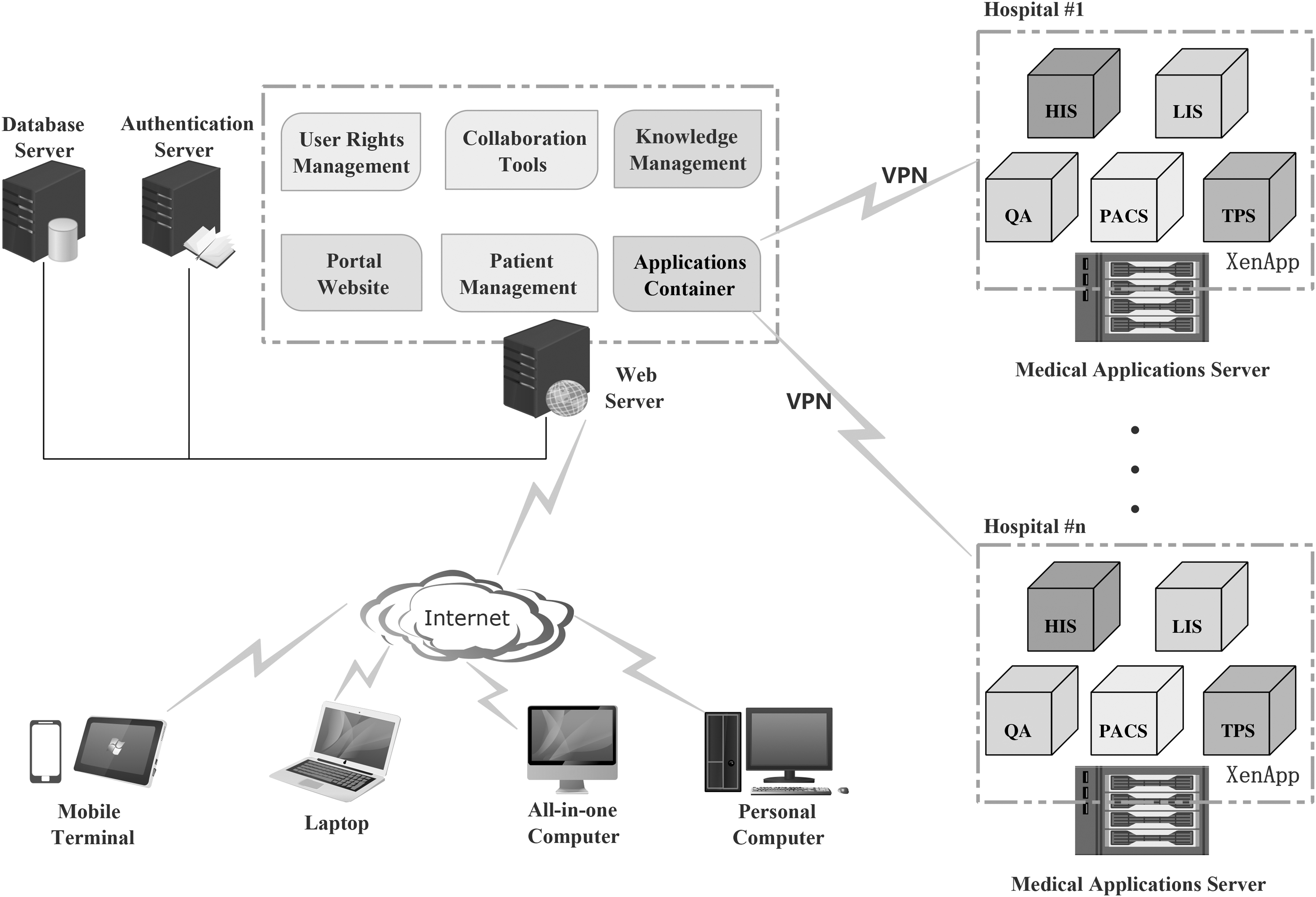
System block diagram of TRIS. HIS, health information system; LIS, laboratory information system; PACS, picture archiving and communication system; QA, quality assurance; TPS, treatment planning system; TRIS, tele-radiotherapy information ystem; VPN, virtual private network.
The client can be any personal computer, a mobile phone, an all-in-one PC, or a laptop. Each account of TRIS is authenticated by a real name and is bound to user's mobile phone number. When a user logs into TRIS, the system will send a real-time verification code to the bound phone number. After passing the verification, the user can access the TRIS; where the internet is connected, experts of SPPH can provide consultation.
Commissioning of TRIS
Commissioning is the indispensable key step before TRIS is applied in clinic. Two aspects are addressed in the commissioning. One is the quality of medical information transmitted through the internet, and the other is the performance of remote operations on various terminals through different network environments.
Two kinds of medical information are included, text and image. The text information can be easily validated by an observer. The evaluation of the transmission quality of the medical image is mainly based on some predefined reference images. Figure 4 shows the imaging quality control phantoms and corresponding reference images. These reference images will be imported into TRIS, and the observers then evaluate the quality of these images transmitted through the internet.

Reference images for commissioning. The upper row shows Catphan504 phantom and its corresponding imaging results. The bottom row shows TOR-18FG fluoroscopy phantom and its corresponding imaging results.
The performance of the remote operation of TRIS in different types of network environments is evaluated by handing selected patients' data, including five head and neck site cases, three thorax site cases, and three abdomen site cases. At the same time, the preset operations are executed both in the TRIS on the internet and in the local workstation of the hospital, and the equivalence of the two methods is evaluated. The main terminal types and internet access modes are covered in these procedures operated by three experts.
Results
All the functional modules of the system are presented in a centralized manner after the user is logged in, as shown in Figure 5a. Each icon represents the entry of a functional module. These functional modules cover all the functional requirements listed in Table 1. Figure 5c shows the screen print of Eclipse TPS, which is managed by the radiotherapy cloud shell (RTCS) Eclipse module of TRIS. The RTCS Eclipse module is the container of Eclipse TPSs in members of RTN-SPPHG. By clicking the button representing the target Eclipse TPS in a member hospital, the corresponding Eclipse will be launched, and the user has the ability to remotely real-time operate the Eclipse. In this manner, all the medical information of patients can be accessed by experts through medical application containers of TRIS (e.g., RTCS PACS and RTCS HIS). Figure 5b and d shows the results of TRIS accessed through the smartphone. It is an efficient way to deal with simple interaction tasks using smartphones, including workflow management, review of target delineation, evaluation of treatment plan, and so on.

The screen captures of TRIS.
The text information is viewed remotely through TRIS, which is very clear without any difference from the local viewing effect. Taking the local view of the reference images shown in Figure 4, when viewed remotely by TRIS, there will be a slight smoothing effect at the thin line pair and the sharp corner position. Remotely viewing the image data on the PACS system, three experts (one physicist, one oncologist, and one radiologist) confirmed that the image quality did not appear to decline.
Three senior professionals using laptops, thin clients, and smartphones as terminals, respectively, in the office asymmetric digital subscriber line (ADSL), home fiber broadband, public WiFi, and mobile 4G network environment, respectively, operate the TRIS system according to a protocol with clearly preset steps. For the selected test cases (five head and neck cases, three chest cases, and three abdominal cases), the simulation operation was carried out according to clinical procedure. All internet-based operations are very fluent, as operating on a local physical workstation. With the same procedure, the results using remote operation through TRIS are consistent with the results using local physical machine operation. In summary, all the three experts confirmed that the TRIS system can meet the technical requirements of remote radiotherapy.
For example, Liangshan High-Tech Cancer Hospital is located in Xichang City, Liangshan Yi Autonomous Prefecture. It joined the RTN-SPPHG in August 2017. Table 2 shows the statistical data of patients served by the expert team of SPPH through the TRIS from December 2017 to October 2018. During this period, experts provided radiotherapy services to a total of 213 patients. All patients received regular radiotherapy, including 75 patients receiving three-dimensional conformal radiotherapy, accounting for 35.2%, and 138 patients receiving intensity-modulated radiation therapy, accounting for 64.8%. The results of the patient satisfaction questionnaire showed that all patients were satisfied with the treatment process and treatment effect, and 93.9% of the patients were very satisfied. About 60% of the remote work was done on the personal computer through the home broadband by experts during the night. About 20% of remote work is done in the hospital office by experts in work hours. About 15% of the remote workload is done by experts during travel. Their laptops serve as terminals for remote operation using the WiFi network at the airport or coffee shop. Another 5% of the remote work is done by experts using their piecemeal time (i.e., taking the bus or subway, lunchtime, and waiting in line), using a smartphone through a 4G network. The team of experts was also very satisfied with the ease of use, convenience, and fluency of TRIS.
Primary Experience of Tele-Radiotherapy Mode of radiotherapy Network of Sichuan Provincial People's Hospital Group
3DCRT, three-dimensional conformal radiotherapy; ADSL, asymmetric digital subscriber line; IMRT, intensity-modulated radiation therapy.
Discussion
Many telemedicine projects started with the support of government funds. Once the government's financial support is over, the project will be stagnant without well-established business model. Judging from the practical experience of the past years, this in-depth cooperative tele-radiotherapy model in the medical alliance has achieved a multiwin situation, including expert teams, patients, hospitals, the health care administrative agency, and the medical insurance bureau.
The expert team of SPPH services the whole RTN-SPPHG by means of remote operation and periodic on-site support. The enhancement of service capacity for primary hospitals allows patients to get appropriate treatment nearby. The patients who are treated nearby will avoid transportation, accommodation costs, and are more easily taken care of by their families. If necessary, patients can be admitted to SPPH directly. This new style of practice effectively reduces the total economic burden of patients. The health care administrative agency and the medical insurance bureau are also benefited by high level of radiotherapy services in primary hospitals. Only when the primary hospitals have good medical service capabilities can we really solve the problem of the shortage of medical resources and poor medical treatment.
The TRIS system is tailored for tele-radiotherapy in the medical alliance. The medical application framework solves the compatibility problem between the legacy desktop applications and the web applications. All the medical applications of member hospitals work like web-based applications in TRIS and can be adapted to a variety of mobile terminals. Experts can provide technical support to all the primary hospitals in RTN-SPPHG through the same platform. Based on the TRIS, the efficiency of experts has been greatly improved, and it is very convenient to realize online collaboration of multidisciplinary teams across regions.
In recent years, automatic tools in radiotherapy have made great progress. With the help of automatic tools, the efficiency of experts will be further increased, and more patients will receive appropriate treatments with high quality in the primary hospitals. Our next plan is to create an expert-as-a-service cloud platform by fully applying artificial intelligence technology.
Conclusions
This study explores a tele-radiotherapy system for the medical alliance. The system consists of two aspects: one is a mutually beneficial business model, and the other is a tele-radiotherapy technology solution for this model. The preliminary operational experience demonstrates the advantages and feasibility of this new tele-radiotherapy business model in RTN-SPPHG. As a scarce resource, the experience of experts is effectively deployed to the primary hospitals with the help of TRIS on the internet.
By solving the problem of shortage of experts in primary hospitals, patients can receive appropriate treatment and are willing to stay in primary hospitals. The strong demands from primary hospitals will also promote the construction of corresponding disciplines in SPPH and promote the further improvement of treatment skills of experts. The tele-radiotherapy system for RTN-SPPHG forms a closed loop with positive driving force. In this loop, SPPH plays an important role in promotion of standardized radiotherapy technology and training for practitioners. During the clinical practice of tele-radiotherapy, the overall radiotherapy level in RTN-SPPHG will significantly improve. These ultimately guarantee the realization of the goal of grading the diagnosis and treatment of radiation therapy appropriate to the capacity and level of the network hospital being served.
Footnotes
Acknowledgments
This work is supported, in part, by grants from the National Key Research and Develop Program of China (Grant Nos. 2016YFC0105102 and 2016YFC0105107), the Leading Talent of Special Support Project in Guangdong (Grant No. 2016TX03R139), the Shenzhen Key Technical Research Project (Grant No. JSGG20160229203812944), the Science Foundation of Guangdong (Grant Nos. 2017B020229002, 2015B020233011, and 2014A030312006) and the Beijing Center for Mathematics and Information Interdisciplinary Sciences, and the National Natural Science Foundation of China (Grant No. 61871374).
Disclosure Statement
No competing financial interests exist.