




Abstract
Background:
Proper hydration is vital for both exercise and general health. Although various methods for hydration assessment exist, many are not valid for either use or never tested.
Introduction:
The purpose of this study was to determine whether the uChek© smart phone application can be used to diagnose underhydration based on elevated urine specific gravity (USG) assessed by refractometry.
Methods:
One hundred forty-seven (n = 147) fresh human urine samples from young and middle-age adults were analyzed for USG with a refractometer and the uChek© application by reading the Siemens Multistix 10G urine reagent strip.
Results:
Bland–Altman analysis showed agreement of the two methods of assessment. Overall diagnostic ability of the uChek© to identify underhydration was fair (area under the curve 79%). However, the sensitivity to correctly identify underhydration was poor (60%) as well as the specificity of correctly identifying euhydration (53%).
Conclusion:
The uChek© application does not accurately detect underhydration.
Introduction
Adequate hydration is important to optimize health and performance. 1 –3 Also, being able to accurately assess hydration status is critical for both research and healthy living. 4 In research, acute body weight change is considered the gold standard of hydration assessment, especially after an intervention like exercise-induced dehydration. In the absence of repeated measures (i.e., changes in body mass), biomarkers such as urine specific gravity (USG) are widely used, assessed by refractometry or reagent strips, with refractometry being the reference method. 5,6
The urine reagent strips are popular, due to low cost and no need for analytical equipment. However, their ability to correctly assess hydration status is limited. 6 Since the ubiquity of smartphone ownership and the changing paradigm toward patient-centered health care, mobile health innovations have engendered the development of mobile health tracking applications. 7
The uChek© mobile application (Biosense Technologies, Maharashtra, India) is a smartphone-enabled medical application that uses a cuboid to standardize the reading process of a urine reagent strip and provide objective readouts of multiple parameters (i.e., protein, creatinine, and USG). The test system uses the camera and light emitting diode (LED) flash of the smartphone in conjunction with the uChek© cuboid standardizing illumination conditions and the uChek© color mat acting as a color and positional reference for the image taken (Fig. 1). Using the LED flash of the smartphone as the light source and a complementary metal oxide semiconductor image sensor module, the optical system reads the color change in the urine strips after the sample is applied. In addition, the device keeps track of results that can be shared wirelessly for patient tracking, 8 which are crucial for rural settings.
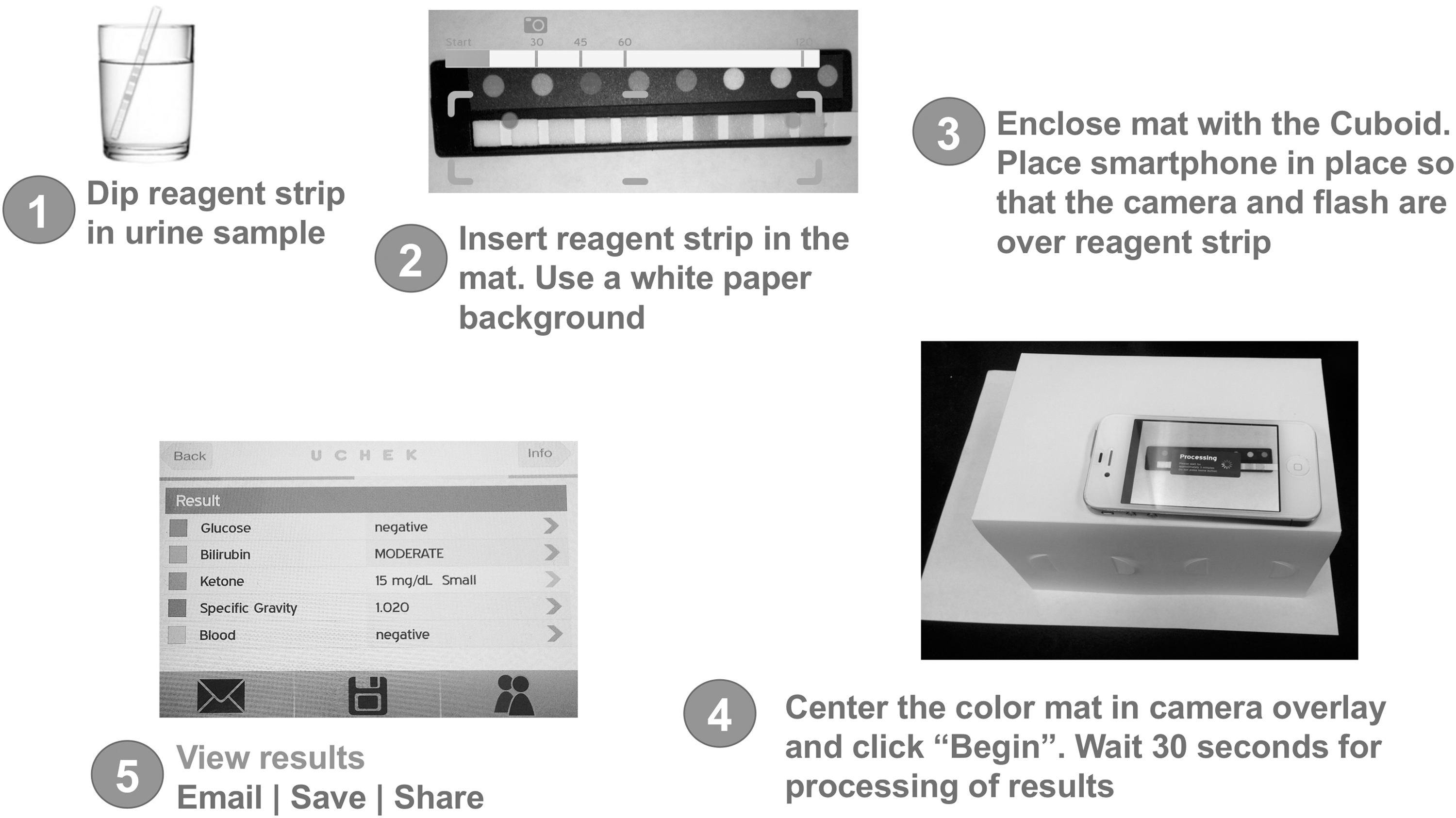
The process of reading the urine reagent strip with the UChek© app. The phone is positioned on the top of the cuboid and the urine dipstick is located on the color mat that appears on the phone screen.
The uChek© system works on the principle of reflectance photometry that analyzes the intensity and color of light reflected from the reagent areas of the urinalysis reagent strip. The uChek© urinalysis system is intended for use with urine reagent strips for the qualitative and semiquantitative determination of urine analyses, including glucose, urobilinogen, pH, ketone, blood, protein, bilirubin, nitrite, leukocyte, creatinine, and USG. Furthermore, the analytics on the uChek© device allow for the calculation of ratios (i.e., protein to creatinine) and suggested follow-up directions for the health care provider.
Previous data indicated that the strips are inaccurate for assessing hydration, particularly diagnosing underhydration. 6 It is hypothesized that the error could be associated with the individual reading of the strip by the user to assess small color differences. The uChek© device has undergone several tests to assess accuracy and strong evidence demonstrates it is a viable technology for urinalysis. 8,9 We believed that using colorimetric detection and controlled lighting could improve the ability of urine strips to assess hydration. Therefore, the purpose of this study was to determine whether the urine reagent strips with the uChek© application can be used to diagnose underhydration as classified by a refractometry.
Methods
One hundred forty-seven (n = 147) fresh human urine samples from young and middle-age adults were analyzed for USG with refractometry (ATAGO MASTER-SUR/NM, Japan), urine reagent strips (Siemens Multistix 10SG; Siemens, Malvern, PA), and the uChek© application. The refractometer was calibrated with distilled water before usage, and samples had reached room temperature (20–22°C) before analysis. The reagent strips were dipped in fresh urine and read within 45 s after dipping, based on the manufacturer's instructions of the strips.
For the uChek© analysis, the same urine strips were inserted into the uChek© color mat that was placed on white paper background. The mat was enclosed with the uChek© cuboid and the smartphone camera was placed on the designated corner of the cuboid, facing the urine strip and color mat. After centering the image over the urine strip, the image was processed and results were displayed. The entire process is shown in Figure 1.
Data were analyzed using Pearson-product moment correlation to assess the relationship between the refractometer and the uChek© application. Bland–Altman analysis was performed to assess potential bias. 10,11 Receiver operating characteristics (ROC) analysis was performed to establish the diagnostic ability of the urine strips and uChek© application to detect underhydration based on elevated USG (USG >1.020). 12
Results
USG by refractometry was significantly correlated (R 2 = 0.27; p < 0.0001; Fig. 2) with the uChek© application. Bland–Altman analysis demonstrated no statistical differences between the two methods (p = 0.66, t = −8.4; Fig. 3). The results of the ROC analysis showed that the overall ability of uChek© to correctly identify underhydration (USG >1.020) was moderate with area under the curve of 79% with sensitivity and specificity of 60% and 53%, respectively. USG by urine reagent strips alone was significantly correlated to refractometry (R 2 = 0.33; p < 0.0001; Fig. 4) and Bland–Altman analysis demonstrated no significant bias of the reagent strips alone (p = 0.12; t = 3.4). The results of the ROC analysis to assess the diagnostic ability of the urine strips to correctly identify underhydration (USG >1.020) revealed an overall diagnostic ability of 78% with sensitivity and specificity of 70% and 56%, respectively.
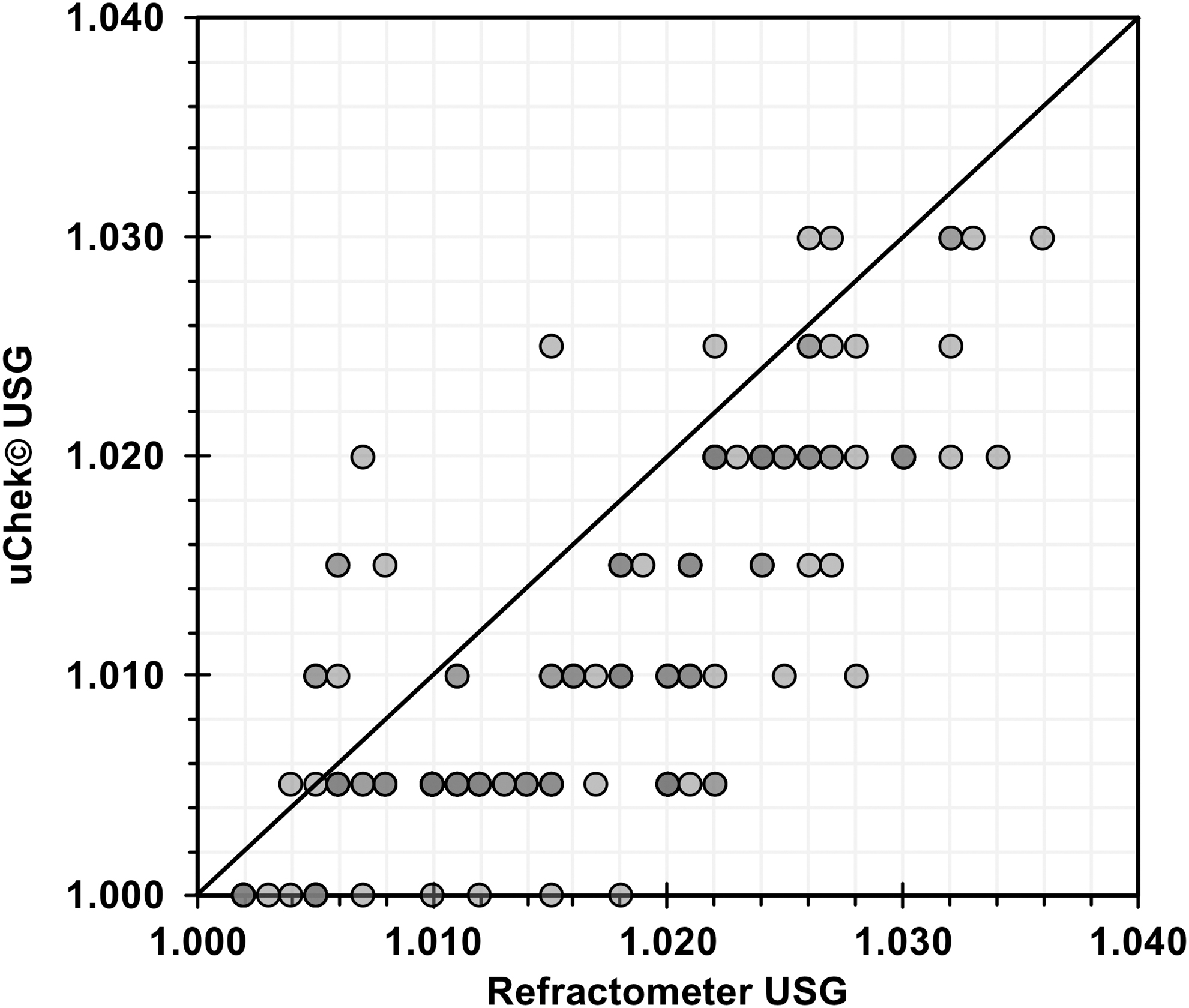
Values of USG read by refractometry and uChek© plotted with the line of identity. The gray shading indicates the number of observations. The darker the shade, more the observations made for that specific point. The two methods are significantly correlated (R 2 = 0.27, p < 0.0001). USG, urine specific gravity.

Bland–Altman bubble plot for differences between USG assessed by uChek© and refractometry. The size of the bubbles is indicative of the number of observations. Difference between methods is represented by the solid line, and two dashed lines represent the 95% confidence interval.
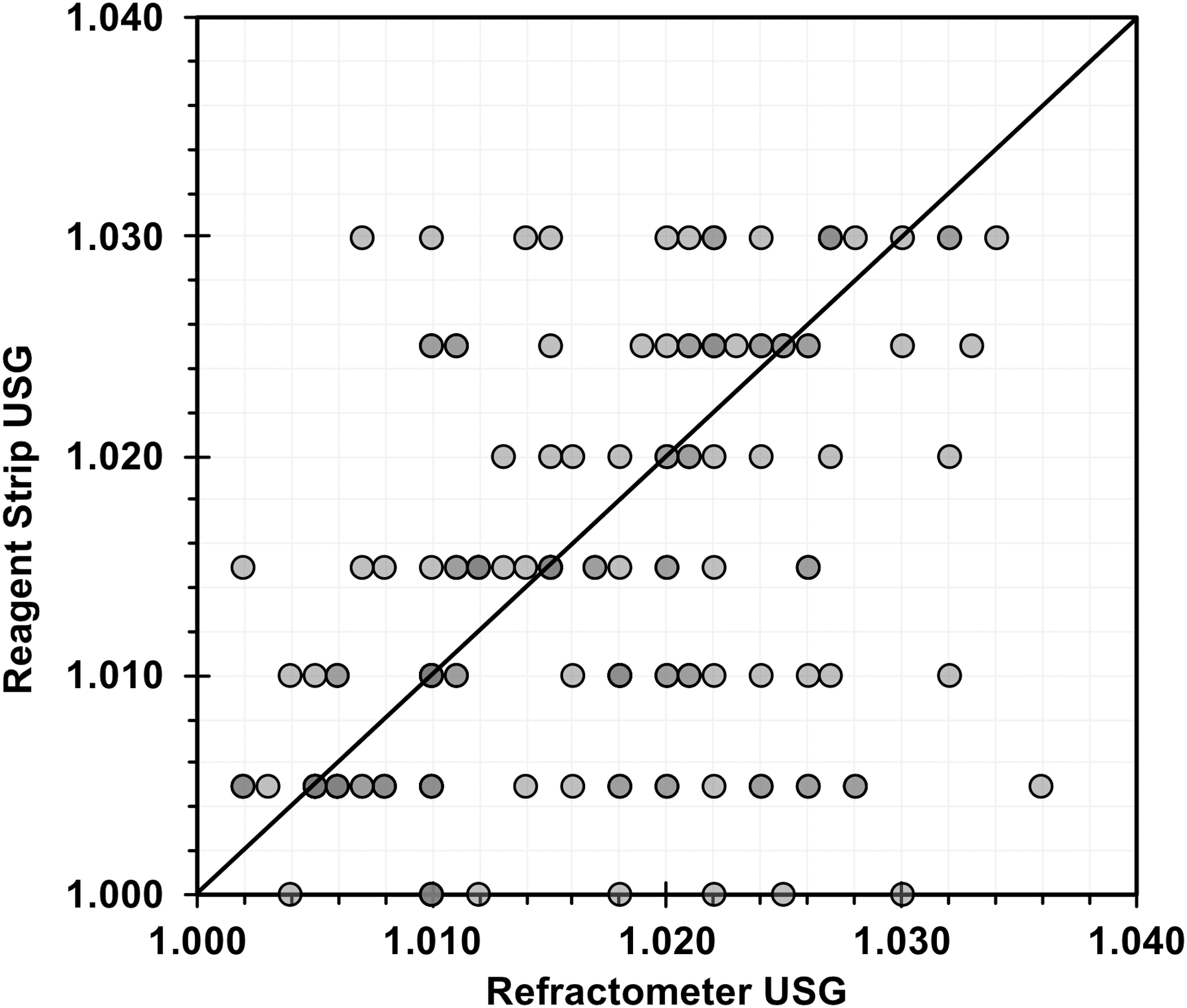
Values of USG read by refractometry and urine reagent strips plotted with the line of identity. The gray shading indicates the number of observations. The darker the shade, more the observations made for that specific point. The two methods are significantly correlated (R 2 = 0.33, p < 0.0001).
Discussion
This study sought to determine whether using a mobile health application, uChek©, could better determine results from urine reagent strips for diagnosing underhydration. The present data indicated that both the uChek© application and the urine reagent strip alone are not valid methods for assessing underhydration.
The increasing number of available sources of health care information and diagnostics through mobile applications triggers the need of the appraisal of their quality. 13 Despite several investigations citing that the uChek© application demonstrates viable technology and ease of use in remote areas, 8,9 this study is the first to examine the misclassification rates of using the uChek© application compared with refractometry. The results of the ROC analysis indicated that the ability of the strips to diagnose underhydration based on the USG was moderate, with a high misclassification rate.
The uChek© system uses urine reagent strips for determination of various diagnostic variables. Given the uChek© application works by taking a picture of the urine reagent strips, it seems that the moderate ability to diagnose underhydration was associated with the reagent strips and not the app. As previously shown, the urine reagent strip alone is not accurate to assess underhydration. 6
Conclusions
In conclusion, the uChek© application is inaccurate in identifying underhydration compared with refractometry. This inaccuracy is due to the poor diagnostic ability of the urine reagent strips used with the uChek©. The refractometer is reliable, fast, accurate, inexpensive, technically easy to use, and requires no supplies. Therefore, we advise assessing hydration by USG through refractometry.
Footnotes
Disclosure Statement
S.A.K. is a scientific consultant for Standard Process and Danone Research. S.A.K. has received an active grant from Standard Process and has received grants from Danone Research. The rest of the authors have nothing to disclose.