




Abstract
Background:
Interprofessional communication using Facebook®, Snapchat®, Instagram®, and WhatsApp® has become a reality that is shaping our future. However, studies evaluating the dimensions of this use in the medical field are scarce and proper guidelines have not yet been established. This highlights the importance of exploring the wide range of using such common communication tools in the medical field.
Objective:
The aim of this study is to investigate the prevalence of WhatsApp use as an interprofessional communication tool among Lebanese physicians and explore the dimensions of its use.
Materials and Methods:
This cross-sectional study was conducted by using LimeSurvey through an e-mail-based questionnaire sent to 5,329 physicians enrolled in the Lebanese Order of Physicians.
Results:
Four hundred twenty-nine physicians completed the survey with a response rate of 8%. Most respondents (96.5%) were WhatsApp users, where 72.7% stated being consulted by colleagues via WhatsApp, and about 50% reported being members of professional WhatsApp groups that mainly share medical cases and patients' updates. Further, most physicians made sure that the shared information contained no patient identifier and kept it for future referencing without the patient's permission or consent before consulting their colleagues. Almost 75% of the respondents agreed that guidelines are needed to illustrate the medico-legal and ethical aspects of WhatsApp use by physicians and recommended using WhatsApp specifically for inter-physician communication.
Conclusion:
The findings of this study illustrate the high prevalence of WhatsApp Messenger use among Lebanese physicians. Utilizing such digital platforms is highly demanded to enhance interprofessional communication between physicians in the medical field.
Introduction
In medicine, interprofessional communication between health care providers is highly needed. This communication needs to be open, collaborative, and responsible with the intention to provide the best care for the patient. The latter, in particular, confers one of the four principles of health care ethics: beneficence. 1 Before the rise of social media, interaction between physicians was more difficult and time consuming due to the absence of simplified means to allow for easy and rapid communication. 2 Previously, physicians used to communicate through phone calls, which is an intrusive way affected by the availability of the other, or through e-mails, which is more time consuming. 3 Henceforth, the instant messaging applications that are becoming available provide an opportunity for decreasing time consumption and increasing work efficiency. 4,5
Over the past decade, telecommunication and particularly social media have been advancing rapidly in obscuring phone calls and face-to-face interactions as means of communication between individuals. 6 With advances in technology, various platforms and devices pitched to make communication easier. 7 Social networking, instant messaging applications, and digital platforms such as Facebook®, Snapchat®, Instagram®, and WhatsApp® are, indeed, among today's mostly used applications globally. 8 These online applications have made social and professional communication a lot easier and much more accessible on the go. One breakthrough that came along with the advances in technology is the alleviation of difficulties in interprofessional communication. 9
With instant messaging applications such as WhatsApp, simplified interaction between physicians increased work efficiency, and decreased time consumption could be potentially achieved. 2,5 This free communication application was founded in 2009 and has become one of the most popular applications of the 21st century. 10 It is a free short message system (SMS) platform that allows end-users to send and receive messages, pictures, videos, and, most importantly, documents, files, and links, via their smartphones. 11 Moreover, WhatsApp added since 2016 an end-to-end security encryption feature to make sure no third parties (including WhatsApp itself) can have access to data sent, which makes it a secure application and protects its users from any unwanted intrusions.
Studies on WhatsApp use as a professional communication tool within the medical field revealed a strong belief among physicians that it is beneficial during clinical practice by enabling them to receive and share data in a matter of minutes. 4,5,12,13 Previously conducted studies showed that WhatsApp is a useful tool that could ease communication between physicians, especially those outside the hospital. It allows for rapid transfer of clinical and radiological data, as well as sharing of patient test results between physicians without having to be physically present. 14 The chance to send and quickly receive responses between clinicians also enabled achieving the targeted diagnosis sooner. 4,5 For instance, one study examined how WhatsApp has flattened the hierarchy within a surgical team, where members of the team communicated with one another at equal levels, leading to a more efficient and collaborative work. 15 Further, a systematic study conducted by Giordano et al. concluded that advanced exploration of the pervasiveness of WhatsApp use in the medical field is required. 16 Thus, the aim of this study was to investigate the prevalence of WhatsApp use for interprofessional communication among Lebanese physicians and explore the dimensions of this use.
Materials and Methods
Study Design and Setting
This cross-sectional study was conducted by using LimeSurvey through an online e-mail-based questionnaire sent to physicians enrolled in the Lebanese Order of Physicians (LOP). The study was conducted in the Faculty of Medicine, Beirut Arab University (BAU), Beirut, Lebanon in the year 2018. Ethical approval for this study was obtained from the Institutional Review Board of BAU.
Recruitment and Study Participants
LimeSurvey was used to invite doctors to participate through e-mails. A list of all registered Lebanese physicians' names was received from both LOP Beirut and LOP Tripoli. To note, all physicians, legally practicing in Lebanon, must be enrolled in the LOP (either Beirut or Tripoli). A total of 5,940 e-mail addresses were obtained and e-mails were sent between December 2017 and February 2018 with an invitation link along with an attached consent form to participate in the survey. Six hundred eleven e-mails were bounced, thus a total of 5,329 e-mails were sent. Two reminders were sent to nonrespondents within periods of 2 weeks and 1 month after the first e-mail. The identity of all participants was kept anonymous. Informed consent was obtained from all study participants.
Questionnaire
The questionnaire was divided into three parts: The first part included the participant's demographics such as age, gender, specialty, years of practice, and the governorate(s) of practice; the second part assessed the inter-physician and the physician
Sample Size
The number of physicians registered in the LOP of Beirut and Tripoli was 13,468 physicians at the time of the study. Given the absence of data from literature, we assumed an estimated proportion of physicians who use WhatsApp to be 50%. For a power of 80%, a confidence level of 95%, and a margin of error of 5%, the calculated sample size was 374 respondents.
Statistical Analysis
Descriptive statistics were reported as absolute or relative frequencies for categorical variables and means (standard deviation) for continuous variables. Statistical significance was set at a p-value <0.05. All analyses were performed with SPSS 22.0 software (SPSS, Chicago, IL).
Results
Participants' Demographics
Four hundred twenty-nine (n = 429) physicians completed the survey with a response rate of 8%. Almost half of the enrolled physicians were younger than 35 years of age, and the remaining physicians were divided among different age groups. The mean age of participants was 40.7 (±1.47). The majority were males (61.3%), around 81% were attending physicians, and almost 50% were physicians with >10 years of experience. Moreover, internal medicine subspecialties represented 27.7% of the respondents, whereas general practitioners and family physicians formed 12.4% of them (Table 1). Possible associations between demographic variables and WhatsApp use were tested, yet none was found to be significant (p > 0.05).
Demographic Data of Respondents (N = 429)
Missing data.
Including subspecialties.
Including family medicine, internal medicine, and general practitioners.
Background on Whatsapp Use among Respondents
The majority of the physicians (N = 414, 96.5%) reported using WhatsApp, with almost all of them having used it for 1 year or more (98.6%). Among those, daily use of WhatsApp was 30 to 60 min in 53.6%, 1 to 3 h in 32.4%, and >3 h in only 14%. Also, most of the respondents who use WhatsApp (86.2%) reported using it for both social and professional purposes (Table 2).
Background on WhatsApp Use Among Respondents (N = 429)
Missing data.
Content and use of Inter-Physician Consultations via Whatsapp
Among physicians who use WhatsApp, 72.7% reported that other colleagues usually consult them via WhatsApp, whereas 65.2% reported using WhatsApp for consulting their colleagues. When asking those who do use WhatsApp for consulting a colleague (N = 270) about the type of consultation (where more than one answer could apply), 73.3% reported using it for “gross images of clinical findings,” 69.6% for “lab results,” 67% for “radiological imaging-related data,” and 37% for “Electrocardiogram (ECG)” (Fig. 1).

Bar graph showing the content and use of WhatsApp consultations among physicians (N = 414). ECG, electrocardiogram.
Around 56% of physicians who use WhatsApp stated that they are members of professional WhatsApp groups, among whom 50.2% described their group(s) as a “one specialty group(s),” 17.3% described their group(s) as “multidisciplinary group(s),” and 32.5% answered that they are members in groups that can be described as “both.” On asking those who are members of professional WhatsApp groups (N = 231) about the aspects of use of these groups (where more than one answer could apply), 69.3% mentioned using it for “sharing updates,” 65.8% for “sharing cases,” and 52.4% for “consulting group members” (Fig. 1).
Physicians' Attitude on Inter-Physician Consultations via Whatsapp
When asking physicians (N = 429) whether they think it is annoying to be consulted by a colleague on WhatsApp, 28.7% answered saying, “Not at all.” However, when asking the physicians whether they think it is annoying to be consulted by a patient on WhatsApp, 43.4% answered saying, “Very much” (Fig. 2).
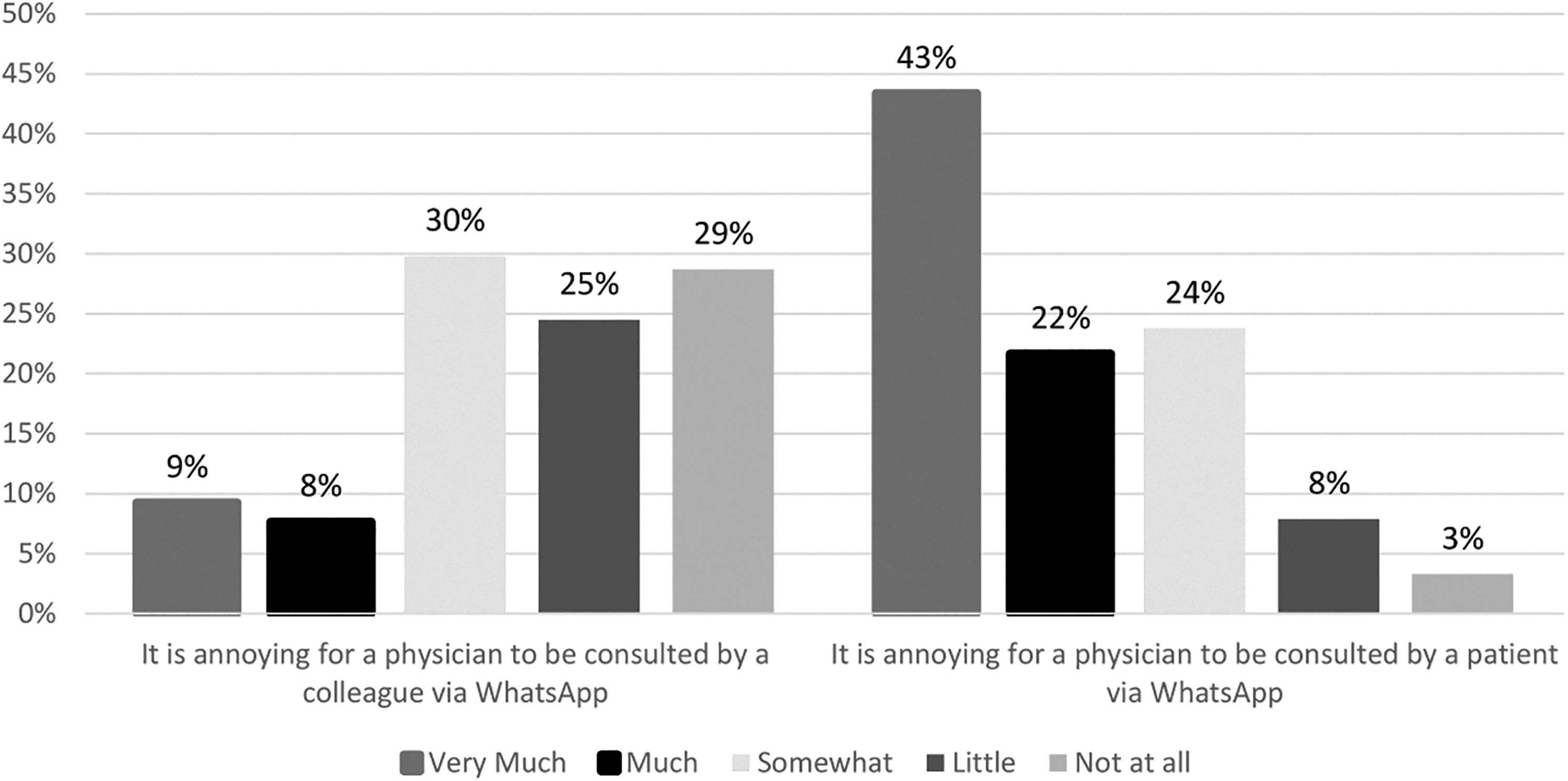
Physicians' attitude on consultations via WhatsApp (N = 429).
Respondents were asked about using WhatsApp for consulting a colleague (N = 429): 56.4% believed that the application does not save time, 58.7% thought that it did not reduce the effort of attaining required information, and 35% answered that it might affect the physician's patient load. Moreover, only 2.1% agreed that the information provided through WhatsApp is enough to reach a diagnosis. Most of the responding physicians (76.2%) recommended the use of WhatsApp for inter-physician communication but did not recommend it for physician

Attitude toward general WhatsApp use for medical purposes.
Physicians' Attitude on Physician– Patient Consultations via Whatsapp
When asking physicians who use WhatsApp (N = 414) whether they would answer a patient's consult via WhatsApp, 31.6% answered saying, “yes” and 47.1% answered saying, “sometimes.” Among those, 60.7% would use WhatsApp for scheduling appointments with patients. Moreover, on asking the physicians whether they would prescribe the patient a drug via WhatsApp, 31.3% answered saying, “no,” and 44.2% answered saying, “only in urgent cases.”
Ethical Considerations in Professional Whatsapp Use: Physicians' Attitudes and Practices
As a further matter, among physicians who would answer a patient's consult via WhatsApp (N = 326), 38.7% reported that they would keep the WhatsApp chat with their patients or the media sent to them by patients on WhatsApp for future reference whereas 32.2% reported that they would not. Around 73% of all respondents (N = 429) thought that consulting another physician through WhatsApp does not violate the patient's privacy, and 63.4% thought that data containing the patient identifier sent to them by WhatsApp should be deleted, whereas 36.6% thought that it should be kept for future reference. Moreover, 37.5% did not know what “end-to-end encryption” means. Among those who knew about the feature, 66% (N = 268) believed that this feature helps in protecting the patient's confidentiality. Most of the respondents (77%) agreed that guidelines are needed to illustrate the medico-legal and the ethical aspects of WhatsApp use by physicians (Table 3).
Ethical Considerations in Professional WhatsApp Use (N = 429)
Total is <429 because 161 do not know what “end-to-end encryption” is.
Missing data.
Further, when asking physicians who use WhatsApp for consulting a colleague (N = 270) whether they would ask the patient's permission before consulting another physician about him/her via WhatsApp, only 17.8% answered saying, “yes.” Moreover, 68.5% reported that the patient information they share while consulting colleagues do not contain any identifier. Around 53.5% of physicians who are usually consulted by colleagues via WhatsApp (N = 301) stated that they would not share patients' information sent to them by WhatsApp with colleagues or students for teaching purposes.
Discussion
In the past decade, our society witnessed an exponential rise in the use of smartphones and adjunctive communication applications to facilitate interaction and bridging the distances between individuals. This advancement in technology has changed different aspects in our daily lives, including health care services and patient care. In fact, many studies have been recently conducted to tackle the use of such communication technologies between physicians, where it was shown to be more beneficial than the traditional systems.
12
–14
This study focused on assessing the prevalence and patterns of using the “WhatsApp” mobile SMS platform by physicians in Lebanon, and further exploring the attitudes of Lebanese physicians toward its use for both inter-physician and physician
Previous studies described WhatsApp as a beneficial tool that is being vastly used in the medical and para-medical fields due to its ease of access and unique features, which allow multiple types of media to be shared free of charge. 9,17,18 The findings of our study were telling. It showed that out of 429 participants, 96.5% used WhatsApp as a communication tool. Most users reported employing the application to consult fellow colleagues mainly for a feedback on radiological imaging, lab investigations, or simply to send images of findings. Our results are consistent with what has been reported by others, where WhatsApp was shown to help physicians in better and faster decision making, saving patients unnecessary referrals, and improving management of acute cases, thus again proving the importance of the application's features as part of its use in the medical field. 17,19,20
Moreover, half of the WhatsApp users in our study reported being members of professional WhatsApp groups of the same specialty or of multiple ones. The groups are used to consult members and to share cases and updates, thus providing an efficient tool for physicians' professional development. We also explored, in our study, the physicians' attitude toward WhatsApp use and found that about 40% of physicians agreed that using WhatsApp for inter-physician communication saves time and reduces the effort to attain the required information, emphasizing previous research, which showed that the application helped health care professionals in terms of making more rapid decisions. 16
Further, when assessing physicians' perspective on the use of WhatsApp for consultations, they did not seem to mind being consulted by a colleague via WhatsApp. However, when asked about doctor
In fact, cases being discussed between physicians via WhatsApp are well explained and understood, whereas the ones given by patients might not be clear enough and could be misunderstood, which renders interpreting signs and symptoms by the physician challenging. This could also explain the perspective of physicians on whether the information provided through WhatsApp is enough to reach a diagnosis, where only 2% agreed. Before the era of social media and social networking via instant messaging applications and digital platforms, the inter-physician communication was administered by face-to-face communication or phone calls. 22,23 Back to the 1970s, a study published by Long and Atkins revealed that communication patterns between the consultants and general practitioners in England used to occur either through the phone (4% of cases) or by letters of referral and discharge (96% of cases), with the latter being, indeed, considered the main method of communication. 24 It is noteworthy mentioning that personal face-to-face contact was extremely limited by that time. 24
Previous studies showed that more data are needed to assess a patient's confidentiality when using WhatsApp for inter-physician consultation. 25 Thus, we tried in our questionnaire to cover this gap in the literature by assessing both the physician's attitude toward the ethical aspect of WhatsApp use and how users dealt with these ethical considerations in practice. Results showed that 73% of physicians involved in our survey do not find WhatsApp consultation a violation of the patient's confidentiality. Further, when asked about their thoughts on the data sent, most participants (including both users and nonusers) stated that the data should be deleted and not kept for future references. However, when asking the users on their actions toward this data, most of them reported keeping it for future referencing. This emphasizes the use of WhatsApp for maintaining proper follow-up of patients, as proposed by previous studies. 26
In addition, most physicians agreed that end-to-end encryption policy by WhatsApp did, indeed, help protect patients' confidentiality. However, it is worth noting that about 38% of users did not know what the end-to-end encryption feature is, which highlights the importance of raising physicians' awareness on this issue, in particular, and on cyber security, in general.
Finally, yet importantly, most subjects in this study made sure that the shared information contained no patient identifier but did not ask for the patients' permission before consulting their colleagues via WhatsApp. In fact, authorizing the release of medical information is a crucial issue that should be considered. No permission is required to be obtained from patients to report communicable diseases, illness outbreaks, child abuse, and other legally reportable conditions; whereas written permission should be acquired from patients to release any piece of information from medical charts in most other conditions, even when consulting other colleagues, laboratories, and consulting physicians. 27 This again raises the question on the ethics of using such technologies in the medical field, where almost 77% agreed that guidelines are needed to illustrate both the ethical and medico-legal aspects of WhatsApp use.
Limitations
Despite the interesting results obtained, we believe our study might have several limitations. First, males consisted around 62% of our sample, which is not consistent with the gender distribution of Lebanese physicians. Second, out of the 13,468 registered physicians, only 5,940 e-mails were obtained. This prevented us from reaching the entire targeted population. Third, the list of e-mails that was provided by the LOP was not up to date, thus explaining the 611 rebound e-mails. Fourth, the fact that the survey studying the use of an online tool (WhatsApp) was conducted through a questionnaire sent by another online tool (e-mail) suggests the possibility of a sampling bias since the sampled physicians may have different attitudes toward electronic communication than those who could not be reached by e-mail.
Conclusions
The findings of this study illustrate the prevalence as well as the implementation of WhatsApp Messenger as a tool with an opportunity to improve interprofessional communication between physicians. The results showed that WhatsApp could be beneficial in the medical field due to its escalating popularity among physicians as well as its ability to enhance interprofessional communication between physicians and their colleagues. However, based on the different opinions among physicians enrolled in our study regarding the ethical and medico-legal issues confronted when using WhatsApp, further studies are needed to tackle these concerns, to outline guidelines that can direct the proper use of WhatsApp in the medical field, and to leverage such communication channels by using the best ways.
Footnotes
Acknowledgments
The authors express their gratitude to all individuals who made this work see the light of day, especially study participants.
Disclosure Statement
No competing financial interests exist.
Funding Information
No funding was received for this article.