




Abstract
Background:
Social media use is prevalent in our society and has become widely used in the health care community. Inflammatory bowel disease (IBD) patients constitute one of the patient populations that benefit from social media use to obtain information on their diseases. West Virginia (WV) is a rural Appalachian state with barriers to internet access and health care and we examined the role that social media plays in patients' lives in this state, which could be reflective of other rural states.
Methods:
Our patient population consisted of patients, 18–65 years old, who live in WV with a diagnosis of IBD. A 17-question survey was sent to 2,131 patients over a course of 4 weeks through an application called REDCap.
Results:
We received 624 responses with a 29% response rate. Approximately 30% of patients reported that they used Facebook for IBD-related information, while 4.3% used Instagram. While most (92%) patients preferred information coming from their physician, the majority judged information from the internet to be reliable (39.3%) or neutral (44.9%). Most patients believed that social media had no impact on their disease management (67%), while 30.3% believed it had a positive impact. Almost 45% of patients stated that they wished their physician had a social media account for IBD.
Conclusions:
Our study shows that patients are interested in obtaining health-related information from social media resources. As physicians, it is our job to point them in the right direction to be able to find reliable information.
Introduction
Social media is a tool through which people can share thoughts, ideas, and information and consequently it has become a common way for patients to manage their medical conditions. Inflammatory bowel disease (IBD) patients are among the many patient populations that can use these different social media outlets as resources for information regarding their disease. There are more than three million people in the United States currently suffering from IBD. 1 These patients face both physical and emotional stress. Through social media, patients can join support groups and obtain information regarding their disease. 2 Examples of social media used today include Facebook, Twitter, Instagram, Reddit, and blogs.
The aim of this study was to evaluate social media use among patients with IBD in the state of West Virginia (WV). WV is an Appalachian state with many rural areas that have poor access to health care and functional internet. WV ranks #44 of 50 among all of the states in education levels. 3 Approximately 35.9% of people living in this state do not have internet access 4 and therefore may not have access to social media. 5 This is significantly higher than the national average of 26% of households without internet access. 5 We examined how the internet and social media were utilized to explore a disease in a state that ranks low in literacy, education level, and internet access.
Materials and Methods
Data Collection
We used an application called SlicerDicer in EPIC's Electronic Medical Record to obtain patient information. Inclusion criteria were patients aged 18–65 years from the state of WV with a diagnosis of IBD. Keywords used to search patient diagnoses included IBD, Crohn's disease, and ulcerative colitis. With this information, we created a list of potential participants. After e-mail addresses were obtained, we sent information to patients (n = 2,131) about the study. Survey distribution and data collection were managed using REDCap electronic data capture tools hosted by the West Virginia Clinical and Translational Science Institute, and patients consented by clicking the link for the survey. Patients were entered into a drawing to win one of 2 $50 gift cards. The survey was active for 4 weeks, with weekly reminders sent to subjects who had not completed the survey.
The survey consisted of 17 questions, which included yes/no, multiple-choice, and free-response questions related to social media use in the setting of IBD. We collected demographic information as well as information about whether patients had regular access to the internet. More detailed questions included whether patients used social media, which social media platforms they used overall, and what type of information they gathered from these sources. Patients were also asked how reliable they thought the information was using the five-point Likert scale, whether they preferred the information obtained on these social media outlets versus from their physicians, and about the impact that social media has had on their life (Fig. 1). We used the population in WV as it could be generalizable to other rural states.
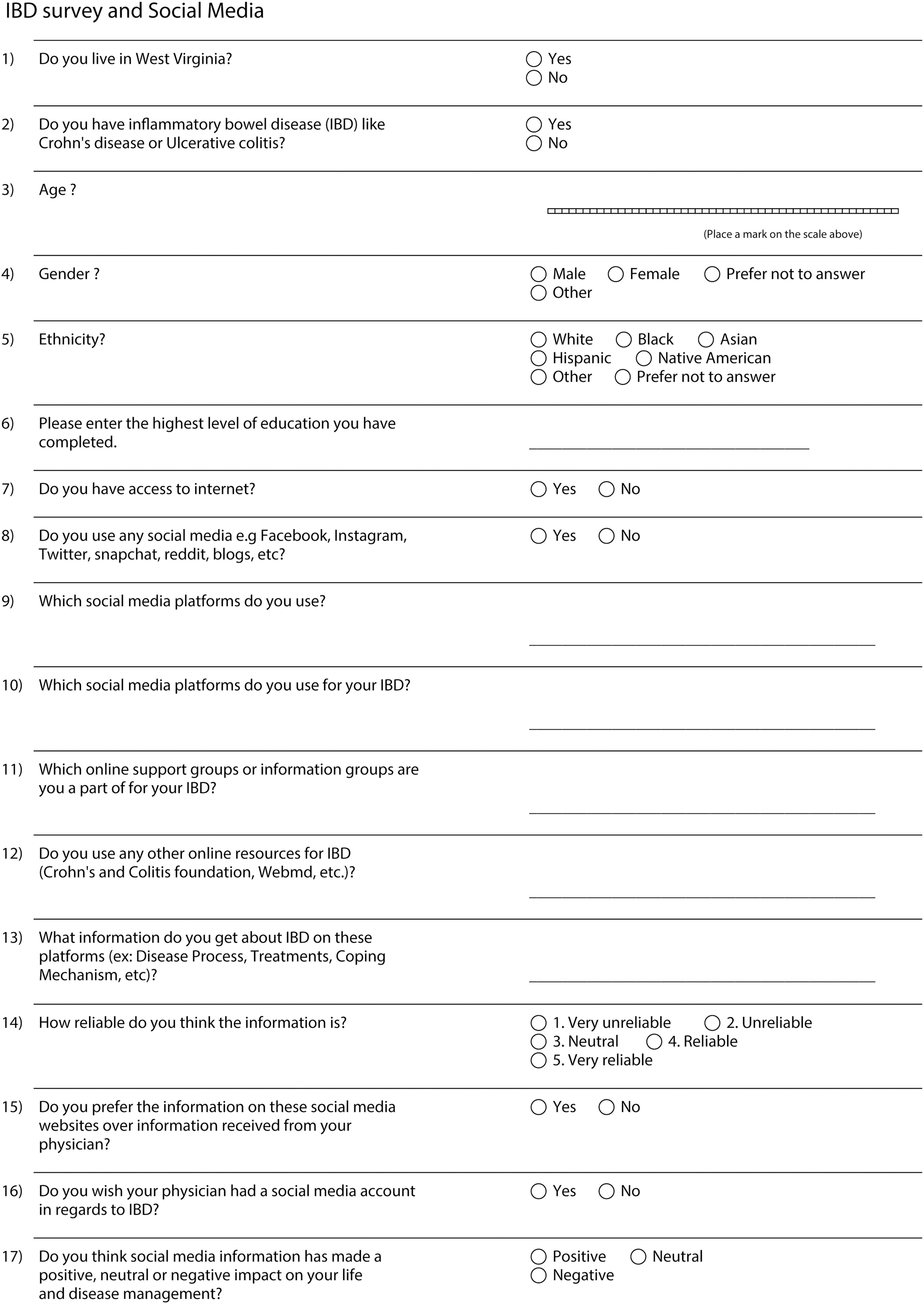
Social media and inflammatory bowel disease survey. A survey of 17 questions was administered to all participants of the study.
Statistical Analysis
A series of contingency tables were constructed to examine the associations between education, gender, and social media and the uses in patient's understanding of IBD. Free-form responses to questions were analyzed using an a priori algorithm (for education) and a keyword search list for more complicated questions. The keyword search list was generated from the most common responses and verified by domain experts. Categorization of responses occurred iteratively so that common misspellings could be integrated into the categories. Educational categories were restricted to four categories to increase statistical power. Likert responses were grouped (unreliable and somewhat unreliable to unreliable, etc.) for the same reason to keep cell responses high in the contingency tables. Chi-squared tests for independence and multiple comparison tests for pairwise comparisons were used.
Results
The REDCap survey was sent to a total of 2,131 patients with 624 total responses, with a response rate of 29%. The gender ratio of respondents did not reflect the gender ratio of the population to whom the survey was distributed as 57% of the e-mail recipients were female, yet only 32% (n = 202) of the respondents were female. The mean age of the patients responding to the survey was 43.5 years and the majority of the population was Caucasian (n = 596). Most of the participants who responded had received their bachelor's degree or higher (n = 161).
For general purposes, Facebook was the most commonly used social media platform, utilized by 80.6% of participants, while Instagram and Snapchat were used by 38.3% and 24.8% of participants, respectively (Fig. 2). Many patients utilized more than one social media platform and just over half used two or more platforms. Approximately 10% of the survey respondents reported that they used no form of social media. We found no association between the level of education or gender and number of social media platforms used.

Social media platforms used with breakdown by education level. Facebook was the most popular social media used, followed by Instagram. All other social media platforms had a smaller user population.
Overall, Facebook support groups and the Crohn's and Colitis Foundation of America (CCFA) were the most widely used resources for patients to research about their IBD. Other resources less frequently used were Twitter, Reddit, Pinterest, and YouTube. Approximately 29.6% of participants noted that they used Facebook for information related to their IBD and 4.3% used Instagram, while all other social media platforms were used by <2% of participants each. The most common topics of interest were treatment options, followed by coping mechanisms. Less common topics included symptoms, diet, disease process, medications, and support (Fig. 3).

Topics of interest by education level. The most popular research topics were treatments and coping mechanisms, while the less popular topics were symptoms, diet, disease process, and medications.
When asked about the reliability of information obtained on social media websites, 44.9% of patients ranked reliability as neutral, while 39.3% of patients thought the information was reliable. It was noted that there was a definite dependence between the education level and the perceived reliability of information obtained on social media (p = 0.015) (Table 1). There was also a difference between genders in their perception of how reliable the information was (p = 0.035). These differences were examined in a pairwise manner, controlling for multiple comparisons using the false discovery rate methodology. It was found that more female subjects categorized information as unreliable rather than neutral (p = 0.049) or reliable (p = 0.0034) (Table 2).
Education Level and Reliability of Information
The perceived reliability of information found on the internet was dependent on the education level (p = 0.015).
Gender and Reliability of Information
There was a difference in how reliable a person thought the information from the internet was based on gender (Q14, p = 0.035). There were more females ranking the reliability of information as unreliable rather than neutral (p = 0.049) or reliable (p = 0.034).
Eight percent of patients preferred information obtained through social media over information received from their physicians, whereas the other 92% preferred to obtain information from their physicians. There was no difference among patients with different educational levels regarding this preference (chi-square p-value >0.05). Approximately 45% of patients wished their own physician had a social media account in relation to IBD. About 67% of patients were neutral about the impact that social media had on their disease management, while 30.3% of patients believed it had a positive impact. Interestingly, men who were older actually seemed to think social media had more of a negative effect on disease management, while younger men thought it had a more positive impact, whereas there was no difference in the female population with this opinion. A significantly larger number of female subjects ranked the impact as neutral versus positive (p = 0.006) (Table 3).
Gender and Impact of Social Media
There was a gender difference in relation to the impact social media had on a person's life and disease management (Q17, p = 0.0045). A significantly larger number of female subjects ranked the impact as neutral versus positive (p = 0.006).
Discussion
Social media has become increasingly prevalent in people's lives and provides an outlet for patients to gather information about their diseases and build a support group with other patients experiencing the same daily obstacles. IBD affects many young people, allowing them to be a great population to study social media. 6 We chose the age group of 18–65 since it would allow us to explore a population that is more likely to use social media not only in general but also in relation to their health problems.
Several studies have examined social media and IBD, with each having different goals and outcomes. One study done by Reich et al. included patients with IBD and found that patients were interested in using social media to help with management of their disease, with use being higher in the younger population, female population, and those struggling with active disease. 7 In our study, the majority of patients to whom surveys were sent were female (63%), but interestingly more males participated and responded (68%) and therefore appeared to use social media more in relation to their disease. The men responding also had a higher education level overall, which could have played a role in more responses from them since we could postulate that higher education means more likely access to the internet. 8 This corresponds to the gender disparity in education in Appalachia.
A common theme among different studies was that the patients were not sure about the reliability of the information obtained through social media. In one study, ∼43% of patients reported that information reliability was one of the primary barriers to social media use. 7 In another study, 55% of patients were unsure of how reliable the information was and 26% thought the quality of information was fair to very good. 9 In our study, however, 39.3% of participants thought the information was reliable and only 16% thought the information was unreliable, with the remainder of patients being neutral. No study to date has examined the quality of IBD-related information posted on social media outlets, 9 therefore this may be beneficial to study in the future.
Although several studies have examined social media use in IBD patients, most of these studies were performed in urban centers. In our practice, we encounter patients who live in rural parts of WV and drive several hours to see a gastroenterologist. Our main goal was to look at how social media affected patients with IBD in rural Appalachian areas. Our survey examined multiple aspects of each patient, ranging from their demographics to their social media use. Our initial question asked patients about their internet access. Of the 624 patients who responded to the survey, four people stated they did not have access to the internet. These patients were motivated to find another way to complete the survey and seemed to care to share their story. We postulate that a significant portion of nonresponders were patients who do not frequently check their e-mails or had a lack of internet access. The majority of patients who responded to the survey appeared to have a bachelor's degree or higher, which might mean that those patients who responded were more likely to have access to the internet and therefore social media.
Interestingly, the elderly population was more likely to think the information on social media had a negative impact on their lives versus the younger population who thought it had a positive impact. This was more specifically seen in the male group. This would be consistent with the higher use of social media in the younger population and greater familiarity. Surprisingly, there was also no significant difference between age groups and opinions on the reliability of the information.
This study had several strengths that are important to examine. The sample size was large and included 624 patients, which allowed us to take an extensive look at the types of social media that people used and the information obtained from these outlets. It is to be noted that the response rate was only 29% overall, which may reflect poor access to the internet and social media in our study population. Another strength was the free-response social media platform question, which allowed participants to list out resources they used to attain IBD-related information. Through this approach, we were able to discover many different resources. Patients appeared to utilize Facebook support groups more than any other resource, with CCFA being the next most common resource. A 2019 study found that Facebook was the most popular social media website used by their study participants as well. 7 Blogs were popular among our patients as well.
There are several limitations to this study that will be discussed. First, patients younger than 18 years old and patients older than the age of 65 were not included in the study. Patients younger than 18 were not included due to consent concerns, but they are likely some of the biggest social media users and may have appreciated or used different resources. 10 We did not include patients older than 65 due to less likelihood of social media use. However, with increase in social media use among older populations, it might have been interesting to see their responses. Another limitation was that the survey was only administered in WV, therefore possibly making it less generalizable to the overall U.S. population, but it could represent the more rural areas of the country.
One potential improvement to this study would have been to ask patients how frequently they used the internet to determine if more frequent internet use led to more social media use related to IBD and if those patients thought it was more useful in management of their disease. Several other studies examined the internet use frequency, and one study found that more frequent social media users were three times more likely to state that social media was helpful in management of their disease. 7 We should have also put more emphasis on not only asking patients whether they use the internet and what they use it for but also about how the information they received influenced their behavior, health care decisions, and treatment plans. Many patients reported a positive impact and reported using the social media outlets for treatments and coping strategies, so we can assume it did likely influence their decision in relation to their disease; however, it would have greatly benefitted this study to obtain more information on this.
Another potential improvement to this study would have been to guide patients to the most reliable sources regarding their disease. This appeared to be one of the most common concerns among other studies, as well as our study, as patients appeared unclear on the reliability of information. In our study, it was interesting that the majority of the patients categorized the information they obtained from social media as neutral or reliable compared with most other studies where reliability of the information obtained was a larger concern. This could also be related to the fact that the other studies were done in more urban populations, in which there might be a higher education level among patients. With WV's education ranking lower than many other states, reliability of many social media resources may not have been questioned as much. Our analysis did show a significant association between the education level and the degree to which patients found the information obtained over social media reliable, which would likely be expected. Higher education usually involves more awareness about how to determine the accuracy of information that one is receiving. 11
We reported that our patient population in the Appalachian region is likely to have lower health literacy, but the majority of our responders had a bachelor's degree or higher. Patients with higher education degrees may have been more motivated to respond and were more likely to have the means to respond to an e-survey as these patients are likely to have access to the internet. We could have potentially targeted the lower health literacy patients more appropriately by offering paper surveys. It is an important concept to target for future studies, and our approach may have been somewhat inadequate to target the more typical population of the Appalachian region.
Overall, patients stated that they did not prefer the information on social media websites over information received from their physician. Although social media has become an important part of patients' lives, it does not appear as if it has devalued the information received from physicians. Patients continue to appreciate discussions with their doctors, and it would be beneficial to conduct a study in the future about determining which social media outlets are reliable for patients. Since Facebook support groups were the most popular source, it could be beneficial to target these for data quality improvement. Only 45% of patients stated that they would prefer that their physician have a social media account, whereas 55% actually stated they would not want that. Multiple studies differed in these results, with one study stating that 37.4% of patients were interested in obtaining information from their GI physician through social media, another study stating that 25.4% of patients preferred to communicate with their physician through social media, 2 one study stating that 84.4% of patients would be interested in some interaction with their physician using social media, 12 and last, a study stating that 62% of patients would be interested in following a social media account led by their gastroenterologist. One study mentioned that due to issues with reliability of information and the increase of patients utilizing social media for this information, health care providers should be more involved in social media to help improve the accuracy of the information. 13 It would be interesting to survey physicians about their interest in social media use to relay information to patients about disease management.
Social media is becoming more widely used among all age groups and impacts many patients' lives. IBD patients in WV and Appalachia represent a rural population with more barriers to social media use; however, they have been able to actively use social media to be involved in their disease management. Many patients were positively impacted by social media use, which stresses the importance of social media in today's world. Although the increase in social media use for health care-related issues is significant, physicians have been slow with their utilization of it, with almost half of the GI physicians reporting that they use no form of social media. 14 Over the last decade, the use of social media in the adult population in the United States has approximately tripled with 20% reported internet use in 2008 and 70% reported internet use in 2016. 7 The use of social media by laymen to ask and answer health-related questions has exploded in recent years, and patients' perception of the reliability of this information has consequences on how patients interact with their doctors and their understanding of their diseases. It is important that health care providers remain aware of this so that they can discuss with their patients and target social media websites for more accurate information.
Footnotes
Authors' Contributions
All authors contributed equally in case design, research, and drafting of the manuscript.
Disclosure Statement
No competing financial interests exist.
Funding Information
No funding was received for this article.