




Abstract
Background:
HIV infection is an increasingly complex chronic disease associated with numerous medical, psychological, and social problems. The life expectancy of affected patients has increased considerably. Medical apps could also play a role in prevention and management of comorbid conditions in the HIV-infected population.
Objectives:
To determine the usefulness of an app designed specifically for HIV-infected patients aged 60 years or older and to assess changes in patient satisfaction, adherence to treatment, and quality of health care.
Methods:
A randomized clinical trial was conducted, including 100 patients (50 per group): (1) an experimental group comprising patients using the app + routine medical care (app group) and (2) with routine medical care (control group). The usability of the app and patient satisfaction were evaluated in the app group at week 48. Quality of life, adherence to treatment, and clinical parameters were compared between both groups at 48 weeks, as well as the number of face-to-face visits.
Results:
We found that 52.2% and 73.8% of patients in the app group used the app at weeks 24 and 48, respectively. Patients used the app for a mean of 23.7 (±2.84) days over the 48 weeks. The most visited screens were health counseling and medical records (24.8% and 22.2%, respectively). At week 48, 85.2% of patients thought that the app was useful and 91.4% would recommend the app to friends or relatives. The app was well valued by participants (4.79 [±0.21] of 5.00) and 64.6% thought that the app improved their health care.
Introduction
Aging is the term used to describe the progressive loss of physical ability, changes in appearance, and/or decrease in mental agility that we experience over time. This process advances at different rates as a consequence of genetic and environmental factors. 1
Aging of the population can be considered a success of public health policies and socioeconomic development. However, it also constitutes a challenge. A recent major study on health and aging warned that the burden of chronic disease will considerably affect quality of life in aging patients. 2 Therefore, determinant changes are needed to improve the health and quality of life, as well as social participation of a growing elderly population.
The increase in the average age worldwide makes chronic diseases and the consequent reduction in well-being a prominent global public health challenge. 3 One of the greatest challenges for a national health system is to achieve sustained care of people with chronic health problems (both physical and psychological). 4 In this sense, health professionals agree that specific management of elderly people reduces morbidity and mortality and improves quality of life and the ability to carry out day-to-day activities. 5,6
HIV infection is a chronic disease. The life expectancy of affected patients has increased considerably thanks to advances in antiretroviral treatment. In 2015, around 50% of HIV-infected patients were ≥50 years old, and it is estimated that by 2030, around 70% of the HIV-infected population in the United States will be aged ≥50 years. 7
Growing evidence in the scientific literature suggests an increased prevalence of long-term comorbidities associated with antiretroviral treatment and the infection itself compared with noninfected controls of the same age. In addition, aging could manifest 10 years earlier with respect to the general population. 8
As a result, HIV infection is an increasingly complex chronic disease associated with numerous medical, psychological, and social problems that require the attention and experience of a wide range of health specialists. 9
Information and communication technologies are strategic elements in improving health and ensuring a quality, modern, and sustainable health system. 10 The development of mobile devices such as smartphones and tablets has shown how mobile applications (apps) have revolutionized health care (medical apps). 11 –15 Information and communication technologies could prove very useful in the care of patients with chronic conditions, such as diabetes, obesity, and cardiovascular disease. Medical apps could also play a role in prevention and management of comorbid conditions in the HIV-infected population. 16 –24
Study Objectives and Endpoints
First, we wanted to know how familiarized the older population was with mobile apps and their interest in medical apps, using a 13-item survey.
Second, in the context of a clinical trial, we determined the usability of an app specifically designed for medical management of HIV-infected patients aged ≥60 years; the percentage of subjects who used the app on more than 10 different days during the clinical trial was assessed at week 24, to monitor usability during the study, and at week 48, to determine usability at the end of the study.
Other objectives focusing on patients randomized to use the app were (1) to identify the most frequently used items in the app according to the register system and (2) to evaluate satisfaction with the app by assessing changes between baseline and week 48 in an ad hoc test, ranging from 1 (worst) to 5 (best).
Finally, we compared the app group and the control group at week 48 with respect to the following parameters: (1) the number of visits to the HIV unit during the clinical trial and (2) self reported adherence (SERAD), 25 quality of life medical outcomes study HIV health survey (MOS-HIV), 26 and a series of clinical parameters (described below, CLINICAL STUDY: DESIGN AND POPULATION section).
Methods
The project was carried out in three phases: (1) a survey to know the opinion of patients about using an app for their clinical management; (2) development of a specific app considering the opinion of patients (group session and app validation); and (3) a randomized clinical trial to know the usability of the app and patient's satisfaction with it.
A 13-Item Survey
To know how familiarized older people were with mobile apps and to assess patients' interest in using apps, a 13-item survey, ad hoc, was developed. The survey requested information on (1) their knowledge about apps; (2) their needs in terms of clinical management, including functional, psychological, and social aspects, as well as geriatric syndromes (sleep disturbances and sexual aspects…); and (3) their opinion on the advantages of using an app to monitor their health. The survey was offered to the first 50 consecutive patients aged ≥60 years who attended our unit.
App Design
Based on the survey results, we created an initial prototype with a visual framework of the screen content and layout of the app in PowerPoint. The app was called +Approp (Fig. 1) and comprised a menu screen with four different sections:
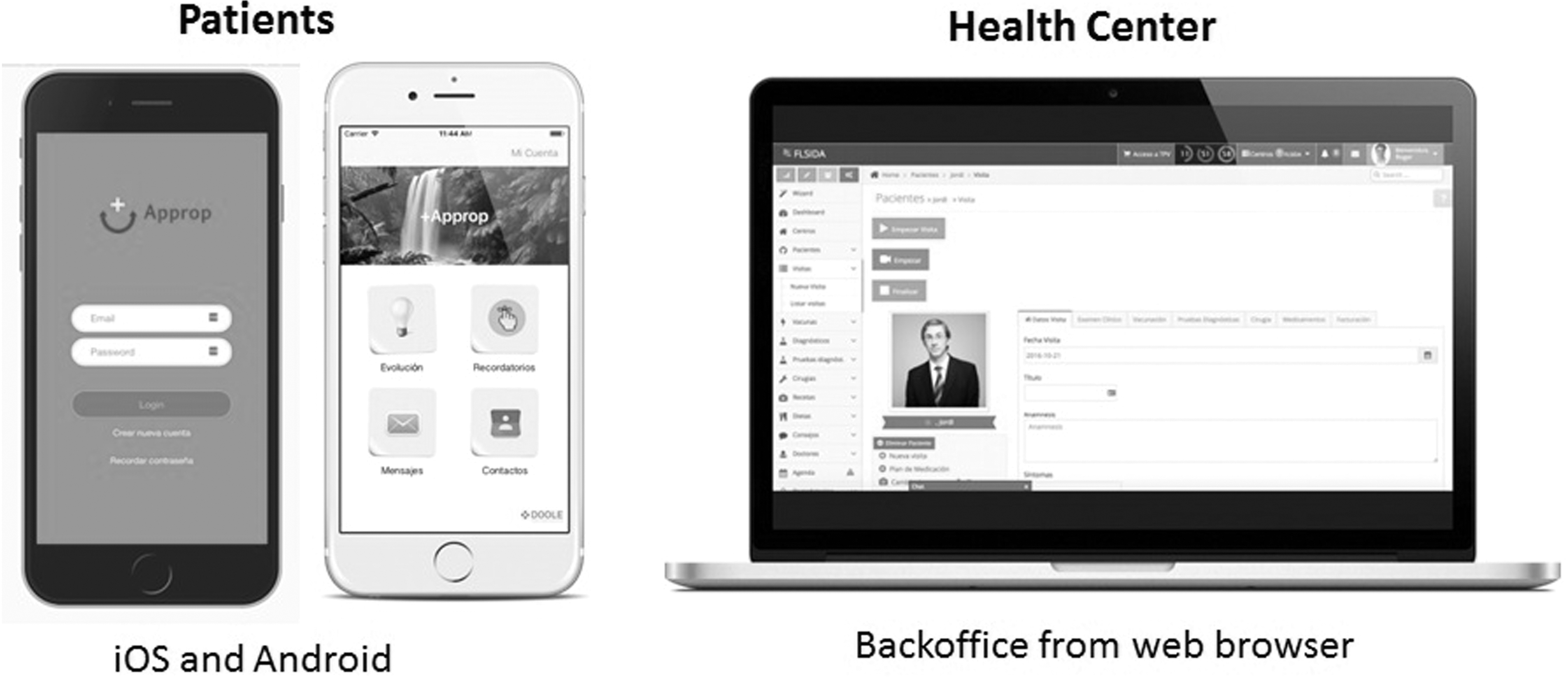
App and back office initial prototype.
Reports: progress of clinical parameters, including clinical history, vaccines, antiretroviral treatment, concomitant medication, drug interactions, and graphs showing changes in specific laboratory parameters (parameters were selected individually according to the patient's interest in improving management).
Education: health counseling programs and diets for prevention of hypertension, dyslipidemia, osteoporosis, and diabetes; this section also included motivational tools to encourage specific exercises and smoking cessation and anthropometric measurements (graphs showing changes in weight, body–mass index, waist/hip perimeter, and blood pressure).
Reminders: alarms to remind patients about medical visits (HIV and other specialties) and taking antiretroviral and concomitant medication and visual alerts with a message for refilling prescriptions and prescription ordering.
Communication: links to obtain medical support through e-mails, messages, and video calls (Fig. 2). App sections.
A personal computer program was created to check all the information included by the patient in real time and to ensure that health personnel could provide additional clinical information (e.g., blood test results), monitor patient data, and answer messages.
The application did not save any data. Data were obtained only for viewing by prior request to the server and were encrypted using Secure Hash Algorithm 1 encryption and with the 256-bit Secure Sockets Layer security certificate. The permissions in the device were for (1) camera: video calls, sending photographs of diagnostic tests, and sending images; (2) photos: add images to diagnostic tests and messaging; (3) microphone: making video calls; (4) calendar: add appointments to the phone calendar; and (5) health: obtaining health data from the device (steps and number of beats/pulses, etc.) and being able to see them in the “Physical activity” section of the app.
After that we scheduled a group session (duration of 4 h) with five HIV patients, a physician, a nurse, a dietician, a computer technician (developer), and a graphic designer to gain information about the user interface of the app prototype created. The first 5 HIV patients (4 men and 1 woman, ages 60–75 years) who answered the previously mentioned survey and had interest in mobile apps were included in the group session. Participants were asked to identify features that could increase technology acceptance, category classifications, design requirements, navigational features, and marketing preferences. The final version of the app, which incorporated the functional specifications and user interface project, was designed according to this information.
Before the clinical study, the same patients who participated in the group session tested the app for a month.
Clinical Study: Design And Population
When the app was available, a 48-week, pilot, randomized controlled trial was conducted to assess the usability of the app for HIV-infected patients aged ≥60 years, patient satisfaction with the app, and the effect on quality of life.
The study was approved by the local ethics committee and health authorities and was undertaken in accordance with the Declaration of Helsinki and the principles of Good Clinical Practice.
To be included, candidates had to be aged ≥60 years, have the HIV infection, be receiving antiretroviral therapy, and be smartphone users. Patients with conditions that hampered understanding and use of mobile applications were excluded.
The clinical trial was proposed to the first 100 consecutive patients who attended a scheduled consultation and met the selection criteria. Those who agreed to participate in the study signed the informed consent document and were randomized 1:1 to the following groups: (1) using the app plus standard clinical management (app group, n = 50 patients) or (2) standard clinical management (without the app) (control group, n = 50 patients). The randomization list was created using a uniform distribution and assigning a range of values to each group.
Standard clinical management included routine clinical visits (2–3 visits per year) and additional visits, if necessary, following clinical practice.
The possibility of using the app once the study was finished was offered to all participants.
The app was installed in the smartphone of the participants who were randomized to the app group and trained in the use of the content of the app. Patients downloaded the app and access (user and primary password) was provided. Then, a specific training for use of the app was carried out with each participant to review the app in detail, section by section, as well as to practice how to include data and send messages. At week 24, a new meeting was conducted with each participant from the app group to motivate them to use the app.
At the baseline visit and at weeks 24 and 48, we recorded information about the usability of the app by measurement of the number of times patients accessed the app, using the register system. Traceability was achieved with the log in date, navigation time, and log out. At baseline and week 48, we recorded adherence (SERAD questionnaire), 25 quality of life (MOS questionnaire), 26 and satisfaction using a 7-item ad hoc survey ranging from 1 (worst) to 5 (best), as well as some laboratory parameters (lipid profile, glucose, viral load, and CD4 count) and anthropometric parameters (height, weight, and body–mass index).
Type of Analysis and Computer Program
The data obtained were processed in Excel and reviewed to detect inconsistencies or processing errors. Statistical analysis and data processing were carried out using SPSS 15 for Windows. All the study variables were separated by group and according to baseline and demographic characteristics of interest. Quantitative variables were expressed as mean, standard deviation, median, interquartile range, and maximum and minimum. Categorical variables were expressed as relative and absolute frequencies and percentages.
Since variables were non-normally distributed, they were compared using the Mann–Whitney test. The chi-square test or Fisher exact test was used as appropriate to compare discrete variables. The Wilcoxon signed-rank test was performed to assess the significance of changes observed, and within-group comparisons were evaluated using the McNemar test when the variables were categorical.
The clinical objectives were analyzed per protocol, that is, the data analyzed at week 48 were those corresponding to patients who were followed up until that week. Statistical significance was set at p < 0.05.
Results
Results From The Survey On App Needs
A total of 50 patients agreed to participate in the survey before the clinical trial; 72% were men and the median age was 66 (interquartile range [IQR], 60–68) years. Almost half of the patients (52%) did not know what an app was. Of those who did know what an app was, 51.1% reported that an app could help in their medical monitoring, 68% reported that they could obtain more information in less time or that it is easier, 65.4% liked the health care recommendations, 69.2% reported that a reminder system for medical visits would be useful, and 84% thought that virtual medical visits could replace some face-to-face visits (Table 1).
Survey on App Needs
Clinical Trial
The clinical trial was proposed to 114 consecutive HIV-infected patients who attended our HIV unit from June to December 2017. Five declined to participate for personal reasons, and nine were not finally included owing to technical problems with their smartphone (eight did not have sufficient random access memory and one had an old version of Android). Finally, 100 patients were randomized: 50 in the app group and 50 in the control group. One patient from the app group was lost to follow-up (Fig. 3).

Flowchart.
Baseline characteristics are described in Table 2. Seventy-three percent were men, and the median age was 65 (IQR, 63–69) years; 46% were men who have sex with men, and the median time with HIV infection was 21 (IQR, 16–25) years.
Baseline Characteristics of Participants in the Clinical Study
IQR, interquartile range.
Usability of the app according to the register system
At week 24, 52.2% of patients had used the app (defined as at least 10 different days using the app); the most frequently used fields were laboratory results (mean of 12, IQR [4.5–26.5]) and medication reminders (mean of 13, IQR [3–30]).
After weekly automatic reminders encouraging the use of the app, the register showed that 73.8% of patients had used (at least 10 different days) the app at week 48. Patients used the app for a mean of 23.7 (±2.84) different days in 48 weeks. The total number of sessions was 6,177, and the mean session time was 6 min and 51 s (±34.72 s). The mean number of screen views was 617.7 (±508.25), with a mean of 6.88 (±1.84) screens per session. The most visualized screens were health care recommendations and medical records (laboratory results) (24.8% and 22.2%, respectively) (Table 3).
Usability of the App at Week 48 According to the Register System
′, minutes; ″, seconds; SD, standard deviation.
Patients aged 60–65 years were the group that most actively used the app compared with those aged over 65 years (p = 0.029).
Intragroup comparison of patient's satisfaction between baseline and week 48 in the app group
Regarding satisfaction with the app, at week 48, 85.2% of patients thought that the app was useful and 91.4% would recommend the app to friends and family. The mean global valuation of the app was 4.79 (±0.41) of 5.00, and 64.6% thought that the app improved their health care.
Comparisons between the app group and controls at week 48
The frequency of face-to-face visits to the HIV unit was 4.29 (±1.43) days for the app group and 5.33 (±1.72) days for the control group (p = 0.03).
Quality of life was classified as good or very good at week 48 by 93.7% of patients in the app group and 91.6% in the control group (p = 0.842). There were no significant intergroup changes in the perception of quality of life from baseline (p = 0.748). There were no significant changes in adherence at week 48 (p = 0.493).
At week 48, there were no significant changes in the clinical parameters recorded, namely physical activity (p = 0.842), body–mass index (p = 0.793), blood pressure (p = 0.921), and laboratory parameters (data not shown).
Discussion
The life expectancy of the HIV-infected population has increased progressively. Nowadays, HIV infection is a complex chronic disease associated with numerous medical and psychological problems and new approaches are needed to better manage this population.
Different studies evaluate medical/health care apps in this population, but they are focused only on prevention, adherence, or information about HIV infection. 24,27 –30 We created a medical app including all these aspects since there are no data on apps that encompass all these characteristics in a single interface. However, older people have negative attitudes toward the use of mobile phones as a didactic aid despite using them to perform daily tasks. 31 For that reason, we created an easy self-manageable app, considering the patient's opinion, to facilitate communication between patients and health care professionals about their medical management.
In fact, the first notable result in the survey was that 40% of patients revealed that they did not know what an app was, although those who did know what it was reported interest in it. A similar study, including subjects with heart failure, also found out patients' interest in a mobile app using a self-administered survey. 32 The majority of 50 survey participants reported interest in several potential features of a mobile app designed for heart failure. Our and other data demonstrate patient interest and the potential benefits of mobile technology in chronic diseases.
Regarding usability, although 74% of those subjects who used the app reported that it was easy to use, at week 24 of the study, the use of the app was considered poor (52% of the participants for a mean of 17.4 days). Health care recommendations and medical records (laboratory results) were the most commonly used sections. However, after we decided to send all participants weekly reminders to use the app, the number of people using the app at the end of the study increased; 73.8% of the participants used the app for a mean of 23.7 days. The frequency of use of this app points to the user's interest in the content. Another recently published study, also in an HIV-infected population, shows an even higher use of an app, although this application was mainly focused on social aspects (Chat and News), while ours manages medical outcomes. 33
Regarding patient satisfaction, at the end of the study, the app was well evaluated by patients, and most said that they would recommend it to friends and family. An explorative mixed-method study involving 200 chronically ill patients revealed that mobile apps for health can improve patients' well-being, but should be easier to use and personalized. 34 With this purpose, our app was specifically designed with patients and for patients, and the survey at the end of the study confirmed the high level of satisfaction of users of the app.
No changes were found in adherence, quality of life, or clinical parameters. Probably, we may need to study the app data for more than 48 weeks to see changes in older patients. Similar to our results, a systematic literature review evaluating mobile health (m-health) apps for self-management in patients with rheumatic and musculoskeletal diseases showed that only very few studies showed improvement in medical outcomes. 35 On the contrary, other groups have shown improvements even in a short follow-up (12 weeks), in functional and clinical parameters, 36 or in patient satisfaction and adherence to chronic medications or interventions. 37,38 This probably means that an individualized and easy-to-manage app that empowers and motivates patients can lead to improvement in clinical management. Regular monitoring through the app may help to increase the use and potential benefit of an app. In fact, people from our study who used the app attended the hospital less frequently than the control group (4.29 days for the app group and 5.33 days for the control group). This could be the first step to achieve more benefits in medical outcomes and quality of life.
Limitations
The first limitation of the study is the small number of participants; many people in this population do not know what an app is or have older smartphone models that prevent the app from being installed. A second limitation was the digital gap, that is, the lack of skill and experience in the use of mobile phones, which could account for the infrequent use recorded. The above-mentioned limitations prevent older people with larger number of comorbidities and needs from taking advantage of this technology.
Conclusions
In conclusion, our study shows the low usability of the app in HIV-infected patients, mainly among those aged over 65 years. However, patients referred that they liked to use the mobile app to receive health counseling and information on their medical records (laboratory results), and usability increased throughout the study after sending weekly reminders to use the app.
It is therefore necessary to promote information and communication technology and motivate patients in this age group to use apps. Likewise, family members and partners can help to improve patients' attitudes toward the use of mobile phones.
m-Health will soon play a key role in monitoring chronic diseases. A large proportion of adults, especially those who are older than 65 years, have or will have a chronic condition that requires or will require regular care. When the percentage of older people who manage apps comfortably rises, a solid and proven strategy for use should already be established. Future strategies should be aimed at promoting our app or similar apps among young people so that they become accustomed to using them.
Footnotes
Acknowledgments
The authors are grateful to the participants for their collaboration in the study.
Disclosure Statement
The authors declare that they have no conflicts of interest.
Funding Information
The study was supported by a grant from Gilead (Goshape 2015).