




Abstract
Background:
Electronic consultation (eConsult) allows asynchronous virtual communication between primary care providers (PCPs) and specialists regarding patient care.
Introduction:
The Ontario eConsult Program enables timely and equitable access to specialist advice for Ontarians. This study examines clinicians' perspectives and experiences with the program.
Materials and Methods:
We conducted an anonymous survey of PCPs registered for the Ontario eConsult Program. The survey ran from June to August 2019 and included questions on PCPs' experiences with the service, opinions on remuneration, and recommendations for enhancement.
Results:
One thousand two hundred fifty-six PCPs completed the survey (response rate of 16%). Seventy-eight percent had submitted an eConsult, of whom 67% were active users (i.e., had submitted ≥3 eConsults in the past 6 months). The majority of PCPs stated that their user experience was very good (57%) or good (31%), 74% agreed that eConsult improved their referral decision making, and 73% agreed that eConsult increased their ability to manage a broader array of diagnoses. Thirty-seven percent felt adequately compensated for using eConsult, 30% wanted higher rates of remuneration, and 31% were not compensated or were unaware of the fee code.
Discussion:
The majority of PCPs who use eConsult had positive experiences with the service. Nevertheless, improvements to further streamline the service's use, particularly through electronic medical record integration, were broadly cited as a desirable improvement.
Conclusions:
PCPs expressed an overall positive experience with the Ontario eConsult Program, citing prompt response times and improved care delivery as chief benefits.
Introduction
Canadians face longer wait times for specialist care than their peers in many developed countries. A 2016 survey by the Commonwealth Fund put Canada last among 11 participating countries to access specialists, with 56% of Canadians waiting four or more weeks for an appointment, versus an international average of 36%. 1 Delays in access to specialists have serious ramifications for patients, resulting in frustration, anxiety, and poorer health outcomes. 2
Electronic consultation (eConsult) is an asynchronous communication tool that facilitates virtual conversations between primary care providers (PCPs) and specialists regarding a patient's care. Through eConsult, PCPs can manage some conditions with remote support by the specialist without patients themselves needing a face-to-face specialist appointment. eConsult services have been shown to reduce wait times, improve access to specialist advice, and increase PCP and specialist satisfaction with the primary care–specialty care interface. 3 –5
This being said, the purpose of eConsult is to provide PCPs with guidance on care, not to replace specialist visits altogether. Previous research has shown that in 3.4% of cases, PCPs had not contemplated a referral initially, but as a result of the advice received through eConsult, initiated one. Further, specialists expressed a sense of urgency in scheduling the referral in 5% of those cases. 6
In 2018, the Ontario Ministry of Health and Long-Term Care implemented the Ontario eConsult Program, a province-wide initiative designed to enable timely and equitable access to specialist advice for all Ontarians. During its first full year of operation, the Ontario eConsult Program completed 45,538 cases. 7
As part of our ongoing evaluation of the program, we circulated an online survey designed to assess users' experiences with the program and perspectives regarding its impact on their ability to provide care. This study presents the findings of that survey, which will be of interest to innovators looking to implement eConsult services in their own jurisdictions.
Methods
Design
We conducted a 24-question web-based survey of all PCPs registered for the Ontario eConsult Program.
Setting
The program includes four services: the Ontario eConsult service, the Champlain BASE™ regional service, Teledermatology, and Teleophthalmology. Individuals who use the Ontario eConsult service can select from two different models: (1) the BASE™ Managed Specialty model, in which PCPs select a specialty group and a case assigner delegates the question to a relevant specialist based on availability, and (2) the Ontario Telemedicine Network (OTN) Direct to Specialist model, in which PCPs identify a particular specialist from a directory and sends the case to them specifically. The PCPs who use the service can be remunerated through the Ontario Health Insurance Program, the province's Medicare program.
Participants
All PCPs currently practicing in Ontario and those enrolled in the Ontario eConsult service or the Champlain BASE eConsult service during the survey period were eligible to participate in the study. Individuals who joined multiple services (single specialty service and the BASE or Ontario eConsult services) were also eligible to participate. Individuals enrolled only to use the Teledermatology and Teleophthalmology services were not contacted and, therefore, ineligible to participate.
The survey was launched in June 2019 and sent to 7,745 PCPs. One thousand three hundred fifty-nine PCPs were registered for the Champlain BASE eConsult service, 6,136 PCPs for the Ontario eConsult service, and 250 PCPs for both services. Twenty-seven PCPs (6 BASE PCPs and 21 Ontario eConsult service PCPs) were removed from the participant list, as their email addresses were no longer active, they had retired, or they were no longer involved in primary care. In addition, 22 PCPs indicated they were out of the office for the entire duration of the survey, resulting in 7,718 surveys being distributed.
Survey
We based the survey on one that had been previously used by the Champlain BASE eConsult service. Our modifications were guided by a literature review and questions were raised over time by PCPs and partners. 8 The survey explored PCPs' opinions in three key areas: experience with the service, remuneration, and recommendations for service enhancements. Question types consisted of multiple-choice, rank ordering, Likert scales, and open-text responses. PCPs who had not yet sent an eConsult (nonusers) completed a 9-question web survey related to reasons for nonusage.
Data Collection and Analysis
The survey was uploaded onto an encrypted survey platform (Hosted in Canada Surveys) that meets all necessary privacy standards. Surveys were anonymous and did not collect identifying data.
The survey remained open for 8 weeks and closed on August 26, 2019. Reminder emails were sent at weeks 4 and 7 to PCPs who had not yet completed the survey. Descriptive statistics were generated. This project was approved by the Ottawa Health Science Network Research Ethics Board.
Results
A total of 1,256 PCPs completed the survey, resulting in a response rate of 16%. Of these, 89% provided demographic details (n = 1,113; Table 1). Most PCPs (65%) were primary care physicians, and more than half (57%) reported practicing in multi-provider clinics (e.g., Family Health Teams, Family Health Organizations). Only 12% of PCPs worked with a practice model that was not listed, including nurse practitioner-led clinics and hospital-based clinics. Twenty-five percent of PCPs graduated between 2010 and 2019, and 58% of the surveys were completed by female PCPs.
Characteristics of Primary Care Physicians Who Completed the Survey
Includes only those participants who completed the demographic portion of the survey (n = 1,113).
CHC, Community Health Centre; FHT, Family Health Team; FHO, Family Health Organization; FHG, Family Health Group; FHN, Family Health Network; LHIN, Local Health Integration Network.
Of the 1,256 survey responses, 78% of PCPs had submitted an eConsult. Of this group, 67% were active users, meaning that they had submitted at least three eConsults in the past 6 months, whereas 26% had submitted one to two eConsults in the past 6 months. Seventy-two percent of PCPs who completed the survey use the Ontario eConsult service most often. Among PCPs using the Ontario eConsult service, there was a fairly even split between the number of users who accessed specialist advice by using the BASE Managed Specialty model (40%) and those who used the Direct to Specialist service (41%), whereas the rest (18%) were unsure.
Most PCPs first heard about eConsult through another primary care colleague (36%), a meeting where eConsult was discussed (20%) or an OTN representative (13%). When asked to list their main reasons for participating in eConsult, the top 3 most frequently selected responses were (1) reduced wait times (which ranked among reasons offered by 62% of PCPs), (2) ability to access specialist advice for patients who are unable to see a specialist (54%), and (3) reduced need to reach specialists by phone (40%).
Experience With e Consult
The majority of PCPs stated that their overall eConsult user experience was very good (57%) or good (31%). Seventy-four percent of PCPs agreed that eConsult improved their referral decision making, whereas 73% agreed that eConsult increased their ability to manage a broader array of diagnoses (Fig. 1). Sixty-nine percent of PCPs reported that eConsult improved care coordination. The majority of PCPs (82%) agreed that eConsult increased their confidence in care management, and more than half (61%) agreed that eConsult broadened their specialist network.
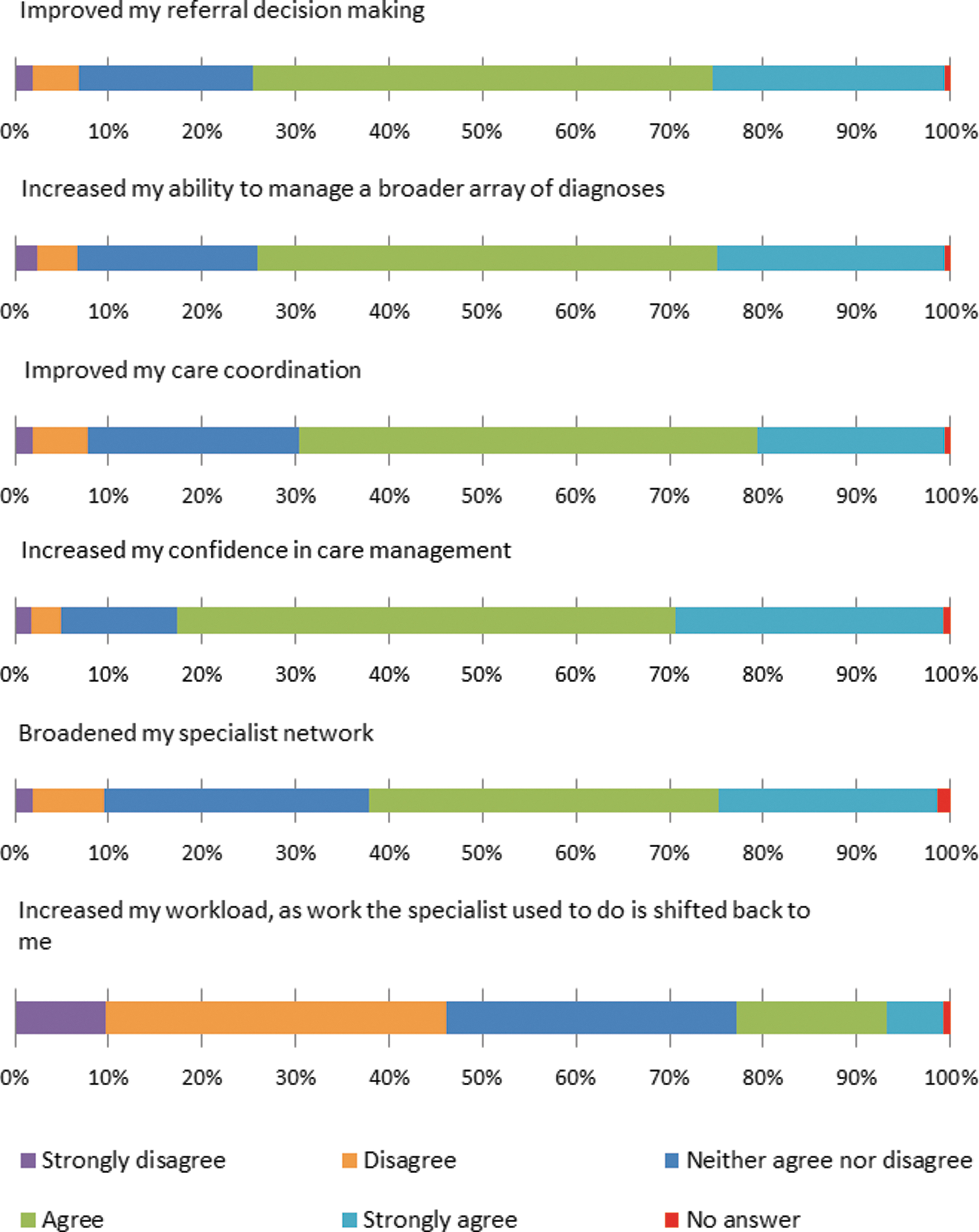
Responses by PCPs (n = 1,256) to questions on their experiences related to eConsult. eConsult, electronic consultation; PCPs, primary care providers.
In some cases (22%), PCPs stated that eConsult increased their workload, though some noted in their comments that “the advantages often outweigh [the increased workload because they get] a quicker response for [their] patients.” PCPs provided examples in the free-text comments of how eConsult improved their capacity to provide care. For instance, one PCP described how eConsult helped them diagnose a patient's unusual gait pattern: “I uploaded the patient video and had a great explanation back from a neurologist within days. Not only did I increase my knowledge through the consult, I also received patient management advice in a timely manner.”
The PCPs, most of whom (67%) have no administrative support for using eConsult, reflected on their experience submitting eConsults. Seventy-two percent of PCPs agreed they received adequate training, and 66% percent agreed they receive adequate support when they have questions. More than half of PCPs (52%) agreed that eConsult could be integrated into their clinical workflow without difficulty. The majority of PCPs (70%) agreed that the eConsult service is user-friendly (Fig. 2). Some PCPs commented on their experience with eConsult, noting that the service was “very easy to use,” “[they] didn't need much training,” “highly responsive and helpful [staff],” and “user-friendly.” Of the minority of PCPs that reported eConsult not to be user-friendly (12.7%), some cited a long log-in process, challenges uploading photos, and difficulties completing the necessary forms, as the reasons hindering usability.
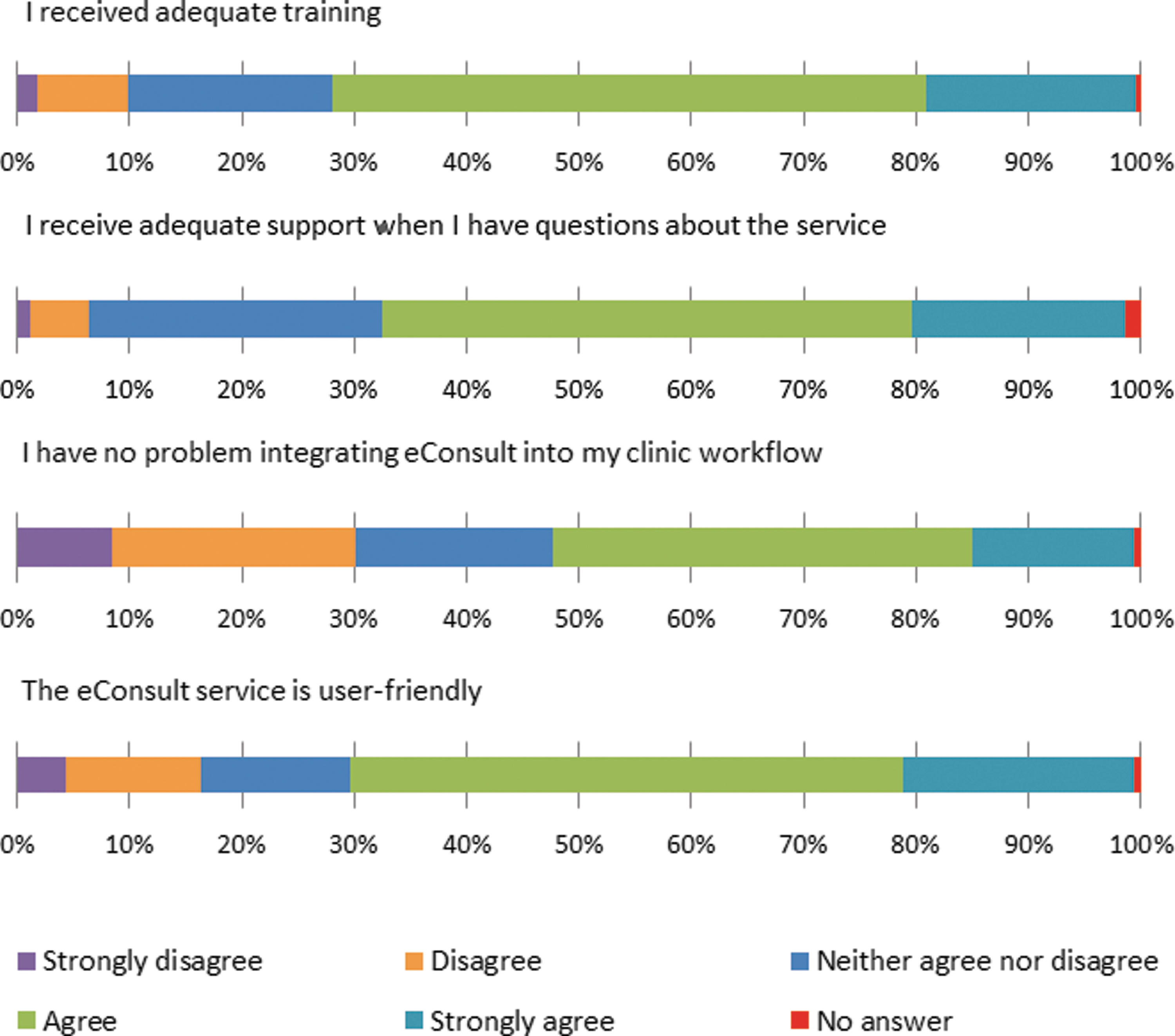
Responses by PCPs (n = 1,256) to questions on their experience submitting eConsults.
The majority of PCPs indicated that they communicate the results of an eConsult to their patients always (64%) or sometimes (13%), whereas only 1% said that they communicate results to patients rarely or never (22% did not provide a response). The top three methods of communication are face-to-face appointments (66%), phone calls from PCPs (55%), and phone calls from clinic nurses (27%), with some PCPs choosing multiple methods depending on circumstance. eConsult requests submitted to specialists most commonly included topics pertaining to treatment plans (76%), diagnosis (60%), and drug management (34%).
Remuneration
More than half of PCPs (56%) reported using billing code K738 when submitting an eConsult, for a payment of $16. Of these PCPs, only 11% reported having a billing code rejected. The PCPs who had had their billing codes rejected offered possible reasons in the free-text comments, such as “I believe it can't be submitted on the same day as another billing/visit code”; “Cannot bill for LTC patients”; and “I […] didn't know they had to be submitted within 6 months of eConsult.”
Thirty-seven percent of PCPs feel adequately compensated for using eConsult. Those who do not feel adequately compensated (30%) noted that “the compensation should also take into account the amount of time [taken from] administrative time to submit and check the eConsult recommendations and then communicate this to […] patients.” As a result, they proposed higher rates of remuneration ranging from $20 to $100.
A few PCPs suggested that the current compensation would be adequate if eConsult were integrated with their electronic medical records (EMRs); however, until then, the compensation should increase due to the time required to submit an eConsult outside of EMR. Further, 31% of PCPs clarified that they were not compensated at all for using eConsult, either because their position does not allow for compensation (e.g., they are salaried) or they were unaware that they could bill for the service: “I didn't know primary care docs could get compensated for using [eConsult]. I've never received any extra compensation for using [eConsult] and I've sent well over 100 [eConsults].”
Recommendations for Enhancement
The PCPs were also asked for suggestions to enhance eConsult. Sixty-eight percent of responses pertained to better integration with clinic workflow, particularly through EMR integration. Other suggestions included creating an app optimized for use on tablets and smartphones (21%), adding more specialists from the PCP's region (17%), and making the service more user friendly (10%). Some PCPs noted that “the process is significantly time-consuming,” the service sends “too many [reminder] emails […] once a week is more than enough,” and “if there were more local providers, the specialists could reply with an answer or if required accept the patient for an in-person consult instead.”
Many PCPs had positive comments about what works well with eConsult, including timely responses from specialists, a broad range of specialties offered, asynchronous communication, high-quality clinical advice, ease of use and communication, and avoidance of unnecessary face-to-face specialist visits. The PCPs commented that eConsult “greatly contributes to the quality of [care provided] as a family physician,” allows users “to get opinions from specialists in days rather than months,” and “has provided [them with] substantial educational value and immeasurable clinical value to [their]patients.”
Nonusers
Among the PCPs who answered the survey, 14% (n = 170) identified that they had not previously submitted an eConsult, whereas 8% (n = 105) did not specify whether they had used eConsult earlier. Among the PCPs who identified themselves as nonusers, 46% were unsure how to access the service. In the free-text comments, PCPs described such barriers to use as forgotten passwords, misplaced login information, and a need to redo training. One PCP noted that competing demands made it difficult to adopt eConsult during its initial implementation, after which they were uncertain how to proceed with accessing the service: “When eConsult was launched, it was during a crazy busy time for me at work. As a result, I have misplaced all information related to eConsult (i.e., how to access, my passwords, etc.). I would love, however, to regain access… just not sure how.”
In addition, 31% of nonusers (n = 52) have not used eConsult because it is not integrated into their EMR: “[using eConsult] requires extra time to print documents, patients' profile and attach to question. [It] would be easier if it could be done through my EMR.” Despite a lack of EMR integration and the perceived administrative burden of adopting the service, 58% of nonuser PCPs (n = 99) were interested in learning more about how to use it.
Discussion
The Ontario eConsult Program was successfully implemented in 2018 and continues to increase its user base. According to the responses submitted via our online survey, the majority of PCPs who used eConsult had positive experiences with the service. Reasons for joining the service included prompt response times, improving access to specialist advice, and offering better management of patient care.
Other studies support PCPs' positive experience with eConsult. As part of a pilot study of an Electronic Consultation Service in Quebec, Canada, a satisfaction survey was conducted, in which overall satisfaction was rated high by PCPs using the service. 9 High satisfaction with eConsult also extends beyond Canada, as systematic reviews of eConsult studies worldwide report satisfaction levels among PCPs ranging from 70% to 100%. 3,7 Many PCPs cited the service's timeliness as one of its chief benefits, replicating past findings. 10 –13 In line with the literature, PCPs also stated that eConsult improved their ability to manage a broader range of patients. 14,15 This echoes a survey on specialists' perspectives of eConsult conducted in 2017, which revealed that most specialists using the service were also satisfied. A majority of them agreed that eConsult is an effective means to provide education and improve communication with PCPs and it allows for the opportunity to learn more about their own cases when asked questions. 8
Despite the majority of PCPs indicating that they have no administrative support for using eConsult, most stated that eConsult did not increase their overall workload. This is in line with recent studies, which have found that eConsult did not increase—or in some cases, even decreased—PCP workloads. 16,17 However, some PCPs have expressed concern that eConsult is shifting work away from specialists and onto PCPs, thereby increasing their workload. 18 For instance, a study of PCPs' perceptions of working with eConsult in the Los Angeles County's safety-net program found that, although most PCPs praised the service's timeliness and educational benefits, they also expressed frustrations with the increased administrative burden and interface issues, broadened clinical responsibility, and restructuring of specialty care delivery. 10 These concerns have been linked to the issue of physician burnout, which is being increasingly recognized as a systemic health care problem with adverse impacts on physician health and patient care. 19 Given the importance of provider experience in adopting new technology, it is important to consider challenges related to increased workload and burnout when deciding how to best implement eConsult services.
Although most PCPs agreed that they have no problem integrating eConsult into their clinic workflow, a majority acknowledged that improvements, such as EMR integration, are necessary—a finding also reported in a study by Lee et al. 10 Similarly, a survey of specialists in Ontario revealed that several specialists supported integration of eConsult with EMR. 20 In a 2015 study of satisfaction with eConsult, specialists identified a lack of inclusion of eConsult with EMRs as a barrier to their use. 12 As a result, EMR integration is a priority to maximize eConsult's potential to reach providers.
The PCPs' opinions on remuneration differed: A third of PCPs stated that they felt adequately compensated for eConsult, whereas the rest did not feel adequately compensated for using the service or were not compensated at all. Of note, PCPs do not receive compensation when referring a patient for a face-to-face specialist visit. A 2017 review of physician remuneration for remote consults found that only PCPs in Ontario and Alberta are remunerated for sending eConsults, receiving $16 and $32.43, respectively—a lower range than the one proposed by PCPs participating in this survey. 21 In light of this, innovators in other provinces looking to adopt eConsult may wish to address this issue by developing policy in support of PCP remuneration for eConsults. In comparison, previous research regarding specialists' perspectives on remuneration found that half of the specialists surveyed stated that they were appropriately compensated for their time answering eConsults. However, similar to PCPs, specialists also thought that there should be increased compensation depending on the workload associated with the eConsult, such as answering follow-up questions. 8
To our knowledge, our study is the first to examine PCP perspectives on eConsult across a jurisdiction of this scope. Another aspect of its novelty was its focus on providers who had and had not previously submitted eConsults.
Limitations
Study limitations include a low response rate of 16%. The nonresponse bias could be due in part to the online survey only being available for 8 weeks over the summer, which may have limited the ability of all PCPs to participate. Despite our survey's large sample size and broad geographic scope, it remains limited to a single province and, as such, may not be generalizable to other settings across Canada. The study is susceptible to recall bias, as participants were asked to comment on cases that may have been completed months earlier. Lastly, although the survey allowed for input from nonusers, we should note that users of the service made up a disproportionately large percentage of respondents (78%, versus the overall ratio of 20% of enrolled PCPs).
Conclusion
The PCPs expressed an overall positive experience with the Ontario eConsult Program, citing prompt response times and improved care delivery as chief benefits. The majority of PCPs did not experience increased workloads after adopting the service, nor did they have trouble incorporating eConsult into their workflows. Nevertheless, improvements to further streamline the service's use, particularly integration through EMRs, was broadly cited as a desirable improvement.
Footnotes
Acknowledgments
The authors wish to thank the providers who participated in the survey, and Justin Joschko for his help with drafting the article and preparing it for publication.
Disclosure Statement
Drs. Liddy and Keely are co-executive directors of the Ontario eConsult Centre of Excellence, funded by the Ontario Ministry of Health and Long-Term Care. They cofounded the Champlain BASE (Building Access to Specialists through eConsultation) eConsult service but do not retain any proprietary rights. Dr. Keely answers eConsults through the service, less than one per month.
Funding Information
Funding for this study was provided by the Canadian Institutes of Health Research (PJT-159769) and the Ontario Ministry of Health and Long-Term Care. The funders had no role in study design, data collection/analysis/interpretation, or preparation of the article.