




Abstract
Background:
Owing to the COVID-19 pandemic, there has been a large shift in health care toward virtual platforms. This study analyzed patient and physician satisfaction with telehealth during the height of the pandemic within the division of sports medicine.
Methods:
All sports medicine patients who completed a telemedicine visit from March 30, 2020, through April 30, 2020, were sent a 14-question Likert scale (1–5/5) survey. Sports medicine physicians who used telemedicine were sent a separate 14-question Likert scale (1–5/5) survey at the end of the study period. Factors influencing patient satisfaction were determined using a multivariate linear regression model.
Results:
A total of 143 patients and 9 sports medicine attendings completed the surveys. Most patients were “satisfied” (4/5) or “very satisfied” (5/5) (88.8%). A multivariate linear regression determined that patients who believed they had a greater ability to adopt new technology and were more effective at communicating questions/concerns to their physicians had greater satisfaction (p = 0.009 and p = 0.015, respectively). Most physicians were either “satisfied” (4/5) or “very satisfied” (5/5) (75.0%). On average, physicians felt that physical examinations conducted through telemedicine were “moderately effective” (2.75/5.00 ± 1.3), that they were “fairly confident” (3.86/5.00 ± 0.83) in their diagnoses, and that most sports medicine attendings plan to use telemedicine in the future (87.5%).
Conclusion:
Telehealth emerged as a valuable tool for the delivery of health care to sports medicine patients during the COVID-19 pandemic. Patients and physicians reported high levels of satisfactions with its use, and this study further identifies areas that can improve the patient and physician experience.
Introduction
Telehealth is a reference to the distribution of health-related services through telecommunication and electronic information. Telemedicine falls under this broader term, referring specifically to the provision of health care services. 1,2 Previously, the overall use of telehealth in the United States has been modest, with 8% of Americans reporting exposure in 2019. 3 As with any new technology, barriers to the rapid adoption were related to infrastructure and policy, including limited reimbursement, lack of comfort with technology, lack of infrastructure to conduct telemedicine visits, and regulatory restrictions. However, the usage of telehealth has been on the uptrend, due, in part, to early results demonstrating overall patient satisfaction with pre- and postoperative surgical consultations, decreased unscheduled visits, and decreased cost. 4 –6
Recently, this rise in telemedicine has seen a dramatic increase, catalyzed by the global spread of the novel coronavirus (COVID-19) in the spring of 2020. The virus quickly spread worldwide with >11 million confirmed cases and >500,000 deaths secondary to the virus. 7 In the United States, >2.8 million cases have been recorded and >129,000 deaths, with New York City being one of the epicenters of COVID-19 cases. 8 This surge continues today, with increases in the number of cases and deaths in many U.S. states, including Florida, Texas, and California. 9 In the wake of this virus, the U.S. health care system found itself with the need to minimize in-person visits as a measure to decrease patient and provider exposure. Telehealth was propelled into a leading role, allowing for continued patient care while maintaining social distancing measures, and continues to play an important role with the increasing cases in many states. Many of the historical hindrances to telehealth utilization were removed as Medicare became authorized to temporarily reimburse for telehealth visits more widely, with many private payers following suit.
Institutions that had established an infrastructure for telehealth found themselves well positioned to facilitate patient care during the COVID-19 pandemic. The sports medicine department at our institution was one of these pioneering groups, which allowed for a funneling of patients' visits toward virtual platforms during the pandemic. This created a controlled environment well suited to study telemedicine. Given the prior paucity of literature regarding perception and outcomes of sports telemedicine, the goal of this study was to analyze the perceptions and satisfaction of both patients and physicians of telemedicine visits within sports medicine at a major teaching hospital during the COVID-19 pandemic, elucidating how telemedicine can improve the delivery of orthopedic care in the future.
Methods
A survey study was performed at a major metropolitan health care center during the height of the COVID-19 pandemic. A 14-question survey was created to identify factors influencing patient satisfaction with telemedicine (Fig. 1). Sports medicine patients who completed a telemedicine visit from March 30, 2020, through April 30, 2020, were e-mailed the survey, with a follow-up e-mail at 1-week postvisit if there was no response. No patients completed the telehealth survey more than once. An online data collection platform (REDCap, Nashville, TN, USA) was utilized to collect survey responses. Manual chart review included age, gender, race, visit length, and whether the visit was a new patient visit, postoperative visit, or follow-up visit.
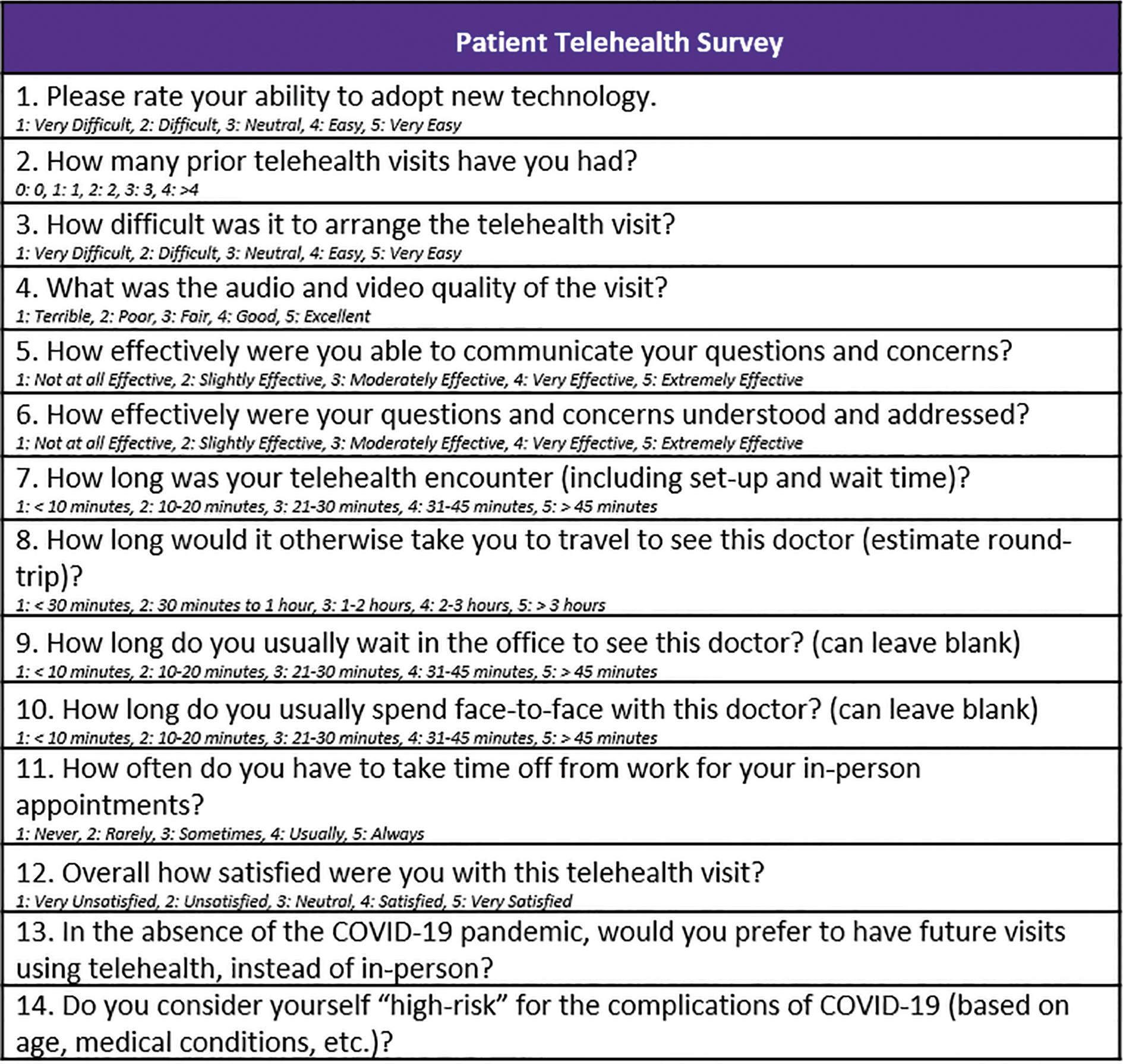
Patient telehealth survey provided to all patients to assess satisfaction with telehealth.
Telemedicine visits, which we define as a synchronous video visit, were performed using the electronic health care record system (Epic, Verona, WI, USA) with Vidyo (Hackensack, NJ, USA) telehealth service integration, which have been operational at the study institution since 2018 and used mostly for postoperative visits during that time.
Telemedicine visits were performed by eight experienced sports medicine physicians familiar with the platform at the start of the study, all of whom completed a 14-question survey assessing experience and satisfaction with telehealth at the end of the study (Fig. 2). Responses were collected using the same online data collection platform (REDCap) and reported descriptively.

Physician telehealth survey provided to all physicians to assess satisfaction with telehealth.
Statistical Analysis
Satisfaction levels for the patient surveys were categorized into three ordinal categories: “very unsatisfied” to “neutral” (1–3), “satisfied” (4), and “very satisfied” (5). Chi-square and Fischer's exact tests were used to compare categorical variables as appropriate. Analysis of variance was used to compare continuous variables. Each variable's ability to explain patient satisfaction was assessed using a univariant matrix correlation. For tests of association, multiple linear regression and correlation matrix were used. A multiple linear regression was conducted to determine if overall satisfaction was significantly affected by the survey questions. A correlation matrix was performed, attempting to identify any correlation among satisfaction and each individual survey question. A p-value of <0.05 indicated significant association between the dependent and independent variables. All surgeon survey scores are presented as mean ± standard deviation. All statistical analyses were conducted utilizing GraphPad PRISM 8.4.2 (GraphPad, San Diego, CA).
This study was exempt from human subjects review by our institutional review board as part of our institutional quality improvement program. No external funding was received for any aspect of this study.
Results
From March 30, 2020, to April 30, 2020, a total of 1,082 patients completed a telemedicine visit with a sports medicine physician and received a survey, with 13.2% completing the survey (143/1,082). The average age of respondents was 55.09 ± 14.6 years, 62.2% (89/143) of respondents were female, and the average telemedicine visit length was 20.8 ± 11.0 min. In total, 58.7% (84/143) of visits were follow-ups, 21.7% (31/143) were for new patients, and 19.6% (28/143) were first postoperative visits. All demographic data are listed in Table 1.
Demographics of Telehealth Patients
Patients were generally “satisfied” with their telehealth visit, reporting a mean 4.34/5.00 ± 0.90. Most patients reported only one prior telemedicine appointment (1.06 ± 1.25), with 37.1% (53/143) identifying themselves as high risk for COVID-19 complication. With respect to accessing the survey, patients noted ease adopting new technology (4.17/5.00 ± 0.91), ease arranging the telemedicine appointment (4.31/5.00 ± 0.90), and audiovisual quality was “excellent” (4.33/5.00 ± 0.84). When assessing communication, patients believed they and their surgeons could communicate effectively (patients: 4.30/5.00 ± 0.77; surgeons: 4.43/5.00 ± 0.77). Approximately 1–2 h of commuting was eliminated, by utilizing telemedicine appointments. Lastly, 42.0% of patients preferred telehealth appointments over in-person appointments. All questionnaire response data are given in Table 2.
Patient Telehealth Survey Responses
SD, standard deviation.
Using a multiple linear regression, ability to adopt new technology (p = 0.0087) and effectiveness of communicating questions and concerns (p = 0.0149) revealed significant influence in determining overall patient satisfaction. The regression calculated an R 2 value of 0.52, suggesting moderate predictability of overall satisfaction. The correlation matrix assessed whether each individual survey question had a direct effect and association on patient satisfaction. Younger age (p = 0.0096), ability to adopt new technology (p < 0.0001), ease with arranging telehealth visits (p < 0.0001), quality of audiovisual component (p < 0.0001), effectiveness in communicating questions and concerns (p < 0.0001), the amount of time needed off from work (p = 0.0179), and self-assessment of risk for COVID-19 complications (p = 0.0022) all suggested direct significant association with overall patient satisfaction. All other multiple linear regression and correlation matrix data are given in Tables 3 and 4 .
Multiple Linear Regression to Overall Patient Satisfaction
Bolded values denote values of significance (p < 0.05).
Correlation Matrix: Association with Overall Satisfaction
Bolded values denote values of significance (p < 0.05).
On average, orthopedic surgeons indicated that it was “easy” to adopt new technology (4.50 ± 0.53), “easy” to coordinate/setup the telemedicine visits (4.50 ± 0.76), that the audiovisual quality of the visit was “good” (4.13 ± 0.83), and that patients communicated “very effectively” (4.13 ± 0.64). Regarding accuracy of their diagnoses and assessments, the orthopedic surgeons were “fairly confident” (3.88 ± 0.83), however, were only “moderately effective” (2.75 ± 1.28) at performing a thorough physical examination. The sports medicine surgeons felt the least confident in their ability to determine and measure sensation (3.00 ± 1.31) and tenderness (3.00 ± 1.20). Surgeons felt the most comfortable measuring range of motion (3.75 ± 1.04). Overall, sports medicine surgeons felt “satisfied” with telemedicine appointments (3.88 ± 1.25). The surgeons felt that 42.6% ± 32.2% of their patients warranted an in-person visit for further evaluation. Almost all sports medicine surgeons (87.5%, 7/8) mentioned that they will continue to use telehealth in their practice, after the conclusion of the COVID-19 pandemic. All other surgeon survey response data are given in Table 5.
Physician Telehealth Survey Responses
Discussion
Telemedicine has evolved as a new modality in patient care that allows for remote evaluation of the patient. The social restrictions mandated by COVID-19 lead to a rapid transition toward telemedicine in orthopedic patient care. 10 Our institution, which had an established telemedicine system in place, quickly transitioned patient visits from the office setting to the virtual platform. This study evaluated patient and physician perspective of telemedicine at a major academic medical center at the epicenter of the COVID-19 pandemic, finding high levels of overall satisfaction with telemedicine and that this satisfaction was linked to patient ability to adopt new technology and perceived effectiveness in communicating questions and concerns.
Patients in this study were highly satisfied with the care they received during their telemedicine visits, rating the visits 4.34/5.00 ± 0.90 on a Likert scale. This speaks of the feasibility of telemedicine in outpatient orthopedic care. Multiple studies have demonstrated high levels of patient satisfaction with telemedicine in orthopedics, including a systemic review of 24 prior studies. 4,6,11 –15 In fact, some research indicates that patient satisfaction with telehealth visits even exceeds that of in-person visits. An earlier study in arthroplasty patients demonstrated higher satisfaction with telemedicine visits than in-office visits, with significantly fewer unscheduled visits in the telemedicine group. 6 Patient satisfaction with telemedicine has also been demonstrated in sports medicine, with satisfaction equivalent to in-person visits in a randomized controlled trial of rotator cuff repair follow-up appointments. 14 In addition to overall satisfaction in the visits, our study revealed strong support for telemedicine visits outside of the current COVID-19 pandemic, with 42% of patients stating that they would prefer future telehealth visits in the absence of the COVID-19 pandemic. Gillbert et al. evaluated patient satisfaction with telehealth visits during the pandemic and similarly found that outside of COVID-19, people preferred telehealth <50% of time. 13 Interestingly, in a randomized controlled trial of pre-COVID-19 telemedicine, 86% of patients preferred video-assisted consultation over in-person consultation. 11 Analysis of the data from our study may shed light on how to further improve patient preference for telemedicine. Patient satisfaction in this study was linked to the patient comfort with technology and ability to communicate. A multilinear regression model, which accounted for all survey variables and how they relate to each other, found that the patient's comfort with adopting the new telehealth technology (p = 0.0087) and their perceived ability to communicate questions and concerns (p = 0.0149) were predictive of patient satisfaction with telehealth. Therefore, finding methods to improve patient comfort with technology and ensuring the patients feel their questions and concerns are addressed can be expected to improve overall satisfaction.
Patients also reported significant time savings with telehealth visits. Our patients estimated that they spend 30 min to 1 h commuting to office visits, 10–20 min in the waiting room, and 10–20 min of actually face-to-face time with the physician when compared with the average telehealth encounter of 10–20 min, that is ∼2 h of time saved per patient. In prior studies demonstrating similar decreased time per visit for telemedicine, patient satisfaction remained equal to or better than in office visits. 14 –16 This represents one of the unique strengths of telemedicine that should be considered when evaluating cost-saving methods for our burdened health care system. This is especially true in resource-limited settings wherein telemedicine visits can improve clinic efficiency by targeting specific clinic visit types such as new patient visits or postoperative visits, decreasing overall in-person patient traffic. In quantifying these cost savings, it is estimated that the average telemedicine visit is 40–50% cheaper than the equivalent in-office visit. 17,18 Telemedicine also increases scheduling flexibility, limiting the amount of time patients need to take time off from work to be seen. In our patient cohort, there were a significant number of patients who reported requiring time off from work for in-office visits. In a randomized controlled trial of trauma patients participating in telemedicine, no patients in the telemedicine cohort required time off for work for follow-up, whereas 56% of patients seen in person required time away from work. 16 Although not directly tied to the cost of health care, these savings can benefit the attributed societal costs.
Physicians in this study were also satisfied with the care they were able to provide through the telemedicine platform, rating overall satisfaction as “satisfied” (3.875/5.00 ± 1.25). Prior research agrees that physicians generally express enthusiasm and satisfaction with telemedicine. 10,17 Physicians reported that the technology used in this study allowed for “easy” technical setup (4.50/5.00 ± 0.76) and “good” quality of the audio/visual presentation (4.13/5.00 ± 0.83). This likely contributed to the effective communication with the patient, rated by both physicians and patients to be “very effective.” Buvik et al., in a randomized controlled trial, found similar physician approval in treating patients remotely. In their study, 98% of physicians rated the overall ability to deliver patient care as “good” or “very good,” and ability to inform the patient about care as “good” or “very good” in 96% of cases. The primary outcome was a sum score of specialist evaluation from which video-assisted remote consultations were found to be noninferior to standard outpatient visits. 19
Regarding the telemedicine visit, physicians expressed less enthusiasm about aspects of the physical examination. The overall effectiveness in completing the physical examination was rated as “moderately effective” (2.75/5.00 ± 1.28). This appeared to be tied to examination components that would typically benefit from hands-on patient examination, such as “confidence in inspection” and “confidence in determining tenderness,” which both received a “moderately effective” rating. Whatever the individual shortcomings of physical examination through telemedicine, most physicians were still able to be “fairly confident” in the accuracy of their diagnoses/assessments (3.875/5.00 ± 0.83). Certain physical examination parameters, namely joint range of motion and incision evaluation, have been studied previously to determine accuracy of video-assisted examination. These studies found that video-assisted examinations provide capabilities equivalent to in-person examination. 20 Smartphones have been suggested as one tool to further augment this evaluation. 21,22 Interestingly, in the previously mentioned study by Buvik et al., most physicians rated their ability to evaluate/examine the patient as “good” or “very good.” This study did not parse out the respective portions of the physical examination (range of motion, sensation, and tenderness), which may relate to the overall improved examination rating. 6 Telemedicine may, therefore, be a useful alternative for basic patient assessment, with more complicated evaluations requiring in-person visits.
This study had several limitations. One was the lack of immediate response from patients as the surveys were not distributed at the appointment but rather during the same week through e-mail, subjecting the responses to recall bias. The use of the Likert scale is also known to create a central tendency bias. This would minimize response rates at extremes. Therefore, a question such as overall satisfaction, which resulted at 4.34/5.0, may actually have been more pronounced on a different scale. Finally, given the study was conducted during the COVID-19 pandemic, no in-person control group was available for comparison. Responses must be compared with historical standards with the future possibility of a direct comparison.
Conclusion
Video-assisted patient evaluation has emerged as a viable alternative to in-person visits in the outpatient management of orthopedic patients. This platform of telemedicine was drawn to the forefront of patient care during the COVID-19 pandemic, when interpersonal distancing and quarantining became essential in controlling the spread of disease. In this study, patients reported that the technology utilized for telemedicine was easy to adopt and allowed for effective communication with their provider. On the provider side, telemedicine allowed physicians to deliver care with continued confidence in diagnosis and treatment. This demonstrates that even during these times of forced utilization, telemedicine was received with satisfaction by patients and physicians in the ability to receive and deliver health care. Looking beyond this, the preference of telemedicine that nearly half of patients expressed provides support for the continued use of the platform. Considering that telemedicine has proven cost-saving capability, we would expect to see telemedicine utilization significantly increase. Future research will be useful to evaluate telemedicine efficiency based upon clinic visit type, identifying specific visit encounters that will benefit most from telemedicine in the future.
Footnotes
Acknowledgments
The authors thank the NYU telemedicine group for their IT support.
Disclosure Statement
Dr. Mandeep Virk is a paid consultant of Exactech and Acumed. For all other authors, no competing financial interests exist.
Funding Information
No funding was received for this article.