




Abstract
Introduction:
Suicide is one of the leading causes of death worldwide, and it can be prevented by psychotherapy. The objective of this study was to examine the risk factors predicting suicide ideation during messaging psychotherapy, and the moderating role of working alliance (WA) in the association between baseline depression and later suicide ideation.
Materials and Methods:
A large outpatient sample (n = 4,388) engaged in daily messaging with licensed clinicians from a telemedicine provider. Using a longitudinal design, depression and anxiety symptoms were assessed at baseline, using the Patient Health Questionnaire (PHQ-8) for depression and the Generalized Anxiety Disorder (GAD-7) for anxiety. The WA was measured with the short version of the Working Alliance Inventory after 3 weeks of therapy, and suicide ideation was assessed at baseline and after 6 weeks of therapy, by item 9 of the Patient Health Questionnaire (PHQ-9). Demographic measures were also assessed.
Results:
Results indicate that depression (β = 0.09, p < 0.001), baseline suicide ideation (β = 0.50, p < 0.001), and WA (β = −0.08, p < 0.001), especially the task subscale (β = −0.14, p < 0.001), significantly predicted suicide ideation after 6 weeks. WA (β = −0.07, p < 0.001), especially the task (β = −0.14, p < 0.001) and bond subscales (β = 0.06, p = 0.002), moderated the association between depression at baseline and suicide ideation after 6 weeks, so that experiencing higher quality of WA decreased the association between depression and suicide ideation.
Discussion and Conclusions:
Suicide ideation may be reduced by experiencing the therapeutic relationship as beneficial, even among at-risk populations, which suffer from depressive symptoms. It is the first study to show this moderation effect in any platform of therapy.
Introduction
Approximately 800,000 people die by suicide every year, and it is one of the leading causes of death worldwide. 1 Currently, the COVID-19 outbreak has increased the prevalence of mental health disorders, including depression. 2,3 Therefore, it is now even more critical than before to identify individuals at risk of suicide to provide them appropriate treatment. 4 One major risk factor of suicide attempts and completion is suicide ideation, 5 a term that refers to thoughts of engaging in behavior intended to end one's life. 6 Suicide ideation is considered to be one of the precursory steps that lead a person to suicidal behaviors. 7 Especially in individuals suffering from depression, suicide ideation has been found to predict suicide completion. 8,9 Fortunately, suicide is preventable, and a major resource of prevention is psychotherapy. 10
Psychotherapy delivered via technology platforms, such as mobile- and internet-based psychological interventions, has the potential to overcome many of the barriers associated with accessing traditional face-to-face therapy, 11 including social distancing required during COVID-19. Psychotherapy via technology platforms has been demonstrated to be effective in a wide range of disorders, 12 including depression, 13 self-injurious behaviors, 14 and suicide ideation. 15 A relatively new technology platform for psychotherapy is short message service text, 16 a medium that has universal popularity and has been found to significantly reduce clinical symptoms. 17 –19
To detect and respond effectively to suicide risk in technology-delivered psychotherapy, such as messaging therapy, it is essential to examine which factors predict changes in suicide ideation during these interventions. Previously documented risk factors of suicide ideation include being female, not being in a relationship, age <25 years, past nonsuicidal injury, having lower educational attainment, and the feeling of hopelessness. 7,20 In addition, a well-researched factor for suicide ideation is depression. 21 Anxiety disorders were also found to be an independent risk factor for subsequent onset of suicidal ideation and attempts. 22
To date, there are few studies examining how the risk factors above modify or are modified by online interventions. Christensen et al. 23 found that participants having higher baseline suicide scores in a web-based intervention were more likely to continue experiencing suicidal ideation at postintervention, whereas those with greater improvements in depression symptoms were less likely to experience suicidal ideation postintervention. Similarly, Hemelrijk et al. 24 found that suicidal ideation among people seeking psychological help on the internet was strongly related to depression, generalized anxiety disorder, social phobia, post-traumatic stress disorder, and not having a partner. However, to the best of our knowledge, there are no previous studies investigating which factors predict suicide ideation during messaging psychotherapy.
One of the factors that may predict improvement in suicide ideation during online therapy is the working alliance (WA), the quality of partnership and mutual collaboration between therapist and client. 25 WA is one of the most important contributing factors of beneficial therapy, 25 including for decreased suicidality. 26 For example, Gysin-Maillart et al. 27 found that higher alliance measures correlated with lower suicidal ideation after a brief face-to-face therapy. Interestingly, research found that the alliance–outcome association in online therapy was approximately the same as in face-to-face therapy. 28
WA also predicted symptom improvement in a mobile text messaging therapy, 29 although suicidality as a specific outcome was not examined. While many studies support the positive treatment effects of mobile and internet-based therapies for suicidal ideation, 14 there are currently no studies examining the influence of WA on suicidal ideation throughout therapy on a technology platform. In the current study, we hypothesize that meaningful relationship can be formed between a therapist and patient even when they never meet in person and their communication is only through messaging. We expect this relationship to be a strong enough factor to moderate suicide ideation during the treatment.
Therefore, the current study examined: (1) Whether baseline measures of depressive symptoms, suicide ideation, anxiety symptoms, and WA, as well as demographic measures (age, gender, education level and marital status) predict suicide ideation after 6 weeks of therapy; (2) Whether WA moderates the association between depression at baseline and suicide ideation after 6 weeks of therapy such that the association between depression and suicide ideation will be lower among patients who score high on the WA measure compared with patients who score low.
Materials and Methods
SETTINGS
The study was conducted through a telemedicine platform (Talkspace) in the United States, which delivers asynchronous treatment by independently practicing, licensed therapists. Individuals accessed this platform via internet search, Employee Assistance Programs, and as a behavioral health benefit through some individual insurances. Before starting the therapy, patients completed a brief, standardized intake meeting with a clinician and then chose one of three therapists suggested by a matching algorithm based on patient's state of residence, patient preference for therapist gender, and therapist experience with patient's presenting complaint. They then completed a self-report assessment at baseline and every 3 weeks, according to the diagnosis they received from their chosen therapist.
Individuals seeking treatment on this platform suffer from a variety of disorders and life stresses; however, in the current study, we included only individuals who had depression- and anxiety-related diagnoses. People with anxiety- and depression-related diagnoses received both the Patient Health Questionnaire-9 (PHQ-9) for depression 30 and the 7-item Generalized Anxiety Disorder questionnaire (GAD-7). 31 The WA was assessed 3 weeks after the beginning of treatment.
Clinicians walked patients through the informed consent and emergency contact process after which therapy began. Data were collected as part of organizational quality assurance and program management processes between 2014 and June 2020. All patients and clinicians gave written consent to the use of their data in a de-identified aggregate format before beginning treatment. Study procedures were approved as exempt by the institutional review board at Teachers College, Columbia University (15-426). A methodology schema of the study is presented in Figure 1.
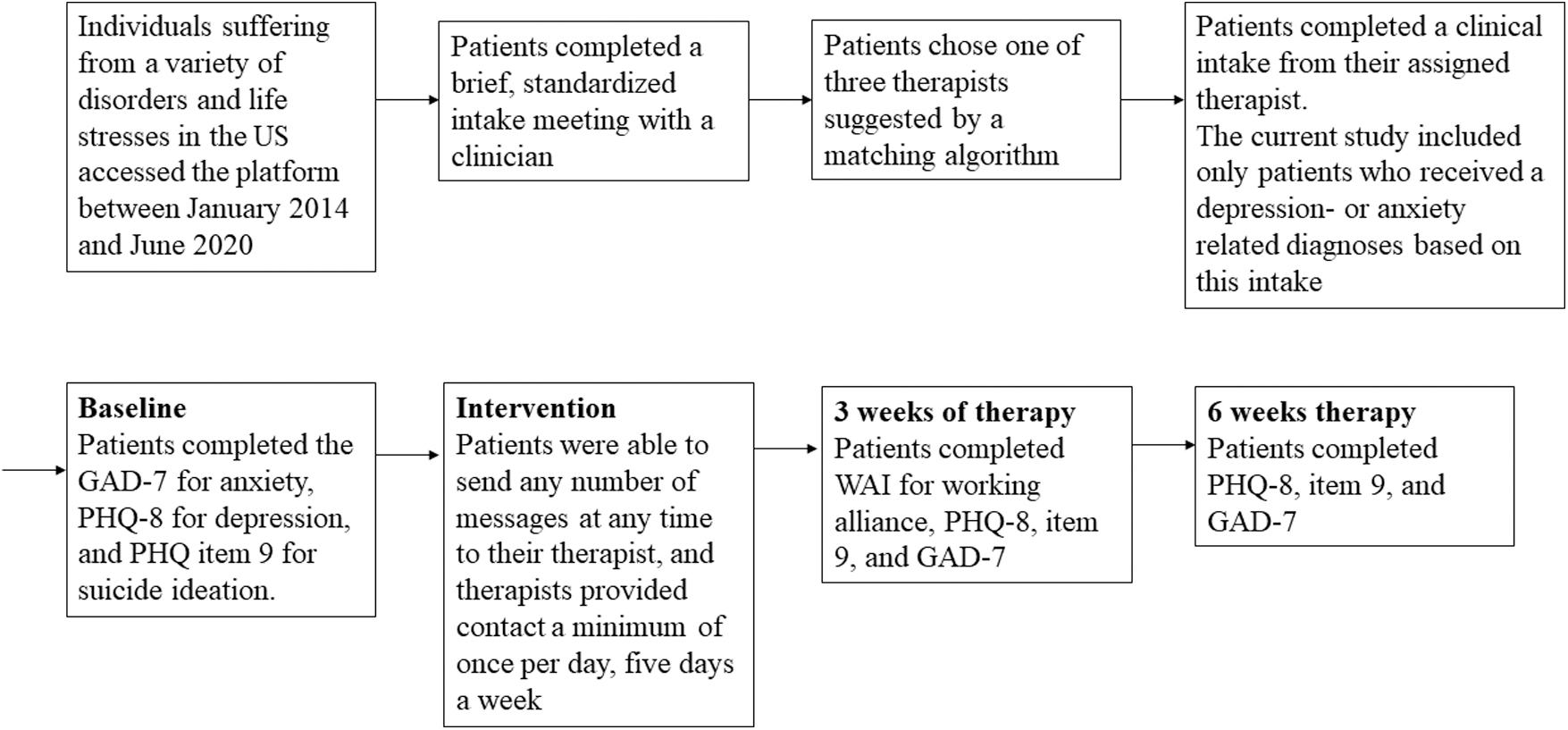
Methodology schema of the study. GAD-7, 7-item Generalized Anxiety Disorder; PHQ, Patient Health Questionnaire; WAI, Working Alliance Inventory.
PARTICIPANTS
The sample included 4,388 participants who sought treatment on the telemedicine platform between January 2014 and June 2020 and who completed all the study's variables (Patient Health Questionnaire-8 [PHQ-8], PHQ-9 item at baseline and after 6 weeks, GAD-7, and Working Alliance Inventory [WAI](. The PHQ-9 has been systematically deployed since June 10, 2018, and 42,087 participants answered this item at baseline, 7,309 after 6 weeks of therapy, and the 4,388 participants who answered all symptom and alliance measures were included in the current study.
Dropout is accounted for by some patients ending the treatment before 6 weeks, and by others who continued treatment, but did not respond to the follow-up questionnaires. Patients were at least 18 years of age, able to read English, able to access the therapy application regularly, and had proficiency in using mobile and desktop technologies. They received a depression- or anxiety-related diagnosis from their assigned licensed clinician based on a clinical intake via live messaging or video-based interview, as recorded in the electronic medical record with International Classification of Diseases, Tenth Revision codes. 32
INTERVENTION
Through a secure Health Insurance Portability and Accountability Act-compliant platform accessible on mobile devices and on desktop computers, clinicians and patients asynchronously exchanged text-, audio-, and video-based messages. Patients predominantly use text, sending audio and video messages occasionally. Patients were able to send any number of messages at any time to their therapist, and therapists provided contact a minimum of once per day, 5 days a week. Response times were scheduled and communicated at the start of treatment.
Therapists practiced from a variety of therapeutic orientations, including cognitive behavioral treatments, third-wave cognitive behavioral interventions, psychodynamic, and integrative approaches. All therapists went through a 30-day orientation process on providing care through the messaging medium but were allowed to practice based on their clinical judgment and orientation. Patients were able to determine how long they wish to participate in care. All professional and ethical standards were observed as per face-to-face treatment, and referrals to higher levels of care were provided when appropriate.
ASSESSMENT
In the current study, we examine depression symptoms, suicide ideation, anxiety symptoms, and demographic measures at baseline, the WA after 3 weeks of therapy, and suicide ideation after 6 weeks of therapy.
MEASURES
Depression
The standardized and validated PHQ-8 was used to assess the depressive symptoms. 30 The PHQ-8 is derived from all items on the PHQ-9, except suicide item 9. The items ask about the presence of symptoms in the past 2 weeks and were scored from 0 to 3.
Suicide ideation
Suicide ideation was assessed by item 9 of the PHQ-9. 30 This item asks “Over the last two weeks how often have you been bothered by this problem: thoughts that you would be better off dead or hurting yourself in some way?” Items were scored from 0 to 3 with response options “not at all” (score 0), “several days” (score 1), “more than half the days” (score 2), and “nearly every day” (score 3).
Anxiety
The GAD-731 was used to assess the anxiety symptoms. Items were scored from 0 to 3, and the rating was determined according to patients' experience in the preceding 2 weeks.
Working alliance
The quality of the therapeutic relationship was assessed by the well-validated short version of the WAI 33 consisting of 12 items rated on a 5-point Likert scale. The three subscales of the WAI include four items each: Bond (degree of mutual trust, acceptance, and confidence between client and therapist); Task (agreement and confidence on therapeutic tasks assigned by the therapist); and Goal (agreement on therapeutic goals).
STATISTICAL ANALYSES
To examine which variables predict suicide ideation after 6 weeks of therapy, we performed two multiple linear regression analyses. Two different regressions were made to separately examine the effect of the WAI overall score and the effect of its three subscales. In the first multiple linear regression analysis, we used the PHQ-8 at baseline, PHQ-9 at baseline, the GAD-7 at baseline, the WAI overall score at 3 weeks, and demographic measures (age, gender, education level, and marital status) as independent variables. In the second multiple linear regression analysis, we used the same independent variables, but instead of the WAI overall score, we used the three WAI subscales.
In addition, two hierarchical regression models were constructed to examine whether WA moderates the association between depression at baseline and suicide ideation at 6 weeks. In the first model, standardized scores of all variables were entered on step 1, and PHQ-8 and WAI overall score interaction was entered on step 2. In the second model, standardized scores of the three WAI subscales and the other variables were entered on step 1, and their interaction with PHQ-8 on step 2. Analyses were performed using SPSS21 with the PROCESS macro developed by Hayes 34 for addressing moderation hypotheses.
Results
SAMPLE CHARACTERISTICS
The sample included 4,388 patients, between the ages of 18 and 65 years, with a majority of 2,088 patients (53.2%) falling between 26 and 35 years. 77.1% (2,654) of the patient sample were women, most of the patients (1,392, 48.4%) had bachelor's degree, most of them were single (1,196, 35.6%), and a large number were married (1,035, 30.8%). Table 1 provides the full distribution of demographic characteristics, and Table 2 provides the clinical characteristics of the sample.
Demographic Characteristics of the Sample (n = 4,388)
Clinical Characteristics of the Sample (n = 4,388)
M, mean; SD, standard deviation; WAI, Working Alliance Inventory.
PREDICTORS OF SUICIDE IDEATION
Results for the two independent multiple linear regression models are shown in Table 3. Both models were statistically significant [WAI overall score: F(27, 4387) = 76.95, p < 0.001, R 2 adj = 0.32; WAI subscales: F(29, 4387) = 72.94, p < 0.001, R 2 adj = 0.33]. As shown in Table 3, many predictors were found to be statistically significant; however, standardized regression coefficients were treated as offering reasonable contribution to explaining the variance of the outcome variable when exceeding 0.08 as a threshold for effect size. Only the depression variable (β = 0.09, p < 0.001), suicide ideation at baseline (β = 0.50, p < 0.001), the WAI overall score (β = −0.08, p < 0.001), and the task subscale in WAI (β = −0.14, p < 0.001) were found to have reasonable effect sizes and therefore predicted suicide ideation after 6 weeks of therapy.
Multiple Linear Regression Analyses Predicting Suicide Ideation After 6 Weeks of Therapy by Depression and Anxiety at Baseline, Working Alliance Inventory at 3 Weeks, and Demographic Measures
MODERATION
Results for the two hierarchical regression analyses are shown in Tables 4 and 5. The analyses revealed a main effect for depression, indicating that the severity of depressive symptoms at baseline was positively associated with suicide ideation at 6 weeks. A main effect was also found for baseline suicide ideation, so that suicide ideation at baseline predicted suicide ideation at 6 weeks. In addition, a main affect was found for WAI overall score and WAI task, indicating that the WA after 3 weeks, and especially the agreement on the therapeutic tasks, was negatively associated with suicide ideation at 6 weeks. Main effect for anxiety was found significant but with a minor effect size. No main effects for WAI bond and goal were found.
Hierarchical Linear Regression Examining the Moderation of Working Alliance Inventory Overall Score on the Association Between Depression at Baseline and Suicide Ideation at 6 Weeks
SE, standard error.
Hierarchical Linear Regression Examining the Moderation of Working Alliance Inventory Subscales Score on the Association Between Depression at Baseline and Suicide Ideation at 6 Weeks
Demographic characteristics were entered as covariates and were found to be not significant. The test of the interaction between depression and WAI overall score revealed a significant effect, and the interactions between depression with WAI bond and WAI task also revealed significant effects.
Tests of simple slopes indicated that depression was significantly associated with suicide ideation when WAI overall score was low (β = 0.13, p < 0.001) but was not associated with suicide ideation when WAI overall score was high (β = 0.01, p = 0.55). This effect is presented in Figure 2. The same pattern was also found for WAI bond and task. When WAI bond was low (β = 0.09, p < 0.001), depression was significantly associated with suicide ideation, but when WAI bond was high, this association was weaker (β = 0.05, p = 0.01).

The effects of depression at baseline on suicide ideation at 6 weeks of therapy as a function of working alliance.
When WAI task was low (β = 0.12, p < 0.001), depression was significantly associated with suicide ideation, but when WAI task was high, this association was weaker (β = −0.06, p = 0.005). These results indicate that the association between depression at baseline and suicide ideation after 6 weeks is lower among patients who score high in the WA measure, especially in its task and bond subscale measures, compared with patients who score low in these measures.
Discussion
The present study is the first longitudinal study examining the risk factors predicting suicide ideation during a messaging psychotherapy, and the moderating role of WA in the association between baseline depression and later suicide ideation.
According to our first hypothesis, we found that patients with higher levels of depressive symptoms at baseline were at significantly higher risk of suicide ideation after 6 weeks of therapy. This association was statistically significant even after controlling for baseline suicide ideation. This finding is in line with a large number of studies indicating that depression is one of the strongest risk factors for suicidality, 35,36 and it was found to be the most common psychiatric disorder in people who die by suicide. 37 However, this is the first study to show the presence of this association in individuals utilizing messaging therapy. Unsurprisingly, we also found that patients with more suicide ideation at baseline were at significantly higher risk of suicide ideation after 6 weeks of therapy. This finding is in line with studies that showed the tendency of suicide ideation to be persistent. 23,38,39
Furthermore, the result regarding the association between WA and suicide ideation is in line with the systematic review of Dunster-Page et al., 26 indicating that WA was found to be associated with suicidality in many studies. Nevertheless, it is the first study to display this association in a messaging therapy. It is fascinating that in the current study, although the patient had never personally met the therapist offline, and their communication was only through asynchronous messages, a therapeutic bond was formed, and this beneficial relationship had the potential to reduce suicide risk.
When we examined the effect of the different dimensions of the WA, the task subscale was found to negatively predict suicide ideation. One possible explanation for this finding might be that patients who take part in messaging therapy, compared with standard face-to-face therapy, expect more concrete support and the provision of clear tools and skills to achieve the treatment goals. It may be that patients with higher scores on the task subscale feel that the therapy is effective and therefore experience lower suicide ideation after 6 weeks.
The findings regarding the moderating role of the WA on the association between depression at baseline and suicide ideation after 6 weeks confirm the powerful and positive impact of the WA on treatment outcomes. 25 It suggests that even among at-risk populations suffering from depressive symptoms, the frequency of suicide ideation may be reduced by experiencing the therapeutic relationship as beneficial. To the best of our knowledge, this is the first study to show this moderation effect for any platform of therapy.
The moderation effect of the WA in the current study may be explained from an attachment perspective conceptualized in interpersonal therapy, 40 which is an evidence-based psychotherapy for depression that has recently been adapted to work with suicidal individuals. 41 The therapeutic relationship is an essential part of the treatment's mechanism for patients with depression. The therapist's daily “presence” and accessibility on the messaging platform may provide the patient a secure base, which enables the patient to experience positive interpersonal relationships, leading to a decrease in depressive symptoms and suicide ideation.
Moreover, the current findings have important implications in the field of psychotherapy during the COVID-19 pandemic. When the mental health of the population is severely affected 42 and people need to stay home, the use of messaging therapy is an innovative way to deliver psychological treatments directly to struggling individuals. In addition, the current findings may contribute to the automatic detection and prediction of patients with suicidal risks in technology-based therapies via algorithm, as done in a previous study. 43
Several limitations of the current study should be considered and addressed in future research. First, reliance on self-report measures may have led participants to underreport or overreport the incidence of depression symptoms and suicide ideation. In addition, the single PHQ-9 item could be augmented by other assessment tools for suicide ideation, 44 and future studies could benefit from using a measure such as the Columbia-Suicide Severity Rating Scale. 45 Another limitation of this study includes missing postintervention and follow-up assessment. There was substantial survey noncompletion in this study owing to the lack of incentives for completing surveys, which leaves a subsample of patients unrepresented in the data.
In addition, the sample consisted mostly of younger women with a bachelor's degree, which may constrain the generalizability of the findings 1 to similar subpopulations with depression or anxiety diagnoses, seeking treatment with clinicians on asynchronous telemedicine platforms. Unexamined in this study is a possible relationship between message type (e.g., text, audio, or video) and WA, which could be examined in future studies to add to the literature on determinants of WA when working digitally. Finally, the study variables may be subject to reverse causality and circularity; therefore, future studies should examine the bidirectional association between the variables.
Conclusions
Notwithstanding the limitations above, the current research is the first study that has examined which factors predict suicide ideation during a messaging psychotherapy, and the moderating role of WA in the association between depression and suicide ideation. Our results suggest that the therapeutic relationship established through asynchronous messaging may have a powerful impact in reducing suicide risk among patients suffering from depression symptoms.
Footnotes
Authors' Contributions
A.B.K. and T.D.H. conceptualized the article, with input from all authors. A.B.K. and A.B. designed the study, with input from all authors, and wrote the statistical analysis plan with Y.D. Y.D. analyzed the data and A.B. drafted the first version of the article. All authors read, drafted, and critically revised the whole report. A.B.K. acts as guarantor for the article.
Data Sharing
Quantitative participant data may be made available from the sponsor on reasonable request with a Data Use Agreement in place.
Disclosure Statement
The fourth author (T.D.H.) is an employee of the messaging platform used for this study, but only helped in the design of the study, in drafting the article, and in supplying information regarding the data. All other authors declare no competing interests.
Funding Information
This study was not funded. The corresponding author had full access to all the data in the study and had final responsibility for the decision to submit for publication.