




Abstract
Introduction:
The COVID-19 pandemic and the intervention measures have increased mental health problems among Americans. Telepsychiatry provides a safe and efficient way to serve mental health patients in emergency departments (EDs). The objective of this study is to evaluate the impact of COVID-19 on telepsychiatry consultations in North Carolina (NC) and analyze the differences across sex and race.
Methods:
This longitudinal observational study used data from the NC Statewide Telepsychiatry Program to examine temporal changes in ED telepsychiatry consultations from January 2019 to March 2021 (117 weeks), including 4,739 telepsychiatry consultations conducted by 27 hospitals in 24 counties in NC during the period. The outcome measures were telepsychiatry consultation counts. Weekly ED telepsychiatry consultation counts were calculated overall and stratified by sex and race.
Results:
The overall weekly ED telepsychiatry consultation counts were decreasing before the national lockdown but started increase after the lockdown. Moreover, the counts of telepsychiatry consultations for white patients had a stronger increasing trend than that for black patients. Comparing telepsychiatry counts during the lockdown period (March and April) in 2020 and the same period in 2019, male patients had higher counts while female patients had lower counts, and white patients had higher counts while black patients had lower counts.
Discussion:
It seems that the COVID-19 crisis has led to a heightening demand for telepsychiatry consultations in NC, and there is a possible race disparity in these demands between black and white mental health patients. These findings underscore the need to further develop telepsychiatry services and enhance access to black patients.
Introduction
The wild spread of COVID-19 has fundamentally influenced Americans in many ways. Besides physical harm, pandemics can cause serious mental health consequences. 1,2 Many individuals are being overwhelmed by mounting physical and financial challenges that can be excessively stressful, leading to a variety of negative feelings and emotions. 3,4 The public health interventions such as social distancing and stay-at-home orders can make people feel isolated, lonely, confused, anxious, angry, nervous, sad, fearful, frustrated, helpless, and hopeless. 5,6 In extreme cases, these negative emotions may trigger suicidal thoughts and, in some cases, result in actual suicide. 7,8 Deteriorating mental health has now become a prominent public health concern in the midst of COVID-19.
Telehealth uses electronic information and telecommunication technologies to distribute health services and information. It allows clinicians to interact with patients and provide care, advice, reminders, education, monitoring, and intervention over long distance. 9 During the pandemic, telehealth has demonstrated multiple benefits by expanding access to care, reducing disease exposure, and preserving scarce supplies. Since the Centers for Disease Control and Prevention (CDC) issued the guidance advising patients and health care providers to adopt social distance practices in February 2020, the use of telehealth has increased dramatically.
During the first quarter of 2020, the number of telehealth visits increased by 50%, compared with the same period in 2019, with a 154% increase in visits noted in the last week of March in 2020, compared with the same period in 2019. 10 The traditional face-to-face clinician–patient interaction practice has shifted to the online mode to provide immediate response to patients' care needs, especially for nonacute cases and psychological interventions. 11 The policy response to the COVID-19 pandemic has removed barriers inhibiting the remote health care delivery. 12 An analysis of the Department of Veterans Affairs data shows that remote mental health clinical encounters rose by 556% from 1,739 on March 11 to 11,406 on April 22, 2020. 13
Due to fear of contracting the coronavirus during the process of seeking cares, United States (U.S.) emergency department (ED) visits decreased in the early stage of the pandemic. The data from National Syndromic Surveillance Program (NSSP), which include ED visits from a subset of hospitals in 47 states accounting for ∼73% of ED visits in the U.S., indicate a declining number of ED visits in the last 3 weeks of March 2020 compared with the same period in 2019. 10 During the 4 weeks in the early stage of COVID-19 (March 29–April 25, 2020), the total number of U.S. ED visits was 42% lower than during the same period a year earlier (March 31–April 27, 2019). 14
Although the ED visit counts have decreased during the COVID-19, a study of about 190 million ED visits finds that visit rates (percentage of ED visits of a specific outcome among all ED visits) for mental health conditions and suicide attempts were higher during the pandemic than the same period in 2019. 15 This suggests that mental health and suicide attempts have become increasingly serious concerns as COVID-19 continued escalating.
As a special mode of telehealth, telepsychiatry uses secure, real-time interactive audio and video technology to connect remote patients where they are with expert psychiatric assessments and mental health care. It has tremendous potential to make a significant impact on the mental health services delivery by improving patient access, cost efficiency, convenience, and compliance with therapy. 16 There is evidence that telepsychiatry in ED can decrease wait times, prevent unnecessary hospitalization, and improve patient satisfaction. 17 During a public health crisis like COVID-19, telepsychiatry in ED is particularly advantageous because it reduces both patients' and physicians' possible exposure to pandemic contagion. However, to date, little research has documented the trend of telepsychiatry use in ED before and during COVID-19.
Our study attempts to: (1) evaluate the impact of COVID-19 on the counts of telepsychiatry consultations in North Carolina (NC) and (2) analyze the differences of telepsychiatry consultation counts across sex and race. This study contributes to psychiatry and public health research and practice in three folds. First, it analyzes the state level data of NC to provide localized insights. Many previous studies on COVID-19 impact of patient visits are based on the national level data. We acknowledge the importance of broad scale national studies. Yet, state level studies cannot be neglected due to substantial heterogeneity across states. Not only are spread time, speed, and severity of COVID-19 different, the government coping measures in each state are also different. In addition, some specific local contextual factors (e.g., geographical, cultural) may also influence patients' medical seeking choices. 18
Second, few studies have analyzed the impact of COVID-19 on telepsychiatry use. Studies have demonstrated the effectiveness and promise of telepsychiatry in providing high-quality services to patients. 19,20 Given the severity of mental health issues during COVID-19, it is imperative to understand whether the telepsychiatry services have been sufficiently used to mitigate the problem.
Third, this study provides nuanced insights by comparing the differences of telepsychiatry use across sex and race. Disparity due to sex and race has long been a grand challenge in the U.S., and COVID-19 has worsened the disparity. The lockdowns triggered by COVID-19 have reportedly caused the increase of gender inequality in employment and income. 21,22 Reports revealed that the pandemic's impact on many minority communities is devastating. The infection rate and death rate for black and Hispanics are higher than the white population. 23 The combination of racism and pandemic has caused immense sufferings to people of color. 24 Revealing the different usage pattern of telepsychiatry across sex and race will help to identify possible disparity issues in telepsychiatry and minimize them so that all patients can benefit from telepsychiatry services.
Methods
SETTING
The NC Statewide Telepsychiatry Program (NC-STeP) was developed to provide statewide psychiatric assessments and consultations to patients linked using telemedicine technologies in EDs across the state of NC. As of June 30, 2020, the program has connected 49 telepsychiatry sites in NC. 25 Hospitals participating in the NC-STeP program receive telepsychiatry equipment, training, and ongoing support.
A web portal, developed by NC-STeP in 2016, supports all the health information technology functions required of the telepsychiatry network. The portal facilitates secure, real-time interactive patient care. It serves as a Web-based hub that connects participating hospital ED and remote psychiatric providers to share health information regarding patient encounters. The portal handles scheduling, status tracking, and reporting on each patient encounter, as well as delivers the data necessary for the billing agents to process charges for each consultation and for administrators to operate the program.
A typical telepsychiatry workflow in the ED involves five steps (Fig. 1). First, the ED physician requests a telepsychiatry consultation to the ED nurse. Second, an ED nurse logs into the portal, confirms patient data, and submits to the psychiatric provider work queue in the portal. Third, the next psychiatry provider in the queue accepts the request, reviews the patient data, conducts a telepsychiatry consult with the patient who receives the consult in a dedicated room in the ED, and documents the results in the portal. Fourth, the ED physician reviews the telepsychiatry consult results and determines the best course of action for the patient. Finally, the ED nurse discharges the patient from the telepsychiatry room and closes the encounter.

ED telepsychiatry consultation workflow. ED, emergency department.
The telepsychiatry consult length varied by the patients' clinical status and complexity. The amount of time spent on assessments was a sum total of time spent by the intake specialists (typically a licensed clinical social worker) and the psychiatrist. On average, the intake took about 21 min, and the telepsychiatry consultation with the remote psychiatrist took about 25 min. However, there are waiting times from entering queue to intake start and from intake end to consult start. Overall, the entire telepsychiatry service from start to finish took about 195 min in 2019 and 230 min.
SAMPLE AND DATA
This study was approved by the University and Medical Center Institutional Review Board of East Carolina University (no. UMCIRB 21-001017). We retrieved all the transaction data of ER telepsychiatry consultations provided through the NC-STeP from January 2019 to March 2021 (117 weeks). The data include 4,739 telepsychiatry consultations conducted by 27 hospitals in 24 counties in NC during the 117-week period.
The inclusion criteria include: (1) The patient visited the ED because of mental health complaints and (2) the patient received telepsychiatry consultation during the ED visit. The data were deidentified to protect patient privacy. Thirty hospitals provided telepsychiatry consultation service through NC-STeP during the study period. We used 27 hospitals' data conducting the trend analysis as these 27 hospitals provided telepsychiatry service across the whole 117 weeks. Over half of the patients were male (54.1%), and a little less than half of the patients were female (45.7%). Most patients were white (70.6%), while black patients accounted for 23.1% of the sample. The detailed patient demographic information is presented in Table 1. Our outcome variable is the weekly count of ED telepsychiatry consultations at the county level. For each county, we have 117 week's observations. Thus, we have a 24-by-117 panel dataset.
Demographics of Telepsychiatry Patients (n = 4,739)
The average age of the patients is 35.63 (SD ±18.54).
SD, standard deviation.
STATISTICAL ANALYSIS
We used two methods to analyze our data. First, we used interrupted time series (ITS) regression to analyze the trend of telepsychiatry consultation counts over time. Following Wagner et al., 26 we analyzed the telepsychiatry count data as an ITS. This type of analysis is commonly used to analyze the effect of an exogenous shock in the situation where a control group is difficult or impossible to find. 26,27 In this study, we attempted to understand how the national lockdown (or stay-at-home) policy during Covid-19 has influenced the patient count using telepsychiatry services.
In our ITS model, the variation within the data was partitioned into three components to provide independent tests for (1) the slope in scores for the prelockdown period, (2) the change in level for the postlockdown period, accounting for the prelockdown trend, and (3) the change in slope from pre- to postlockdown. In the model estimation, the outcome variable's growth over time was treated as linear before and after the lockdown order. Three predictors are included in the linear regression model: WEEK, LOCK, and POSTLOCK. The model is described as:
The coefficient of WEEK,
Results
Table 2 presents the ITS regression results. Column 1 shows the analysis with the entire sample. As the results indicate, the overall telepsychiatry patient counts had been decreasing before the lockdown started (
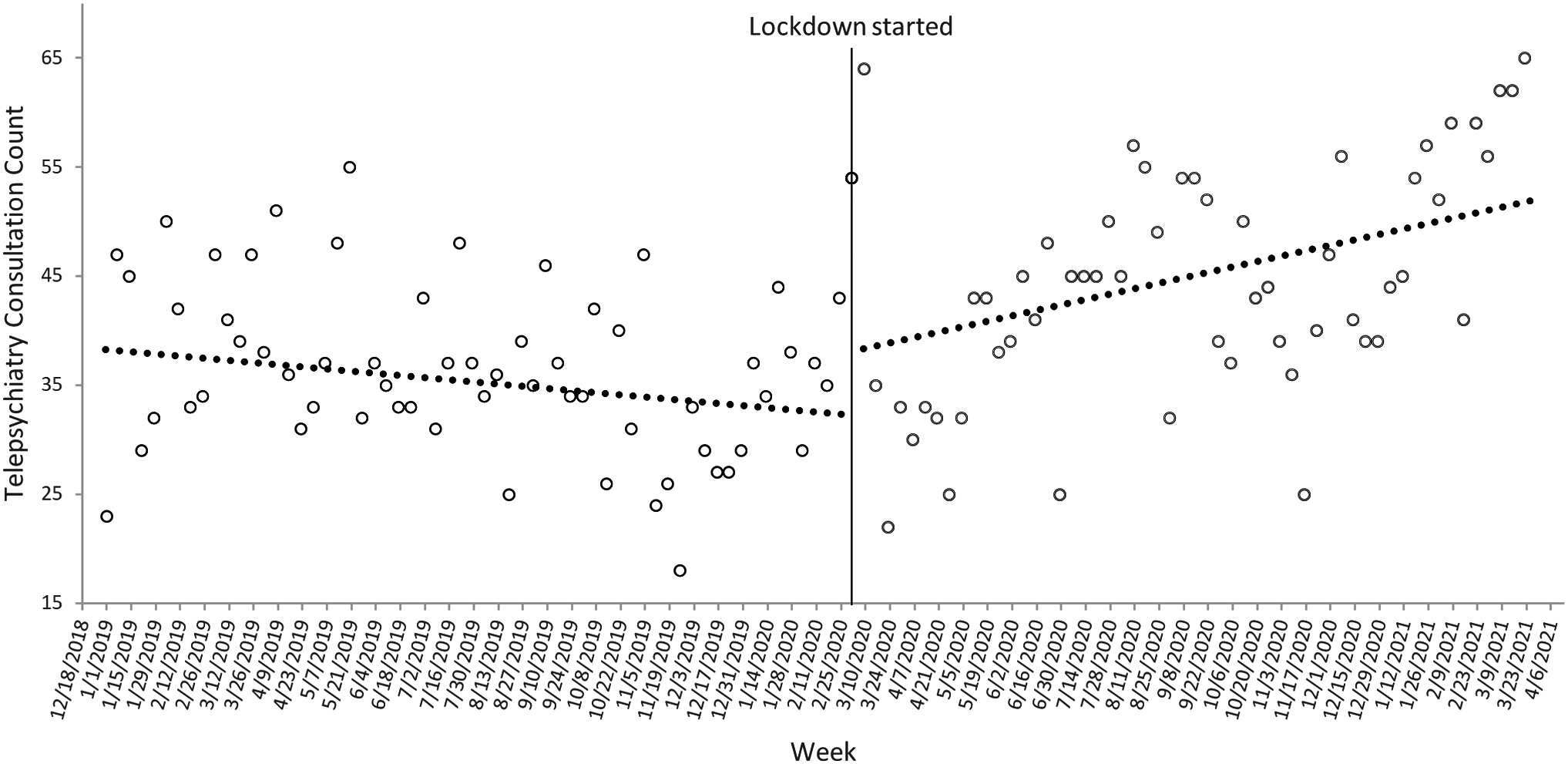
Growth trends of telepsychiatry consultation counts before and after lockdown. The vertical line indicates the first week of March 2020. The dashed lines are trends adjusted for seasonality.
Interrupted Time Series Regression Results
Values in parentheses are robust standard errors clustered at county level. We controlled for the county fixed effects to eliminate possible biases due to county heterogeneity.
p < 0.05, ** p < 0.01.
We conducted subgroup analysis based on sex (male vs. female) and race (black vs. white). In Model 2, we run the ITS analysis using the subsample of only male patients, and Model 3 is the ITS analysis on only female patients. As Table 2 shows, compared with the female patient count, the male patient count has a similar decreasing trend before the lockdown (−0.083 vs. −0.047, p = 0.277) and a similar increasing trend after the lockdown (0.203 vs. 0.192, p = 0.274), and the differences are not statistically significant. The male patient count has a larger level change at the beginning of the lockdown (4.003 vs. 0.754, p < 0.001) than the female patient count. Figure 3 shows the difference between the male and female subsamples.
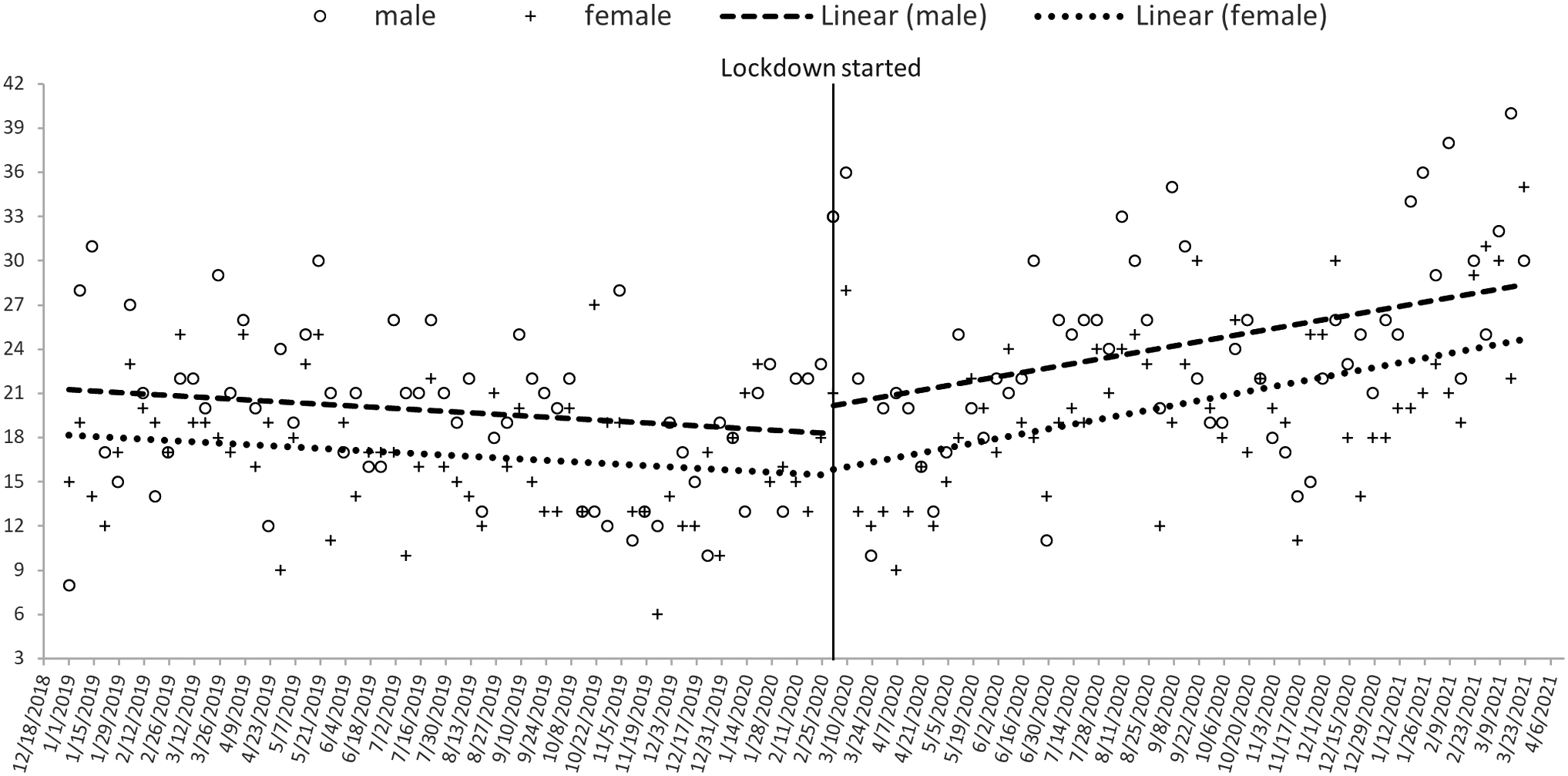
Weekly telepsychiatry consultations for male versus female patients from January 2019 to March 2021. The vertical line indicates the first week of March 2020. The dashed lines are trends adjusted for seasonality.
Models 4 and 5 in Table 2 are ITS analysis based on the black patient subsample and the white patient subsample, respectively. Compared with the white patient count, the black patient count has a similar decreasing trend before the lockdown (−0.061 vs. −0.046, p = 0.157) but a much weaker increasing trend after the lockdown (0.227 vs. 0.109, p < 0.001), and it also has a smaller level change at the beginning of the lockdown (0.876 vs. 3.585, p < 0.001). Figure 4 shows the difference between the black and white subsamples.
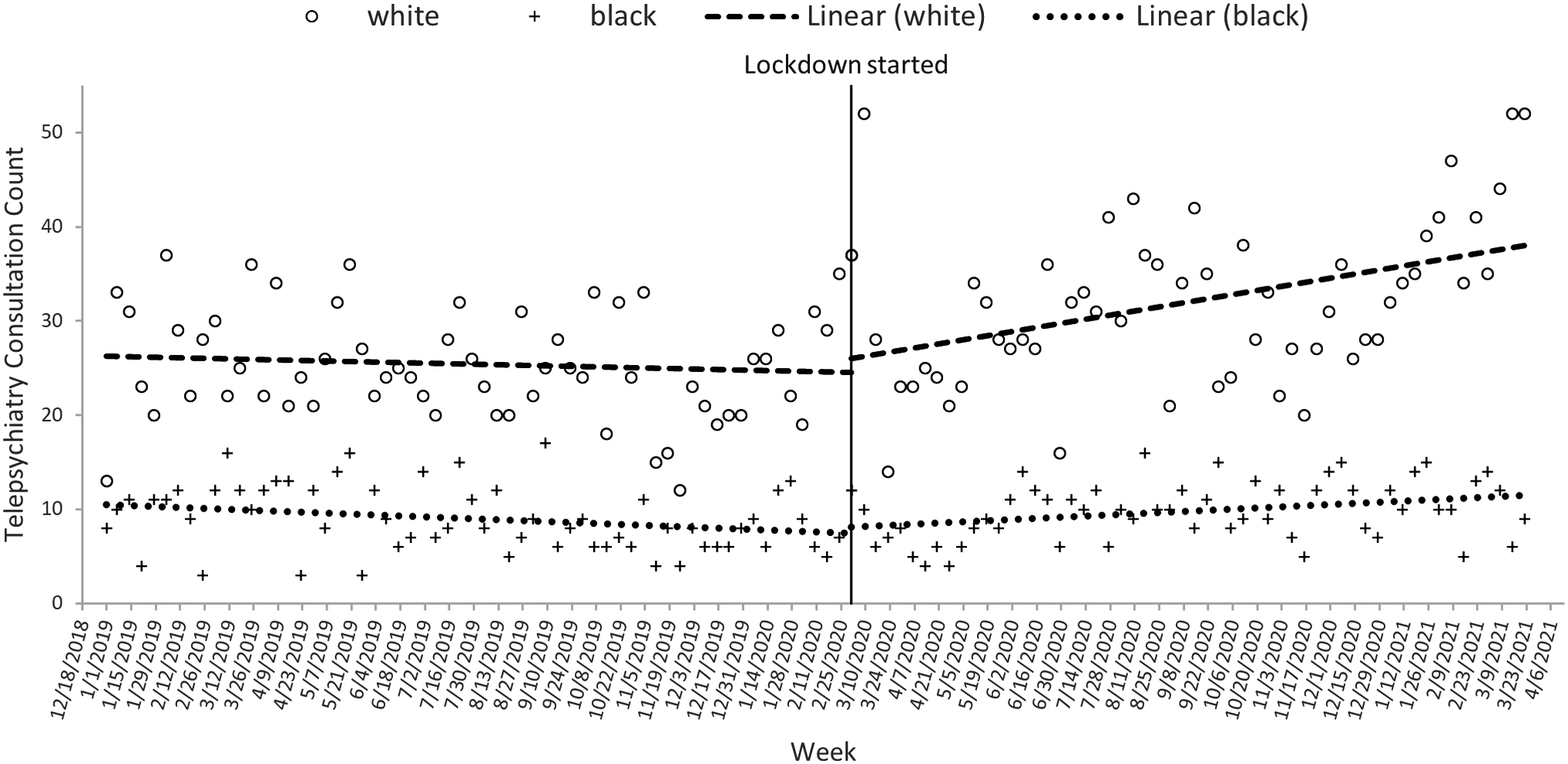
Weekly telepsychiatry consultations for black versus white patients from January 2019 to March 2021 (117 weeks). The vertical dashed line indicates the first week of March 2020. The dashed lines are trends adjusted for seasonality.
In addition, we compared the mean weekly patient count in the year after the national lockdown policy (March 2020 to February 2021) to the mean patient count in the year before the policy (March 2019–February 2020). The paired t test results are shown in Table 3. The postlockdown weekly patient count (n = 45.4) is significantly higher than the prelockdown patient count (n = 37.8) (p < 0.001).
Comparison of Weekly Patient Counts in the Same Periods Across Years
In order to avoid biases, the comparison periods are 1 year (52 weeks) before the national lockdown (March 2019–February 2020) and 1 year after the lockdown (March 2020–February 2021). This involves 104 weeks, instead of the entire sample of 117 weeks.
Weeks 10–61 in 2019–2020 correspond to March 2019–February 2020. Weeks 10–61 in 2020–2021 correspond to March 2020–February 2021.
Weeks 10–17 in 2019–2020 correspond to March–April 2019. Weeks 10–17 in 2020 correspond to March–April 2020.
Weeks 18–61 in 2019–2020 correspond to May 2019–February 2020. Weeks 18–61 in 2020–2021 correspond to May 2020–February 2021.
ED, emergency department.
We also compared the mean weekly patient count in March and April 2020, during which the lockdown policy was in effect, to the weekly patient count in the same period in 2019. Although the weekly count in 2020 (n = 42.3) is slightly higher than that in 2019 (n = 42.2), the difference is not statistically significant (p = 0.439).
Furthermore, we compared the mean weekly patient count from May 2020 to February 2021, when the lockdown policy was removed but COVID-19 was still spreading, to the weekly patient count in the same period in 2019 and 2020. Again, the postlockdown weekly count in the 2020–2021 period (n = 46.0) is significantly higher than that in the 2019–2020 period (n = 36.8) (p < 0.001).
We also conducted subgroup comparisons based on sex and race. All subgroups had similar results except during the lockdown period (weeks 10–17). During weeks 10–61 and weeks 18–61, all subgroups showed higher weekly counts in the year after than in the year before. However, during weeks 10–17 (March and April), male patients had higher, while female patients had lower, weekly counts in 2020 than in 2019. In the same period, white patients had higher, while black patients had lower, weekly counts in 2020 than in 2019.
Discussion
Overall, our results show that the ED telepsychiatry consultation count switched from a decreasing pattern in the pre-COVID period to an increasing pattern in the post-COVID period. There was a slight decreasing trend in weekly telepsychiatry consultation counts before the lockdown policy for COVID-19. The 2020 NC psychiatric hospitals annual report indicates a similar decreasing trend on NC psychiatric hospitals' persons served before COVID-19. 25 The sudden spike of patient count right before the state lockdown policy indicates an overreaction to a serious threat whose exact damage was still largely unclear. After the initial overreaction, the patient count came back down to the normal level. However, as the new cases and deaths of COVID-19 steadily increased in 2020 and early 2021 (despite a slight decline in the second half of 2020), the telepsychiatry use shows an increasing trend. Although more rigorous causal evidence is yet to emerge, this observation suggests that COVID-19 might have contributed to the increase of mental health issues and thus the growth of telepsychiatry consultations.
Interestingly, we find that the use of telepsychiatry service for male patients showed a more dramatic initial reaction to COVID-19 than female patients, exhibited as a higher spike right before the lockdown. This may be because women experienced social and economic challenges (e.g., unemployment) resulting in reduced health care access during pandemics. 28 Other than this, male and female patients have similar declining demand before COVID-19 and growing demand after COVID-19 for telepsychiatry services.
White patients' telepsychiatry use showed a more dramatic initial reaction to COVID-19 than black patients. Although reported prevalence estimates of certain mental health diseases are not generally higher among racial and ethnic minority groups, persons in these groups are often less likely to receive treatment services. 29 Moreover, black patients have a weaker increasing demand for telepsychiatry services than white patients during COVID-19.
While there may be many possible reasons, the fact is that black patients are missing the opportunity to benefit from getting safe and timely help from doctors using telepsychiatry. As time passed, the disparity between black and white patients' telepsychiatry use was even enlarging, as suggested by the different postlock trends in Figure 3. Persistent social, economic, and health inequities can further compound health problems faced by racial minority groups during COVID-19 pandemic. 30 –32
A limitation of this study is that we did not have data about all the psychiatric patients visiting ED of our target hospitals during the study period. The NC-SteP only collected data from the patients who received telepsychiatry consultations. Therefore, we could not calculate the proportions of different genders and different races among all the ED psychiatric patients. If such data were to be available, we could have gained more insights on the gender and racial disparity issues. Future research should analyze the trends of proportions of different patient subgroups who received telepsychiatry consultations if the population data become available.
Conclusion
This study describes changes in NC ED telepsychiatry consultation counts before, during, and after the state lockdown policy. The findings reveal that the demand for telepsychiatry consultations has increased and continued to increase during the COVID-19 crisis. However, the low increasing trend for telepsychiatry consultations provided to black patients raises the concern of possible race disparity in telepsychiatry services in the U.S.
Footnotes
Disclosure Statement
No competing financial interests exist.
Funding Information
No funding was received for this research.