




Abstract
Objective:
To evaluate the use of telemedicine as a collaboration tool between a pediatrician and subspecialists looking to address challenges, such as the lack of health care specialists, which are present in the Dominican Republic.
Study design:
During this 6-year study, 65 patients were evaluated by a medical team consisting of a local pediatrician and 17 subspecialists from a leading academic medical center in the Unites States. Patient's age ranged from 2 months to 16 years of age (mean 8 years old). The most common reasons for referral were masses or malignancies, vascular malformations, urogenital anomalies, stuttering, and cochlear implant programming.
Results:
A total of 39 out of 65 cases (60%) carried an initial diagnosis. Of the 65 cases, a change in medical management occurred in 92.31% of cases (60 cases). There was no change in medical diagnosis or treatment in 5 of 65 cases (8%).
Conclusion:
This protocol exhibited high patient satisfaction with the technology and platform and direct patient savings from transportation costs. It also demonstrated the importance of thorough diagnosis in providing appropriate treatment and solutions. Telemedicine use in comparable practices should be studied further to aid in the development of policies for the diagnosis and management of chronic illnesses that require referrals to subspecialists.
Introduction
For decades, inaccurate or delayed diagnoses that persist across all treatment areas have compromised health care and put an unacceptable number of people at risk. Diagnostic inaccuracies can adversely affect health, cause psychological distress, and increase financial expenses. A patient may receive incorrect or unnecessary therapy if a diagnostic error occurs, or essential, potentially life-saving treatment may be withheld or delayed. 1
According to Human Resources for Health, imbalances in the shortage, composition, and distribution of the health care system have shaped the Latin American and Caribbean region. 2 Within countries in the vicinity, there is wide variation in the regional distribution of health professionals and standards of care. For example, while Grenada has six nurses for every physician, the Dominican Republic (DR) has only 0.2. 2
The health care system in the DR faces several challenges of socioeconomic constraints, shortage of health care professionals, and availability of adequate, cost-effective, and quality health care facilities. Many patients are undiagnosed or misdiagnosed for diverse reasons, including a lack of knowledge of these diseases among physicians and inadequate screening. In addition, primary care providers often overlook the need for referral. An even greater disadvantage is that patients cannot afford the cost of consultation in a hospital. 3
Hence, telemedicine has emerged as a powerful platform to deliver health services through Information and Communication Technologies, reduce health inequalities, enhance health outcomes, and guide health care providers. 4,5 It also provides remote access to health services, particularly to isolated or underserved communities. 6,7
In 2020, a leading telegenetics study was conducted in the city of Santo Domingo, DR, aiming to determine the feasibility of telemedicine as an appraisal tool for the clinical and morphological assessment of children with undiagnosed genetic diseases. 3 However, this research explores the application of telemedicine as a collaboration tool looking to address many challenges existing in the country when it comes to consultations that require referral. This study also reports a collaborative telehealth service model with a pediatrician to improve access to pediatric subspecialty care in an underserved region. It is expected that communication and collaboration within multidisciplinary teams lead to more precise and higher quality care.
Methods
PATIENTS
A total of 65 individuals with imprecise and uncertain diagnoses or challenging management were referred for a second opinion and evaluation between 2015 and early 2021 at Centro de Obstetricia y Ginecologia in the DR. The local pediatrician issued all the patients' referrals. They were to be seen by Cincinnati Children's Hospital Medical Center (CCHMC) subspecialists within a 15-day average of consult requests.
EVALUATIONS
A licensed pediatrician in the DR evaluated all patients in an outpatient setting to obtain a complete family and medical history using a previously reported model by Mena et al. 3 and Kubendran et al. 8 The evaluation of complex pediatric patients consisted of specialized indications and protocols explicitly developed for this program. The pediatrician accomplished the imaging and histopathology review process before the telemedicine visit.
Telemedicine visits occurred through video conference between the local licensed pediatrician, CCHMC subspecialists, patients, and their families. The videoconferencing equipment (BCC950; Logitech), Cisco Jabber, or Microsoft Teams, was connected at a bandwidth of 100 Mbps, using one Integrated Services Digital Network line. The parents or legal guardian consented in writing to participate in the telehealth consultation. The pediatrician evaluated the patients in conjunction with the subspecialists during the video encounter. Retrospective data were abstracted from medical charts for this study and approved by Centro de Obstetricia y Ginecologia. In the case of unknown conditions, the subspecialists recommended further testing and medical imaging to reach a diagnosis.
Several cases already had a known etiology. However, to guarantee an optimal treatment, there were several deliberations applying management recommendations. The subspecialists were also present in the discussion of findings to establish care. Furthermore, the publication of photographs and a patient satisfaction survey required written informed consent (see Table 1 for survey results). All physical examinations were completed in Spanish, all protocols were translated into Spanish for proper understanding by the families, and outpatient consults were translated in real time to ensure that the patients' families understood everything correctly.
Telemedicine Patient Satisfaction Survey Results [n = 28/65 (43%) Patients]
Results
The medical team evaluated a total of 65 patients during this 6-year study. The patients' age ranged from 2 months to 16 years of age (mean 8 years old). The most common reasons for referral were masses or malignancies, vascular malformations, urogenital anomalies, stuttering, and cochlear implant (CI) programming. The most frequent subspecialties consulted were orthopedic surgery (15%), neurology (12%), gastroenterology (8%), hematology (8%), oncology (8%), rheumatology (8%), and urology (8%) (see Table 2 for classification of patients by subspecialty).
Age and Sex of Study Subjects by Subspecialty
F, female; M, male; SD, standard deviation.
Subspecialty consultation frequently influenced diagnosis and management (Fig. 1). A total of 41 of 65 cases (63%) had been diagnosed already. A change in medical management occurred in 92% of cases (n = 60). Out of 60 cases, subspecialty consultation presented a change of diagnosis and treatment plan of 55% (n = 33), whereas, in the 60 cases involving management change, 43.3% (n = 26) changed only treatment and 2% (n = 1) diagnosis alone. In 43% (n = 28), changes improved symptoms and/or overall health. Subspecialty consultation led to surgical intervention in 12.3% (8/65) and diagnostic imaging in 32.3% (21/65).
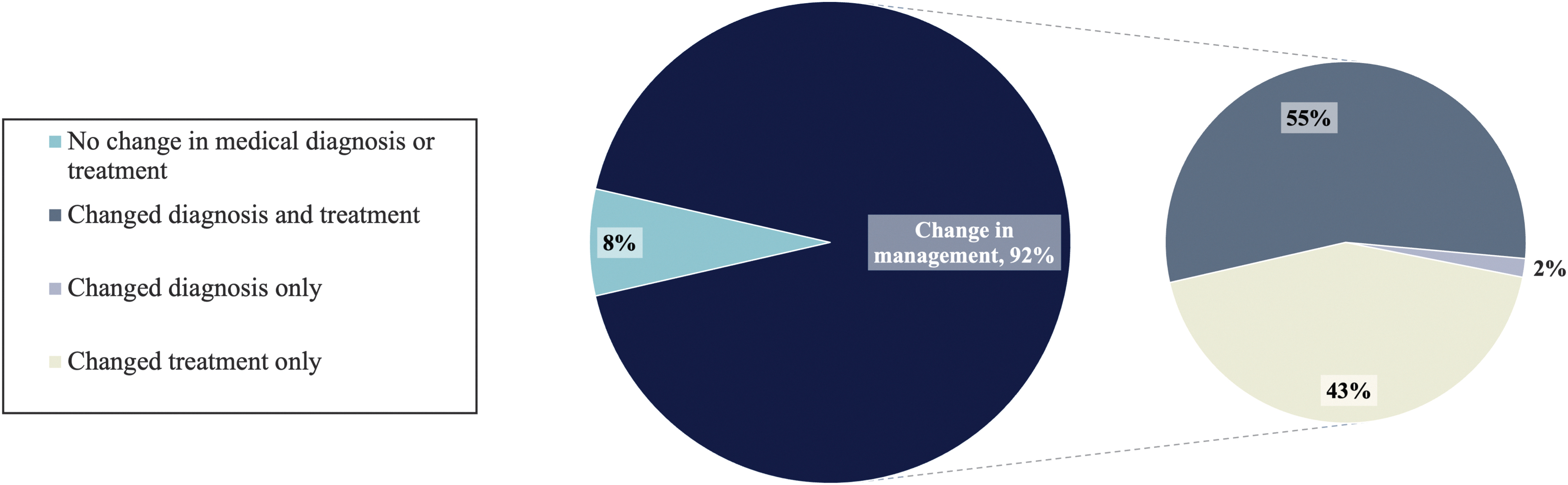
Effect of subspecialty consultation on change of patient diagnosis and/or management.
In this study, we describe four patients from our cohort (Table 3 details diagnostic evaluation and intervention of all participants): an 11-year-old child presented persistent leg pain and limping. Interventional radiology biopsied a leg mass identified by a leg magnetic resonance imaging (MRI) scan. Histopathology was consistent with CRMO (chronic recurrent multifocal osteomyelitis), a rare condition with a prevalence of 0.5 per 106. Technetium bone scan identified lumbar vertebral column involvement (Fig. 2A), a high-risk lesion for compression fracture. 9 She received bisphosphonate therapy in Santo Domingo; subsequent MRIs and bone scans displayed marked improvement of the lesions (Fig. 2B).

Magnetic resonance imaging scan presenting lesion
Indications and Outcomes of Telemedicine in a Cohort of 65 Individuals from the Dominican Republic
ADHD, attention-deficit/hyperactivity disorder; AQP-4, aquaporin 4; BMI, body mass index; CBC, complete blood count; CCHMC, Cincinnati Children's Hospital Medical Center; CFS, cerebrospinal fluid; CI, cochlear implant; CRMO, chronic recurrent multifocal osteomyelitis; CT, computed tomography; D/c, discontinue; Dx, diagnostic; EGD, esophagogastroduodenoscopy; EMG, electromyography; FMF, familial Mediterranean fever; GnRH, gonadotropin-releasing hormone; IBS-C, irritable bowel syndrome with constipation; IR, interventional radiology; ITP, immune thrombocytopenic purpura; JAK2 V617F, somatic mutation; MRI, magnetic resonance imaging; N/A, not applicable; OT, occupational therapy; PFAPA, periodic fever, aphthous stomatitis, pharyngitis, adenitis; POG, personalized oncogenomics; R/o, ruled out; S/p, status post; SC, spinal cord; TEF, tracheoesophageal fistula; TMPRSS6, transmembrane serine protease 6; US, ultrasound; UTI, urinary tract infection; UVJ, ureterovesical junction obstruction; VCUG, voiding cystourethrogram; VUR, vesicoureteral reflux; vWF, Von Willebrand Factor Panel; WPW, Wolff-Parkinson-White.
A full-term female neonate 14 days old was diagnosed with an amniotic band on her right leg by a sonogram 2 weeks before being born. Clinical examination revealed one skin fissure at the level of the right leg; the wound's edges were red and inflamed, a class 2 on the diagnostic criteria by Patterson 10 (Fig. 3A). Constriction band showed a marked lymphedema and there was an important improvement after surgical release (Fig. 3B). Graded compression stocking and lymphatic massages after the surgery were recommended by a CCHMC team composed of a pediatric surgeon, an interventional radiologist, and a hematologist.

Child's leg showing constriction band and a marked lymphedema before surgery
A 3-year-old boy who experienced a diffusely violaceous, macular rash throughout his body had increased inflammatory biomarkers (Fig. 4A). Local rheumatologists treated him with systemic glucocorticoids and methotrexate for presumed systemic onset juvenile idiopathic arthritis. However, neither his clinical examination nor laboratory results improved. Multiple local dermatologists consulted, yielding a skin biopsy without a definitive diagnosis. Telemedicine consultation followed with University of Cincinnati dermatopathology determined that it was lupus erythematosus panniculitis, a rare type of Antinuclear antibody (ANA) negative pediatric cutaneous lupus erythematosus. 11 CCHMC consultants in dermatology and rheumatology prescribed hydroxychloroquine, allowing him to discontinue systemic steroids successfully. He has gradually improved per serial follow-up with his pediatrician and every 3-month digital image review by his CCHMC consultants using store and forward technology (Fig. 4B).

Child before
A 3-year-old child showed worsening ataxia and incremental balance problems for many months. She had visited multiple specialists, including a physical visit to a tertiary freestanding children's U.S.-based hospital. After a detailed examination, she was diagnosed with opsoclonus myoclonus, most likely due to a Mycoplasma pneumonia infection. Meta-iodobenzylguanidine scan excluded neuroblastoma. Following treatment with a single rituximab infusion in Santo Domingo, she experienced a durable recovery sustained for the past 4 years with a resolution of her presenting symptoms. She avidly participates in sports (video in Supplementary Video S1 digital content).
Discussion
This article illustrates the importance of telemedicine as a successful tool to solve challenging cases between countries of different cultures by fostering an established international collaboration between CCHMC and pediatric patients at Centro de Obstetricia y Ginecologia. We previously reported a partnership between genetic services in the DR and CCHMC, showing that telemedicine programs can facilitate access to genetic services for patients living in remote locations with a very high diagnostic yield and patient satisfaction. 3
In 2019, 11% of patients in the United States used some form of telehealth, whereas by May 2020, that figure increased to 50%. All health care systems quickly adapted. Providers across all specialties now see between 50 to 175 times the number of patients by telehealth compared with pre-pandemic levels. 4
Currently, cost-effectiveness plays a pivotal role in decision management. Our cohort includes patients with the same diagnoses and different care approaches. One patient traveled to CCHMC to obtain expert oncology consultation for an anaplastic brain ependymoma, while another patient received care through telemedicine in the DR. Neuroradiology reviewed the MRI scan from the latter patient; both patients received similar chemotherapy regimen modifications per oncology recommendations.
Similarly, a patient with portal hypertension due to cavernous portal vein thrombosis received a Rex shunt at CCHMC. He obtained serial monitoring with serial abdominal ultrasounds and platelet counts in the DR, supervised using telemedicine by his CCHMC surgeon. Another patient who underwent neurosurgery at CCHMC for brain cavernoma obtained subsequent MRI scans in the DR that the CCHMC neurosurgeon reviewed during monitoring visits using telemedicine, avoiding expensive travel for this patient's ongoing care. The incremental difference in travel costs favors telemedicine.
Telemedicine offers to revolutionize health equity by addressing existing health care disparities in the developing world. Patients obtain access to care without the burden of travel costs or geographic barriers. The remarkable alliance between the DR hub and CCHMC distance sites allows patients to attain efficient ongoing management that improves their quality of life. For example, bilateral CI used to treat congenital sensorineural hearing loss requires precise adjustments for new hearing needs that can be performed by serial, sophisticated software programming by telemedicine. One young man residing in the DR who obtained adjustments provided immediate gratitude to his Cincinnati-based audiologist during a telemedicine follow-up visit.
The lack of access to CI services in rural locations creates a significant health care disparity. Moreover, rural residence is a cause for delayed implantation in eligible adult and pediatric CI candidates. Our two CI cases support a previous study, 9 which evaluated the effectiveness of remote CI programming through telehealth. Smaller hospitals and hospital systems can collaborate with larger academic institutions to build systems that enable emergent telehealth services. 12
Telemedicine's positive impact on the appropriateness of referrals to medical/surgical subspecialists and redundancy reduction in evaluative and diagnostic studies has been established. 13,14 However, studies also show that improved communication between the pediatric health care team and the patient has the potential to enhance disease management. 15
One growing subspecialty of rising importance is Pediatric Palliative Care (PPC). PPC targets the best possible quality of life for children with life-threatening illnesses along with their families, 16 for example, by enhancing the care of patients with serious malignancies. The American Academy of Pediatrics issued recommendations in 2000 for an integrated palliative care model for children with life-threatening illnesses, which begins at the diagnosis and stresses the provision of curative therapies. Furthermore, they suggested comfort measures to improve the quality of life throughout their disease. 14
While local expertise had previously recommended leg amputation in a case of alveolar rhabdomyosarcoma, the CCHMC counterpart understood that the outcome would be the same, independent of any further action. Parents were advised to avoid amputation and focus on the quality of life. Even though the patient passed away a couple of months later, they did not have to go through the agony of an amputation.
The following three cases highlight the significance of pathology for a proper diagnosis. Case 1 was initially embryonal rhabdomyosarcoma. After a CCHMC pathologist reviewed the slides, there were suggestions that it could be an alveolar rhabdomyosarcoma, which is more aggressive and justified the patient's course of disease. Case 2 initially was thought to be a fibrous histiocytoma; however, University of Cincinnati's pathologists determined a desmoid tumor. An oncologist recommended a change in the chemotherapy treatment; 5 years later, the patient is well. Case 3 (Fig. 4) had a diagnosis, by the DR pathologist, as vasculitis with lobular panniculitis. However, the dermatopathologist from the University of Cincinnati diagnosed it as lupus panniculitis, leading to treatment with hydroxychloroquine and improving the clinical course for the child.
A limitation of this study is that, occasionally therapeutic options offered to some patients and specific subspecialists were unavailable in the country. Some patients did not have the possibility of traveling to the United States, presenting a barrier to accessing specific subspecialty care. Another limitation is that as the sole provider in the DR, there is a potential to introduce referral and participation bias. Many patients do not seek care, assuming that they cannot obtain a diagnosis in the country, and those who do are because they are patients who often seek consultation in the clinic. Also, this study is limited from an epidemiologic perspective due to its retrospective, descriptive, and observational nature.
Conclusion
This study assessed 65 patients referred for subspecialty consultation, using a collaborative telemedicine protocol involving a local pediatrician and 17 subspecialties at a leading academic pediatric hospital. This approach showed high patient satisfaction with the technology platform, direct patient savings from transportation costs, access to subspecialty care, and the quality of care derived. It confirmed that telemedicine can be used safely and efficiently and proved the importance of accurate diagnosis to offer optimal management.
Telemedicine offers to revolutionize health equity by addressing existing health care disparities in the developing world through its capacity for global outreach. We demonstrate how a collaborative, international partnership between institutions can provide high-quality care from subspecialists at a distance pediatric academic center facilitated by a hub specialist in-country to patients in underserved regions. This approach is a cost-effective, personalized, and targeted solution that assists ongoing care for patients with chronic conditions. Telemedicine implementation needs further examination to improve access to subspecialty care.
Footnotes
Acknowledgments
The authors would like to thank all the patients and their families for participation in this study and for contributing their experiences to this publication. They would also like to thank Centro de Obstetricia y Ginecologia and Cincinnati Children's Medical Center for the support of this study.
Article Summary
This study evaluated 65 patients referred for a second opinion through telemedicine and a strategy, including a pediatrician and 17 subspecialties from a pediatric hospital.
Disclosure Statement
The authors have no conflicts of interest to disclose.
Funding Information
This research received no specific grant from any funding agency in the public, commercial, or not-for-profit sectors.
Supplementary Material
Supplementary Video S1
References
Supplementary Material
Please find the following supplemental material available below.
For Open Access articles published under a Creative Commons License, all supplemental material carries the same license as the article it is associated with.
For non-Open Access articles published, all supplemental material carries a non-exclusive license, and permission requests for re-use of supplemental material or any part of supplemental material shall be sent directly to the copyright owner as specified in the copyright notice associated with the article.
