




Abstract
Introduction
: The increase in the use of mobile apps since the COVID-19 pandemic, even among people with multiple sclerosis (PwMS) and health care providers (HCPs), has enabled access to reliable information, symptoms monitoring and management, and social connections. The pandemic has undoubtedly contributed to the acceleration of the “digital revolution.” But how far has it progressed for the MS communities?
Methods
: Italian Google Play and App Store were queried, selecting MS-specific apps in English or Italian language and usable by a wide public.
Results:
Fifty-four (n = 54) MS-specific apps were identified; most were PwMS-oriented (83%), free of charge (94%), and in English language (76%). The 45 PwMS-oriented apps focused on increasing MS knowledge (71%), tracking symptoms (33%), and promoting networking with peers or HCPs (38%). The 13 HCPs-oriented tools addressed education and updates on MS (62%), disease assessment and management (54%), and research (15%). Google Search tool was also queried to find non-MS–specific apps to fulfill some unmet domains (as sleep, pain, sexual or mental health). Twenty-four additional apps were listed to provide a valuable contribution.
Conclusion
: The “digital revolution” led to increasingly customized tools for PwMS, especially as m-health or social-networking apps. However, apps to support other specific MS-relevant domains, appealing HCPs-oriented apps, and specific mobile tools for MS caregivers are still lacking. The absence of data assessing the usability and quality of MS apps in ecologically contexts leads to not reliable conclusions about potential benefits. A strong dialogue between MS communities and the digital industry is encouraged to fill this gap.
Background
To contrast the COVID-19 pandemic, countries adopted some preventive measures, such as social distancing and full lockdown. These measures often led to condition of social isolation, psychological stress, reduction, or interruption of physical activity. 1 Concurrently, the redistribution of health resources and concerns about contagion within health care settings contributed to the challenge in accessing in-person health care, highlighting the need for alternative tools to support personal well-being. Shortening physical distances is particularly crucial for chronic diseases such as multiple sclerosis (MS), a neuroinflammatory disorder affecting ∼2.8 million people in 2020, being one of the main causes of progressive physical and cognitive disability in young adults, 2 and affecting the quality of life of people with MS (PwMS) and their families. 3,4
The COVID-19 pandemic, despite its tragic consequences, has also exponentially accelerated the so-called “digital revolution” in any field of daily life. The worldwide estimated internet users increased from 4.1 million in 2019 to 5.3 million in 2022, 5 with 255 billion mobile applications (apps) downloaded and an estimated average daily mobile internet consumption of >6 h in 2022. 6,7 Similarly, the availability of mobile health (m-health) apps grew significantly between the beginning of 2020 and the end of 2021, reaching over 65,300 (Google Play Store) and 54,000 (Apple App Store) tools. 8,9
m-Health apps are a branch of telemedicine and are revolutionizing the health care ecosystem by enhancing communication, diagnosis, appointments scheduling, and medical supply delivery. Their use positively influence communication and relationships between patients and health care providers (HCPs) even at a distance, supporting patients' self-efficacy, improving access to health care services, and facilitating relationship-centered health care. 10 Consistently, a recent survey reported extensive and frequent smartphone use among a sample of PwMS, considering it acceptable for health care purposes. 11 Similarly, increased adoption of mobile apps among HCPs better supported clinical decision-making and patient outcomes. 12
Furthermore, social networks has become a popular mean of staying in touch with friends and family even during the COVID-19 lockdown, creating affiliations and experiencing a sense of belongingness and participation, potentially buffering the effects of health anxiety under conditions of isolation. 13 In the United States, ∼30% of people used social media 1–2 h additionally per day during the COVID-19 pandemic, 14 engaging in more text messages and voice calls to maintain contacts. 15
These statistics clearly indicate how digital and mobile technology can support the development and use of new and valuable mobile apps, providing more reliable health information, favoring physical and mental symptoms monitoring and health management, and fostering social connections. However, the question remains: has the “digital revolution” effectively contributed to improve the quality of life and care among MS communities? This article aims to present the currently available MS-specific mobile apps, to provide guidance and additional support to PwMS, their caregivers, and HCPs. Through a systematic review methodology and a stepwise process, we first identified and narratively summarized the main features of existing mobile apps designed specifically for MS communities (PwMS, MS caregivers, and HCPs). In addition, we planned to highlight potential lacks in mobile apps within MS-relevant domain 16 and provide suggestions to temporarily fill these gaps.
First step: Available MS-specific mobile apps
Methods
In May 2023 a search strategy was defined using the keyword “multiple sclerosis” and its Italian translation “sclerosi multipla.” In the Italian versions of the two most popular online application stores, that is, Google Play Store (Android) and App Store (Apple), we first entered the keyword “multiple sclerosis” in quotation marks in the app stores search bar. We further conducted the same procedure using the keyword in its Italian translation “sclerosi multipla.” We systematically performed these searches in both Google Play Store and App Store, completing a double check in both smartphone (Android version 13; iOS version 16.5) and tablet devices (Android version 12; iOS version 16.4.1), for a total of eight queries.
Selection criteria comprised the following: (a) tools specifically dedicated to MS pathology, with the term “multiple sclerosis” appearing in the app's title or description. Apps intended for pathologies other than MS or addressing multiple diseases (e.g., apps for general chronic illnesses) were excluded. (b) App's title, description, and interface in English or Italian languages. (c) Apps accessible and usable by a wide public. Tools with restricted access to a specific and limited audience or for a limited period (e.g., apps related to MS annual congresses/conferences or specific MS trials/research projects) were not considered.
To avoid overlooking any relevant MS-specific app, a further hand-searching was conducted, manually checking all the “similar apps” associated with the relevant records identified in our search.
Three reviewers (L.V., E.Z., and V.S.) independently identified eligible mobile apps, resolving disagreements through discussion and consensus. The same app presented in both stores was counted as one. Apps meeting the selection criteria were downloaded and installed into testing devices for a final check. Whether an app required a registration to access, we attempted to finalize the procedure; in case of private access (e.g., apps requiring a specific ID directly provided by the physician) or paid apps, we still included the app and extracted only publicly available information.
Descriptive characteristics of the selected MS-specific apps were extracted from the smartphone Italian stores and recorded using a predefined data extraction form: name; description; store (Google Play and/or App Store); target audience (PwMS oriented, caregiver oriented, HCPs oriented); availability for smartphone and/or tablet; type of access (registration and/or ID request); price; store category; star rating; number of reviews; number of downloads; language (English and/or Italian); developer name(s) last update; Italian app store URL(s).
Results
Our search identified 193 mobile apps (last access May 20, 2023). After removing duplicates and applying selection criteria, we included 54 MS-specific apps (Fig. 1) with an excellent inter-rater reliability (0.92, Cohen's Kappa). Apps detailed description is provided in the Supplementary Data. Several apps were not accessible for a final checking and specific features were retrieved from public information: 3 were paid apps, 4 had registration issues, and 10 needed an ID to access.
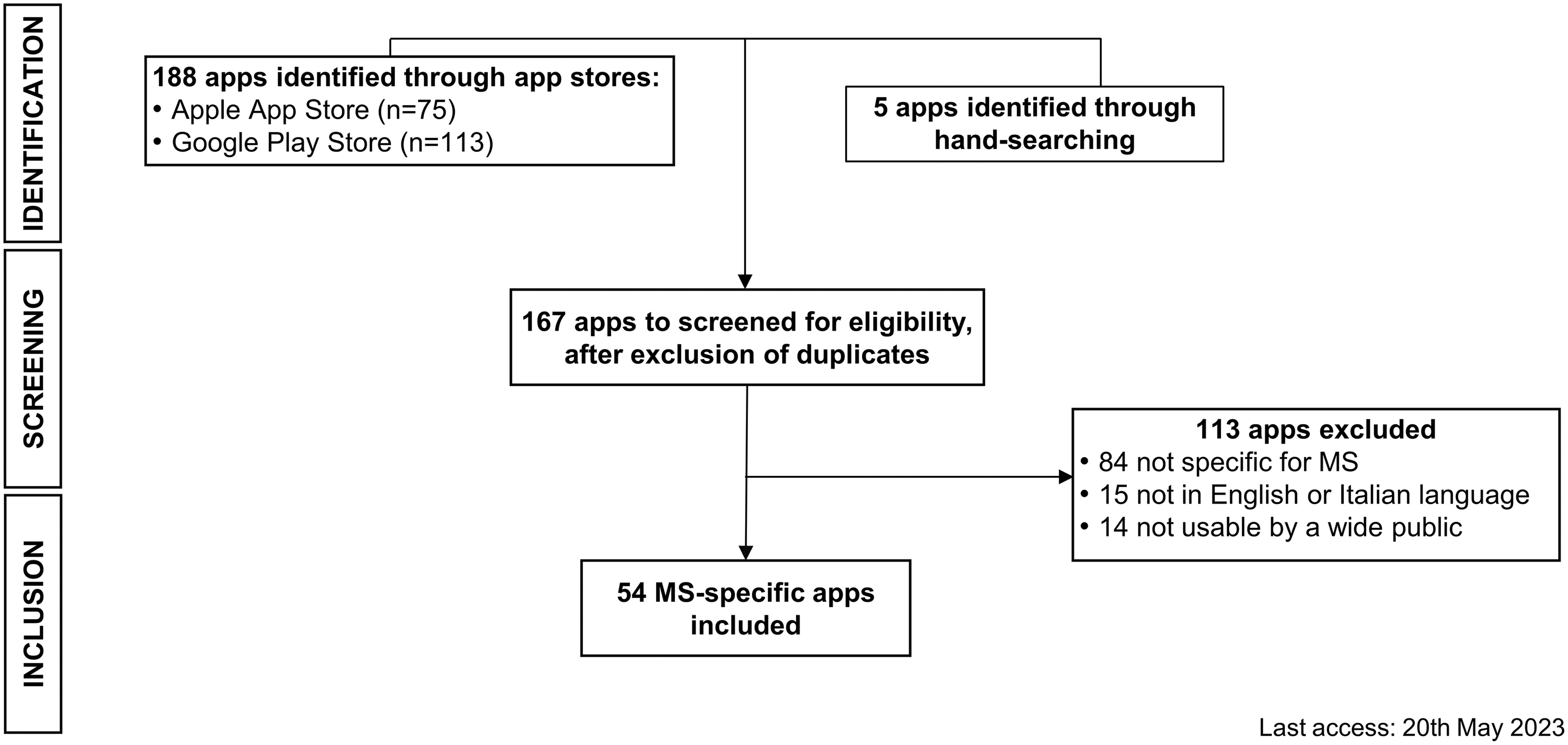
Flow chart of included MS-specific apps. MS, multiple sclerosis.
Table 1 summarizes the general characteristics of MS-specific apps. Forty-five of 54 MS-specific apps (83%) were PwMS oriented and 13 (24%) were HCPs oriented; only 4 apps were addressed to both PwMS and HCPs. No apps specific for MS caregivers were identified, but six tools (11%) were also relevant for this population (Supplementary Data). Twenty apps were available exclusively in the App Store, 6 in Google Play, and 28 in both stores. Most apps were available in English (n = 36, 67%), 13 (24%) in Italian, and only 5 apps (9%) in both languages. Almost all apps were free to download (94%), with three paid apps ranging from €0.99 to €5.99. Nearly 40% of the MS-specific apps had >1,000 downloads, and 11% were downloaded >10,000 times; “Cleo” and “BelongMS” had >100,000 downloads. According to previous classifications, 17,18 most of apps' developers were small or medium-sized enterprises (32%), and a significant portion (26%) involved collaborations between digital or information technology (IT) companies or freelancers and other partners, as educational organization (university or college) and nongovernmental agencies (patients association or charity foundation).
Main Features of the 54 Multiple Sclerosis-Specific Applications
HCPs, health care providers; n.a., not applicable; PwMS, people with multiple sclerosis.
The 13 HCPs-oriented apps provided information, updates, and training for HCPs (62%), assisted in MS assessment and management (54%) and could also be used for scientific purposes (15%; Table 2).
Main Features of 13 Health Care Providers–Oriented Applications
Apps are listed in alphabetical order.
ID to access; available information were extracted from app description and descriptive pictures reported in the app URL.
Paid app; available information were extracted from app description and descriptive pictures reported in the app URL.
Registration issues; available information were extracted from app description and descriptive pictures reported in the app URL.
apps., applications.
Regarding PwMS-oriented apps (Table 3), 71% (32/45) included tools to enhance disease knowledge, providing general or more specific information about MS, including magazines, radio, or podcasts. Thirteen mobile apps (29%) also provided some practical advice and training. Several apps could be qualified as m-health tools, allowing the tracking and collection of health and clinical data, real-time symptom monitoring, and sharing of health information with HCPs. Eleven apps (24%) enabled recording of pharmacological therapies, 12 (27%) allowed setting reminders for medication or medical appointments, and 5 (11%) facilitated storage of patients' medical reports. Nine apps (20%) enabled symptoms testing and 15 (33%) symptoms tracking and recording; the main MS symptoms tracked are given in Table 4. Eight apps (18%) promoted networking with peers through social networks and chats, whereas 12 (27%) supported telecommunication with HCPs for professional assistance. Finally, 11 mobile apps (24%) included tools for disseminating MS information through events, rising public MS recognition and engagement, and for fundraising.
Main Features of 45 People with Multiple Sclerosis–Oriented Applications
Apps are listed in alphabetical order.
ID to access; available information had been extracted from app description and descriptive pictures reported in the app URL.
Registration issues; available information were extracted from app description and descriptive pictures reported in the app URL.
Paid app; available information had been extracted from app description and descriptive pictures reported in the app URL.
Main Symptoms Tracked and Recorded by 14 People with Multiple Sclerosis–Oriented Applications
Apps are listed in alphabetical order.
“Noteness” app is a symptoms tracking tool, but it do not provide a prespecified form to fill-in, thus it was not included in the present table.
Paid app; available information had been extracted from app description and descriptive pictures reported in the app URL.
ID to access; available information had been extracted from app description and descriptive pictures reported in the app URL.
Registration issues; available information were extracted from app description and descriptive pictures reported in the app URL.
Second step: Lacks in MS apps and suggestions
The previous phase identified 54 MS-specific apps available in the Italian app stores. However, it highlighted the lack of mobile tools for some MS-relevant domains, as sleep, pain, sexual or mental health. 16 Several blogs and website URLs provide advice about general and nonspecific apps, but useful to support MS. Thus, to address this deficiency, we queried the Search tool of Google website through an incognito window. A total of 335 website URLs (Fig. 2) emerged from the English string (“multiple sclerosis” AND app*) and the Italian query (“sclerosi multipla” AND app*).
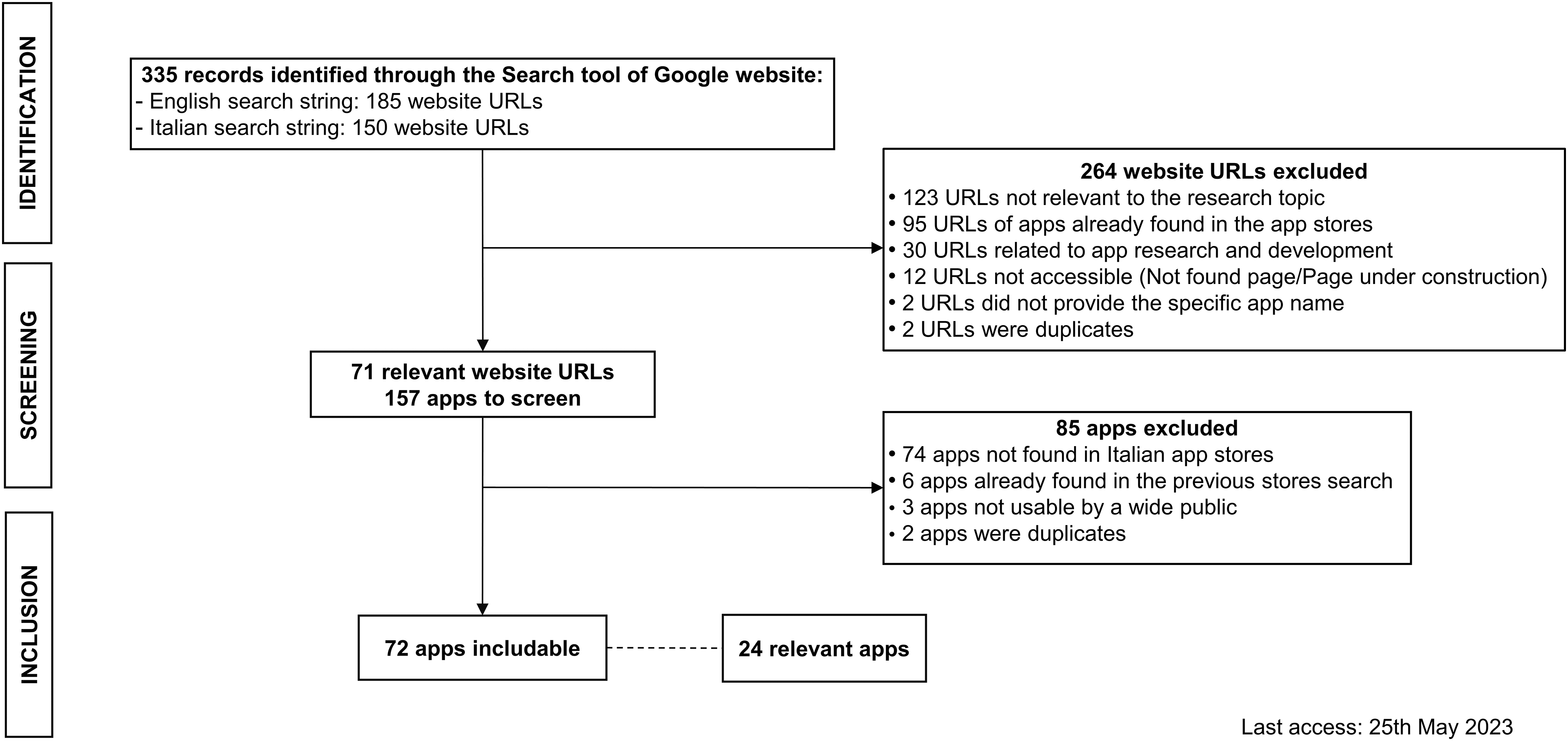
Flow chart of suggested mobile apps for MS.
The three reviewers (L.V., E.Z., and V.S.) independently identified relevant website URLs reporting non-MS–specific apps but suggested for the pathology, excluding URLs related to apps already found in the app stores or associated with apps research and development (e.g., scientific literature or grant-winning for Information Technology projects). Sixteen relevant website URLs were selected (Table 5); 72 mobile apps suggested for MS were finally identified, all available in the Italian stores, in English or Italian language and usable by a wide public. A proposal list of 24 apps aimed to support some MS-relevant domains currently lacking among the available MS-specific apps is given in Table 6; the remaining 48 tools addressed more general functionalities or less common difficulties in MS. 16
Website URLs Suggesting a List of Mobile Applications for Multiple Sclerosis
List of 24 Suggested Mobile Applications for Multiple Sclerosis-Relevant Domains
Each line reports the name of the app and the Italian store(s) in which any app is available. In the first column are reported the nine mobile apps for the physical health; in the second column, nine apps for mental health; in the third column, three mobile tools for sleep problems; in the fourth column, two apps for pain; in the last column, three other relevant mobile apps are listed. “HeadSpace: Mindful Meditation,” “Insight Timer–Meditazione” apps have been listed in more than one category.
Discussion
The prevalence of mobile apps in our daily lives has particularly increased in the last few years. 7 Before the COVID-19 outbreak, the use of mobile apps could be an option for some, whereas during the lockdown it has become a need for most. In case of self- or institution-imposed social distancing, nonautonomous people, or even in addition to traditional therapy, the digital development can promote remote disease monitoring and self-management, and reduce sense of isolation through digital social networking. The COVID-19 pandemic has undoubtedly contributed to accelerate the “digital revolution” in almost any field of daily life, but how far has it progressed for the MS communities?
In this article, a total of 54 MS-specific apps were identified in May 2023 in the Italian app stores; most were PwMS oriented (83%), free of charge (94%), and available in English language (76%). The 13 HCPs-oriented apps provided education and update on MS (62%) or supported disease assessment and management (54%). The majority of the 45 PwMS-oriented apps focused on MS management, primarily through tools to increase the knowledge of the disease (71%) or symptoms tracking (33%), promoting also networking with peers or telecommunication with HCPs (38%). Despite the good number of MS-specific apps present in the Italian stores, only few used the Italian language (33%); however, the most downloaded apps (“Cleo” and “Belong MS”) were available in several languages.
Monitoring the MS-specific apps evolution since 2020, 19,20 we faced a highly heterogeneous and dynamic digital environment, where apps availability and updates in the stores rapidly changed. App name, features, and other relative information may slightly differ between app stores (e.g., App Store does not provide the number of downloads, Google Play has no information about languages), or even between countries (e.g., the European “Cleo” is called “Aby” in the United States and Canada; the Italian “SM mobile” is “MS mobile” in Germany). Therefore, a comparison with previous reviews on MS-specific apps resulted often not feasible. 17,18,21 –24 Moreover, apps malfunction (app crashing, problems in the registration or opening an account, no updates for newer mobile devices) was frequent, and among the primary user complaints. 21
Despite this complex scenario and initial critical appraisal, in the Italian stores are present some comprehensive and valuable MS-specific PwMS-oriented apps, as the multi-downloaded “BelongMS” and “Cleo,” or as “icompanion” and “BeCare MS Link.” All these tools support daily disease management through specific and updated information about MS, monitoring of symptoms and therapies, and connection with HCPs and/or peers. Most of previous reviews focused on m-health and (self)management features of MS apps, 17,21 –25 because mobile tools could supplement some aspects of in-person care, and the COVID-19 isolation enhanced the creation of new m-health apps from 2020 to 2021. 8,9 In our research, 38% of PwMS-oriented apps can be categorized as m-health self-management devices, tools that well support the fields of telemedicine and e-health. Testing and keeping track of key information and symptoms, later shared with the personal doctor during a routine visit or remotely, may promote a better PwMS–HCPs interaction and treatment adherence.
The “icompanion” app allows even to auto-take validated tests, which investigate the level of fatigue, cognitive and bodily functioning, evaluating trends over time and sharing the metrics with the MS team. Similarly, “My MS Manager” allows to monitor through questionnaires symptoms such as fatigue, depression, or bladder control. This approach may foster a stronger sense of self-efficacy and self-involvement in MS management, and an increased patient-centered care by focusing on specific and personalized critical areas, with a monitoring in a more ecological context than in the clinics.
Self-management consists also in learning different skills to cope with symptoms. Until 2021, 19,20 our monitoring confirmed how treatment and rehabilitation interventions were better achieved by web-based solutions than mobile apps. 17,22 Today, the situation has considerably improved with apps-specific sections dedicated to well-being.
“Cleo” is a tool strongly focused on PwMS daily life, with several relevant features and customizable contents. Similarly, the various groups in “BelongMS” app are dedicated to the discussion and clarification of multiple aspects, enabling to choose information and tips tailored to specific personal needs and thus encouraging active health management. The complex scenario of MS cognitive dysfunction 26,27 is today targeted by the “MYA Brain Training” app, proposing exercises to improve memory, learning, and attention. “Swiss MS” addresses physical exercise in MS through video tutorials and customized exercises programs supervised by a physiotherapist. Other apps such as “Cleo,” “BelongMS,” “BeCare MS Link,” “The MSing Link,” and “SM Happy” offer physical and mental training games or exercises and a testing section, informative both for the patient and HCP. “Wahls Diet App” provides nutrition guidelines and allows to organize nutrition plans to complementarily monitor the progression of the disease. 28 –30
Some practical information can also be found within comprehensive PwMS-oriented apps: “BelongMS” had a social section called “Nutrition and MS,” allowing interaction between users or with a professional expert, whereas “Cleo” offered personalized programs to improve eating habits. To date, “Cleo” app also proposes practical advice to bear with MS fatigue, 31 and “Cleo,” “SMhappy,” and “Digital Buddy” finally dedicated informative articles to the topic of pregnancy in women with MS. 32
Nevertheless, other MS relevant domains remained unmet, 16 or just recorded in their daily status (Table 4). Therefore, we searched for nonspecific MS apps but suggested for this pathology, focusing on 24 most pertinent mobile tools (Table 6). Speech-language difficulties are supported by apps such as “Constant Therapy” and “Cuespeak,” focused on language training with customized exercise programs tailored to user progress and real-time performance monitoring. “Squeezy” app promotes pelvic floor muscle exercises for lower urinary tract or sexual difficulties (male and female version available), whereas “Swallow Prompt” prevents the accumulation of excess saliva in case of swallowing symptoms. Through artificial intelligence, “Seeing AI” offers the description of objects, people, and texts close in space, being useful in case of optic neuritis.
Mostly based on neuroscientific and cognitive psychological approaches, the “Mental Health category” includes nine apps aimed at enhancing resilience and coping strategies against depression, anxiety, and stress. Particularly, the “C.Coach” app developed by professor Benedict aims to maintain or boost cognitive reserve in MS by enhancing behaviors to compensate for low conscientiousness, a psychological trait that can predict cognitive deterioration and brain atrophy in PwMS. 33 Apps for sleep difficulties (“Sleepio,” “HeadSpace,” and “Insight Timer”) are mostly recommended by neuropsychologists and physicians and provide tools for meditation and relaxation. “Pain Toolkit” and “Curable Pain Relief” are self-management tools for people with chronic neuropathic pain. “AccessNow” shares accessibility information about specific places (such as restaurant, hotel, store) around the world for people with reduced mobility or for wheelchair users, whereas “AV1” works as a stand-in through a personal robot for children who are unable to attend school owing to longer hospitalization or chronic illness (e.g., pediatric MS patients).
Previously limited to a single MS-specific app, 17 today virtual connections and peer-to-peer social and emotional support are considerably expanded (18%), reducing the sense of isolation, and ensuring continuity of care. “Belong MS” has a very active community as its strength, enabling chat groups for assistance, tips, and support from a vast social network specific for PwMS and medical professionals. “BelongMS,” “Cleo” and “icompanion” apps also report the scientific sources of their contents, a quality feature rarely present in the apps. 18 The COVID-19 pandemic underlined the need for receiving timely, clear, and accurate information from experts, to counter the infodemic and the spread of misinformation and fake news that may generate confusion and insecurity among the general population. 34 A good structuring and categorization of information, along with professional approval of data through source material or direct communication with HCPs, empower patients with chronic disease and their families in discerning and critically understanding available information about disease and web-based advance care planning. 35,36
Moving toward health professionals, the main purposes for using HCPs-oriented apps include easier communication and consulting between professionals, patient monitoring and management, health record access and update, time management, and medical education, update, and training. 12 Benefits comprise an enhanced productivity and a better clinical decision-making, with more rapid and appropriate diagnoses and treatment decisions, improved practice efficiency and knowledge, positive effects on patient care outcomes (as reduction in adverse events and in the duration of the hospitalization).
We identified 13 MS-specific apps to be HCPs oriented, all addressing the main purposes of medical apps (Table 2). Assessment and management category comprised valuable clinical and scientific contents, as well as validated tests for accurate neurological evaluations useful both for routine clinical practice and research. Some apps tested MS progression with the Expanded Disability Status Scale 37 or the Multiple Sclerosis Functional Composite, 38 or other specific domains, as cognition (“CogEval” app); other apps enabled patient management (organization of medical records, management of appointments, tracking of patient activities, and communications). Nevertheless, half of these tools were either paid apps or with limited access. Moreover, among non-MS–specific apps, only a tool for language difficulties (“Cuespeak”) and two apps to manage Dysphagia (“Dysphagia” and “Dysphagia Therapy”) were HCPs oriented, suggesting a limited development of mobile applications for this population and making difficult to provide a critical content appraisal.
Addressing the clinical and scientific needs of MS HCPs should be the first goal for future mobile apps development. HCPs require standardized and clinically validated apps to manage the large amount of recorded data while preserving the complexity of patient experiences, 39 and educational programs within health care systems are recommended to support clinicians in understanding the value and the potential of digital technologies in routine clinical care and research. 22,39
We finally want to provide some considerations and possible contribution to digital and IT designers and developers in MS mobile solutions. Meaningful progress in MS apps would only be guaranteed with the engagement of MS communities. 22 With respect to previous findings, 18 collaborations between digital and IT companies and other institutions related to health or MS communities has increased (26%). Nevertheless, still few information are available about the nature of this collaboration, as to how the knowledge and perspective of MS experts (PwMS, caregivers and HCPs) had been incorporated by app developers. 21
Scientific literature related to included MS-specific apps are scarce, with data often based on specific and restricted populations, on small sample sizes, and on nonecological conditions, resulting in not representative and not generalizable to MS population. Available scientific information just regards PwMS perspective about “icompanion” app, 40 or validation of tests included in the “Floodlight MS” and “CogEval” apps, 41 –47 whereas apps feasibility and usability require further investigation. Another concern leads precisely to the absence of a formal and common accepted evaluation for mobile apps quality, enhancing the difficulty to recommend high-quality tools 21 ; this could be particularly relevant for HCPs in suggesting the use of m-health tools to their patients.
Moreover, recent preliminary study are highlighting how despite PwMS perceived acceptable the smartphone use for health care purposes, 11 the real percentage of PwMS consistently using any app to manage their condition varies considerably, especially in relation to age, socioeconomic status, geographic site, or purpose of use. 25,39,48,49 MS being a chronic disease usually diagnosed in their 20s–30s, new mobile apps should increase the compliance of younger PwMS, even incorporating features such as gamification and customized contents. 18,36,50,51 Effectively, the primary needs of newly diagnosed PwMS include accepting the disease, maintaining hope, and receiving support from the family and HCPs. 52 Otherwise, PwMS with higher disease duration may feel confident in managing their condition without the additional support of m-health apps and current tools seem not to fit with “veteran” PwMS interests and needs. 48,49 m-Health apps enhancing patient–HCP relationship and communication should also be designed to prevent any form of depersonalization of health care because of reduced face-to-face interactions. 10,39
Furthermore, except for “Jointly,” a mobile tool created by carers for carers, apps specifically designed for MS caregiver are totally lacking, highlighting an entire area of potential development. Considering caregivers' needs, 53 mobile tools may improve the quality of care and assistance by providing reliable information on MS, teaching specific skills, facilitating useful contacts and support, and enabling coordination with other caregivers and HCPs.
Mobile app developers should also consider issues related to data privacy, security, and legal concerns in case of incorrect disease diagnosis and management. 23,39 The U.S. FDA and Europe adopted a similar position on medical apps, proposing the regulation only for “medical devices,” defined as tools intended to help diagnose, manage, or prevent disease. 54 “icompanion” resulted the only MS-specific app registered as a medical device in the Italian apps market, suggesting that labeling and regulatory processes are still required to better regulate the development and use of mobile devices, even in the MS field.
Conclusions
The COVID-19 “digital revolution” enabled the development of increasingly customized apps for PwMS, especially as m-health and social-networking apps. Meanwhile, apps to support other MS-relevant domains, appealing HCPs-oriented apps and specific mobile tools for MS caregivers are still lacking. Furthermore, the absence of apps usability and quality assessment in ecological contexts hinders reliable conclusions about potential benefits. A strong dialogue between MS communities and the digital industry is encouraged to fill this gap.
Footnotes
Authors' Contributions
L.V.: conceptualization; methodology; project administration; data curation; formal analysis; writing—original draft; writing—review and editing. E.Z.: investigation; data curation; formal analysis; writing—review and editing. V.S.: investigation; data curation; formal analysis; writing—review and editing. G.C.: writing—review and editing. C.F.: writing—review and editing. All authors read and approved the final version of the article.
Ethical Approval
Authors confirm to have read the Journal's position on issues involved in ethical publication and affirm this review is consistent with those guidelines. The present study did not directly involve human subjects.
Data Availability
All data generated and analyzed during this study are included in this published article and in its supplementary material files.
Disclosure Statement
No competing financial interests exist.
Funding Information
No funding was received for this article.
Supplementary Material
Supplementary Data
References
Supplementary Material
Please find the following supplemental material available below.
For Open Access articles published under a Creative Commons License, all supplemental material carries the same license as the article it is associated with.
For non-Open Access articles published, all supplemental material carries a non-exclusive license, and permission requests for re-use of supplemental material or any part of supplemental material shall be sent directly to the copyright owner as specified in the copyright notice associated with the article.
