




Abstract
Objectives:
Telemedicine has been widely used during the COVID-19 pandemic. Among other health care professionals, Chinese medicine practitioners (CMPs) face practical challenges in providing telemedicine consultations. This study aims to explore CMPs' experience and perceptions of telemedicine service provision before and during the pandemic.
Methods:
A territory-wide cross-sectional online survey was conducted in Hong Kong between April and May 2022. A structured questionnaire with open-ended questions was used to investigate the provision of and perception on telemedicine service, as well as usability of telemedicine among CMPs.
Results:
A total of 195 CMPs participated the survey. Before COVID-19, 42% (81/195) had been providing telemedicine services, and the proportion doubled during COVID-19. CMPs in the private sector are the main providers. Mobile apps including WhatsApp, WeChat, and Zoom were commonly used for consultations (75%, 120/161). Barriers in providing telemedicine included inability of conducting physical examination on patients (69%, 134/195), legal and ethical concerns over medical negligence (61%, 118/195), and patients' incompetence on e-literacy (50%, 98/195). Respondents urged professional and regulatory bodies to provide an explicit clinical guideline that demonstrate best practice in traditional Chinese medicine telemedicine, and to clarify legal and ethical implications of such practice.
Conclusions:
CMPs demonstrated their competency in telemedicine, and most of them provided telemedicine during COVID-19. Development of appropriate guidelines on the provision of telemedicine would support CMPs to continue provision after the pandemic, whereas a user-friendly and comprehensive telemedicine e-platform would enhance quality of such service. Facilitating patients with lower e-literacy to access telemedicine is key to reduce disparities.
Introduction
The COVID-19 pandemic has raised disruption in the health system across the world. The related service delivery restrictions generated significant interest in implementing and scaling up telemedicine service. Telemedicine service does not only allow health care providers to offer remote consultations and care to patients, it also further enables an extended coverage of services as well as the potential to improving clinical management, facilitating ongoing professional development of health care providers and students, and fostering online clinical supervision and mentoring. 1 –3
In recent years, there has been a notable increase in the utilization and availability of telemedicine services worldwide. In the United States, ∼25% of adults have utilized telemedicine for medical consultations. 4 Similarly, in Europe, ∼15% of adults have opted for online health services over traditional doctor visits. 5 In Australia, ∼23% of primary health care professionals have embraced telemedicine as their primary method of service delivery. 6 In China, close to 20% of tertiary hospitals have directly provided telemedicine services to patients or through a business-to-business-to-consumer model. 7 Telemedicine serves as a platform for offering a wide array of services to patients, including screening, diagnosis, care coordination, treatment, and long-term management of chronic illnesses. 8
In addition, the provision of telemedicine services facilitates the education and professional development of health care practitioners across various health care institutions. 7 Existing evidence indicates that telemedicine has the potential to enhance patients' clinical outcomes, improve long-term patient follow-up rates, and offer logistical advantages for both patients and health care providers. 9 However, current literature highlights certain limitations of telemedicine, such as the inability to conduct physical examinations, invasive instrumental assessments, and advanced clinical laboratory investigations. 10
Traditional Chinese medicine (TCM), the dominant form of traditional and complementary medicine in Chinese communities, has recently gained popularity globally. 11,12 As recognized by the World Health Organization, TCM could be beneficial in the treatment of mild-to-moderate COVID-19, and existing evidence supports its effectiveness in reducing the risk of progression to severe COVID-19. 13 Recent studies further suggest the efficacy of Chinese medicine for COVID-19 rehabilitation. 14,15
The increasing demand for consultations with Chinese medicine practitioners (CMPs) during the pandemic has catalyzed the application of telemedicine in this ancient practice. This development direction is consistent with China has issued a plan for encouraging TCM technological innovation in her 14th Five-year Plan Period (2021–2025). 16 Hong Kong, a special administrative region of China, has recently issued a blueprint on primary health care, which targets to strengthening the roles of CMPs to complement conventional medicine in the health care system. 17
A number of barriers have been identified in the current state of implementing telemedicine services, including barriers in the individual domain (e.g., language, e-Health literacy, health care professionals, and patients' engagement), technological domain (e.g., ease of using online platform for providing telemedicine consultation), as well as other determinants in the organizational and policy domains including regulatory, clinical, ethical, security, privacy, professional accountability and financing issues. 2,8,18,19
Given the unique nature of TCM, which consists of different types of diagnostic methods (inspection; listening and smelling; inquiry and palpation) 20 and interventions (including Chinese herbal medicine, acupuncture and moxibustion, therapeutic massage, and traditional exercises), 21,22 specific challenges could be raised for the provision of telemedicine services among CMPs.
To promote the provision of TCM telemedicine services, a situational assessment is required to review TCM telemedicine service availability as well as perception among CMPs 23 before relevant policy could be formulated. The objective of study is to explore CMPs' experience and perceptions of providing telemedicine service during the COVID-19 pandemic. The findings would facilitate the development of appropriate regulatory framework, as well as to inform policy makers in designing implementation strategies for promoting TCM telemedicine services.
Methods
We conducted a territory-wide, cross-sectional, Web-based survey to investigate the provision of telemedicine service before and since the COVID-19 pandemic, as well as the perceived usability of telemedicine implementation and service among CMPs in Hong Kong. The study is presented in accordance with the STROBE cross-sectional study reporting guideline. 24 The online survey was conducted through Qualtrics 25 from April 26 to May 16, 2022.
CMPs with full/limited registration, as well as those who are listed CMPs under the Chinese Medicine Council of Hong Kong would be eligible to join the survey. An invitation letter with weblink to the survey system was distributed through the mailing lists of three major TCM professional societies. These mailing lists provided direct reach to CMPs who are graduates of all three Schools of Chinese Medicine in Hong Kong, including the Chinese University of Hong Kong, Hong Kong Baptist University, and University of Hong Kong.
These three schools are all recognized by the Chinese Medicine Council of Hong Kong, the statutory regulatory body of Chinese medicine practice. 26 Thus, this sampling frame provides a complete listing of CMPs trained in Hong Kong. In addition, invitation and online survey links were also disseminated in TCM social media group pages on Facebook, as well as major CMP group pages on WhatsApp and WeChat.
The survey took ∼5–10 min to complete, and a reminder was sent to encourage participation. The sampling frame has provided a good coverage of target population. With a total of 10,557 CMPs in the region, 27 a sample size of 193 would be required to estimate the proportion of CMPs who provide telemedicine services, assuming a proportion of 50% with 95% confidence level and 7% margin of error. 28
We designed a structured questionnaire to collect data on CMPs' age, gender, working experience, previous infection with COVID-19, provision of telemedicine service before and since the COVID-19 pandemic, telemedicine platforms and functions used, experience in telemedicine service provision (based on the validated Telehealth Usability Questionnaire [TUQ]), 29 and perceived barriers to telemedicine service provision.
We also asked open-ended question regarding factors that may facilitate the development of telemedicine service in the Hong Kong health system context. The survey was anonymous and was approved by the Survey and Behavioral Research Committee of the Chinese University of Hong Kong (Ref No. SBRE-12-0691) before data collection. We requested all respondents to provide online written informed consent before the beginning of this anonymous survey. Respondents were provided HK$100 incentive for completing the questionnaire.
Survey data were exported from Qualtrics 25 into SPSS Version 27. 30 We summarized the descriptive statistics of respondents' characteristics, their patterns of telemedicine service provision, the function of telemedicine used by providers, their perceived barriers in providing telemedicine, and their TUQ scores for each question using mean, standard deviation (SD), and frequency distributions. To calculate TUQ scores for each domain, individual question scores within each domain were averaged.
Chi-square test was used to compare the responses between CMPs who provided and those who not provided telemedicine. Multiple logistic regression was further applied to examine factors associated with the provision of telemedicine consultation. A 5% level of significance was considered to be statistically significant and no missing data were imputed.
Results
RESPONDENT CHARACTERISTICS
In total, 195 CMPs who met the inclusion criteria responded to our survey. Most participants were female (63%, 123/195) and worked in a private solo practice (43%, 83/195) or with partners (30%, 58/195). Participants had a mean age of 38.93 (SD = 12.46) and 38% had been practicing over 10 years (74/195) A quarter of the respondents (25%, 49/195) were infected by COVID-19 before responding to the questionnaire (Table 1).
Demographic Characteristics of All Respondents (n = 195)
SD, standard deviation.
USE OF TELEMEDICINE
Before the outbreak of COVID-19, 42% respondents (81/195) had ever provided telemedicine services, of which 10% respondents (8/81) adopted telemedicine as their routine mode in delivering TCM consultations. Since the outbreak of COVID-19 pandemic, 83% (161/195) respondents had undertaken telemedicine consultations (Fig. 1) and 26% (53/195) respondents delivered telemedicine regularly. As shown in Table 2, 80% of respondents offered telemedicine for new patients and 83% for follow-up consultations.
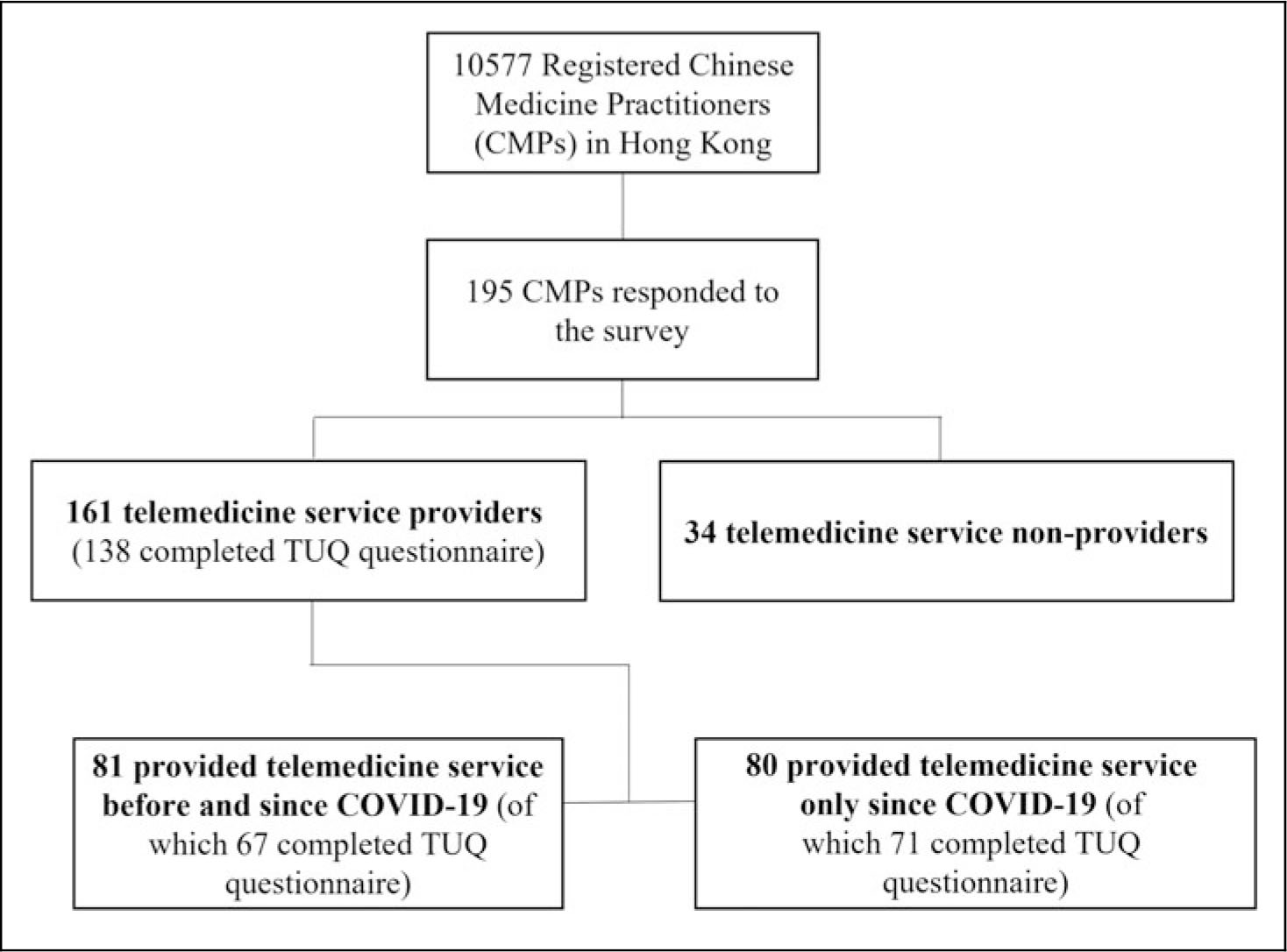
Telemedicine service provision among respondents.
Type of Services Provided by Chinese Medicine Practitioners Who Provided Telemedicine (n = 161)
Most used audiovisual media (77%), whereas others used phone. Common platforms included WhatsApp, WeChat, and Zoom (75%), with some using telephone calls (17%). Additional services included online payment, home delivery of medications, online appointments, and electronic prescriptions. CMPs who utilized telemedicine rated communication platforms positively for usefulness (mean = 5.46, SD = 0.82), ease of use (mean = 4.89, SD = 1.12), and facilitating smooth interactions with patients (mean = 4.46, SD = 1.06).
They also found the platforms to be a good communication interface (mean = 4.46, SD = 1.06). Although perceived reliability received a lower rating (mean = 3.41, SD = 1.13), most CMPs expressed satisfaction and intent to continue using telemedicine platforms (mean = 4.61, SD = 1.14) (Table 3).
Chinese Medicine Practitioners' Experience on the Use of Telemedicine Platforms (Telehealth Usability Questionnaire)
Out of 161 CMPs who provided telemedicine, 138 responded to the TUQ questionnaire.
CMP, Chinese medicine practitioner; TUQ, Telehealth Usability Questionnaire.
BARRIERS TO TELEMEDICINE USE
Respondents who had used telemedicine cited barriers such as inability to physically examine patients (67%), legal and ethical concerns (61%), lack of patient technological competence (54%), and patient access to Information Technology equipment (48%). Nonusers also identified similar barriers, with fewer noting patient technological competence as a barrier (32% vs. 54%, p = 0.02) (Table 4).
Barriers to Telemedicine Service Provision
p < 0.05.
IT, Information Technology.
FACTORS ASSOCIATED WITH THE USE OF TELEMEDICINE
Having adjusted for other factors, respondents working in the public sector (adjusted odds ratio [OR] = 0.11, 95% confidence interval [CI]: 0.03–0.44) or nonprofit charitable TCM clinics (adjusted OR = 0.15, 95% CI: 0.04–0.60) were less likely to provide telemedicine services, compared with solo practice respondents who are working in private clinics. Providers of telemedicine services were more likely to perceive patients' technological incompetence as a barrier to implementation (adjusted OR = 3.84, 95% CI: 1.19–12.42) (Table 5).
Multiple Logistic Regression: Factors Associated with Provision of Telemedicine Service
p < 0.01.
p < 0.05.
CI, confidence interval; OR, odds ratio.
ENHANCING TCM TELEMEDICINE SERVICE DEVELOPMENT
More than half of respondents (58%, 114/195) answered open-ended questions, providing their views on how to facilitate the provision of telemedicine in the sector. Respondents urged regulatory bodies to provide an explicit clinical guideline that demonstrate best practice in TCM telemedicine, and to clarify legal and ethical implications of such practice. It is also expected that the profession will need to implement measures to strengthen the protection of patient privacy and security of electronic health records.
From the perspectives of technical advancement, respondents would like to have a comprehensive e-platform that provides a one-stop electronic health record-based solution for appointment, record of informed consent, video consultation, prescription as well as follow-up scheduling. Specifically, respondents considered that a more user-friendly patient-facing virtual consultation software, complemented with appropriate patient education and guidance, would enhance patients' satisfaction. Some respondents considered an extended coverage of insurance and reimbursement would facilitate higher uptake of TCM telemedicine services in the community.
Discussion
This study examines CMPs' experience and perceptions of using telemedicine during the COVID-19 pandemic. Given that COVID-19 coronavirus is highly contagious, 31 it is advised to cease social activities that incur close contact of people in avoiding the spread of coronavirus over the period. 32 The use of telemedicine has been emerging as an alternative and safe mode to response the need to reduce the risk of COVID-19 transmission through face-to-face consultations, without compromising the quality and access of essential health services in the community. 33
In line with other health care professionals, 4 –7 our results found that CMPs practiced telemedicine during the COVID-19 pandemic to prevent transmission of coronavirus, with around one-quarter of surveyed CMPs provided routine telemedicine services regularly. The volume of service provided through telemedicine increased substantially since the pandemic, mainly in the form of virtual consultation. In a densely populated city such as Hong Kong, the clinics (especially private clinics) would usually have limited space and CMPs may have difficulties to implement preventive measures (e.g., triaging patients with suspected or confirmed COVID-19 in a separate room with good ventilation). 34
A prior study reported that nearly one-third of residents opted to avoid seeking medical consultation during the COVID-19 pandemic. 35 The demand of an alternative mode of consultation thus emerged to protect both patients and health care professionals, especially when around one-quarter of the surveyed respondents had been infected over the period.
Our findings demonstrate that surveyed respondents working in the clinics operated in the public sector or nonprofit charitable clinics are less likely to provide telemedicine service. One major reason is their engagement to the government-led special face-to-face outpatient program for COVID-19 rehabilitation over the period. 36 The involvement of government and policy makers and other stakeholders (e.g., an extended coverage of insurance and reimbursement by insurers) would be crucial in facilitating the wider use of telemedicine.
In fact, two-fifth of survey respondents practiced telemedicine before COVID-19, but the local authority has not provided corresponding regulations or good practices for CMPs in providing telemedicine, until a brief guideline is issued in late 2021. 37 To promote the implementation of telemedicine in the post-pandemic era, the World Health Organization emphasized the need for the policy makers and regulatory bodies in setting up corresponding regulatory policies and guidelines, including legal and ethical considerations as well as data privacy and security, to ensure “quality of care, clarifying accountability, and protecting health workers and patients during provision of services.” 23
A comprehensive regulation could enhance CMPs in providing telemedicine services, and relevant clinical practice guidelines are essential for ensuring quality of services. A recent systematic review has located 60 clinical practice guideline on virtual consultation services in conventional medicine, providing guidance on best practices in obtaining consent, technological setup, physician preparation and training, verbal and nonverbal communication skills, documentation and prescription. 38 In the future, there is a need to adapt these guidelines to fit the context TCM practice, and pilot their implementation in Hong Kong.
Among surveyed respondents who practiced telemedicine, most of them intended to continue provision of telemedicine services after the COVID-19 pandemic, and they pointed out several key policy initiatives that would improve quality of future services. Concerns on patients' e-Health literacy in using TCM telemedicine service is widespread among CMPs. Addressing this issue will enhance service access and thus reduce health disparities due to digital divide.
Possible policy options would include (1) delivering public education programmes on e-Health literacy tailored for the disadvantaged, 39 (2) providing assistance programmes to facilitate use of telemedicine services, and (3) provision of telemedicine services at the community where assistance is available (e.g., telemedicine booths at community health centers). 40 Another key improvement area suggested is the development of a comprehensive telemedicine e-platform to facilitate the administrative operations and clinical management.
In Hong Kong, the government launched an electronic health record programme recently, with a goal to develop a territory-wide patient-oriented eHealth Record sharing system (eHRSS). The use of eHRSS will facilitate health care professionals in managing their records and workflow, 41 and its use extended to cover patients' Chinese medicine record in 2022.
There is a need to perform assessment of implementation determinants on the adoption of eHRSS among CMPs, and devise appropriate implementation interventions to promote uptake. In the future, augmentation of eHRSS with Artificial Intelligence-related capacity may further enhance function of remote diagnosis, monitoring and management, but ethical challenges of deploying these AI function will require careful consideration. 42
LIMITATIONS
This study has several limitations. The data were collected in Hong Kong, a smart city with relatively high internet usage for business. 43 The findings might not be generalized to other places with varying levels of digital infrastructure. Although the survey was conducted through online to cover the target population in a short time period, a sample of CMPs who are relatively younger in age and a higher proportion of females was recruited.
The respondents might be skewed to CMPs who are more frequently adopted information technology in their daily lives. The survey was conducted during a critical moment for the health care sector against the COVID-19 pandemic, which might have affected the response rate. CMPs with polarized view about telemedicine might be more likely to participate in the survey.
Conclusions
This is one of the first study to quantify CMPs' experience and perception in providing telemedicine during the COVID-19 pandemic. In the face of this pandemic, CMPs have demonstrated the ability to adopt and adapt telemedicine into their practices, but barriers involving the technology itself, legal and ethical issues, lack of detailed guidance and patients' competency may prevent them from continuing the provision of TCM telemedicine services.
Development of best practice guidelines by professional and regulatory organizations is necessary for CMPs to maintain confidence in telemedicine service provision in the post-COVID-19 pandemic era, whereas institutional initiatives and development of a user-friendly and comprehensive e-platform would empower the use of telemedicine for both patients and CMP communities.
Footnotes
Acknowledgments
The authors would like to thank all Chinese medicine practitioners who responded to this survey amidst the COVID-19 pandemic.
Ethical Approval
The study was approved by the Survey and Behavioral Research Committee of the Chinese University of Hong Kong (Ref No. SBRE-12-0691). Participants provided written informed consent for participation in the study.
Authors' Contributions
Conceptualization by V.C.H.C., H.F., and E.-K.Y. Literature review and protocol development by V.C.H.C. and Y.W. Subject recruitment and questionnaire development by W.Y.H.C., Y.C.C., and C.P.L. contributed equally. Data analysis and ethical approval by H.-M.S. Drafting of the article by D.C.N.W. All authors reviewed and edited the article and approved the final version of the article.
Disclosure Statement
No competing financial interests exist.
Funding Information
No funding was received for this article.