




Abstract
Introduction:
Elite athletes experience sport-specific stressors and are at risk of developing mental health symptoms during and after their careers. E-Mental health interventions may pioneer a new approach to health care, which could help overcome barriers regarding its accessibility for elite athletes. This study aims to examine the needs and demands regarding the design and content of e-mental health interventions for elite athletes.
Methods:
A cross-sectional study was conducted via a web-based survey with N = 275 elite athletes, of which 167 were female and who participated in a variety of individual and/or team sports. Previous experience using e-mental health interventions was assessed. Needs and demands regarding format, frequency, content, and topics of an e-mental health intervention were analyzed descriptively and were compared between individual and team athletes using ANOVAs.
Results:
Elite athletes expressed a preference for an individual program via smartphone app (94.2%) with audio/video material (69.1%) and interactive tasks (60.4%). Regarding the frequency of e-mental health intervention, athletes in individual (62.2%) and team sports (60.0%) both preferred weekly intervention with sessions lasting between 20 and 30 min, whereas athletes engaged in both kinds of sports favored an intervention either on a weekly basis (44.7%) or on request (38.3%). The most relevant topics of e-mental health interventions for elite athletes were “Coping with pressure” (92%) and “Self-worth/self-esteem” (90%).
Conclusions:
The results of this study highlight the potential relevance of a user-centered design approach and could contribute valuable insights into developing e-mental health interventions for elite athletes.
Introduction
Athletes participating in elite sports typically face a range of specific stressors. 1 Engaging in high-level physical exertion within elite sports can detrimentally impact mental health, possibly heightening susceptibility to anxiety, depression, overtraining, injuries, and burnout. 2 Additionally, adolescent elite athletes are engaged in their sports at the peak onset age of mental health problems, 3 –5 which may contribute to the development of mental health issues. 6 A systematic review and meta-analysis indicate that the prevalence of mental health symptoms and disorders among current elite athletes may slightly exceed that of the general population, ranging from 19.6% for symptoms of distress to 33.6% for symptoms of anxiety/depression among current elite athletes. 7 Notably, elite athletes in individual sports seem to be more likely to report anxiety and depression compared with those in team sports. 8
Despite these heightened risk factors and the prevalence of mental health symptoms, elite athletes show a reluctance to seek professional assistance in contrast to the general population. 9 This hesitancy can be attributed to various factors, including fear of stigma, 10 potential ramifications on performance and career, the notion of seeking help being construed as a weakness, and insufficient comprehension of mental health. 11,12 Further barriers to treatment encompass low mental health literacy, negative past experiences with mental health treatment-seeking, and busy schedules. 13 Moreover, young people in general, especially young men, tend to not seek help for mental health problems. 14 This appears relevant because elite athletes often reach their peak performance at a relatively young age. 15 Further obstacles may include structural barriers such as inadequate cross-sector coordination, limited availability of care in certain regions, and long waiting times for psychotherapy. 16
In light of these challenges, e-health comprises health services and information delivered or enhanced through the internet and related technologies 17 and represents a pioneering approach to health care delivery facilitated by information and communication technology, encompassing telemedicine, mobile health, and health informatics. 18 Therefore, to conquer some of the aforementioned barriers, e-mental health interventions may prove a promising approach, 19 as they provide education about mental health, flexibility, and may present a lower threshold for actual use by elite athletes.
Numerous studies have already confirmed the effectiveness of e-mental health interventions for treatment and prevention of mental health problems. 20 –22 Still, high dropout rates are a common challenge in trials on e-health interventions, especially in self-help applications. 23,24 Furthermore, adherence to e-mental health interventions was also found to be low, which can be problematic. 25 To ensure high adherence, e-mental health interventions should be tailored to match the severity of symptoms and the individual’s specific needs, following a user-centered approach. 25 –28 Therefore, in the process of developing e-health interventions, past studies indicate the relevance of evaluating the needs and values of future users. 29 Furthermore, the design of an e-health intervention is of utmost importance to provide adherence to the intervention. 30
Given these considerations, a tailored approach has been specifically recommended for addressing elite athletes’ mental health 31 and that mental health interventions for athletes should be easily accessible. 32 Following this directive, it seems crucial to assess elite athletes’ needs and demands for an e-mental health intervention before developing and designing it.
Despite the growing interest in elite athletes’ mental health, 10,33 to date there is no widely known e-mental health intervention available for elite athletes that has been designed with the participation of elite athletes and evaluated for its effectiveness. Some existing programs use supportive e-mental health tools, and different tools have been examined for their effect on mental health symptoms in elite athletes. However, it is important to note that none of these tools are known to have been developed using a user-centered design approach or have been systematically evaluated for their effectiveness. 34 –37
Objectives
To ensure that e-mental health interventions are truly aligned with the unique needs of elite athletes, it is essential to consider individual perspectives and preferences. Therefore, this study aims to examine the needs and demands of elite athletes regarding e-mental health interventions. Additionally, it seeks to explore potential differences in preference as well as previous experience with e-mental health interventions among elite athletes’ subgroups.
Methods
This study is reported according to the “Strengthening the Reporting of Observational Studies in Epidemiology” (STROBE) guidelines for cross-sectional studies. 38
STUDY DESIGN AND PARTICIPANTS
An online, cross-sectional study design was chosen to recruit German elite athletes from December 2021 to December 2022. The eligibility criteria were legal age (≥18 years), having internet access, and being an elite athlete. Therefore, participants had to meet the following criteria: (1) alignment of life to sports, (2) striving for excellence, and (3) current participation in professional or Olympic competitions. 10,39,40 For recruitment, regional and national sports federations, along with sports clubs featuring elite athletes competing in regional, national, and international tournaments, were contacted via email and social media. The criteria that needed to be met to qualify as an elite athlete and to participate in the study were listed here. Participation in this survey was voluntary and anonymous.
Prior to the survey, each participant provided electronic informed consent. There were neither financial nor material incentives. The employed software was Unipark (Tivian XI GmbH). The study was designed in accordance with the Declaration of Helsinki and approved by the Ethics Committee of the Faculty of Medicine of the University of Duisburg-Essen (19-8947-BO).
MEASURES
Sociodemographic and sport-related data
Sociodemographic data, such as age, family status, living situation, level of education, and employment status, were recorded. Sport-related data included type of sports, average duration of training sessions, and training frequency per week.
Previous experience with e-mental health interventions
One item was used to assess elite athletes’ previous experience with e-mental health interventions (“Have you had any experience with online psychological support services?”). Possible answers were either “Yes, I have already made use of online psychological support services” or “Yes, I am aware of the possibility of using online psychological support services but have not yet used one” or “No, I was not previously aware of the possibility of using online psychological support services”. This item is established and has already been used in other studies. 41 –43
Needs and demands of elite athletes
Participants estimated how often they would use the intervention (1 = every day, 2 = once a week, 3 = every two weeks, 4 = once a month, 5 = only on demand) and indicated which type of program would suit them best (e.g., a very short, intensive program: several exercises per day, every day of the week, over approximately 4 weeks; a program that can be individually tailored to your needs: more support on more days a week at the beginning, which is gradually reduced). Participants also expressed their preferences regarding the availability of the e-mental health intervention (e.g., computer; mobile phone), format of the content (e.g., application; material for download), availability of new content (e.g., daily; monthly), and duration of one session (e.g., 1–10 min; over 45 min). These items were developed and adapted in prior studies. 27,42,44,45
Moreover, participants rated how much they thought different topics should be addressed by an e-mental health intervention on a five-point Likert scale (0 = “not relevant” to 4 = “very relevant”). The list of topics was developed based on current literature in the field of psychosomatic practice and compiled by experts in the field of psychosomatic medicine, sport psychology, and digital health. 43,45,46
STATISTICAL ANALYSIS
The data analysis was conducted using SPSS Statistics version 26 (IBM) and RStudio version 4.0.3/4.3.3 (R Core Team). Only participants with complete datasets were included. The participants of this survey were sorted into categories according to their type of sports: individual sports, team sports, or both individual and team sports. First, descriptive statistics of all self-generated items were calculated. Differences in presumed frequency of use, suitable formats, and preferred content for an e-mental health intervention were analyzed using standard and robust ANOVAs and post hoc tests based on trimmed means. The level of significance was set to α = 0.05 (two-sided tests). A sample size calculation, based on a medium effect size (Cohen’s f = 0.25), α = 0.05, and power = 0.90, indicated a required sample size of 85 participants per group.
Results
STUDY POPULATION
Of 382 participants, 29 (7.59%) participants were underage and 78 (20.42%) stated that they did not meet the criteria for elite athletes [(1) alignment of life to sports, (2) striving for excellence, and (3) current participation in professional or Olympic competitions] and thus had to be excluded at the beginning of the survey. This resulted in a final sample of N = 275. Of these 275 elite athletes, 108 (39.3%) were male and 167 (60.7%) were female. The participants were between 18 and 63 years old (M = 23.67; SD = 6.29). Eighty-five (30.9%) athletes were engaged in team sports, while 143 (52.0%) practiced individual sports, leaving 47 (17.1%) elite athletes to practice both individual and team sports. The great majority of elite athletes in our population were active in ball sports (32.8%), followed by water sports (29.6%). For more detailed information see Table 1. Most athletes started participating in elite sports during their school years and engaged in it for an average of M = 9.69 years (SD = 5.25). Regarding their recent training habits, the average duration of each training session amounted to M = 96.89 min (SD = 32.96) with M = 8.20 training sessions per week (SD = 4.27). Further details on education and employment are listed in Table 1.
Sample Characteristics (N = 275)
EXPERIENCE WITH E-MENTAL HEALTH INTERVENTIONS
Two hundred (72.7%) elite athletes were unaware of e-mental health interventions in general, while 56 (20.4%) athletes were aware of this possibility but had not yet used it. Only 19 (6.9%) athletes had used an e-mental health intervention before.
NEEDS AND DEMANDS OF E-MENTAL HEALTH INTERVENTIONS
Presumed frequency of use
A significant difference among the different subgroups of elite athletes was found for the presumed frequency of use (team sports M = 3.56; SD = 0.969; individual sports M = 3.28, SD = 0.945; both M = 3.72; SD = 1.097; p = 0.011, F 2,274 = 4.566). More than half of elite athletes in individual sports (62.2%) and team sports (60.0%) preferred participation in an e-mental health intervention on a weekly basis, with the biggest share (38.3%) of elite athletes engaged in both individual and team sports favoring an intervention on request.
Suitable formats
All groups expressed a similar preference regarding the type of program. Specifically, around half of the participants in each subgroup asked for an individual program following the elite athletes’ specific wishes in terms of frequency and intensity. Participants mostly asked for new material on a weekly basis or every 2 weeks. However, about 20% asked for instant access to all material to guarantee an individual approach to the program. Most athletes favored session durations of 20–30 min (41.8%) or 10–20 min (40.7%). The most preferred format by far was a smartphone app (94.2%), followed by audio/video material (69.1%) and interactive tasks (60.4%). Thus, availability through smartphones was favored (95.3%), but tablets (77.1%) and computers/laptops (74.9%) were requested as well. ANOVAs revealed no significant differences. For detailed data on the favored type of program, frequency of new material, and session duration displayed for each subgroup (individual sports, team sports, both, total), see Table 2.
Absolute and Relative (in Parentheses) Number of Responses Concerning Type of Program, Frequency of New Material, and Session Duration (N = 275)
Relevant and irrelevant content
Very relevant topics of e-mental health interventions for elite athletes were “Coping with pressure” (68.0%), “Self-worth/self-esteem” (66.5%), “Coping with fears” (49.1%), “Coping with pain/injuries” (49.1%), and “Coping with helplessness/overload” (47.3%).
Mostly rated to be more relevant were “Quality of life” (49.1%), “Relaxation techniques” (47.3%), “Maintaining a positive outlook” (45.8%), and “Self-care” (42.9%). Less relevant topics for elite athletes were “Faith/spirituality” (26.5%) and “Sexuality/intimacy” (25.5%). For a detailed overview of favored content and topics, see Fig. 1.
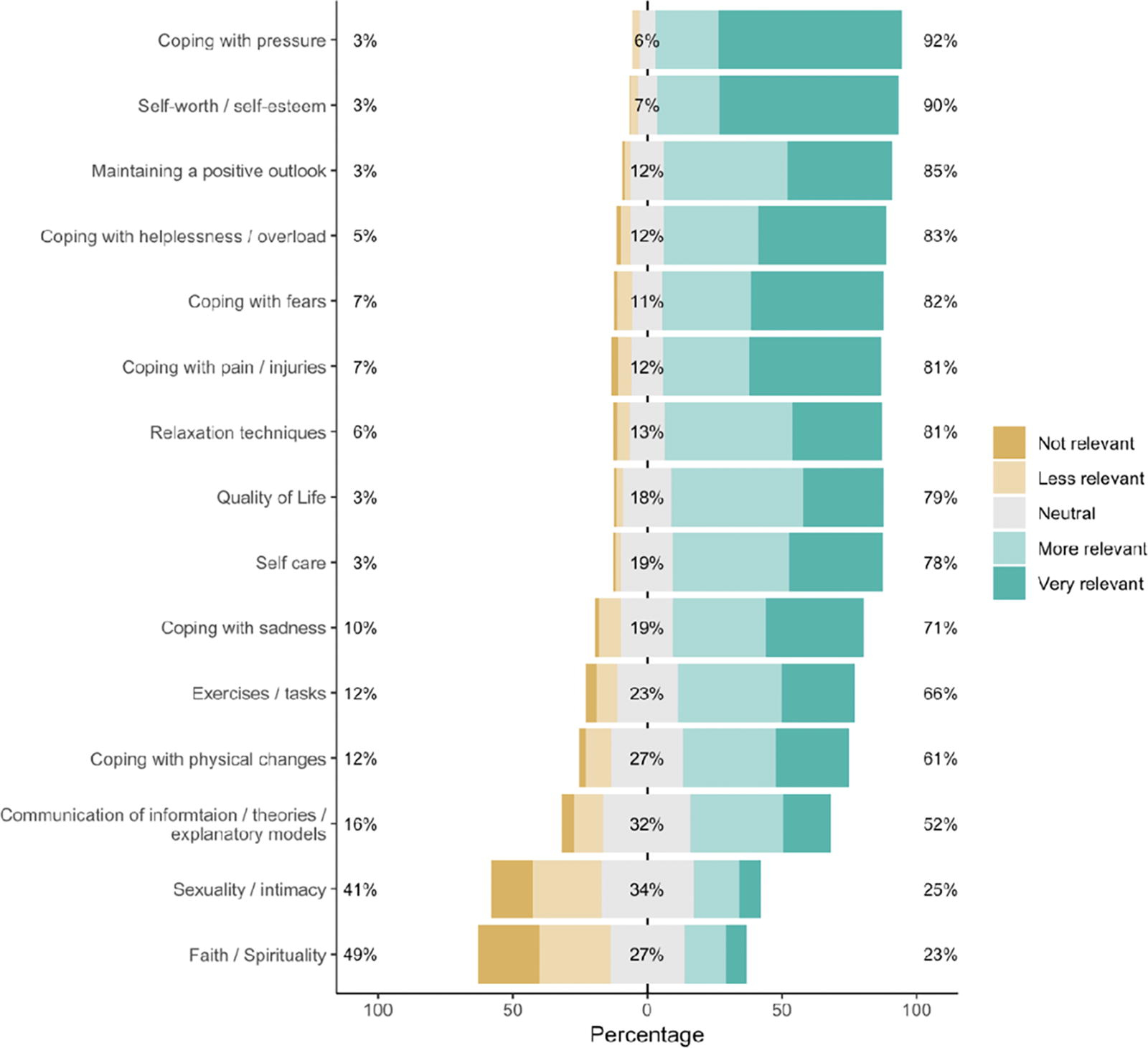
Irrelevant (dark and light beige) and relevant (dark and light green) content and topics for an e-mental health intervention for elite athletes.
Descriptive differences between groups were observed in several topics, but robust ANOVAs and post hoc tests revealed no significance of these differences. For a detailed and comprehensive overview see Supplementary Table S1 in Supplementary Data S1.
Discussion
This study examined the needs and demands of elite athletes regarding the content and design in e-mental health interventions. It also investigated differences in content and design preferences among subgroups of elite athletes, as well as previous experience with and presumed frequency of use of such interventions.
Few participants reported prior experience with e-mental health interventions, consistent with a representative German survey indicating limited awareness of online counseling. 47 As awareness is a prerequisite for the acceptance and use of new interventions, 48 this finding emphasizes the need for more public awareness and understanding of the effectiveness of internet-based treatments, which would ultimately lead to increase users’ acceptance and adherence. However, about one-fifth of participants had heard of an e-mental health intervention for elite athletes but never made use of it. Hence, it may not be enough just to hear about the possible interventions, but athletes should perhaps be motivated by coaches and their sporting environment to make use of them. This underlines the role of stigma related to the need for any psychological support among elite athletes. 12 Research shows that low mental health literacy is an important barrier for elite athletes to seek help12,13 and that education about mental well-being and mental health problems should be provided 49,50 with the aim to reduce stigma 51 and increase awareness. 52
Regarding presumed frequency of use, a significant difference was found, as more than half of elite athletes in individual sports and team sports assumed to use an e-mental health intervention on a weekly basis, while the largest share of elite athletes, engaged in both individual and team sports, favored for an intervention on request. While a significant difference was found, it does not appear to be of importance, as measures for all three groups lay in between the same two categories (presumed usage every 2 weeks and every month). However, despite these differences in presumed usage frequency, the relevance ratings of the topics did not differ significantly between athletes in individual, team, or both individual and team sports. This suggests that athletes, regardless of their sport type, have similar needs resulting in the same intervention being a suitable option for both groups, given that it offers flexible usage frequencies.
Smartphones were the most preferred device (95.3%), followed by tablets and laptops. This is in line with several other studies highlighting their popularity for digital health interventions due to their accessibility and frequent use. 42,44,45,53,54 This underlines the importance of mobile-friendly designs for effective implementation.
Moreover, the preferred content delivery formats for the intervention were smartphone applications (94.2%), followed by audio/video material (69.1%) and interactive tasks (60.4%). The most preferred type of program was the individual program, which initially provides more frequent support and then decreases the frequency of support according to the needs of its user. This finding supports the importance of a user-centered design approach. Since elite athletes face special challenges and barriers in accessing psychological support, such as busy schedules 10,13 and frequent traveling, 55,56 it is understandable that they prefer a flexible and individual program that adapts to their needs. Furthermore, since high rates of psychological distress have been reported, 57 it is crucial that e-mental health interventions should not present any additional burden for elite athletes but should align with athletes’ circumstances of life.
Exactly 44% of participants expressed a desire to use the intervention weekly, indicating a preference for consistent integration into their routines. Approximately 40% of the participants indicated a desired session duration of 10–20 min, and a further 40% favored 20–30 min, emphasizing the need for concise and targeted content.
Regarding content and topics of e-mental health interventions, “Coping with pressure” and “Self-worth/self-esteem” were the most relevant topics for elite athletes in our sample. Recent literature also underlined the relevance of “Coping with pressure” 58,59 while “Self-worth/self-esteem” has been known to be a crucial contributor to the success of elite athletes for over 20 years. 60,61 The topics “Coping with pain/injuries” and “Coping with fears” were also of particular importance for elite athletes in our sample. Hence, it is notable that although not statistically different, topics obviously closely related to performance in sports are rated more highly than those rather related to general well-being or mental health (e.g., “Quality of life,” “Maintaining a positive outlook,” and “Self-care”).
Another very relevant topic was “Coping with helplessness/overload,” which might reflect the mental burden found in elite athletes. 57 However, the participating athletes did not rate “Communication of information/theories/explanatory model” as very relevant. This could indicate that many athletes are not interested in explanatory background knowledge but in practical advice. The least relevant topics were “Faith/spirituality” and “Sexuality/intimacy,” which may indicate a general preference for sports-related content. This finding could be influenced by broader societal trends in Germany, such as secularization and declining church membership, as well as cultural discomfort around discussing sexuality in professional settings.
Differences regarding relevant and irrelevant content for each subgroup of elite athletes showed no significance. The desire to perform at their best and the intense focus on their sport unite athletes, irrespective of whether they are involved in individual or team sports. Additionally, the sample’s age group may have contributed to similar interests and needs, as almost 90% of participants were aged between 19 and 30. Across sports, there are common areas that appear to be insufficiently addressed in training and support, further reinforcing the need for e-mental health interventions tailored to the needs and demands of elite athletes.
Practical recommendations based on these findings suggest that e-mental health interventions should be integrated into the support system of elite athletes. To improve adoption and reduce stigma, these interventions should be endorsed by coaches, sports physicians, and physiotherapists, helping athletes incorporate mental health support into their routines more effectively.
Limitations and Strengths
This study has several notable strengths. The majority of participants were female athletes, an important demographic, as they are both more likely to have mental health problems and seek help than male athletes. 5 This increases the relevance of the study for future users of mental health support systems. In addition, the online survey ensured anonymity, which likely encouraged honest responses to sensitive questions and attracted participants with an affinity for digital platforms, which is the target audience for future digital interventions.
However, the results of this study should be interpreted with certain limitations in mind. Since the study design was cross-sectional, causal conclusions cannot be drawn from the data. The online survey may have led to a sample more representative of individuals comfortable with digital devices, potentially overlooking the views of those less familiar with the internet. This potential selection bias should be considered. However, it is noteworthy that 91% of the German population reported using the internet at least occasionally for private purposes in 2021 with the number rising continually. 62 Furthermore, the classification of participants as athletes relied on self-reported information, which may have resulted in the inclusion of individuals who did not fully meet the criteria. Additionally, the study was conducted during different stages of the COVID-19 pandemic, so varying restrictions and challenges may have influenced the needs and demands of elite athletes. 63 Furthermore, it should be noted that elite athletes without psychological support provided by their club or association might be more likely to take part in the survey. Moreover, the present study had a higher proportion of female participants, which should be considered in terms of generalizability, as research shows that female athletes are more likely to suffer from mental health problems 64 –67 and are more willing to seek help5,14 compared with male athletes.
Conclusions
This study describes the needs and demands for the content and design of e-mental health interventions for elite athletes. Elite athletes had low previous experience using e-mental health interventions and preferred such interventions to be delivered on handheld devices. An individualized type of program with content focused on elite athletes’ specific needs was preferred most. The results of this study provide useful insights for developing and implementing e-mental health interventions tailored to the needs of prospective users, thus contributing to specialized health care in an evidence-based manner.
Footnotes
Acknowledgment
The authors are thankful to their colleagues who provided expertise that greatly assisted them in their research.
Authors’ Contributions
A.B., M.T., E.-M.S., and S.G. initiated and conceptualized the study. J.A. and T.M. were jointly responsible for participant recruitment. S.G. and J.A. conducted the statistical analyses and data interpretation, with S.G. writing the initial draft of the article. A.J.E.-S., E.R., S.V., and the other authors contributed to subsequent revisions of the article and approved the final version.
Ethics Statement
The study setup was developed in accordance with the Declaration of Helsinki and approved by the Ethics Committee of the Faculty of Medicine at the University of Duisburg-Essen (19-8947-BO).
Disclosure Statement
No competing financial interests exist.
Funding Information
This study received no funding.
Supplementary Material
Supplementary Data S1
Supplementary Table S1
References
Supplementary Material
Please find the following supplemental material available below.
For Open Access articles published under a Creative Commons License, all supplemental material carries the same license as the article it is associated with.
For non-Open Access articles published, all supplemental material carries a non-exclusive license, and permission requests for re-use of supplemental material or any part of supplemental material shall be sent directly to the copyright owner as specified in the copyright notice associated with the article.
