




Abstract
Introduction:
Telemedicine research in France remains relatively underexplored, with a notable absence of comprehensive literature reviews or bibliometric analyses guiding research prioritization and funding allocation for public health interests. The objective of this study is to provide a comprehensive overview of telehealth research in France, elucidating its current trends and primary funding sources.
Methods:
A bibliometric analysis was conducted spanning a 20-year period from January 1, 2004, to December 31, 2023, using six open-access databases, including the Ministry of Health of France (public research funding), Health Data Hub (research protocols from France), Clinicaltrials.gov (global repository of research protocols), PubMed (scientific publications), Theses.fr (PhD database in France), and DUMAS (master’s and doctorate theses database in France).
Results:
The French Ministry of Health funded 41 telehealth research projects between 2009 and 2022, amounting to €15 million, which constituted 1.1% of all projects funded during this period. 279 study protocols were identified on ClinicalTrials.gov, peaking in 2021 with 58 protocols (20.8%), representing 5.8% of worldwide protocols. Public hospitals provided most of the funding (66%), with 18% coming from the industry. A total of 1,254 publications related to telehealth were identified in PubMed, representing 2.5% of worldwide telehealth publications.
Discussions:
This is the first study in France and Europe to describe the trends in telehealth research over a 20-year period. Telehealth research in France started in the early 2000s, had a linear growth between 2011 and 2021, peaked during the COVID-19 pandemic, and decreased in 2022 and 2023. All types of telehealth interactions were covered, and funding came mostly from public sources. Funding for telehealth research was however limited and should be increased in France.
Introduction
Telehealth, encompassing the remote provision of health care services via telecommunications technologies, has undergone significant evolution in France over the past decade. Legalized in 2009, it has witnessed substantial growth with the introduction of reimbursable services such as teleconsultations, tele-expertise, and remote patient monitoring (RPM) since 2018.1–4
The onset of the COVID-19 pandemic further accelerated its adoption, evidenced by 17 million reimbursed teleconsultations in 2020, primarily conducted by primary care practitioners. 5 Beginning in 2024, teleconsultation platforms have been allowed to obtain a dedicated license from the Ministry of Health (MOH) to directly bill the National Public Health Insurance.
Despite these advancements, telemedicine research in France remains relatively underexplored, with a notable absence of comprehensive literature reviews or bibliometric analyses guiding research prioritization and funding allocation for public health interests. The first comprehensive review on telehealth research in France, focusing solely on the ClinicalTrials.gov database, was published in 2014, a decade ago. Similarly, the first literature review, published in 2020, exclusively focused on acute telestroke studies.6,7
To date, there has been no integrated study combining multiple databases in postpandemic France, despite the observed peak in telehealth-related publications during 2020–2021 due to COVID-19.8–11 Therefore, the objective of this study is to provide a comprehensive overview of telehealth research in France, elucidating its current trends and primary funding sources.
Methods
A bibliometric analysis was conducted spanning a 20-year period from January 1, 2004, to December 31, 2023, chosen to encompass the evolution of telemedicine in France following its initial introduction into legislation in 2004. 12 Studies included in this analysis were those published or conducted by French-affiliated authors focusing on telemedicine, telehealth, or telecare in either French or English.
Data for this analysis were sourced from six open-access databases: (1) the MOH of France (public research funding), 13 (2) Health Data Hub (research protocols from France),14,15 (3) Clinicaltrials.gov (global repository of research protocols), 16 (4) PubMed (scientific publications), (5) Theses.fr (PhD database in France), 17 and (6) DUMAS (“Dépôt Universitaire de Mémoires Après Soutenance”) (master’s and doctorate theses database in France). 18
The MOH of France allocates yearly public research funding across several programs, including the translational research program (PRT), 19 the clinical research hospital program (PHRC),20,21 the medico-economic research program (PRME), 22 the health system performance research program (PREPS), 23 and the paramedical and nursing hospital research program (PHRIP). 24 Each project funded under these programs is documented online, detailing project names, funding types, affiliations, and budgets. We systematically screened each file to identify projects related to telehealth, recording characteristics such as year, project name, telehealth type, funding program, and budget. We calculated ratios between telehealth projects and total funding across years and programs.
Data from the Health Data Hub were extracted from the website’s search page, focusing on protocol upload years, telehealth activity types, funding sources, and links to the French National Health Data Information System (SNDS).25–27 ClinicalTrials.gov data were obtained through an online search related to telehealth, collecting information on protocol years, titles, funding sources, study statuses, study designs, and number of patients included.
Scientific publications were sourced from PubMed using a predefined algorithm capturing relevant terms and specifying France as the geographical focus. The algorithm was: ((“Telemedicine"[Mesh]) OR (“Telepathology"[Mesh]) OR (“Telemonitoring"[Mesh]) OR (“Teleophtahlmology"[Mesh]) OR (“Teleradiology"[Mesh]) OR (“Remote consultations"[Mesh]) OR “Remote patient monitoring” OR “tele-expertise” OR “teleexpertise” OR “telehealth” OR “telecare” OR “teleneurology” OR “telestroke” OR “telecardiology” OR “teleconsultation” OR “teleassistance”) AND “France.” Articles were screened based on titles and abstracts, manually extracted into a dedicated database for analysis, and documented with publication years and journal names. There were no exclusion criteria. Theses.fr and DUMAS databases were searched manually based on thesis titles, capturing years and types of graduate programs (medicine, pharmacy, and dentistry).
All data collected underwent comprehensive analysis, including point estimates, absolute values, percentages for qualitative variables, and means, standard deviations, and medians for quantitative variables. This study did not require ethics approval due to its use of publicly available data.
Results
In total, the MOH of France funded 41 telehealth research projects between 2009 and 2022, amounting to €15 million, which constituted 1.1% of all research projects funded during this period through the mentioned research funding programs (Fig. 1). The proportion of funding allocated to telehealth projects fluctuated over the years, rising from 0.2% in 2013 to 3% in 2016 before decreasing to 1.1% by 2022.
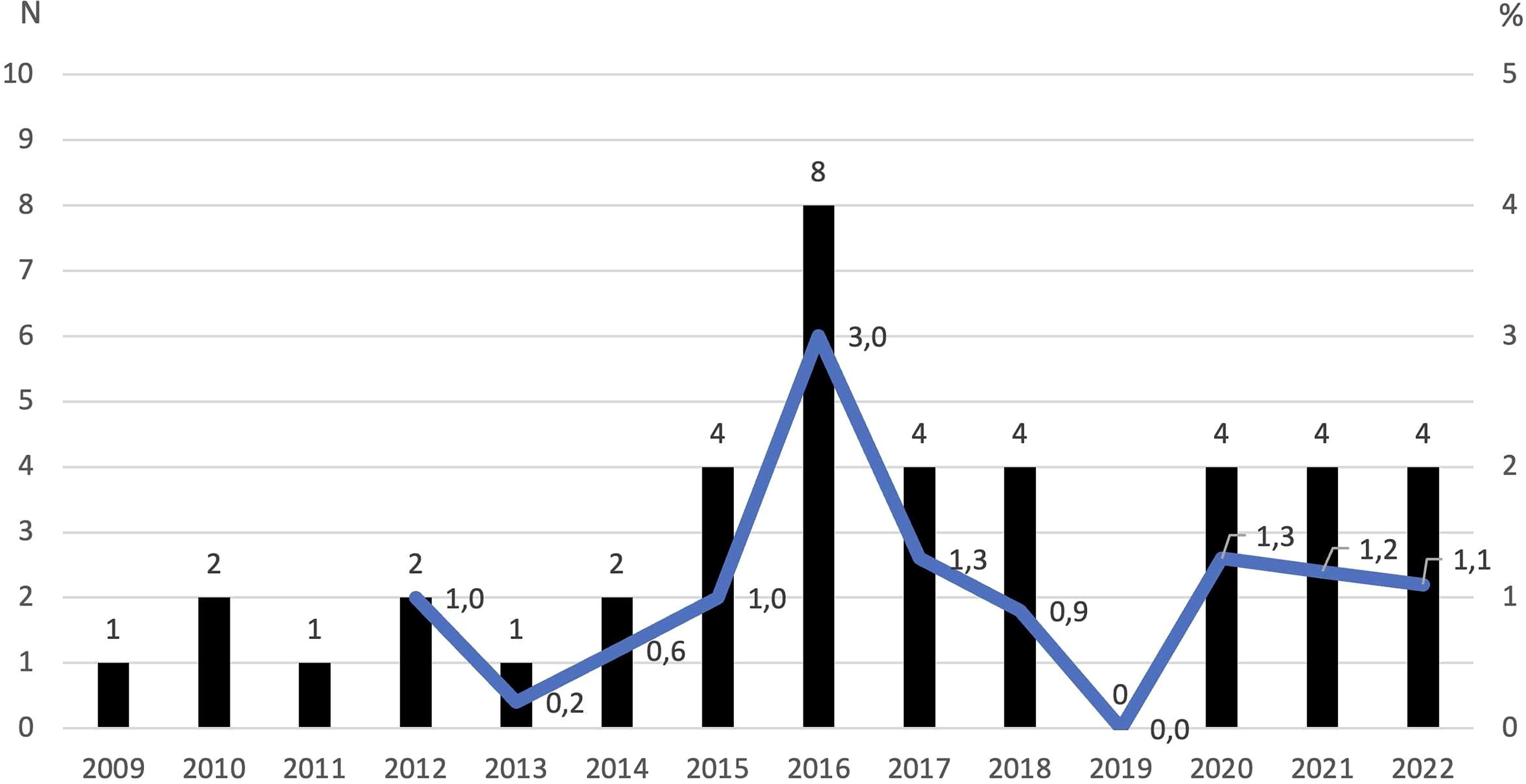
Telehealth research projects funded by the Ministry of Health in France between 2009 and 2023. The blue line represent the % of projects funded related to telehealth.
Most of the projects funded came through the PREPS program (54%), followed by PHRC (32%), PRME (7%), and PHRIP (5%). Within each program, PREPS accounted for the highest proportion of telehealth funding (7.2%), followed by PRME (2.6%), PHRIP (1.2%), PHRC (0.3%), and PRT (0.3%).
The peak year for the number of projects funded was 2016, with eight projects receiving funding. From 2017 to 2022, four projects were funded annually, except for 2019, when no telehealth projects were identified. Thirteen academic hospital centers (CHU) received funding, with Toulouse (6 projects), Lyon (five projects), and Paris (five projects) emerging as the top three recipients. Only CHUs were receiving funds for these projects. Teleconsultations received the most focus (37%), followed by remote patient monitoring (29%), tele-expertise (27%), and medical regulation (7%).
Fifty-four research protocols were identified in the Health Data Hub database, with no significant increase observed from 2020 to 2023. Industry-sponsored projects accounted for 30% of these protocols, predominantly focusing on remote patient monitoring (56%), followed by teleconsultations (37%) and tele-expertise (8%). A total of 24% of projects utilized the SNDS database, primarily for remote patient monitoring (63%), including applications in gestational diabetes, postsurgery monitoring, and oncology. Only two protocols related to tele-expertise in dermatology were identified, and no protocols specifically related to SNDS usage for teleconsultations in primary care.
A total of 279 study protocols from France were identified on ClinicalTrials.gov, peaking in 2021 with 58 protocols (20.8%). French protocols represented 5.8% of worldwide protocols, with this proportion declining from its peak of 8.7% in 2014 to 4.7% in 2023 (Fig. 2). Public hospitals provided most of the funding (66%), and 18% came from the industry. Twenty-one percent of studies were actively recruiting participants, and 15% included children. The median number of patients per study was 150, but the largest teleconsultation study involved 84,000 patients sponsored by the Les Entreprises de Télésanté (LET), the association of telehealth companies, representing the main private telehealth providers in France. 22 Interventional studies accounted for 57% of the protocols, compared to 43% that were observational.

Telehealth research protocols from France registered in ClinicalTrials.com between 2005 and 2023. The blue line represent the % of research protocols related to telehealth in France compared to the world.
A total of 1,254 publications related to telehealth were identified in PubMed, representing 2.5% of worldwide telehealth publications. Publication volume showed a steady increase annually from 2011 to 2021, peaking at 189 publications in 2021 (Fig. 3). However, there was a decrease in publications in 2022 and 2023. Since 2016, France’s share of global telehealth publications has varied between 2.7% and 2%. The journal with the highest number of publications was Stud Health Technol Inform (4%), followed by J Med internet Res (3.4%), Soins (3.3%), Telemed J E Health (2.6%), and J Telemed Telecare (2.6%).
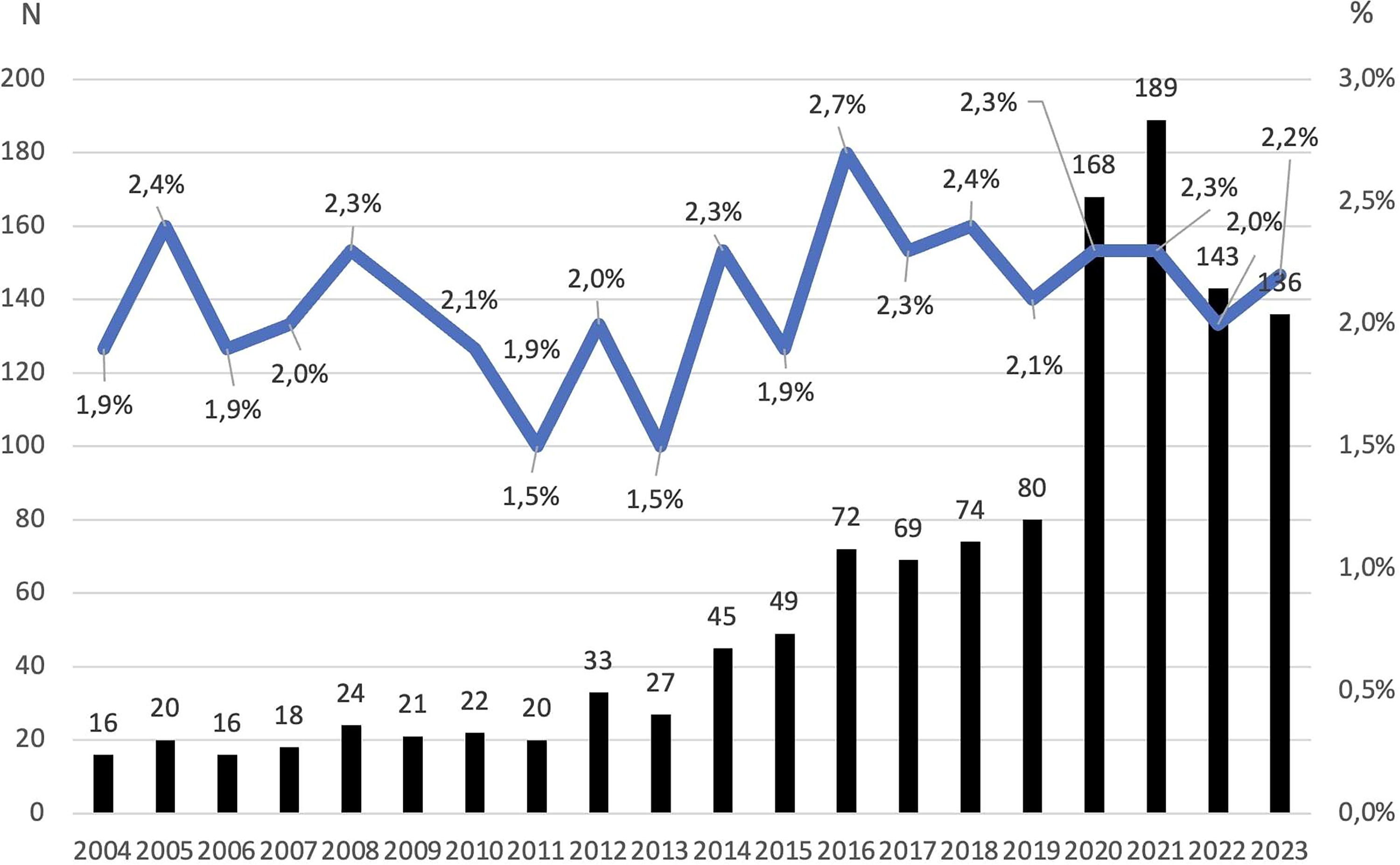
Telehealth publications from France available on PubMed between 2004 and 2023. The blue line represent the % of publications related to telehealth in France identified on PubMed compared to the world.
Between 2008 and 2023, a total of 267 doctoral theses related to telehealth were identified, with a peak of 50 theses in 2021 (18.7% of the total 267 theses). Medical doctorate (MD) theses accounted for the majority (78%), followed by pharmacy (12%) and dentistry (6%). In addition, there were 188 PhD theses related to telehealth, with a peak of 21 theses in 2021. The number of PhD theses showed a linear increase from 2004, with a slight decline in 2022 and 2023 compared to 2021.
Discussion
This is the first study in France and Europe to describe the trends in telehealth research over a 20-year period. Telehealth research in France started in the early 2000s, had a linear growth phase between 2011 and 2021, peaked during the COVID-19 pandemic, and decreased in the following 2 years of 2022 and 2023. The research covered all types of telehealth interactions, was diversified, and was funded both by the public and the private sectors. The amount of public funding remained, however, quite low compared with the public health needs and the increasing deployment of telehealth in clinical routine practices in France.
Regarding the MOH funding for academic research in telehealth, the amount of 15 million euros within 15 years, equivalent to 1 million euros per year, was a low amount in absolute value. While the overall budget for research from the MOH has increased in the past decade, the relative proportion of funding for telehealth research decreased. In addition, most of the publicly funded telehealth research was focused on health systems analysis rather than on medico-economic analysis. This lower proportion of studies could be seen as a structural weakness preventing to properly guide policy makers on funding and reimbursement models for telehealth in France.
In terms of the type of telehealth activity funded, the higher proportion of funded research related to teleconsultation seems logical given the national context of routine funding for video teleconsultations since 2018 and the primary emphasis that has been put on this modality since at least 2014. As remote patient monitoring and tele-expertise are more recent, it seems also logical that there was less research funded related to these modalities by the public sector. It is, however, interesting to observe the role of industry funding in RPM research in France through the Health Data Hub database of projects.
Regarding the sources of data used for telehealth research, the SNDS seems to have been more used in recent years, maybe due to efforts in improving access to the database with the support of the Health Data Hub since 2019-2020. It represents an additional source of data that can be combined and paired with the telehealth ad hoc study data to describe the impact of the telehealth practice on patient pathways, funding, and prescriptions. This research mostly focused on noncommunicable diseases, diabetes, and oncology. None were identified related to the role of teleconsultations in primary care, creating, therefore, an opportunity to define this type of research.
The median number of patients recruited in telehealth research in France was also quite low at 150 patients, demonstrating limited capacity in conducting large-scale telehealth research. The largest study was conducted by the LET with a retrospective inclusion of 84,000 patients over a period of 3 months in 2021. This study was the first study in France and Europe of this scale and was purely funded by private telehealth companies without any public funding support. The relative share of telehealth research in terms of protocols on ClinicalTrials.gov or publications available on PubMed has also been decreasing in the past years despite an absolute increase, demonstrating that overall, telehealth research has been growing faster outside of France compared to France.
The main strengths of this study were the multiple databases used to identify trends, the 20 years’ timeframe allowing to observe trends on a long-term scale, the availability of funding information, and the possibility to conduct global comparisons. This is also the first time that such research methodology was conducted for telehealth research in the world, which could be replicated for other countries based on available sources of information.
The main weaknesses relied on the available information to be extracted, which were mostly limited to study titles and abstract, potentially leading to missing studies or wrong classifications. This information was not available on open access and could not be requested in detail from the MOH. The databases used for the study were also not exhaustive, potentially leading to some bias, even though these databases are the best proxies that could be used for bibliometric trends analysis.
Overall, telemedicine research in France demonstrates diversity but shows signs of postpandemic stagnation. Continued funding challenges highlight disparities between public health needs and investment priorities. Strategic prioritization of research projects is essential to address health care access crises effectively. Streamlined administrative processes, akin to those adopted during the COVID-19 vaccine development, are recommended to expedite telemedicine integration across health care sectors. Leveraging the research capabilities of leading public institutions can further bolster telemedicine’s public health impact.
Conclusions
In conclusion, telemedicine research in France exhibits significant potential yet requires sustained financial backing and strategic alignment with public health priorities. Enhancing research quality and quantity through collaborative efforts and streamlined funding mechanisms is imperative to advance telemedicine’s role in modern health care delivery.
Footnotes
Acknowledgments
The authors thank all individuals and companies from the LET which contributed to the study.
Funding Information
This study was funded entirely by Les Entreprises de Télésanté (LET), France.
Ethics Approval
Ethics approval was not required according to French legislation as no patient data was collected.
Data Availability
Data will be made available upon request by e-mail to the corresponding author.
Disclosure Statement
No competing financial interests exist.