




Abstract
We carried out virological surveillance of dengue virus (DENV) in field-caught Aedes mosquitoes during 2004–2007 to estimate the monthly prevalence of infected females in dengue high-risk areas of Taiwan. A total of 92,892 Aedes aegypti (43,133 females and 49,759 males) and 79,315 Aedes albopictus (57,319 females and 21,996 males) adults were collected, grouped into 25,654 pools, and processed for virus detection using a one-step SYBR Green–based real-time reverse transcriptase–polymerase chain reaction assay. DENVs were periodically and sympatrically detected in Ae. aegypti females in accordance with major dengue outbreaks and the corresponding dengue serotypes. Only 0.2% of 7628 pools of Ae. aegypti females were positive for DENVs. This resulted in an overall estimated infection rate (maximum likelihood estimation) of 0.970 per 1000 mosquitoes (95% confidence interval [CI] = 0.53–1.65). The total monthly infection rates ranged from 0.50 to 2.23 per 1000 mosquitoes (95% CI = 0.03–10.71). When sampling areas were scaled down to the city level, monthly infection rates increased to 0.73–12.59 (95% CI = 0.06–59.19). Monthly infection rates over all sampling areas and at the city level increased significantly by month. All positive pools were collected in July (one pool), August (two pools), September (one pool), October (three pools), November (four pools), and December (one pool). All four virus serotypes were detected in mosquitoes, which were consistent with dengue serotypes infecting humans in 2004 (DENV-4), 2005 and 2006 (DENV-2 and DENV-3), and 2007 (DENV-1). Our results provide supporting evidence that, in general, DENV infection rates were low in local Aedes mosquito population during 2004–2007 and that transovarial transmission may not be occurring or is occurring at much lower rates than evidenced in some endemic countries.
Introduction
In many tropical and subtropical areas of the world, dengue is an endemic disease with periodic or annual outbreaks. Taiwan has a different pattern of dengue transmission in that dengue outbreaks will usually start in the early summer (June), peak in the autumn (October), and end in the winter (February of next year) due to cold weather each year. With the exception of over-winter outbreaks with the same DENVs in 1987–1988 (DENV-1) and 2001–2002 (DENV-2), no dengue cases were identified between March and May (Huang et al. 2007). Molecular epidemiological studies analyzing a wide variety of DENV strains isolated from imported and indigenous dengue cases during 1981–2006 showed that different serotypes, genotypes, and/or strains were responsible for the yearly outbreaks and that epidemic strains disappeared with the ending of each local outbreak (Chao et al. 2004, Huang et al. 2007). These results suggested that constant importation of multiple DENVs from the neighboring Southeast Asian countries through close commercial links and air travel was mainly responsible for local outbreaks that occur each year. Indeed, accumulated data of dengue surveillance showed increasing numbers of imported cases during the last decade in Taiwan (King et al. 2004, CDC-Taiwan 2005, 2006, Shu et al. 2005). However, these findings do not exclude the possibility that imported DENV persists in Taiwan with limited silent transmission (Chen et al. 1996).
In dengue-endemic countries, such as Singapore and Colombia, human patients and mosquito infections were detected year-round through continuous mosquito–human–mosquito transmission cycles (Chow et al. 1998, Mendez et al. 2006). Mosquito infection rates of DENVs in field-caught Ae. aegypti and Ae. albopictus females were detected by polymerase chain reaction (PCR) methods, and they ranged from 6.1 to 222.2 and 6.1 to 114.3 infected females per 1000 mosquitoes, respectively (Chow et al. 1998, Chung and Pang 2002, Mendez et al. 2006). DENV is potentially maintained between successive generations of mosquitoes through vertical transmission from an infected female to her progeny (Joshi et al. 2002). In Singapore, high infection rates of 13.3 and 21.5 infected males per 1000 mosquitoes have been reported for field-caught males of Ae. aegypti and Ae. albopictus, respectively (Kow et al. 2001). In Malaysia, field-caught larvae of both species had minimum infection rates of 2.3–40.0 infected larvae per 1000 mosquitoes (Lee and Rohani 2005). These results suggested that virologic surveillance by reverse transcriptase (RT)–PCR for detecting infected Aedes mosquitoes in the field in dengue-endemic areas may serve as an early warning system for dengue outbreaks. Independent surveillance studies from Singapore and Colombia showed that infected Ae. Aegypti were detected as early as 6 weeks before the start of the dengue outbreaks, and increases in mosquito infection rates were associated with increases in human infection rates in the following trimester, respectively.
Although PCR assays have the advantages of higher rapidity, sensitivity, and capability to detect nonviable viruses than virus isolation systems that amplify viable viruses, it is notoriously prone to contamination due to carryover contamination. Therefore, high infection rates of DENVs determined by RT-PCR in field-caught mosquitoes should be interpreted cautiously and confirmed by sequence analysis and/or virus isolation. In contrast, RT-PCR may fail to detect some serotypes, genotypes, or strains of DENVs because of large sequence variation. It is always desirable to have multiple primers targeted at different gene regions to detect different strains and potential variants. Recent development of automatic real-time RT-PCR assays had greatly improved the detection of DENV infection. The real-time RT-PCR assays have many advantages over conventional RT-PCR methods, including rapidity, quantitative measurement, lower contamination rate, higher sensitivity, higher specificity, and easy standardization (Shu and Huang 2004, Moureau et al. 2007). For laboratory-based DENV surveillance, we developed a group- and serotype-specific one-step SYBR Green I real-time RT-PCR assay for the screening and typing of DENV RNA in the human serum samples, infected cell cultures, and mosquito pools (Shu et al. 2003a). To avoid potential false-positive reactions, positive mosquito pools tested by real-time RT-PCR were followed by nucleotide sequencing of real-time RT-PCR product and virus isolation by cell culture to confirm the virus detection and to determine the DENV serotypes and genotypes.
In contrast to many dengue-endemic Southeast Asian countries, Taiwan has experienced a distinct interepidemic period before the summer months when dengue cases normally occur (Huang et al. 2007). This unique feature of dengue outbreaks could be explained by several mechanisms, including (1) intermittent reintroduction of virus from endemic countries, (2) continuation of a low level of virus transmission within the human population between outbreaks, and (3) transovarially infected mosquitoes orally transmitting the virus, which has been demonstrated in the laboratory by Mourya et al. (2001). To characterize the seasonal dynamics of transmission and to better understand how DENVs are maintained in dengue high-risk areas of Taiwan, we conducted virological surveillance of DENVs in field-caught Aedes mosquitoes during 2004–2007. Our principal objective was to characterize year-to-year fluctuations in mosquito infection rates so that we could understand how DENVs are maintained in dengue high-risk areas of Taiwan. Results of the survey are reported in the present publication.
Materials and Methods
Study sites
Our study was conducted over the geographic range of Ae. aegypti in Taiwan (Fig. 1). This region is located between 120°02′–121°03′E and 21°53′–23°29′N. In general, the region has a tropical climate with an average temperature of 24.6°C (range, 18.9–28.7°C) and separate rainy and dry seasons. The rainy season (averaging 1567.2 mm per season) is from May to September, and the dry season (averaging 248.2 mm per season) is from October to April. Periodic dengue outbreaks have been reported in this region since 1987. Dengue cases have been reported from the following cities/counties: Tainan city (TC), Tainan county (TCT), Kaohsiung city (KC), Kaohsiung county (KCT), and Pingtung county (PCT), which are subdivided into 7 districts, 31 townships, 11 districts, 27 townships, and 33 townships, respectively. However, for the past 9 years, almost all (98.9%) of the indigenous dengue cases were reported from KC (44.4%), KCT (24.8%), TC (18.4%), PCT (7.4%), and TCT (4.0%) (Table 1). Fenshan city and Pingtung city accounted for 85.6% and 84.2% of cases in KCT and PCT, respectively. Therefore, mosquito collection efforts were concentrated in these four cities (TC, KC, Fenshan city, and Pingtung city). In these cities, the total land area, the number of households, and the population of these four cities ranged from 26.745 to 175.645 km2, 69,427 to 560,921, and 216,258 to 1,520,555, respectively (the details of each city are listed in Fig. 1). With the exception of Fenshan city in KCT, which is adjacent to KC, the cities used in our investigation were geographically separated.
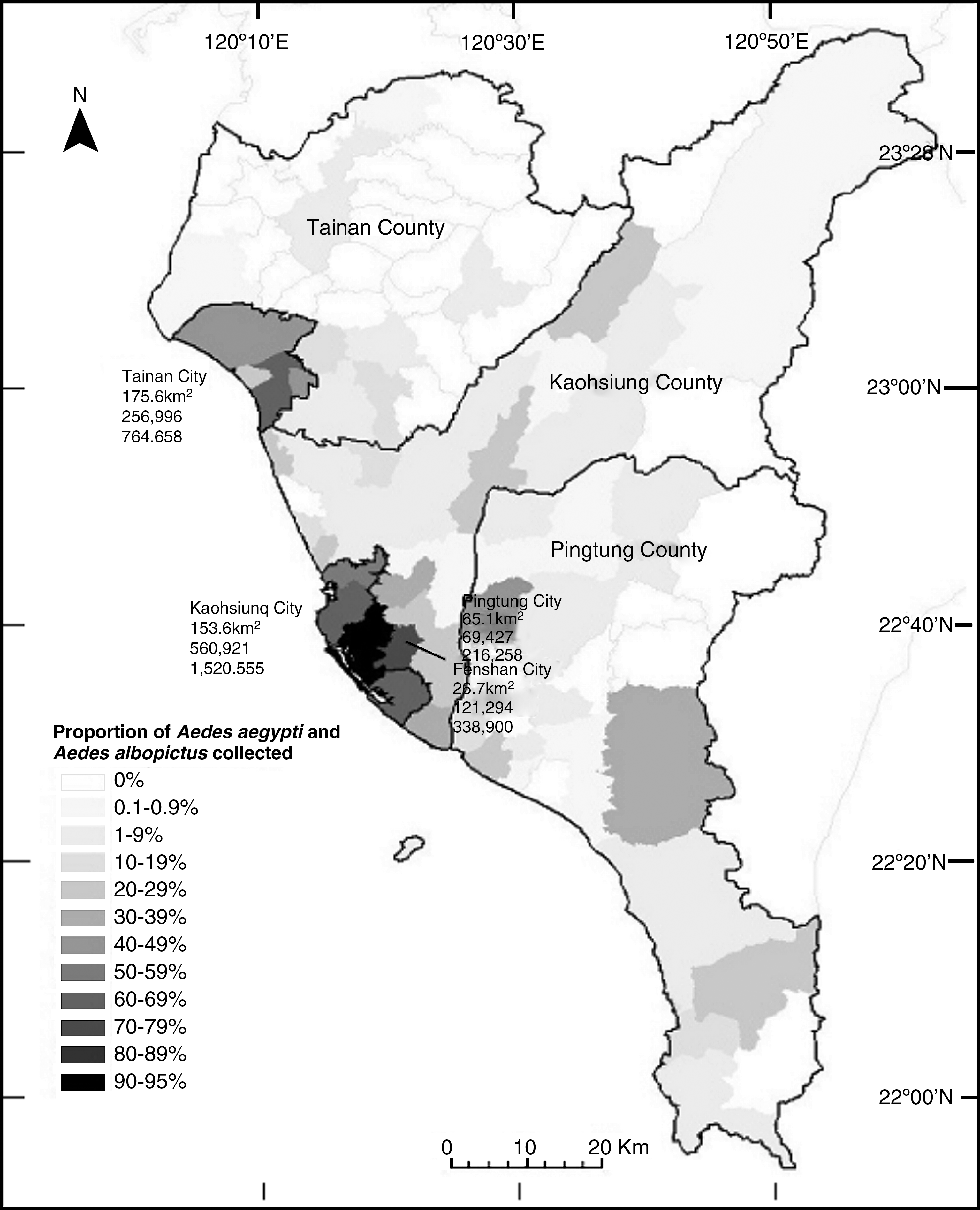
Major survey cities (land area, number of households, and population size) and proportion of Aedes aegypti and Aedes albopictus adults collected in districts/townships of southern Taiwan townships from 2004 to 2007. Eleven and one positive pools of Ae. aegypti females were collected in five districts of Kaohsiung city and Tainan city, respectively. In these areas, the dominant mosquito was Ae. aegypti (comprising 90–95% and 69.6%, respectively, of the mosquitoes collected).
Mosquito collection
Adult Aedes mosquitoes were extensively collected from high-risk areas with a history of dengue cases or high vector density in southern Taiwan as part of an entomological surveillance program for dengue. In general, over 50% of the wards of each city/county were visited at least once per month and whenever a dengue case was reported. The house of a reporting case and its surroundings were visited at least once within 7 days of being reported. The wards were randomly selected using a stratified random sampling scheme by county/city if there were no reported cases. The total number of wards sampled in TC, KC, KCT (Fenshan city), PCT (Pingtung city), and TCT were 233, 459, 441 (78), 464 (79), and 521, respectively. The mean number (±SE) of monthly visits to the wards were 251 ±14, 632 ± 101, 424 ± 38 (307 ± 28), 416 ± 60 (97 ± 18), and 358 ± 17, respectively. At each visit, a cluster of 50 houses was surveyed with each house inspected and mosquito collections made in the first floor (including basement) and outside surroundings, for adult Aedes mosquitoes, using small sweeping nets. The first house was selected randomly or it was the house of the reported case. All adult mosquitoes collected from each visit were identified and pooled according to the premise for each visit, and by species and sex. Collected specimens were mailed back to the laboratory (frozen in insulated boxes) and then stored at −20°C or −80°C until tested.
Virus detection in mosquitoes
A one-step SYBR Green I–based real-time RT-PCR assay was used to detect DENV RNA in mosquito pools. Details of the assay have been described previously (Shu et al. 2003a). Briefly, mosquito pools were homogenized in a total volume of 200 μL and clarified by centrifugation. Viral RNAs were extracted from 140 μL of mosquito suspension using the QIAamp viral RNA mini kit (cat. no. 52,906; Qiagen, Hilden, Germany) according to the manufacturer's instructions. One-step real-time RT-PCR (QuantiTect SYBR Green RT-PCR kit; Qiagen) was performed with the Mx4000TM quantitative PCR system (Stratagene, La Jolla, CA) using two sets of consensus primers: one primer set to target a region of the nonstructural protein 5 (NS5) genes to detect all of the flaviviruses, and the other primer set to target a region of the capsid (C) gene to detect all of the DENV serotypes. Positive samples were then confirmed by DENV serotyping using four sets of serotype-specific primers targeting the C gene to differentiate the DENV serotypes. Each sample was assayed in a 50 μL reaction volume containing 10 μL of sample RNA and optimal concentrations of primers determined with a QuantiTect SYBR Green RT-PCR kit (cat no. 204,243; Qiagen). The thermal profile consisted of a 30-min RT step at 50°C and 15 min of Taq polymerase activation at 95°C, followed by 45 cycles of PCR. After amplification, a melting curve analysis was performed to verify the correct product by its specific melting temperature. Positive real-time RT-PCR was subjected to nucleotide sequencing and virus isolation for further characterization. Partial NS5 gene sequencing (153 nucleotides in length) was performed using real-time RT-PCR products to determine the DENV serotypes and genotypes as previously described (Huang et al. 2007). Virus isolation was attempted by using a mosquito cell line (clone C6/36 of Ae. albopictus cells) as previously described for human serum samples (Shu et al. 2003a). The maximum number of mosquitoes included in each pool was 50.
Infections in human
Dengue is a notifiable disease in Taiwan that requires physicians to report suspected cases within 24 h of clinical diagnosis. DENV infection was defined as a febrile illness associated with the detection of DENV-specific IgM and IgG antibodies, the isolation of DENV, or the detection of DENV RNA by RT-PCR (Huang et al. 2007). One-step SYBR Green I real-time RT-PCR (QuantiTect SYBR Green RT-PCR kit; Qiagen) was performed with the Mx4000TM quantitative PCR system (Stratagene) to detect and differentiate DENV serotypes in acute-phase serum samples from ill patients who exhibited symptoms of dengue as previously described (Shu et al. 2003a). For the detection of DENV-specific IgM and IgG antibodies, Envelope (E)/Membrane (M)-specific capture IgM and IgG enzyme-linked immunosorbent assays (ELISAs) were used to detect and differentiate primary and secondary DENV infection in both acute- and convalescent-phase serum samples as previously described (Shu et al. 2003b). DENV was isolated using a mosquito cell line (clone C6/36 of Ae. albopictus cells) (Shu et al. 2003a). For each acute-phase serum sample, 50 μL of 1:50, 1:100, 1:200, and 1:400 diluted serum sample (diluted with RPMI 1640 medium containing 1% fetal calf serum; Gibco/BRL Life Technologies, Gaithersburg, MD) were each added to an individual well of a 96-well microtiter plate, and then 100 μL of cell culture fluid containing 105 C6/36 cells was added to each well of the microtiter plate, followed by incubation for 7 days at 30°C. Cells were harvested and infection was confirmed by an immunofluorescence assay using dengue serotype–specific monoclonal antibodies.
Statistical analysis
DENV-positive pools were only detected in Ae. aegypti females. Therefore, the pooled infection rate of DENVs among Ae. aegypti females was calculated using maximum likelihood estimation (MLE) methods for unequal pool sizes. This MLE estimate is more accurate and robust than minimum infection rates, which estimates the lower bound of the infection rate (Gu et al. 2003, Mendez et al. 2006). Calculation of MLE for different pool sizes requires numerical iterations and computer implementation. We used PooledInfRate software (version 3.0 available at
Results
Mosquito collections
From 2004 to 2007, a total of 172,207 Aedes mosquitoes were collected. Aedes aegypti adults were found in some districts/townships, whereas Ae. albopictus adults were collected in all districts/townships in the study areas (Fig. 1). However, Ae. aegypti was the predominant mosquito collected in all districts of KC, and in four out of seven districts of TC and in Fenshan city in KCT. The percentage of Ae. aegypti of the total number of adults of both species was 59.5–94% in KC, 21.6–69.6% in TC, and 71.2% in Fenshan city. In the rest of the townships surveyed, the predominant species was Ae. albopictus. In addition, the number of mosquitoes collected varied considerably between sampling sites (KC = 33.6%, KCT = 29.5%, PCT = 24.3%, TCT = 8.8%, and TC = 3.7%) (Table 2).
All positive pools were Ae. aegypti females.
Infections in mosquitoes
A total of 92,892 Ae. aegypti (43,133 females and 49,759 males) and 79,315 Ae. albopictus (57,319 females and 21,996 males) adults were grouped by residence, date, and sex into 25,652 pools (7628 and 5783 pools of Ae. aegypti females and males, respectively; 8779 and 3464 pools of Ae. albopictus females and males, respectively) (Table 2). Among the Ae. aegypti female pools, 2418 (31.7%) contained 1 mosquito, 4125 (54.1%) contained 2–10 mosquitoes, and the remaining 1085 pools (14.2%) contained 11–50 mosquitoes (Table 3). Among Ae. albopictus females and males of both species, 4102 (22.8%) contained 1 mosquito, 10,496 (58.2%) contained 2–10 mosquitoes, 1797 (10.0%) contained 11–20 mosquitoes, 732 (4.1%) contained 21–30 mosquitoes, 598 (3.3%) contained 31–40 mosquitoes, and 299 (1.7%) contained 41–50 mosquitoes.
Overall, only 0.2% of the 7628 pools of Ae. aegypti females were found to be positive for DENVs by RT-PCR, and the mosquitoes comprising these pools were all captured during the epidemic period (Table 2, Fig. 2A). Mosquitoes in 11 pools were captured from six districts of KC in Ae. aegypti–dominant areas (90–95% of species proportion) and one pool from one district of TC (69%). When combined, the overall pooled infection rate was 0.97 females per 1000 mosquitoes (95% CI = 0.53–1.65) (Table 4). The total monthly infection rates ranged from 0.50 to 2.23 females per 1000 mosquitoes (95% CI = 0.03–10.71). When sampling areas were scaled down to the city level, monthly infection rates increased to 0.73–12.59 (95% CI = 0.06–59.19). Monthly infection rates over all sampling areas and at the city level increased significantly by month (r = 0.41, p < 0.01 and r = 0.32, p < 0.05, respectively). All positive pools were detected in mosquitoes captured between July and December. The number of pools in July, August, September, October, November, and December was 1, 2, 1, 3, 4, and 1, respectively. The number of positive mosquito pools per month was significantly related (r = 0.36, p < 0.05) to the number of human dengue cases per month. Table 4 showed the DENV serotypes and genotypes of these positive pools determined by real-time RT-PCR serotyping and nucleotide sequencing analysis of real-time RT-PCR products (153 nucleotides in length) in the NS5 gene region. The results showed that all four serotypes of DENV were detected in mosquitoes with DENV-4 (8.3%) in 2004, DENV-2 (16.7%) and DENV-3 (66.7%) in 2005 and 2006, and DENV-1 (8.3%) in 2007. Attempts to isolate virus using C6/36 cell culture were not successful.
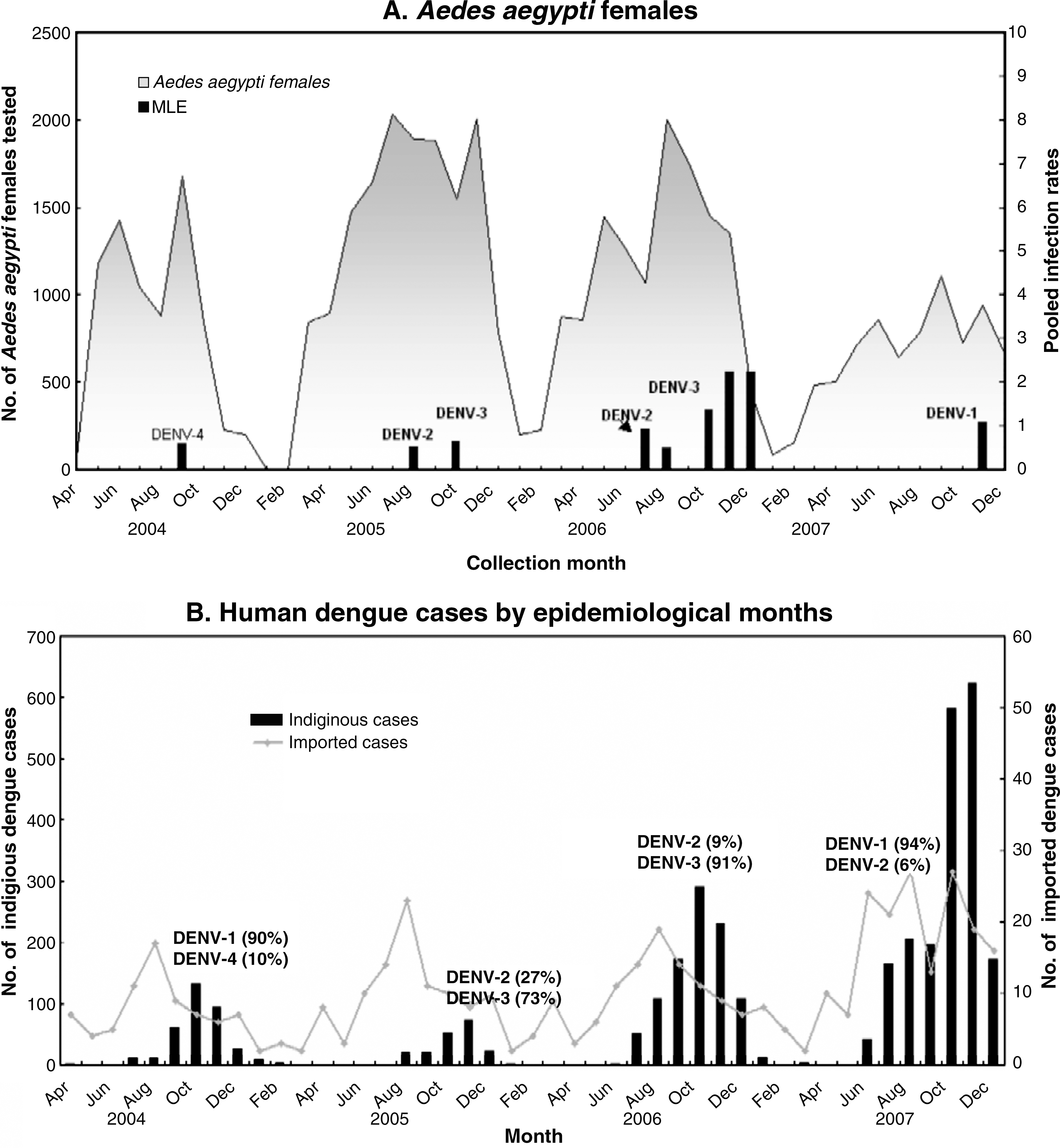
Number of mosquitoes tested and dengue virus (DENV) infection rates in Ae. aegypti females (
Infections in human
During the study period, dengue outbreaks with 336, 202, 965, and 2000 confirmed dengue cases were recorded for each year from 2004 to 2007 (Fig. 2B). Outbreaks usually started between June and August and ended in the beginning of the next year. The peak months were October and November. The dominant serotypes of outbreaks were DENV-4 in 2004, DENV-2 and DENV-3 in 2005 and 2006, and DENV-1 in 2007. Imported cases were detected year-round, peaking in August for all of the years during the study period except in 2007 when numbers of cases peaked in October. For acute-phase serum samples collected from confirmed dengue cases, 70% was PCR positive, virus was isolated from 55% of confirmed cases, and 30% were IgM and/or IgG positive. Japanese encephalitis virus (JEV) cross-reactivity can be reliably excluded from our ELISA assay since we always performed an dengue and JEV-ELISA simultaneously in the same plates. There is limited IgM cross-reactivity between these flaviviruses, but none for IgG assay.
Discussion
Vertical and venereal transmissions are two modes of transmission for the maintenance of arboviruses including DENVs. Transovarial transmission of DENVs has been reported to occur with varied probabilities depending on the virus strain, infection method, and mosquito species and strain (Rosen et al. 1983, Chen et al. 1990, Mitchell and Miller 1990, Mourya et al. 2001, Joshi et al. 2002, de Castro et al. 2004, Fouque et al. 2004, Lee and Rohani 2005). Also, virus-infected males could infect females through a venereal transmission mechanism (Rosen 1987, Tu et al. 1998) during mating, and the infected females could pass the virus to their offspring vertically. In our 4-year study, DENVs were only detected in Ae. aegypti females (captured during the outbreak period), not in Ae. albopictus females or in males of either species. The results of male entomological collections presented here suggest that very limited or no vertical or venereal transmission was occurring in local Aedes population.
Virological surveillance in field-collected mosquitoes by RT-PCR has been suggested as an early warning monitoring system for dengue outbreaks in endemic areas and for the detection of newly introduced virus serotype (Chow et al. 1998, Kow et al. 2001, Mendez et al. 2006). In Singapore, infected mosquitoes were detected six weeks ahead of human cases. However, results in our study did not support this finding. Infected mosquitoes were detected at the same time as outbreaks of disease in humans, which were caused by the same DENV serotypes. For nonendemic countries, such as Taiwan, virological surveillance in mosquitoes is not cost effective if mosquitoes are sampled from numerous sites over broad geographic areas, such as an entire city or county. Detection of low rates of virus infections in mosquitoes (focal transmission) with a high probability requires a large number of samples (Gu and Novak 2004). Based on Gu and Novak's formula (n = log [1 − P]/log [1 − r]), the sample size (n) needed to detect an infection rate (r) of 0.50–12.59 females per 1000 mosquitoes in our study with a probability of 0.8 (P) would require the collection and testing from 127 to 3219 females per site. In general, it would not be feasible to obtain this sample size at all sites because of resource restraints. Therefore, selection of potential virus transmission foci for intensified sampling to achieve early detection of infected mosquitoes would be a practical alternative DENV surveillance strategy. For example, areas with a history of reporting dengue cases or with high vector density could be targeted for intense sampling. In addition, collection of adults with sweep nets is not efficient and should be replaced by backpack aspirators, sticky ovitraps, or BG-sentinel mosquito traps, which are comparatively more efficient (Ritchie et al. 2004, Geier et al. 2006, Kröckel et al. 2006).
The underlying assumption of all mosquito pool screening models is that the samples are collected at random from an essentially infinite population (Katholi and Unnasch 2006). Therefore, the sampling strategy should be designed to obtain samples randomly and independently from the overall population of mosquitoes. However, it should be pointed out that this random sampling strategy is usually not practical because sampling schemes are often devised to specifically target infected insects. This sampling strategy may be effective in detecting virus-infected mosquitoes and in documenting ongoing transmission, but it would likely over-estimate the prevalence of infection in vector populations. Therefore, in our study, our MLE might overestimate the actual prevalence of virus-infected mosquitoes in the vector population (i.e., true value is lower than 0.50–12.59 females per 1000 mosquitoes).
We evaluated the potential usefulness of detecting DENV-positive mosquitoes for early surveillance of dengue epidemics in Taiwan by screening field-caught mosquitoes using one-step SYBR Green I–based real-time RT-PCR. One step real-time RT-PCR based on SYBR Green I method has the advantages of rapidity, simplicity, and higher sensitivity compared to traditional RT-PCR and virus isolation methods in detecting DENV in human and mosquito samples. The SYBR Green–based detection system has the disadvantage of false-positives due to dye binding to primer dimmers or to DNA amplified nonspecifically. Thus, great care should be taken to optimize the assay system to increase the sensitivity and specificity and avoid false-positives. Among various measures, careful primer design, reduction of cross-contamination by automation, quality control by inclusion of positive and negative controls, and melting curve analyses are important steps that help reduce false-positives. On the contrary, false-negative results may happen due to mismatch of primers and targeted sequences in the detection of variants of DENVs. This can be improved by performing real-time RT-PCR with multiple primers to increase the positives.
In this study, all real-time RT-PCR–positive mosquito pools were subjected to confirmation by sequence analysis and virus isolation. Using a Ct value ≤35 as a cutoff point to define positive real-time RT-PCR, 12 mosquito pools were found to be positive and their partial NS5 sequences (153 nucleotides in length) were successfully determined. Table 4 shows the DENV serotype and genotype of each of these positive mosquito pools collected during 2003–2007. Despite extensive effort, the virus isolation attempt was not successful. Although these positive results could not be confirmed by virus isolation using cell culture method, the nucleotide sequences obtained from these positive pools correlate well with dominant DENV serotypes and genotypes known to be circulating during the study period. The failure was most likely resulted from the inactivation of DENVs during the long-term transport on ice of collected mosquitoes. Using the same real-time RT-PCR protocols, positive results were obtained and JEVs were successfully isolated from live adult Culex mosquitoes collected from pig farms during 2005–2008 all over Taiwan (unpublished data).
Our results on mosquito surveillance using real-time RT-PCR showed that the infection rate detected in mosquitoes is quite low as compared to endemic countries. The results also suggest that transovarial transmission may not be occurring or is occurring at much lower rates than evidenced in some endemic countries. These findings suggest that dengue is not maintained year-round in Taiwan due to comparatively dry and cold winter months, averaging 20°C with occasional declines in temperature to 10–15°C. However, a few dengue outbreaks have persisted over winter months (e.g., 1987–1988 and 2001–2002), indicating that DENV can survive and be cryptically transmitted in winter, leading to continuous dengue outbreaks next year if conditions permitted (e.g., a warm and humid winter).
Dengue transmission in Taiwan is unique, as compared to endemic countries. Molecular epidemiological studies suggested that constant importation of multiple DENVs from the neighboring Southeast Asian countries through close commercial links and air travel was mainly responsible for local outbreaks that occur each year. Through increased international trade and tourism, the number of annually imported cases has increased dramatically in Taiwan. Laboratory-based dengue surveillance had identified 104, 109, 179, and 226 imported dengue cases, and 3, 6, 4, and 8 imported DENV strains causing local outbreaks in Taiwan for 2005, 2006, 2007, and 2008, respectively. This trend suggests that dengue is becoming a more serious health threat in Taiwan. Our results highlight the importance to strengthen active surveillance for early detection and better control of dengue outbreaks.
Footnotes
Acknowledgments
We thank the people in the Tainan City Health Bureau, Tainan County Health Bureau, Kaohsiung City Health Bureau, Kaohsiung County Health Bureau, and Pingtung County Health Bureau who helped to collect mosquitoes from 2004 to 2007, especially Wan-Shih Hung, Chung-Lin Chung, Chi-Fong Kang, and Chi-Jhang Kang. Thanks are also extended to Liang-Chen Lu for his assistance in processing the detection of DENV infections. This study was partially supported by a scientific research grant from the Centers for Disease Control, Taiwan, in 2007 (DOH96-DC-2008). We also thank Charles S. Apperson and Judy Peng for their critical review of the manuscript.
Disclosure Statement
No competing financial interests exist.