




Abstract
In 1994, an ecoepidemiologic study was carried out in the mid-Ariège valley (French Pyrenees) where autochthonous cases of canine leishmaniasis had been previously reported. Serologic samples were collected from 336 dogs in two groups of villages. The seroprevalences were 11.67% in the valley villages and only 1.43% in the foothill villages. Five lymph node biopsies were taken from serologically positive dogs, and resultant isolates were identified as Leishmania infantum zymodeme MON-1. Phlebotomine sandflies were collected in five locations by CDC light traps. Both of the known French vectors, Phlebotomus ariasi and P. perniciosus, were identified. Bioclimatic and floristic studies showed that this area is an enclave of the supra-Mediterranean climatic zone, containing a typically xerothermophilic Mediterranean flora. The Pyrenees Mountains are usually considered to be outside of the endemic range of leishmaniasis in southern France, and so our demonstration of a microfocus of canine leishmaniasis in the northern foothills is noteworthy.
A second serologic survey carried out in 2007 (216 dogs) showed an inversion of the seropositive rates between the two groups of villages compared with those of 1994: only 2.72% in the valley villages and 11.32% in the foothills villages. The decrease of seroprevalence in the first area (valley villages) can be related to a considerable use of deltamethrin collars during the transmission season. The increase of seroprevalence of the foothill villages could be related to climatic conditions, since there was an increase of about 1°C in the mean annual temperature.
Introduction
Leishmaniasis is located in the Mediterranean climate areas, particularly along the French Mediterranean coast, from Spain in the west to Italy in the east. The five distinct foci are, from west to east: Pyrénées-Orientales, Cévennes, Provence, Côte-d'Azur, and the island of Corsica (Pratlong et al. 2004). Within this area, canine leishmaniasis is enzootic, with an estimated yearly incidence of around 10,000 cases. Outside this classical area, cases of canine leishmaniasis have occasionally been reported from Auvergne, central France (Prat 1944, Rey et al. 1977), and Brittany, North-West of France (Guilhon and Logé 1950). While some of these cases might have been imported from endemic areas, some others could be autochthonous, occurring in microfoci where adequate ecologic conditions are present. Such are the cases of the Touraine (central France) focus described by Houin et al. in 1974, and the Agen area (South-West of France) (Mayer 1996).
Veterinarians of the Ariège “département” (French territorial administrative unit), on the northern slope of the Pyrenees mountains, have repeatedly reported autochthonous canine leishmaniasis in the middle Ariège valley, between Tarascon-sur-Ariège and Ax-les-Thermes. These reports motivated the ecoepidemiologic investigations described in the present paper, which were carried out twice, at an interval of 13 years. The main objectives of the first study were to verify the existence of canine leishmaniasis outside the Mediterranean area in southern France and to analyze the bioclimatic and ecologic conditions that could ensure the maintenance of such a microfocus.
As the transmission of the disease is linked to the presence of the sandfly vector, the distribution of which is closely correlated with specific climate (Rispail et al. 2002), global warming might be expected to increase the canine leishmaniasis enzootic area (Rodhain 2000). Therefore, a further objective has been to investigate the evolution of the enzootic with time and to try to correlate this with environmental changes, by studying climatic and landscape changes.
Materials and Methods
Study area
The study area was the midvalley of the Ariège river, which flows from Ax-les-Thermes to Tarascon-sur-Ariège (Fig. 1). The valley is oriented from the southeast to the northwest and is limited in the north by the Tabe massif whose highest point is 2,348 m, and in the south by the Pyrenees chain. The global climatic conditions of the Ariège “département” place it in an intermediate position between the Atlantic and the Mediterranean influences (Dupias 1985).

The study area: the midvalley of the Ariège river. Triangles, valley villages; circles, foothill villages.
A detailed analysis of the climatic conditions of the study area (altitude between 475 and 720 m) was carried out through study of temperature and rainfall records from 1985 to 1993 and from 1997 to 2006 (data provided by Météo-France, Tarascon-sur-Ariège station). Data processing of these two time periods allowed the construction of a Gaussen's ombrothermic diagram (Gaussen 1963) and an Emberger's climatogram (Emberger 1952). Vegetation was evaluated by identifying current plants present in the prospected areas and from reference maps and books (Dupias 1985, Gaussen 1964).
In order to investigate the role of potential major landscape changes over the course of the study period, two Landsat images covering the area were acquired, georeferenced, radiometrically referenced, and classified. The images are from 1992 and 2004. Land cover was described using maximum likelihood classification. A combination of image-differencing and classification comparison was used to detect changes. The study villages were georeferenced using the 1/100,000 topographic map (IGN 2005) and overlaid on the land cover maps. Two-kilometer buffers were constructed around the villages. Due to proximity and overlap, buffers around foothill villages were considered as one territory and buffers around valley villages as another. Land cover at the two time points as well as land cover change were examined within these territories. Since this resulted in two territories, simple comparison between percentages were performed.
Prospected periods
The first dog survey was carried out between March and July 1994 and the second one in April 2007. The two surveys were conducted in the same way, and dogs were investigated in the same localities. Sandfly surveys were carried out in July 1994 and 2005.
Canine population
The investigations obtained previous agreement from the Direction of Veterinary Services of the Ariège “département” and from the Faculty of Medicine of Toulouse.
The first canine population surveyed (1994) included 336 dogs from 13 villages in two groups. Six villages were located along the riverside in the valley at the South-East of Tarascon-sur-Ariège (Aston, Cabannes, Verdun, Albiès, Château-Verdun, and Luzenac), and they will be referred to as “the valley villages”; the seven others were located northwest of Tarascon-sur-Ariège, on the mountain slopes (Aliat, Niaux, Miglos, Quié, Surba, Arignac, and Rabat), and they will be referred to as “the foothill villages” (Fig. 1). The second canine population surveyed (2007) included 216 dogs from the same villages, except Niaux, which was not sampled in 2007. The numbers of dogs investigated in the villages appear in Tables 1 and 2. No dogs investigated during the first investigation were analyzed in 2007.
The additional columns (1:40 and 1:160 results) were added for depicting that the temporal changes are independent of the chosen cutoff.
The additional columns (1:40 and 1:160 results) were added for depicting that the temporal changes are independent of the chosen cutoff.
Data regarding breed, age, sex, and medical history of the animals were obtained from the owners, with their agreement for bleeding and their address for further investigations. A question about the wearing of a deltamethrin collar (Killick-Kendrick et al. 1997, Maroli et al. 2001) during summer time was included in the 2007 survey (deltamethrin collars were not available in 1994). All dogs were clinically examined and were bled for serum separation and further immunologic diagnosis.
Serologic survey
Anti-Leishmania antibodies were detected by indirect fluorescent antibody test (IFAT), the antigens being prepared with a L. infantum MON-1 reference strain (MHOM/FR/78/LEM 75); the cutoff value selected was 1:80, according to OIE (2000) and Alvar (2001). Statistical analysis of the results used Fisher exact test.
Leishmania identification
Five of the positive dogs detected during the 1994 study had popliteal lymph-node puncture for culture of the parasites on NNN medium and subsequent isoenzymatic identification by starch gel electrophoresis with 15 enzymatic systems according to Rioux (1990). There was no identification of parasites during the 2007 survey.
Entomologic survey
Sandflies were collected using CDC light traps, placed close to kennels where positive dogs were detected (15 light traps in five collection sites in July 1994, and seven light traps in three collection sites in July 2005; one night collection for each period). The sandflies caught were preserved in 70°C alcohol then cleared in potassium chlorate, stained with fuchsin, and mounted in Canada balsam. Identification was based on the morphology of the male genitalia and female spermathecae. Only specimens of Phlebotomus were identified at species level; the Sergentomyia samples were discarded.
Results
Dog seroprevalence
1994 survey
Twenty-five of 336 dogs had antileishmanial antibodies greater or equal to 1:80 (global seropositive rate of 7.44%). None of the serologically positive dogs had clinical symptoms of leishmaniasis. The distribution of the positive dogs according to location are presented on Tables 1 and 2. Highly significant differences (p < 0.001) were found between the seropositivity rates of the two groups of villages: 23 of 197 dogs (11.67%) in the valley villages (Table 1) and only 2 of 139 (1.43%) in the foothill villages (Table 2).
2007 survey
Fifteen of 216 dogs had antileishmanial antibodies greater or equal to 1:80 (global seropositive rate of 6.94%). Some dogs had clinical symptoms of leishmaniasis or were known to be sick and treated. This survey shows low significant differences (p = 0.012) between the seropositivity rates of the two groups of villages: 3 of 110 (2.72%) for the valley villages (Table 1) and 12 of 106 (11.32%) for the foothill villages (Table 2).
The use of deltamethrin collars was completely different in the two groups of villages: 50.90% in the valley group versus 9.52% in the foothill group.
Leishmania identification
The five strains obtained from seropositive dogs during the first survey were identified as L. infantum MON-1 (MCAN/FR/95/LEM 3101; MCAN/FR/95/LEM 3099; MCAN/FR/95/LEM 3100; MCAN/FR/95/LEM 3356; MCAN/FR/95/LEM 3227). The corresponding dogs were all from the valley villages (Aston, Cabannes, and Verdun).
Sandfly distribution
The 1994 sandfly collections showed the presence of two Phlebotomus species, which are common vectors of L. infantum in the south of France (Rioux et al. 1984), namely P. ariasi and P. perniciosus. P. ariasi was the predominant species: it was present in all the five collection sites and numerically the most important: 176/179 (98.32%) versus 3/179 (1.67%) for P. perniciosus. The 2005 collections confirmed these results: of more than 100 sandflies collected, only 43 were identified; they all were P. ariasi.
Bioclimatic features
Bioclimatic situation
The 1985–93 ombrothermic diagram (Fig. 2) showed that the highest temperatures were in July and August (mean temperature of the warmest month, August: 19.6°C); the mean minimum temperature of the coldest month (January) was −2.5°C. The mean annual rainfall value was 760.9 mm, with highest levels during May (90 mm) and lowest levels during February (47.5 mm).
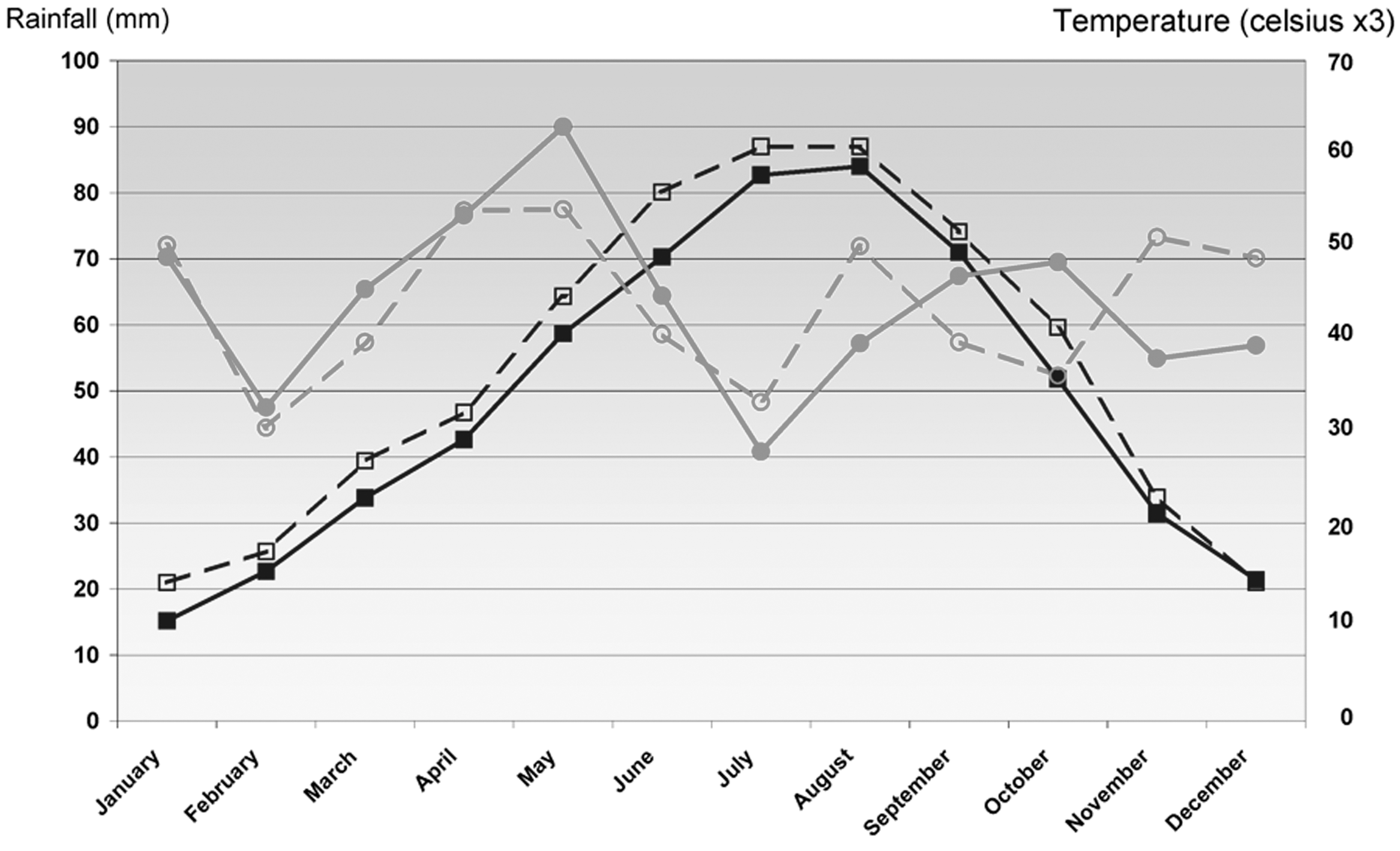
Gaussen's ombrothermic diagram, combining the monthly temperature (squares) and rainfall (circles) curves. The curves of the monthly mean temperatures (closed squares and continuous line for 1994; open squares and broken line for 2007) show an increase of 0.98°C in the annual mean temperature of the 2007 year.
Hours of sunshine are particularly high, due to the south-east-north-west orientation of the valley: for example, the village of Verdun-sur-Ariège has an average of 15 hours of sunshine daily during summer, which explains its nickname of “Nice of Ariège.”
The temperature and rainfall curves do not intersect on the ombrothermic diagram, which indicates an “axeric” climate, with no real dry period of time (Gaussen 1963). However, if the scale of temperatures is expanded to three times that of rainfall, the two curves do intersect, indicating a “subarid climate” (Fig. 2).
The formula of the Q2 index on the Emberger's climatogram is Q2 = (200P)/(M + m)(M − m), where P is the mean annual rainfall (in millimeters); M is the mean maximal temperatures of the warmest month in Kelvin degree; and m is the mean minimal temperatures of the coldest month in Kelvin degree. In the study area the Q2 index is 91.83, which is located between the humid and subhumid bioclimatic stages, in the center of the evergreen-oak zone (Fig. 3).
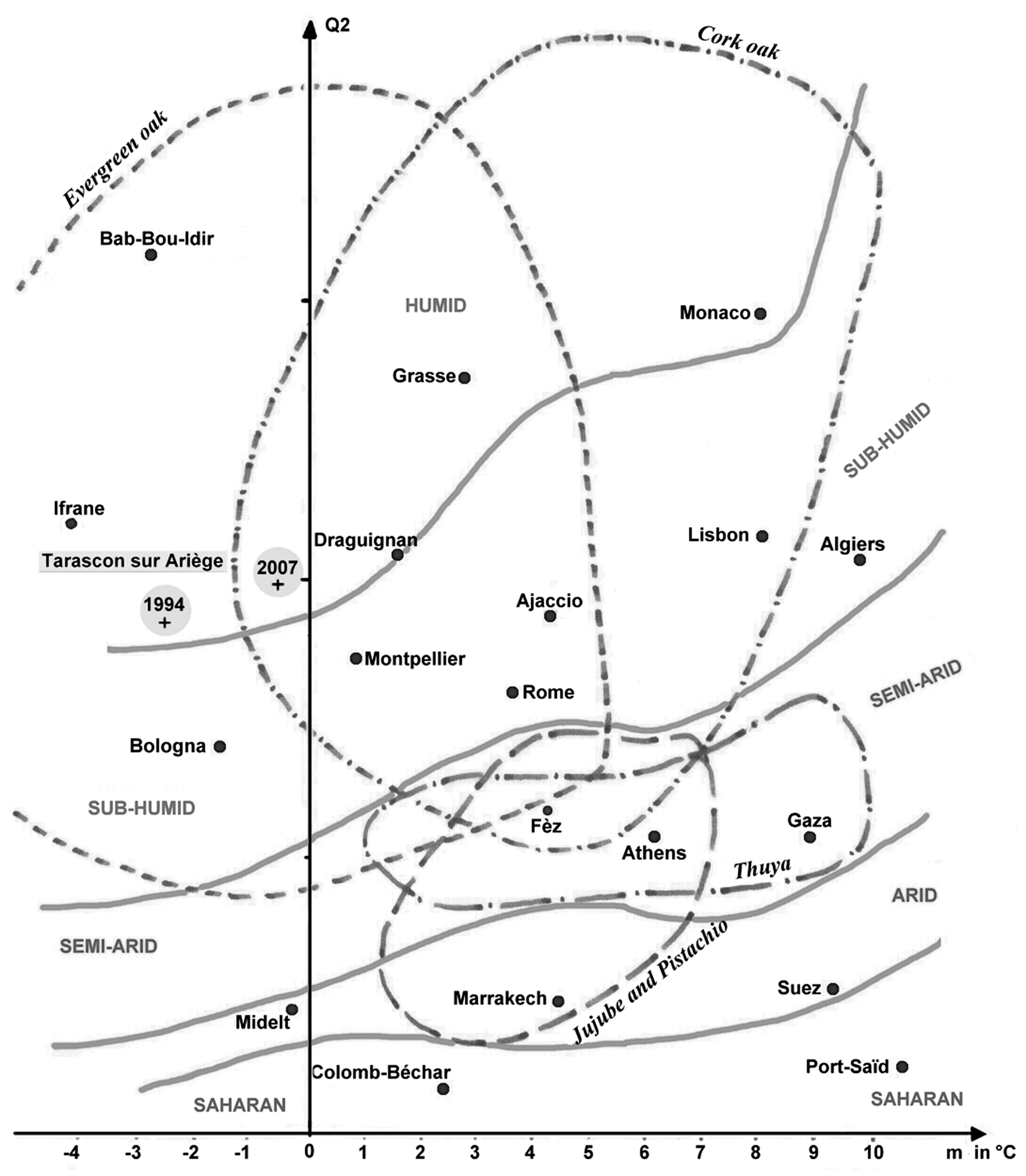
Emberger's climatogram showing the Q2 values for Tarascon-sur-Ariège calculated for both survey years (1994 and 2007). These values are indicative of the evergreen-oak vegetation zone. The Q2 for 2007 (ordinate) and the mean temperature of the coldest month (abscissa) are higher than those of 1994.
The flora was characterized as “xerothermophilic Mediterranean” type, with the presence of thyme, lavender, broom, juniper, and evergreen-oak.
Temperature change
The 1997–2006 ombrothermic diagram showed that the warmest months were also July and August (mean temperature of the warmest month, August, 20.3°C). The mean minimum temperature of the coldest month (January) was −0.5°C (Emberger index = 98.82) (Fig. 3). The mean annual rainfall value was 760.6 mm, with highest levels during May (77.5 mm) and lowest levels during February (44.4 mm).
The curve of the temperatures shows an increase of mean annual temperature of 0.97°C between 1985–93 and 1997–2006 periods (Fig. 2).
Environmental change
The land cover at the two time points is similar for the two environments (valley and foothill villages). Forest and transition to forest occupy the majority of the territory considered (in 2003, 69%), with the remainder divided between seminatural grassy and/or bushy vegetation and managed land uses such as pastures. No major land cover change was observed over the period 1992–2004. Net changes in forest (including increase and decrease) total less than 2% of the territory in both areas.
Discussion
Previous reports of canine leishmaniasis cases in the Ariège region justified an ecoepidemiologic investigation, which confirmed active L. infantum canine leishmaniasis focus, located outside the classical Mediterranean area.
The 1994 study showed that seropositivity rates of the dog population in the valley villages studied (11.67%) were close to values reported in the enzootic focus of Cévennes, in south of France (Keck and Dereure 2003) and significantly different from the rates in the foothill villages (1.43%). The identification of L. infantum zymodeme MON-1 from all the strains isolated is in agreement with data obtained from other foci from the Mediterranean basin, including southern France, where MON-1 is the predominant zymodeme (Pratlong et al. 1995). The presence of P. ariasi confirmed the possibility of parasite circulation within the focus. This species had already been reported from Ussat, another location of the Ariège valley (Mirouse 1959).
The Tarascon-sur-Ariège basin belongs to the hilly supra-Mediterranean vegetation stage (Dupias 1985). The vegetation found (lavender, broom, juniper, and evergreen-oak particularly) is closely related to the climatic data, as confirmed by the ombrothermic diagram of the area, which appeared, after correction, characteristic of the Mediterranean regions. The position of Tarascon-sur-Ariège on the Emberger's climatogram is also demonstrative; even though the mean minimum temperatures of the coldest month places this city in a negative zone, the Q2 index (91.83) is close to that of purely Mediterranean towns, such as Ajaccio, and even higher than those of Rome or Montpellier. Moreover, the climatogram places the studied area within the evergreen-oak vegetation stage, in accordance with our field observations, and in the humid and subhumid bioclimatic stages, which is confirmed by the predominance of the sandfly species P. ariasi, known to be related to these bioclimatic stages (Rispail et al. 2002).
So, the addition of these bioclimatic data showing the presence of a Mediterranean type vegetation, with the presence of the various elements constituting the L. infantum pathogenic complex, reinforce the demonstration of the circulation of the parasite within the studied ecosystem. All the conditions required are present here for the development and maintenance of the parasite life cycle: (1) a special microclimate with adequate temperatures, (2) a vegetation known as a phytoecologic indicator of the vector characteristic biotopes, and (3) the infected reservoir hosts and potential vectors. Here again, ecoepidemiologic methodology shows its high value.
The Pyrenees Mountains are usually considered to be outside of the endemic range of leishmaniasis in southern France. Our demonstration of a microfocus of canine leishmaniasis in the northern foothills is noteworthy. This focus can be classified as “ectopic” and could possibly be considered as a surviving relic of an old larger focus from a time when the temperatures were higher. In this context, it could be considered as a “sentinel focus,” of particular interest for the study of leishmaniasis extension and/or emergence in relation to global warming. This focus is therefore included in the area selected for surveillance of canine leishmaniasis within the European EDEN project (Emerging Diseases in a changing European environment). Such geographical extension has already been documented in Italy, where a northward spread of canine leishmaniasis has been reported (Maroli et al. 2008).
The 2007 survey was included in this program. It showed significant differences between the seropositivity rates of the two groups of villages: 3 out of 110 (2.72%) for the valley villages (Table 1) and 12 out of 106 (11.32%) for the foothill villages (Table 2). The most surprising of the 2007 results is the inversion of the seropositive rates compared with those of the 1994 study: only 3/110 dogs (2.72% versus 11.67%) from the valley villages (Table 1) were positive and 12/106 (11.32% versus 1.43%) from the foothill villages (Table 2).
During the two surveys and in each village, the sampling of dogs was carried out in an identical way, avoiding any bias with respect to breed, age, and sex, which could explain the heterogeneity of the village results compared to the global pattern of the corresponding group of villages.
The decrease of the seroprevalences in the first area (valley villages) can be explained by the widespread use of deltamethrin collars during the season of transmission of the disease (50.90% of the sampled dogs), according to their owners. Conversely, in the second area foothill group the seroprevalence increased, from 1.43% to 11.32%, with only 9.52% of the dogs wearing a deltamethrin collar. The question is now whether the change in climate demonstrated on the ombrothermic diagram and the Emberger's climatogram, and the increase, between 1997 and 2006, in the average of mean annual temperature (0.97°C) is involved in the increase of canine leishmaniasis seroprevalence in this area.
Regarding environmental changes, it is fair to conclude that the observed changes in serology cannot be attributed to a change in landscape that would either modify contacts between susceptible dogs and infected sandflies or that would modify the amount of suitable sandfly habitat.
A final question concerns the absence of human visceral or cutaneous leishmaniasis cases in such a well-established and persistent focus of canine leishmaniasis. This could be explained by the restricted territorial size and population living in this focus in comparison with main foci from southern France, where human cases occur. The reduced number of infected dogs in the Ariège focus, and consequently of infected sandflies, could also explain the absence of human infection. But the existence of asymptomatic infections in humans as occurs in other enzootic areas (Le Fichoux et al. 1999) should also be considered.
No definitive conclusion can be drawn at the moment, as several factors are involved. More studies are required to confirm and explain the present results.
Footnotes
Acknowledgments
The authors thank Drs. Michel Sedeilhan and Graham Hart, veterinarians in the prospected area; Dr. José Périères and Pr. Bernard Pesson, for fruitful cooperation; Dr. Philippe Rispail for the statistical analysis; and MM Patrick Lami and Hugues Corbière for expert technical assistance. The authors acknowledge Pr. Richard W. Ashford for revision of the manuscript.
Disclosure Statement
This work received financial support from the French Ministry of Health. This publication was partially funded by EU grant GOCE-2003-010284 EDEN and is catalogued by the EDEN Steering Committee as EDEN00123 (