




Abstract
Sandfly-transmitted phleboviruses, such as Toscana, sandfly fever Sicilian, and sandfly fever Naples, can cause human disease and circulate at high rates in Mediterranean countries. Previous studies have also established that viruses other than phleboviruses may be detected in and isolated from sand flies. The recent detection and isolation (in a large variety of mosquito species) of insect-only flaviviruses related to cell fusing agent virus has indicated that the latter is not an evolutionary remnant but the first discovered member of a group of viruses, larger than initially assumed, that has high genetic heterogeneity. Insect-only flaviviruses have been detected in and/or isolated from various species of mosquitoes, but nevertheless only from mosquitoes to date; other dipterans have not been screened for the presence of insect-only flaviviruses. The possible presence of flaviviruses, including insect-only flaviviruses, was investigated in sand flies collected around the Mediterranean during a trapping campaign already underway. Accordingly, a total of 1508 sand flies trapped in France and Algeria, between August 2006 and July 2007, were tested for the presence of flaviviruses using a PCR assay previously demonstrated experimentally to amplify all recognized members of the genus Flavivirus, including insect-only flaviviruses. Two of 67 pools consisting of male Phlebotomus perniciosus trapped in Algeria were positive. The two resulting sequences formed a monophyletic group and appeared more closely related to insect-only flaviviruses associated with Culex mosquitoes than with Aedes mosquitoes, and more closely related to insect-only flaviviruses than to arthropod-borne or to no-known-vector vertebrate flaviviruses. This is the first description of insect-only flaviviruses in dipterans distinct from those belonging to the family Culicidae (including Aedes, Culex, Mansonia, Culiseta, and Anopheles mosquito genera), namely sand flies within the family Psychodidae. Accordingly, we propose their designation as phlebotomine-associated flaviviruses.
Introduction
Materials and Methods
Accordingly, a total of 1508 sand flies trapped in France and Algeria between August 2006 and July 2007 were screened for flaviviruses using a PCR test previously experimentally demonstrated to amplify all recognized members of the genus Flavivirus, including insect-only flaviviruses (Moureau et al. 2007). A total of 67 pools were tested by semi-nested PCR using an additional PF3S primer (5′-ATH TGG TWY ATG TGG YTD GG, position 8941–8960 in the open reading frame of yellow fever virus [Genbank NC_002031]). The expected product size was 197 bp, resulting in a 157 nt sequence (primers excluded). Two pools consisting of male Phlebotomus perniciosus (2 pools of 30 individuals, each) trapped in Algeria were positive. Two PCR products of the expected size were gel purified, cloned into pCRII (TA Cloning Kit Dual Promoter; Invitrogen, Cergy Pontoise, France), and sequenced in both directions using M13 primers (Genbank accession no. FJ817075 and FJ817076). To ensure that positive pools represented viral RNA, samples were tested under the same conditions and protocols but excluding a reverse transcription step. Sequencher (Gene Codes, Ann Arbor, MI) was used to combine reverse and forward sequences, and final datasets were compiled using Se-Al (available from
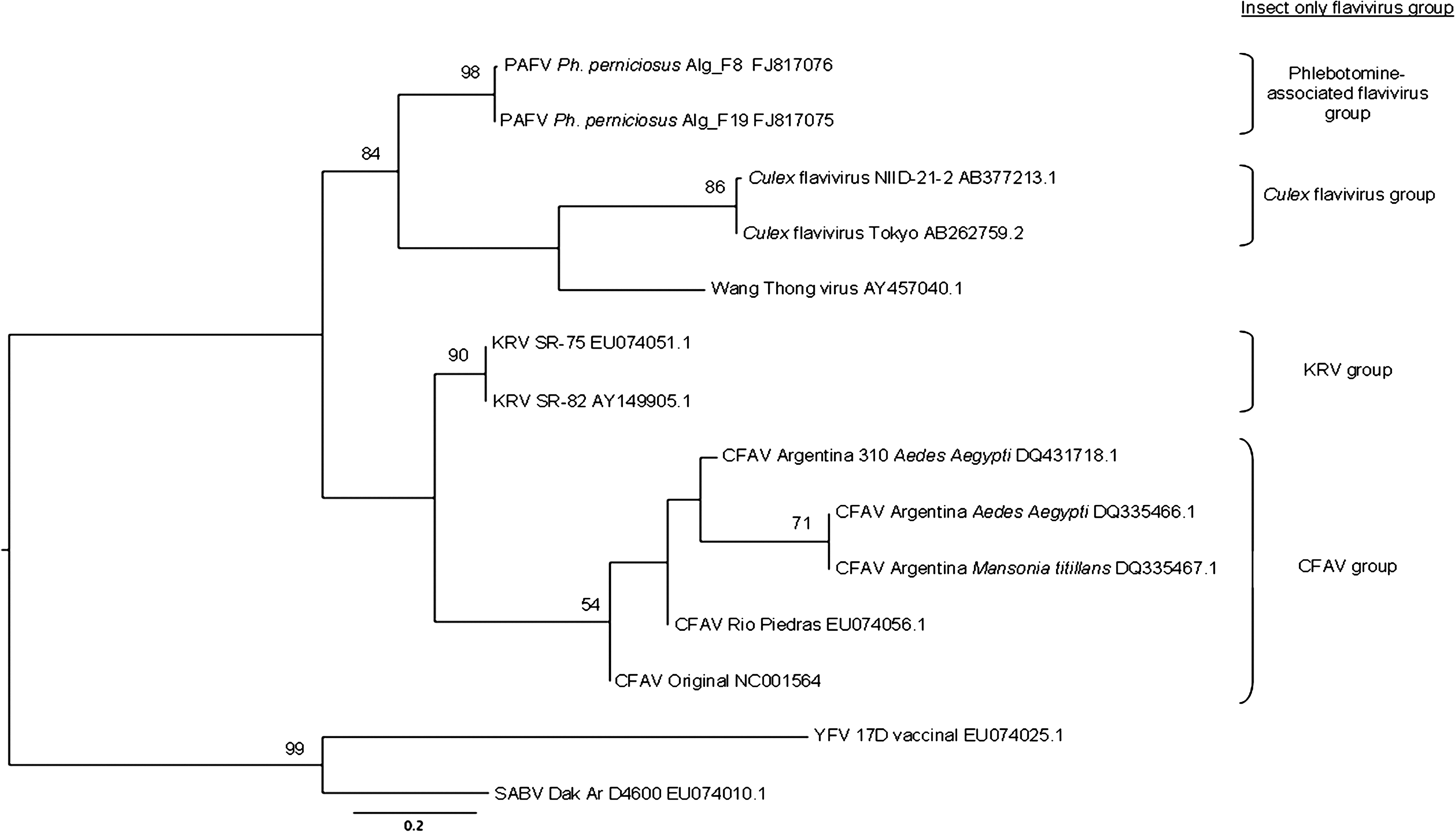
Phylogenetic reconstruction of insect-only flaviviruses, rooted using yellow fever and Saboya viruses. ML tree and bootstrap proportions of greater than 50% are shown.
Results and Discussion
The three resulting phylograms provided similar tree topologies using the three different techniques (data not shown) and indicated that the two novel sequences determined from Ph. perniciosus were more closely related to insect-only flaviviruses than to arthropod-borne and no-known-vector vertebrate flaviviruses. Genetic and phylogenetic analyses indicate that both sequences are clearly distinct from other insect-only flaviviruses previously described, and constitute a unique and new lineage. CFAV and KRV formed a distinct lineage that can be subdivided into CFAV- and KRV-related sequences. Sequences derived from Culex mosquitoes grouped together. Finally, the two phlebotomine-derived sequences grouped together in an ndependent lineage that appeared more closely related to Culex-derived than to Aedes-derived sequences, and are proposed to be designated as phlebotomine-associated flavivirus (PAFV). Unfortunately, virus isolation could not be attempted due to the fact that sand flies were preserved in guanidinium thiocyanate. These results should be considered as preliminary; longer sequences and additional sequence data are necessary to increase our understanding of insect-only flaviviruses circulating in sand flies. However, the three different phylogenetic methods used in this study provided comparable results, and flavivirus-positive results were not obtained when a reverse transcription step was absent, both of which strongly support the fact that insect-only flaviviruses can be found in phlebotomine flies. The significance of this finding within the natural cycle of the viruses in the field remains unknown. To address the role of sand flies in flavivirus transmission, further seroprevalence studies that investigate the presence of specific antibodies in vertebrates living in areas where sand flies predominate over mosquitoes are necessary. This justifies further investigation of arthropod-borne flaviviruses in sand flies as previously described with Saboya virus, and field campaigns will shortly be organized with the aim of isolating these sand fly flaviviruses.
Footnotes
Acknowledgments
This work was supported in part by (i) the European Commission through the 6th Framework Program for Research and Technological Development project under the VIZIER project (LSHG-CT-2004-511960), (ii) the Rivigene project, and (iii) internal funding from the Aix-Marseille University and the Institute of Research for Development.
Disclosure Statement
Authors have no conflict of interest in relation with this study.