




Abstract
The incidence of human rabies in the United States has decreased significantly over the past century. This analysis examines the ecological status of rabies in Louisiana with the intent of identifying differences in risk of rabies transmission from exposures to different species of animals. Louisiana presently harbors one terrestrial variant of rabies, a skunk variant, and several bat variants. Surveillance data collected from 1988 through 2007 were examined, comparing areas of the state characterized by circulating terrestrial variants and areas free of terrestrial rabies. Nine state public health regions were also compared. The proportions of rabies-positive laboratory submissions from each species and/or species group were used as indicators of risk. In addition, differences in proportions positive were examined temporally. A significant proportion of positive bats (9.64%) and skunks (44.3%), examined after biting or otherwise exposing a human being, were identified by diagnostic laboratories. Samples from wild terrestrial animals originating in areas known to harbor circulating terrestrial rabies variants were more than 30 times more likely to be positive for rabies than samples originating from areas thought to be free of terrestrial rabies. Bats were also slightly more likely to be positive when submitted from areas known to be endemic for terrestrial rabies. Rabies in pets and agricultural animals were rarely reported. Seasonal variations in prevalence of positive tests were also identified. The results of this examination of rabies epidemiology in Louisiana can be used in determining recommendations for both pre- and postexposure rabies prophylaxis. Similar applications of surveillance data are encouraged in other jurisdictions.
Introduction
It is important to examine the ecological status of the virus in specific public health jurisdictions with the intent of identifying differences in risk of rabies transmission from exposures to different species of animals. Physicians often are called upon to evaluate the need for both pre- and postexposure rabies prophylaxis (Freer 2004, Manning et al. 2008). Should uniform recommendations for preexposure prophylaxis be put forth for veterinarians, wildlife workers, taxidermists, and others in all regions of the state? Should animal bite cases be addressed with a strict set of guidelines, or should practitioners and public health officials recognize differences not only among vector species but also in areas of the state where specific virus variants circulate? Is risk of rabies transmission in Louisiana the same at all times of year, or does risk of transmission vary seasonally?
Louisiana harbors one terrestrial variant of rabies, a skunk variant, and several bat variants (Blanton et al. 2007, USDA 2007). Since 1988, positive bats have been reported from virtually all regions of the state (Fig. 1). Cases of rabies in terrestrial animals are very rare in extreme southeast Louisiana, likely due to the absence of the skunk variant in the region. Rabies in agricultural animals (horses and domestic ruminants), pets, and wild terrestrial species are reported sporadically from all regions of the state with the exception of the extreme southeast. The map of rabies cases in wild terrestrial animals appears to indicate two relatively heavy foci, one in southcentral Louisiana and the other in the northwestern portion of the state (Fig. 1).

Maps of incident animal rabies cases, Louisiana, 1988–2007. (Dots are only accurate to parish and are not accurate to precise location.)
Materials and Methods
In order to evaluate risk, several analyses were carried out looking at the proportion of submissions for each classification of animal in each public health region of the state. If, for a particular species, the proportion of positive specimens compared to all specimens tested from one area of the state differed from the proportion in other areas, this difference might be used to define geographic differences in risk. Physicians and public health officials may consider these differences when choosing prophylactic regimens for rabies prevention. Another component of the study involved a temporal analysis of the time of year when most laboratory tests were submitted, which might indicate variations in the incidence of animal bites and other exposures. Evaluation of the temporal distribution of proportion of positive tests in bats and skunks, by region, was also done.
From January 1, 1988, to December 31, 2007, the Office of Public Health Laboratories (OPHL) and the Louisiana Animal Disease Diagnostic Laboratory (LADDL) tested brain tissues from 21,501 animals. Most of the indirect fluorescent antibody tests performed by OPHL were done as part of the Office of Public Health (OPH) passive surveillance system for rabies virus. OPH policies directed testing of animals where humans had been bitten, scratched, or otherwise exposed to animals potentially infected with rabies virus. Animal bites are not reported in Louisiana; therefore no information was available on exposures that occurred and no animal testing was done. LADDL performed clinical diagnostic testing for rabies in addition to testing of animals implicated in human exposures. Tests that were inconclusive or indeterminate were not included in the summary. Epi Info (version 3.4.3) and SAS (version 9.1) were used to perform statistical analyses.
Results
Since 1988, there have been 8 dogs, 6 cats, 206 skunks, 3 foxes, 2 raccoons, 84 bats, 6 horses, and 1 cow identified to be infected with rabies. Table 1 summarizes the proportion of rabies-positive samples compared to all samples submitted for each species of animal. Just under 10% of bats, 10.05% of terrestrial wild animals, 1.79% of agricultural animals (for the purpose of this analysis, horses and farm ruminants constituted this category), and 0.08% of the pet animals were found to be positive. The relatively high percentage of positive wild terrestrial animals is, no doubt, due to the extremely high proportion of positive skunks (44.3%). No cases of rabies were identified in exotic nonnative species, such as zoo animals or exotic pets, and no cases were identified in those species not considered natural vectors of rabies in the United States, that is, rodents and lagomorphs (Moro et al. 1991, Freer 2004, Manning et al. 2008).
The data were analyzed geographically in two modes. In the first analysis, the state was divided into terrestrial rabies endemic regions and terrestrial rabies nonendemic regions (Fig. 2). Although terrestrial animals have been found to be positive, albeit rarely, in the southeastern parishes, the present consensus is that terrestrial rabies circulates in skunks in areas west of the Mississippi River in north Louisiana and west of the Atchafalaya River basin in south Louisiana (Blanton et al. 2007). Table 2 illustrates the results of this analysis.
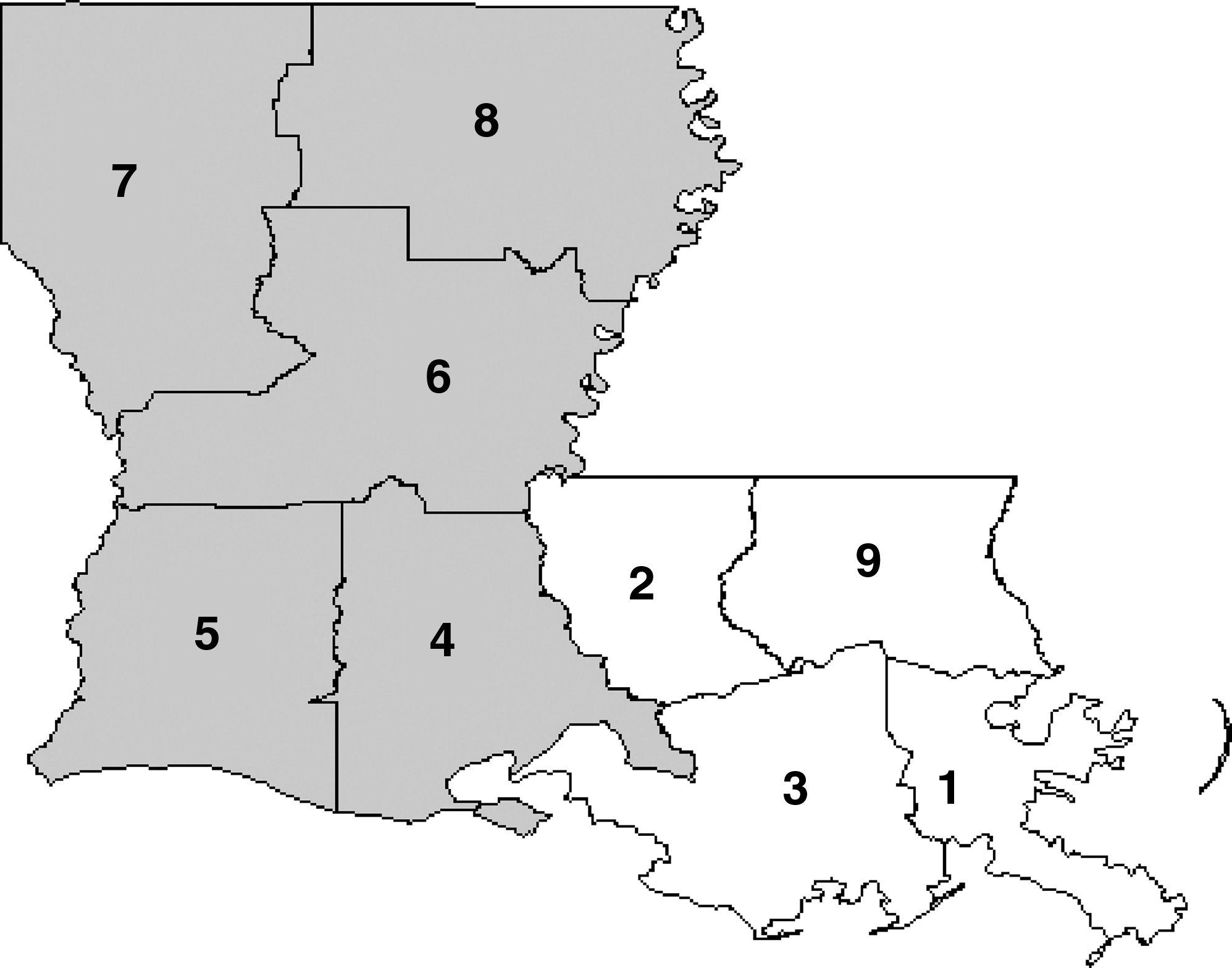
Map of Louisiana Office of Public Health (OPH) terrestrial rabies endemic regions (gray) and terrestrial rabies nonendemic regions (white).
OR, odds ratio; CI, confidence interval.
The second geographic analysis was done by attributing the proportions of rabies-positive tests to Louisiana's nine public health regions. Figure 2 illustrates these regions. Where appropriate, analysis of variance calculations were used to select groupings of regions, and chi-square comparisons were then performed to evaluate differences in risk. In each comparison, regions from which no positive samples were reported over the 20 years of the study were excluded, thus providing three categories: high-risk regions, low-risk regions, and regions with no positive cases found. The results of this analysis are illustrated in Table 3.
NA, Not applicable.
The laboratory received the highest number of submissions during May to August. Categorized into species, the same peak was observed in submissions of bats and pet species during these months. A similar peak was observed in summer months in submission of agricultural animals, wild terrestrial animals, and exotics, but the trend was not as profound. Submissions from rodents appeared to peak from September to November.
The number of bats identified as positive increased steadily from January to September, and then decreased precipitously. The proportion of positive bats relative to all tested was highest from August to December, with a large spike in September and October. OPH regions 1, 2, 3, 5, and 9, which encompass all of southeastern Louisiana as well as the southwestern corner of the state, exhibited an increase in proportion of positive samples from late summer to early winter (Fig. 3). OPH regions 4, 6, 7, and 8, which make up the southcentral and central portions of the state as well as all of north Louisiana, were also characterized by an increased proportion of positive tests in late summer to early winter. However, an additional spike in proportion of positive tests was observed in late spring (Fig. 3).
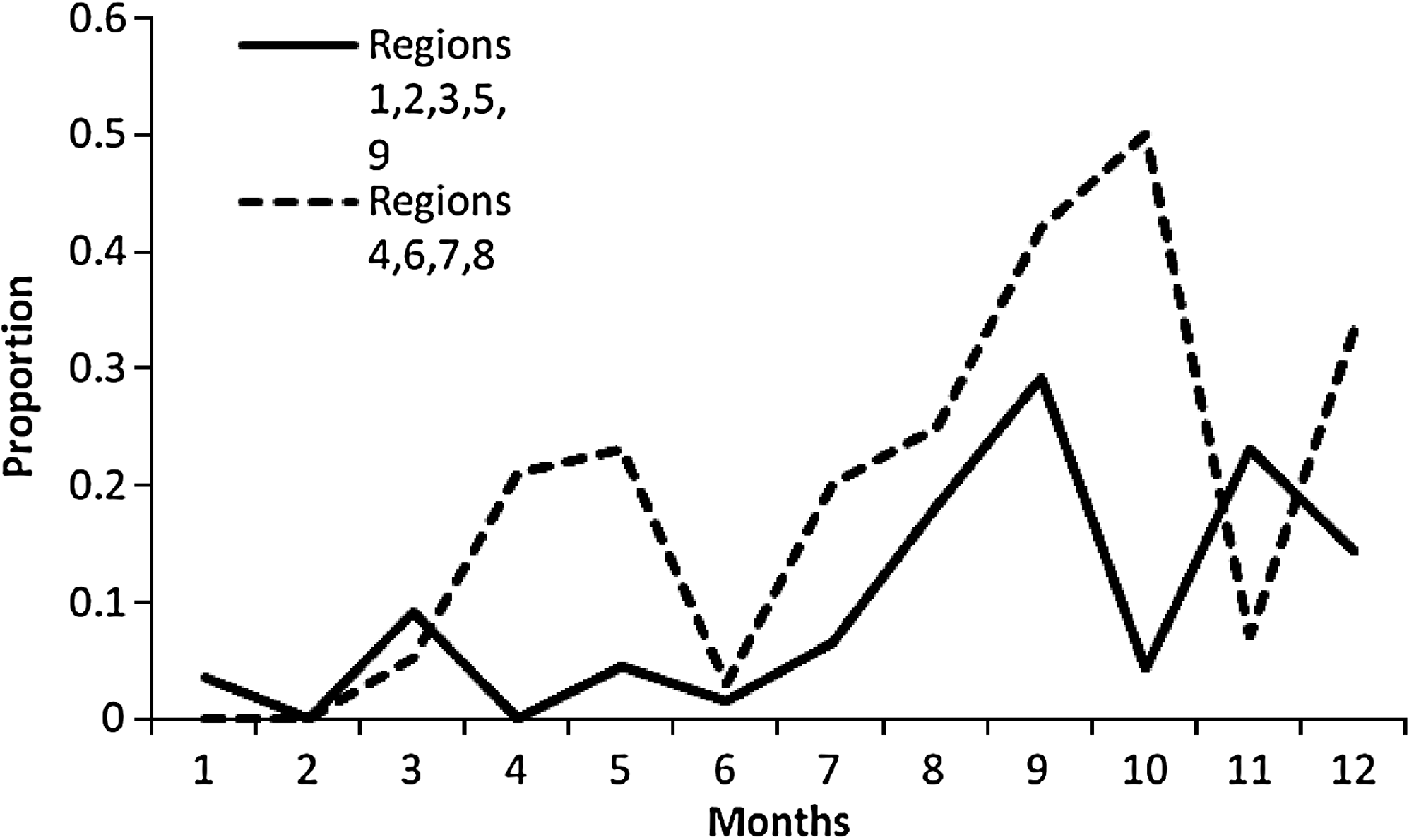
Comparison of proportion of positive samples to total samples tested for bats, by selected regions (regional proportions combined based on similarities in temporal pattern).
Both the number and proportion of positive skunks relative to all tested peaked in January and February. Over the 20-year period of the study, regions 1, 2, 3, and 9 never reported a positive skunk and region 5 reported only two positive skunks. Regions 6, 7, and 8, which encompass all of north and central Louisiana, showed an increased proportion of positive tests from January through June (Fig. 4). Region 4, the southcentral portion of the state and the area of the state reporting the greatest proportion of positive skunks to all tested, was characterized by the highest proportion of positives from January to March, but the overall proportions remained fairly high (36.4–77.4% of samples tested) throughout the year (Fig. 4).
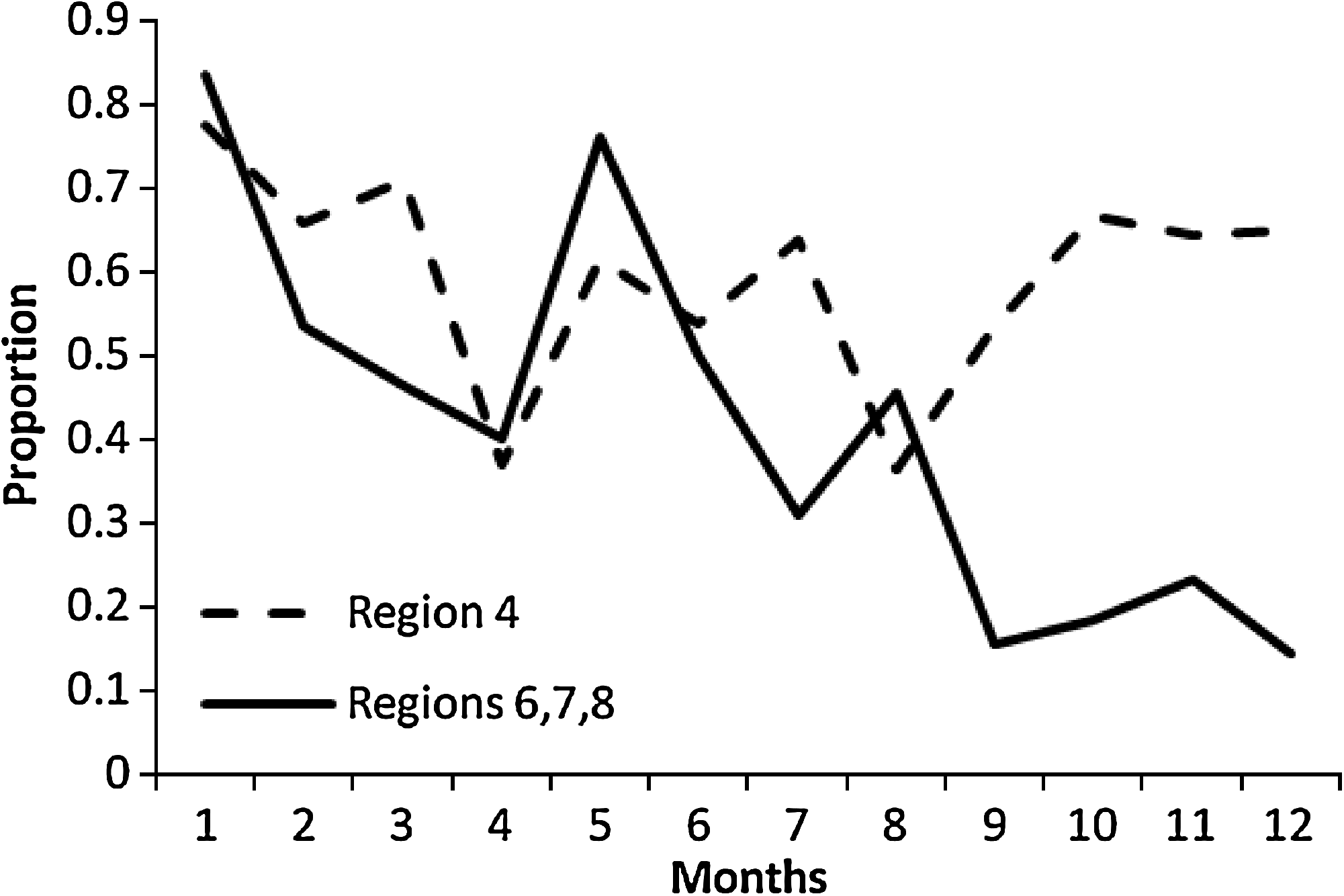
Comparison of proportion of positive samples to total samples tested for skunks, by selected regions (regional proportions combined based on similarities in temporal pattern).
Discussion
The Advisory Committee on Immunization Practices (ACIP) recommends preexposure rabies prophylaxis based on the risk category of the person involved in rabies virus related activities. The continuous risk category includes persons who work with rabies virus in research laboratories or in vaccine production facilities. Persons in this category are vaccinated with a three-injection series, and sera from these vaccinates are tested for rabies virus neutralizing antibody every 6 months. A single booster dose of the vaccine is given if the serum titer is not at least 1:5 by the rapid fluorescent focus inhibition test (RFFIT) (Feyssaguet 2007, Manning et al. 2008). The frequent risk category includes laboratory personnel who perform rabies diagnostic testing, spelunkers, animal control and wildlife control personnel, wildlife rehabilitators, taxidermists, and veterinarians in areas enzootic for rabies. Persons who handle bats anywhere in the world are also included in the frequent risk category. Veterinarians, veterinary students, wildlife rehabilitators, taxidermists, and animal control and wildlife control personnel, for whom rabies infection is uncommon to rare, are classified in the infrequent risk group (National Association of State Public Health Veterinarians 2001, Manning et al. 2008). Although preexposure prophylaxis is recommended for persons in the frequent risk and infrequent risk groups, follow-up to the initial immunizations remains a question. Persons assigned to the frequent risk category are directed to have serum evaluated for adequate titer on the RFFIT at 2-year intervals, while those assigned to the infrequent risk group are considered immunologically primed against rabies and 2-year interval serum titer determinations are not necessary (Manning et al. 2008).
The results of this study can be used to assist the physician or public health practitioner in determining the appropriate risk category for persons regularly exposed to animals in the state. Although geographical differences were detected in the probability of diagnosis of rabies in bats, interactions with bats are so strongly associated with rabies that recommendations should be uniform throughout the state (Manning et al. 2008). The results of this study illustrate a very high proportion of bats positive for rabies (9.64%) among those that have come in contact with humans. Therefore, ACIP recommendations are reinforced, categorizing any person regularly handling bats in the frequent risk group (Manning et al. 2008).
Veterinarians, animal handlers, animal control officers, and others who regularly come in contact with terrestrial wildlife, particularly skunks, in what this paper defines as the terrestrial rabies endemic areas of the state, especially OPH regions 4, 6, 7, and 8, should also be considered to be in frequent risk, and serum titer determinations should be performed at 2-year intervals (Manning et al. 2008). Animal contact personnel in OPH region 5 should be evaluated on a case-by-case basis. Unless wildlife contact is extremely infrequent, frequent risk category should be considered, due to the lack of natural barriers to movement of animals from areas with more intense transmission. Veterinarians, animal control officers, and others who regularly come in contact with terrestrial wildlife in terrestrial rabies nonendemic areas of the state (OPH regions 1, 2, 3, and 9) may be considered to be in the infrequent risk group. Titer determinations do not appear to be necessary (Manning et al. 2008). Although the difference in the proportion of positive pet species in terrestrial rabies endemic areas of the state was statistically significant, the extremely low percentage (less than 1 in 1000) seems to justify the classification of veterinarians and veterinary workers in Louisiana who deal only with pets in the infrequent risk group. Veterinarians who work with large agricultural animals, horses, and domestic ruminants in terrestrial rabies nonendemic areas of the state should also be classified in the infrequent risk group. However, large animal practitioners in terrestrial rabies endemic areas of the state should be considered to be in frequent risk. The likelihood (odds ratio: 21.48, 95% confidence interval: 8.62–53.52) of a positive test in a horse or a domestic ruminant was over 20 times more than in a pet species. Distribution of cattle rabies has been demonstrated to be similar to that of skunks in many areas of the country, and therefore rabies in skunks may be directly associated with rabies in farm animals (Blanton et al. 2007).
A person with preexposure prophylaxis exposed to a potentially rabid animal is required to receive two booster doses of the vaccine regardless of the risk group. The adequacy of serum titer by RFFIT or the duration of time elapsed since primary preexposure prophylaxis is irrelevant. Veterinarians should strictly enforce 10 day observation periods for pet species (dog, ferret, cat) that bite or otherwise expose those in contact. A dog, cat, or ferret that shows neurological signs of illness during the observation period should be humanely euthanized and submitted for testing. Booster vaccinations are recommended after exposure to bats or wildlife, unless the animal is available for testing.
Postexposure rabies prophylaxis consists of a series of five vaccines and the administration of human rabies immunoglobulin, except in persons who have previously completed the entire post- or preexposure vaccine regimen (previous vaccinates receive two booster doses). The decision whether vaccination is required should be based on a thorough evaluation of each exposure (Freer 2004, Manning et al. 2008). All persons bitten by reservoir species, such as bats, foxes, raccoons, and skunks, should receive postexposure prophylaxis if the animal is not available for testing (Manning et al. 2008). The State Public Health Sanitary Code requires that any dog, cat, or ferret that bites a human being be confined for a minimum of 10 days following the bite, or that the animal be euthanized and the head submitted to a laboratory for examination for rabies. The Sanitary Code sets out legal requirements that must be enforced uniformly across the state (Louisiana Administrative Code 2007). Unprovoked bites by pet animals, especially in areas of the state classified as endemic for terrestrial rabies, should be addressed by enforcement of 10 day observation, testing, or postexposure prophylaxis of the victim, depending on the availability and health status of the animal. Seemingly provoked bites of pet species in terrestrial rabies endemic areas of the state should also be addressed with a degree of suspicion. The vaccination status of the animal; the conditions of husbandry, precisely the maintenance of the animal separate from wildlife; and health status of the animal should be evaluated. Under several circumstances, exposures to dogs, cats, or ferrets may not be considered potential rabies exposures in terrestrial rabies nonendemic regions of the state. Exposure to a pet with a well-documented, thorough rabies vaccination history is an example of such a circumstance (Manning et al. 2008).
Exposure to nonnative, exotic species should be addressed on a case-by-case basis. The animal's species, health status, conditions of confinement, rabies vaccination status, import status, or duration of time since import should be considered along with the circumstances of the bite (Michigan Department of Community Health 1997). Invariably, these animals are considered wild animals and, as such, are addressed specifically by the State Public Health Sanitary Code (Louisiana Administrative Code 2007). As evidenced by the results of this study, over the past 20 years no lagomorphs or rodents were found to be positive for rabies within Louisiana. Although rabid rodents and lagomorphs (rabbits, hares, and chinchillas) have been discovered in other parts of the United States, they seldom secrete the virus in saliva and have not been associated with human cases (Moro et al. 1991, Freer 2004, Manning et al. 2008). In the eastern United States, larger rodents infected with rabies, such as woodchucks, have been found to be extremely aggressive to humans. Larger rodents may survive attacks from rabid small animals and thus survive to develop disease (Moro et al. 1991, Freer 2004). Bites from larger rodents native to Louisiana may be cause for alarm. Bites from rodents, especially larger rodents, should be reported to OPH for evaluation. Uncharacteristically aggressive or ill rodents or lagomorphs exhibiting signs of central nervous system disease should be considered potentially rabid (Moro et al. 1991, Freer 2004).
The increase in rabies test submissions in the summer months is consistent with an increased incidence of animal bites in these months (Ball and Younggren 2007, Palacio et al. 2007, Edwards 1998). Advisories to the public about the risk involved in contact with stray pets or wildlife should be circulated widely prior to and during summer months.
The gradual increase in raw numbers of positive bats from very low in January to a peak in September was also observed in surveillance data from Texas, collected from 1987 to 2002 (Texas Department of State Health Services 2008). From 1995 to 2005, increased numbers of positive bats were reported in August, September, and November in the state of Alabama (Hester et al. 2007). A similar gradual increase in raw numbers of reported positive bats beginning in the month of January was observed in nationwide statistics from 2006; however, the peak occurred in August (Blanton et al. 2007). A 2003 study conducted in Minnesota found that a higher proportion of rabid to nonrabid bats encountered humans in the month of September (Liesener et al. 2006). This study found a similar peak in the proportion of positive tests to total tests conducted in September (regions 1, 2, 3, 5, and 9) and October (regions 4, 6, 7, and 8). The peak in submission of bats for testing during the summer months in all likelihood reflects both the return of bats that overwinter in more southern latitudes and parturition in May and June, with increased numbers of immature bats (Gannon 2003). It appears that the late summer and fall peaks in proportion of positive bats to total bats tested may be the result of increased contact during times of increased bat activity in the late spring and early summer. The peak in the proportion of positive bats in spring requires further study, which is beyond the scope of this work. Although seasonal fluctuations in population, activity, and rabies virus circulation in bats are apparent, the time of year when contact occurred should never be used to determine if postexposure prophylaxis is necessary (North Carolina Division of Public Health 2006).
The temporal distribution of the proportion of positive skunks seems to agree with other studies that have discovered an association with rabies infection and periods of breeding and parturition. The winter peak, associated with increased contact during fall dispersal of juveniles, and spring peak, associated with increased contact during breeding season and denning, observed in regions 6, 7, and 8, have been demonstrated in other parts of the country. The persistent high level of positive percentage in region 4, the region with the highest overall proportion of positive tests, also has been observed in counties in other parts of the country with high positive to negative test ratios, and may be related to higher skunk density (Rosatte 1984, Gremillon-Smith and Woolf 1988, Charlton et al. 1991). These seasonal differences should be addressed by more direct assessments of the skunk population and, due to discovery of rabid skunks during all seasons, should not be used in consideration of the need for vaccine prophylaxis.
The conclusions in this work are based on 20 years of routine potential rabies exposure surveillance data. These data, reflecting the ecology of rabies in Louisiana over the past two decades, are used prudently in determining risk and resultant recommendations for both pre- or postexposure rabies prophylaxis, and are testimony to the importance of continued analysis of such data by OPH. Similar evidence-based epidemiologic findings from other jurisdictions should be analyzed and used accordingly (Moran et al. 2008). Louisiana has not reported a human case of rabies since 1953 (Office of Public Health 1990). The rare occurrence of human rabies in Louisiana complicates evaluation of this application. If a case of human rabies occurs after initiation of these recommendations, circumstances of the animal exposure should be studied closely to determine any effect of this application on risk.
Footnotes
Acknowledgments
We thank the Environmental Services and the State Laboratory, Office of Public Health, Louisiana Department of Health and Hospitals; and the Louisiana Animal Disease Diagnostic Laboratory, Louisiana State University School of Veterinary Medicine.
Disclosure Statement
No competing financial interests exist.