




Abstract
A trichinellosis outbreak occurred in early 2008 in two villages in Timis County, Romania, due to consumption of pork from an infected animal. The infective species, detected by multiplex polymerase chain reaction, was Trichinella spiralis (Isolate Code ISS 1951). This report presents an extensive characterization of the outbreak using the documents of the epidemiological investigation and the medical charts of the hospitalized patients. Fifteen people consumed pork from the same backyard pig, which was slaughtered in the household without veterinary inspection of the meat. Among them, five patients presented clinical forms of the disease and were hospitalized. The analysis within this report includes only the hospitalized cases that were serologically confirmed. The mean age of the patients was 33.4 years. The common symptoms presented by these patients included headache, eyelid and lower limb edema, myalgia, fever, diarrhea, and nausea. Eosinophil counts ranged between 5.5% and 52%. Favorable outcomes were achieved for the patients using antihelminthic therapy. As an important public health concern, trichinellosis outbreaks reinforce the need to urgently implement veterinary and educational programs. Identification of T. spiralis in this case strengthens the supposition that it is one of the most frequently spread species in Romania.
Introduction
Timis County, the largest of the Romanian counties, is situated in western Romania along the Serbian and Hungarian border. A recent epidemiological study covering the period 1990 to 2005 and including 521 patients reported an annual average incidence of about 4.9 cases of trichinellosis per 100,000 inhabitants (Neghina et al. 2009). Additionally, two small trichinellosis outbreaks occurred in 2006 and 2007 involving six and five people, respectively (Neghina R, unpublished data).
In January 2008, an outbreak of trichinellosis involved 15 people in the localities of Carpinis and Peciu Nou in Timis County, Romania, due to the consumption of pork from an infected animal. This report extensively characterizes this outbreak to highlight new evidence that has occurred since the previous international papers published regarding Timis County. This outbreak is the first from Timis County in which the exact Trichinella species responsible for the infection was detected at the molecular level.
Materials and Methods
The epidemiological investigation as performed by the Department of Public Health in Timis County and the medical records of the patients hospitalized at Victor Babes Hospital of Infectious Disease in Timisoara were the main sources of data. We retrospectively collected the following data from the medical documents: registration number of the medical record, age, sex, address, date and length of hospitalization period, profession, clinical symptomatology, routine laboratory tests (i.e., eosinophil and leukocyte count and erythrocyte sedimentation rate [ESR]), specific investigations (i.e., immunoglobulin G [IgG] anti-Trichinella antibodies), and applied therapy.
The normal values for the routine laboratory tests were considered as follows: eosinophil count, 0% to 4.99%; leukocytes, 4000 to 10,000 cells/mm3; ESR, 3 to 10 mm/h for men and 6 to 12 mm/h for women.
IgG anti-Trichinella antibodies in human serum were detected using indirect enzyme-linked immunosorbent assay in private laboratories, with an index value over 1.1 considered as positive.
A carefully taken anamnesis of the hospitalized patients made the identification of the infected pork and its products possible in the Carpinis village (45°47′14″ North, 20°54′15″ East) in Timis County.
To isolate the Trichinella larvae, a sample of infected fresh meat (3 g) was examined using artificial digestion with pepsin and hydrochloric acid in the Laboratory of Veterinary Public Health Department in Timisoara (Fig. 1). Eight to 10 larvae per gram of infected meat were detected, and they were subsequently preserved in ethanol.
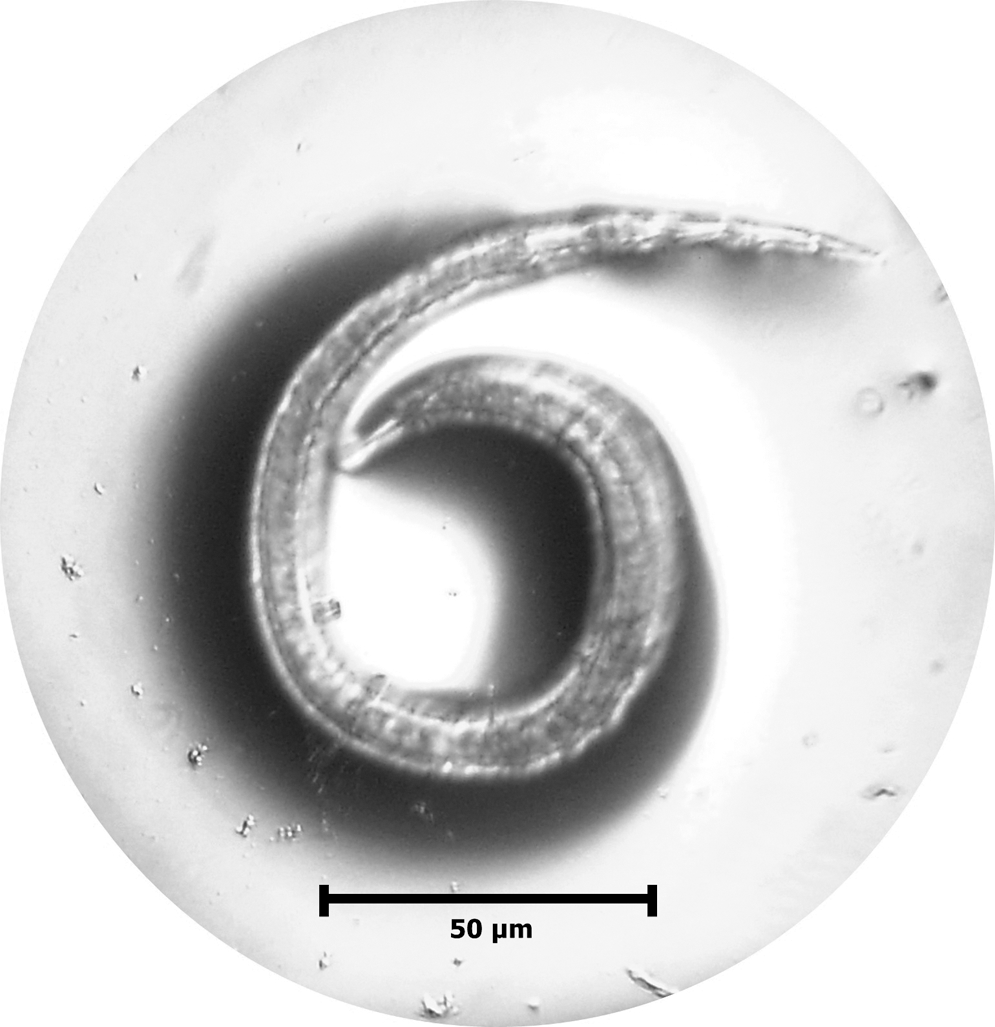
The Trichinella spiralis larva isolated from an infected pork sample using artificial digestion. The sample was taken from the pork responsible for the outbreak in Timis County, Romania, in January 2008.
Trichinella muscle-stage larvae at the species level were detected using multiplex polymerase chain reaction (PCR) at Istituto Superiore di Sanita, Rome, Italy (CRLP code 223/08).
Currently, the genus Trichinella contains eight species and three genotypes, all of which have different compositions and/or dimensions of nucleotide sequences belonging to the Internal Transcribed Spacer 1 (ITS1, interspaced sequence 1 of the nuclear ribosomal gene), Internal Transcribed Spacer 2 (ITS2, interspaced sequence 2 of the nuclear ribosomal gene), and Expansion Segment 5 (ESV, sequence belonging to domain 4 of the nuclear ribosomal gene). A comparative analysis of the three mentioned sequences using the multiplex-PCR technique with five pairs of oligonucleotide primers allows the identification of single larvae to the species or genotype level with only one amplification assay (Community Reference Laboratory for Parasites, Istituto Superiore di Sanita).
Results and Discussion
The trichinellosis outbreak was officially reported on 21st January 2008. Fifteen people were involved after consuming insufficiently prepared pork and sausage during the 2007 Christmas celebrations (i.e., 25th to 26th December). The source of the infected meat was a backyard pig that was slaughtered in a household in the Carpinis village and consumed without veterinary inspection. A previous study performed in Timis County (1990 to 2005) also indicated that most of the cases (81%) were diagnosed in winter (Neghina et al. 2009). Five of the individuals who consumed the infected meat were from a nearby village, Peciu Nou.
The infective species was identified by PCR as Trichinella spiralis (Isolate Code ISS 1951; International Trichinella Reference Center—The database of Trichinella strains).
Five patients presented clinical forms of the disease and were hospitalized. These cases were serologically diagnosed by positive IgG antibody titer against Trichinella ranging between 1.2 and 2.7 index values.
The following information focuses only on the hospitalized patients with trichinellosis. Patients were admitted to the hospital between 18th and 24th January 2008. The mean age of the trichinellosis patients was 33.4 years (range 22 to 53). In terms of employment, three patients were unemployed, one was retired, and one was a social worker. Symptoms appeared 17 days after the consumption of the infected meat, and all patients presented with headache, eyelid and lower limb edema, myalgia, fever, diarrhea, and nausea. Other symptoms also occurred in some cases, including palpitations (two patients), asthenia (two patients), tachycardia (one patient), and erythema (one patient). The eosinophil values ranged between 5.5% and 52%, while the leukocyte values ranged between 11,700 and 19,100 cells/mm3. Additionally, the ESR ranged between 10 and 65 mm/1 h. The mean hospitalization period was 10.2 days, which is similar to a previous study in which 52.02% of the patients were hospitalized for 8 to 14 days (Neghina et al. 2009). Favorable outcomes were achieved for the hospitalized patients after treatment with albendazole (800 mg/day; 2 × 2 tablets/day, for 10 days), dexamethasone (8 mg/2 mL per day injection, for 7 days), and calcium lactate (1500 mg/day; 3 × 1 tablet/day, for 10 days).
Relatives of the patients who consumed meat from the same source remained ambulatory consulted with infectious diseases specialists. None of them developed clinical symptoms. Only the routine laboratory tests (i.e., eosinophil and leukocyte counts and ESR) were performed in this group, and the results either indicated normal values or were slightly increased in some cases. All of them were treated with albendazole (800 mg/day; 2 × 2 tablets/day, for 7 days).
The Veterinary Public Health and Food Safety Departments confiscated approximately 160 kg of frozen pork and pork products from the patients' residences.
Another outbreak involving 19 clinical cases occurred in the neighboring county of Arad during December 2007 to February 2008 (Neghina R, unpublished data). At the same time (i.e., in January 2008), an outbreak of trichinellosis from pigs imported from Romania was reported in Verona, Italy. Four patients were hospitalized, and the source of the infection was determined to be ham that originated from a pig slaughtered without any veterinary control (Angheben et al. 2008).
Even though the current European legislation prescribes that all pigs, horses, and other susceptible wild animals intended for human consumption must undergo a Trichinella meat inspection, people who slaughter their own domestic pigs are not always informed about this requirement. As an important public health concern, trichinellosis outbreaks reinforce the need to urgently implement veterinary and educational programs. The identification of T. spiralis is in accordance with other studies covering the same geographical area and strengthens the supposition that it is one of the most frequently spread species in Romania (Pozio et al. 2009, International Trichinella Reference Center—The database of Trichinella strains).
Footnotes
Acknowledgments
The authors are grateful to Dr. P. Muntean, Head of the Veterinary Public Health Laboratory, Timis County, Romania, for providing the Trichinella larvae that were isolated by artificial digestion from an infected pork sample, and to Dr. E. Pozio, Head of the Community Reference Laboratory for Parasites, Istituto Superiore di Sanità, Rome, Italy, for genotyping the larva.
Disclosure Statement
There are no competing financial interests to disclose.