




Abstract
Rodents play an active role in the transmission of a number of zoonoses by harboring and disseminating the pathogens involved, either through their biological materials or via their ectoparasites. Hence, the spatial and seasonal distribution of potential agents of zoonoses may be studied by examining their distribution in the rodent vectors and their ectoparasites. A surveillance was conducted in wild rodents in 51 different areas of Cyprus, an island ecosystem, to monitor the reemergence of Echinococcus granulosus and Encephalomyocarditis virus (pathogens that have been eradicated from Cyprus), to study the presence and dispersal of Salmonella spp. (a bacterium found in patients and poultry in the island), as well as to investigate the presence of helminth parasites and rodent ectoparasites. Biological material collected from 625 rodents, examined macroscopically, microscopically, and after culture, showed that the most widespread pathogens encountered in wild rats (Rattus rattus and Rattus norvegicus) were helminth parasites, found in 92 animals (three helminth species found for the first time in Cyprus: Cysticercus fasciolaris, Hymenolepis diminuta, and Physalloptera spp.), and Salmonella spp., detected in the intestine of 56 rats (12 different Salmonella spp. and serotypes). None of the rodents were found infected with the cestode Echinococcus or Encephalomyocarditis virus, indicating that the control measures taken by the Veterinary Services on the island prevented its reestablishment despite changing conditions. The rodents were also free of the nematode Trichinella. Over 40% of the rats collected were infested with fleas, mainly Xenopsylla cheopis. The results, analyzed using the Geographical Information System technology, revealed two of the areas studied as high risk for public health.
Introduction
Cyprus, situated in the eastern Mediterranean at the crossroads of three continents Europe, Asia, and Africa (Fig. 1), has played a very important role in history and commerce through the ages. An island, a close ecosystem, with a temperate climate and rich wildlife with the agricultural and stock-raising sectors forming the backbone of the economy is ideal for the manifestation of zoonoses. Rodent populations are large and widespread. Rattus rattus, known to inhabit the island since ancient times, and the recently introduced Rattus norvegicus (Hoppe 1985) are the two species of rats established in Cyprus, which play an important role in the epidemiology of the zoonoses found there. In this role they are aided by blood-sucking arthropods, found in all prefectures of the island (Spyridaki et al. 2002, Psaroulaki et al. 2006), and by migratory birds stopping in Cyprus during their journey from Africa to Europe and vice versa, importing new pathogens and ectoparasites to the ecosystem (Kaiser et al. 1970, Harrus and Baneth 2005).

The geographic distribution of Rattus rattus (RR) and Rattus norvegicus (RN) in Cyprus. Helminth parasites found in rats in the five prefectures of the island and the two high-risk areas for Salmonella spp. (Kofinou and Palaiometocho). Both locations were near abattoirs and dumps.
The object of this study was to investigate the presence and distribution of a number of pathogens, important for public health in Cyprus, using rodents as sentinels. These were Echinococcus granulosus, a cestode widespread in Cyprus before the 1970s, with an annual surgical incidence rate of 12.9 per 100,000 inhabitants (Economides et al. 1998). After it was successfully eradicated, consumable animals and people stayed clean of the parasite for over 30 years. However, changed political and economic conditions present this cestode the opportunity to reemerge. Autochthonous echinococcosis has been diagnosed in a number of sheep and goats during the last 10 years (Economides and Christofi 2000, Christofi 2007). The reestablishment of this parasite would be indicated by its presence in the food chain, in which infected rodents play an important role. The same would be true for Encephalomyocarditis (EMC) virus, which when introduced in the island in 1994 caused great economic losses in the pig-raising industry (Loucaides et al. 1996). At the same time, the incidence and dispersal of a number of pathogens carried by rodents was also studied. The survey involved the capture of rodents from representative areas of the island and the study of their ectoparasites. Their tissues and intestinal contents were examined for parasites and cultured for the isolation of bacteria and viruses. The results were analyzed using the Geographical Information System (GIS) technology to identify high-risk areas.
Materials and Methods
Study area, rodents, ectoparasites, and biological material
Sampling was conducted during a 3-year period, 2000–2003, in 51 different areas of the Republic of Cyprus covering all five prefectures. The collecting sites included residential and agricultural areas and were classified into five main types of land use: (1) animal-raising areas (chicken, sheep, goats, rabbits, and mixed); (2) storehouses, bakeries, and mills; (3) residential areas; (4) areas with vegetation (vegetable fields, orchards, and woodlands); (5) dumps and abattoirs. The altitude and soil geomorphology were noted and coordinates of each site were located using a digital Global Positioning System (MAGELLAN-SporTrak, Magellan Navigation, Inc., Santa Clara, CA).
Wild and domestic rodents were captured alive using modified rodent traps. Six traps were placed in each study area in appropriate locations and were checked next morning. If they contained no animals they were left at the same position for 5–6 days so the rodents would become familiar with their presence. Baits (cheese, peanut butter, and other food materials) were replaced if required during this period. Capturing and handling the rodents was done according to the Center for Disease Control safety measures. Live rodents were carried to the laboratory, given a code number, and euthanized. Ectoparasites were collected from each animal (fleas after combing the rodent), counted, and typed using accepted morphologic criteria. The rodents were identified using morphometric characters, aged, sexed, and weighed and their length was measured. They were examined for signs of clinical symptoms (low weight for their age, sex, and species; poor quality of hair; dermatological problems; skin lesions; blindness) and were classified into five categories accordingly: not in good health, in moderate health, in good health, in very good health, and in perfect health. Biological samples (blood, organs, and tissues) were obtained from each animal and stored in plastic tubes, for safety, until testing.
Macroscopical and microscopical examination
During necropsy, the organs and intestine of each animal were examined for the presence of helminth parasites macroscopically. The intestine was cut open, and after removing the fecal samples required for the bacteriological tests, it was placed in physiological saline and examined for helminths. Muscle samples and the diaphragms of all rodents were removed and examined microscopically, after pressing the tissue between two glass slides, for the presence of larval stages of Trichinella spp. using a trichinoscope.
Bacteriological tests
For isolating Salmonella spp., 25 g of fecal samples, from different parts of the intestine, were homogenized and after preenrichment were cultured on semisolid Rappaport-Vassiliadis and selenite broth with
Virological tests
The heart and part of the spleen of each of the 625 rodents were used for primary EMC virus isolation. The processed tissue (0.5 mL) was used to inoculate cells of the cell line Baby Hamster Kidney, which was then incubated at 37°C and checked for cytolysis (Billinis et al. 1999).
Mapping and statistical analysis of the results
The distribution of rodents and the pathogens they carried was mapped using the GIS software (ArcGIS 9.2) to identify high-risk areas, where accumulated cases of rodents carrying infectious agents were found. Possible associations between binary or nominal variables were assessed using the chi-squared test or Fisher's exact test (for 2-by-2 tables) where the expected frequencies were small. The significance level was set to 1%, that is, all p-values of <0.01 were considered statistically significant. The statistical package SPSS 14.0 (SPSS, Chicago, IL) was used. For the statistical analysis, only the 622 rats were taken into account because the number of mice captured was negligible.
Results
Animals and their ectoparasites
Of the 625 rodents captured, 402 (64.6%) were R. norvegicus, 220 (35.4%) R. rattus frugivorus, and 3 Mus musculus. The majority were females (329, 52.4%). Most of the rodents appeared healthy with satisfactory weight for their age, species, and sex: 11 were not in good health (low weight, dermatological ulcers, poor quality of hair, skin lesions, and many had problems with eyes); 94 in moderate health (low weight, poor quality of hair, and skin lesions); 253 in good health (expected weight and no obvious problems); 234 in very good health (higher than expected weight and no obvious problems); 30 in perfect health (a lot higher than expected weight and no obvious problems). The number of rodents captured varied according to the time of the year: the greatest numbers caught in August (101 animals), September (95 animals), and October (82 animals), although the same effort was put each month. The majority of the rats were captured in Nicosia prefecture, the center of the island (33.3%). A high percentage of the rodents (40.5%) harbored arthropods. A total of 1038 ectoparasites were collected from 252 animals (59 from R. rattus and 193 from R. norvegicus) (Table 1), 1035 fleas, and 3 ticks. The number of fleas per rat ranged from 1 to 25 (mean, 4 fleas/rat). Five flea species were identified: Xenopsylla cheopis (70.34%), Ctenocephalides felis (24.22%), Ctenocephalides canis (0.48%), Leptopsylla segnis (4.36%), and Nosophylla fasciatus (0.67%). A higher proportion of ectoparasites were found on R. norvegicus (48% cf. 27% on R. rattus, p < 0.0001) (Table 4), on males (47% cf. 35% on females, p = 0.002), in Ammochostos and Larnaca prefectures (68% and 62% respectively, compared with other prefectures, p < 0.0001), and on healthy animals (50% of those in perfect health cf. 18% of those not in good health, p < 0.0001) (Table 4 and Fig. 2).
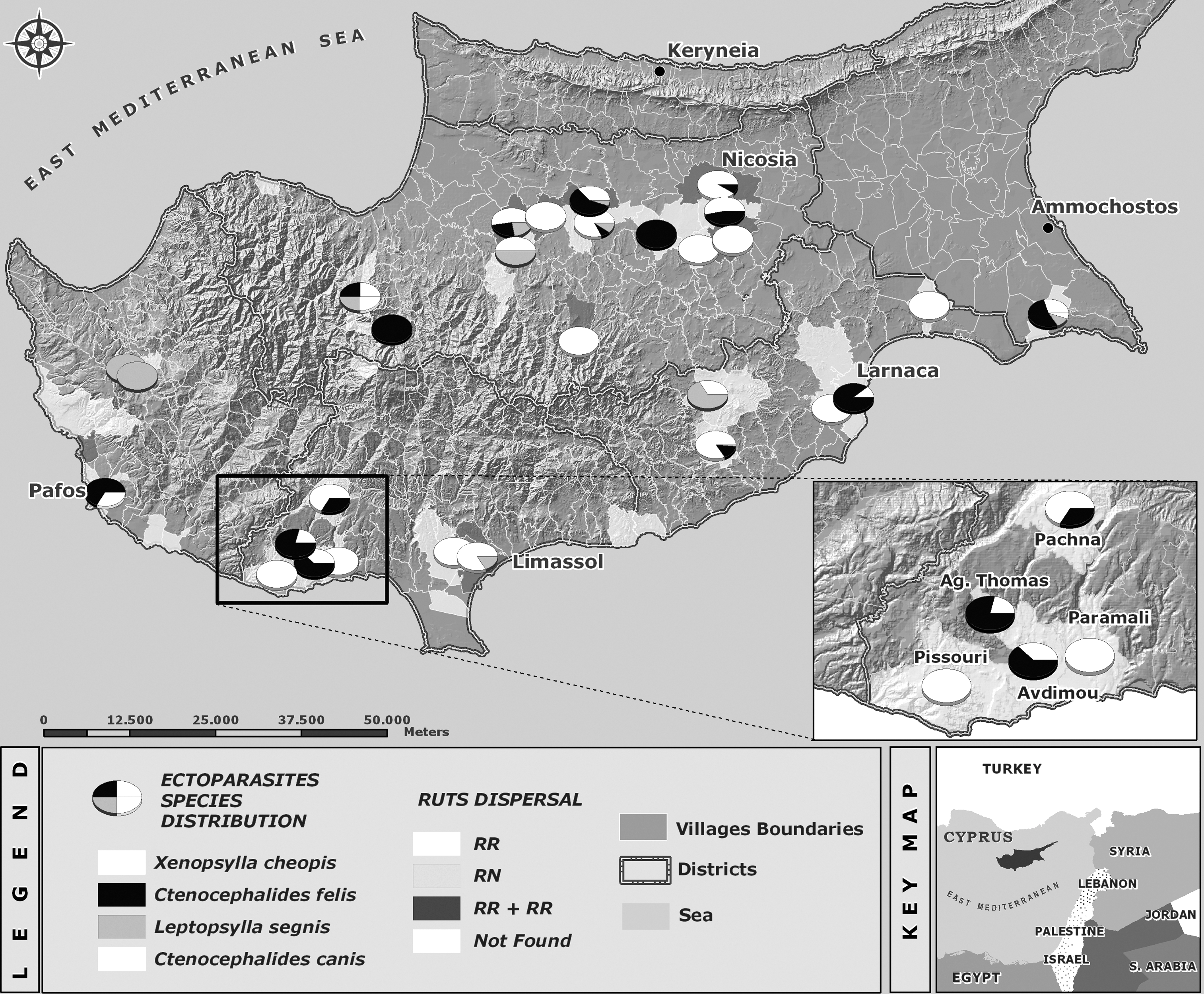
The geographic distribution of arthropod ectoparasites on R. rattus (RR) and R. norvegicus (RN) in Cyprus.
Macroscopical and microscopical examination
Three different species of helminth endoparasites were found. Cysticercus fasciolaris in the liver of 55 rodents, Hymenolepis diminuta in the intestine of 44 rodents, and Physalloptera spp. in the stomach of 1 rodent (Table 2 and Fig. 1). Echinococcus and Trichinella were not found in any of the 625 rodents. A higher proportion of helminthes were found on R. rattus (20% cf. 12% on R. norvegicus, p = 0.007). Land use was statistically significant for the presence of helminth parasites, which appeared to favor animal-raising areas (18.5%) and residential areas (13%) compared with areas with vegetation (5%), areas with storehouses (0%), and dumps/abbatoirs (0%) (p = 0.0006). Also the prefecture the animals came from was significant, favoring Limassol (27%), Ammochostos (23%), and Larnaca (20%) districts compared with Pafos (6%) and Nicosia (3%) (p < 0.0001). Rat body weight and sex comparisons were not statistically significant.
Bacteriological tests
Culture fecal material resulted in 12 different Salmonella spp. and serotypes from 56 (8.96%) rodents (Table 3). The presence of Salmonella spp. in a rat was found to be strongly associated with the region in which the animal was caught (p < 0.0001) and abattoirs or dumps (p < 0.0001). All infected rats were captured in three different areas: Palaiometocho (17 rats), Kofinou (38 rats), and Kokkinotrimithia (1 rat) (Fig. 1). Also, Escherichia coli was isolated from fecal samples of most rodents tested (470/625), whereas Proteus spp., Staphylococcus spp., Clostridium spp., and fungal pathogens were less common (14.4%, 4.8%, 1.3%, and 0.5%, respectively).
SD, standard deviation.
Virological tests
None of the 625 rodents were found to be positive to EMC virus.
Discussion
The distribution of the two rat species, R. rattus and R. norvegicus, appears to have changed during the last years, indicating a movement and rearrangement of populations. The recently introduced R. norvegicus has established itself in niches previously occupied by the black rat, which was introduced in Europe during the Roman times bringing the cholera epidemic (Audoin-Rouzeau 1999). The movement of rodents is important in the spread of diseases in time and space, affecting the local population, livestock, and wild animal health (Fèvre et al. 2006) and causing great economic losses to animal husbandry and agriculture.
Cyprus, an island ecosystem of 9455 km2 with over half a million inhabitants, has succeeded in the elimination of a number of zoonoses, such as echinococcosis and brucellosis (Steele et al. 1976, Economides et al. 1998, Economides 2000). However, it appears that these, as well as other zoonoses, are reemerging/emerging because of changing conditions.
Rodents play an important role in the maintenance and spread of Echinococcus because they can be eaten by canines, the final host. Before 1970 the parasite caused great economic losses with 40–100% of sheep, 4–50% of lambs, 20–50% of cattle, 27–93% of goats, and 5–22% of pigs infected (Polydorou 1982). The control program carried out by the Department of Veterinary Services in 1971–1985 successfully eradicated the parasite (Polydorou 1977, 1984). At that time, the number of dogs dropped from 46,000 to 6000. However, this number is estimated to be over 100,000 presently and consumable animals are known to be illegally transported to the Republic from the non–government-controlled area. This, as well as the fact that stray dogs and rodents freely cross the boarder from the North to the South, where the parasite is still found (Sadjjadi 2006), can result in the reemergence of the problem. Recognizing the danger, the Department of Veterinary Services reintroduced the control program in 1994 and the absence of cysts in rodents shows that the measures taken are successful. Trichinella larvae were not found in any of the rodents examined. The veterinary services are carrying out trichinoscopic tests on biological samples from wild and livestock animals since 1970. Our results confirm that the island is free of this Nematode because rodents are important in the epidemiological chain of the parasite (Oivanen et al. 2000).
This is the first survey concerning EMC virus on the island since 1994, when it was found responsible for great economic losses in the pig-raising industry (Loucaides et al. 1996). EMC virus is found in different continents associated with the death of pigs (Koenen et al. 1999). Rodents are probably the most common reservoir hosts and the source for the infection of animals and humans (Seaman et al. 1986). The mechanism by which the virus is transferred from reservoir hosts to pigs is probably by the consumption of infected rodents or animal feed contaminated with their urine or feces.
Three helminth parasites were found in 92 rodents; all three, C. fasciolaris, H. diminuta, and Physalloptera spp., were detected for the first time in Cyprus (Table 2 and Fig. 1). These parasites, carried by rodents, although may be transmitted indirectly to humans, do not pose a serious health hazard. H. diminuta was detected in 44 animals scattered all over the island, indicating that this helmith is well established in the ecosystem. C. fasciolaris, the larval stage of Taenia taeniafornis, was found in 55 rats caught along the south cost of the island (Fig. 1). It uses members of the Felidae as final host and rodents as intermediate hosts. It produces a cyst on the liver without obvious impairment. Physaloptera spp. was detected only in one rat in the Paphos district. It uses a number of arthropods as intermediate hosts and may be transmitted to humans causing gastric ulcers. No human infections due to these parasites have been reported on the island. It is interesting that rats of both species were infested with helminth parasites, although a higher proportion was found on R. rattus (p = 0.007); yet, infested rats were found mainly in animal-raising areas (p = 0.0006).
Medical reports show that salmonellosis is a common health problem in Cyprus. Rodents are carriers of a great number of Salmonella spp., thus helping in their distribution (Davies and Wray 1995). This pathogen was isolated from the intestine of 9% of the rats examined and the majority of the infected animals came from areas near abattoirs and garbage disposal. The serotypes found in the rodents are the ones found in patients and poultry in Cyprus. Today, Salmonella enteritidis, the most infectious and most widespread species in the world, has been reported as one of the most frequently identified Salmonella sp. in the island (EFSA Annual Report 2007). More than 50 phage types of S. enteritidis are known, with S. enteritidis phage type 4 being the most hazardous one. In Cyprus the species S. enteritidis, S. typhimurium, S. dublin, S. anatum, S. infantis, S. sainpaul, S. blokley, S. morbificans, S. essen, S. agona, S. hadar, S. bredeney, S. chincol, S. mission, and others have been isolated from biological materials, food staffs, and animal tissues (EFSA Annual Report 2007). Twelve of these species and serotypes were also isolated from the rodents examined (Table 3). Humans and animals, especially pigs and poultry, may be asymptomatic carriers of Salmonella and excrete the bacterium, thus infecting the environment, animals, and humans. GIS indicated 2 out of the 51 study areas as high risk for Salmonella spp. (Kofinou and Palaiometocho), both locations near abattoirs and dumps (Fig. 1).
The use of rodents as epidemiological tool proved valuable for the study of the incidence and dispersal of pathogens on the island and for monitoring the antiechinococcosis campaign. Their use as disease sentinels has the advantage of low cost, shorter latency of disease development, and greater ease of obtaining tissue samples and autopsy material. They could be used as early warning systems because animal and human health is closely related. Although Cyprus is an island, the political problem dividing the island north and south has not allowed common preventive actions for zoonoses. Rodent control measures have been undertaken in the past in Cyprus (Hoppe 1985); yet, a campaign to control zoonotic pathogens, to be effective, must cover the whole of the island and it should be targeted around abattoirs, dumps, and animal farms.
Footnotes
Acknowledgments
The authors thank the technicians of the Veterinary Services and the Department of Agriculture of Cyprus for their help and support; Eleni Svirinaki, Ippokratis Messaritakis, Vasiliki Christodoulou, and Doros Dimitriou for technical assistance; Loizidis Evagoras and Lefteris Panagiotou for providing valuable data and assisting in the field work; the Director of the Department of Cyprus Cadastral Andrea Hantzirafti for providing the geographical data of Cyprus. The authors are grateful to the Cyprus Research Promotion Foundation for funding this project.
Disclosure Statement
No competing financial interests exist.