




Abstract
In the search for toxic compounds against Aedes aegypti L. (Diptera: Culicidae) larvae, a collection of commercially available aromatic and aliphatic diversely substituted compounds were selected and evaluated. p-Cymene exhibited the highest larvicidal potency LC50 = 51 ppm, whereas 1,8-cineole exhibited the lowest activity value LC50 = 1419 ppm. To aid future work on the search for larvicidal compounds, the structure–toxicity relationships of this collection have been evaluated. The presence of lipophilic groups results in an overall increase in potency. In general, the presence of hydroxyl groups resulted in less potent compounds. However, methylation of such hydroxyls led to an overall increase in potency. The most potent compounds showed comparably good larvicidal activity in A. aegypti larvae as other terpenes, which we assume to be the result of the increased lipophilicity.
Introduction
Recently, there have been an increased number of investigations aiming to find novel larvicidal agents in natural products (Carvalho et al. 2003, Cavalcanti et al. 2004, Morais et al. 2006, Lucia et al. 2007, Silva et al. 2008). Several essential oils have been evaluated for their lavicidal activities on A. aegypti (Carvalho et al. 2003, Albuquerque et al. 2004, Cavalcanti et al. 2004, Lucia et al. 2007, Kim et al. 2008). Terpenes and phenylpropanoids are constituents of the essential oils and are present in several plants. For example, cinnamon leaf contains large amounts of eugenol, and vanillin is the main flavor compound of Vanilla planiflora (Orchidaceae). Camphor and cineole are present in essential oil of Salvia officinalis L. Additionally, thymol, p-cymene, and carvacrol are found in Thymus vulgaris L. (Dewick 2001). Simas et al. (2004) and Kim et al. (2008) have evaluated the activity of some terpenoids and phenylpropanoids as larvicidal on third-instar A. aegypti larvae. Waliwitiya et al. (2009) reported the larvicidal activity of 15 terpenoids. Pulegone, thymol, eugenol, trans-anethole, and citronellal exhibited high larvicidal activity against A. aegypti.
The structure–toxicity relationships of natural products as larvicide have been reported. Sodium salts of cashew nut shell extracts, cardanol, cardol, and anacardic acids isolated from Anacardium occidentale exhibited larvicidal potency against A. aegypti larvae similar to various monoterpenes found in essential oils (Laurens et al. 1997, Lomonaco et al. 2009). The hydrogenation of double bonds in such fractions and compounds resulted in a decrease of the larvicidal activities, demonstrating the importance of the double bonds on the side chains of such compounds. Similar results were found by Belzile et al. (2000), who evaluated the synergistic activity of dillapiol derivatives against Aedes atropalpus Coq. When the allyl side chain of dillapiol was modified, synergistic activity was either reduced or eliminated compared with dillapiol. However, no comprehensive reports on the structure–toxicity relationships of compounds usually found in essential oils have been reported to date. In view of this fact, the goal of the present work was to study the relationships between the larvicidal activity of a collection of commercially available aromatic and aliphatic diversely substituted compounds and their structures.
Materials and Methods
Ethics considerations
Breeding, housing, and experimental blood-feeding of insect procedures with animals followed guidelines established by the Colégio Brasileiro de Experimentação Animal (COBEA) and approved by the University Ethics Committee (CEPA) for the care and use of laboratory animals.
Chemicals
The following compounds were used: aromatic [carvacrol (99.9%), catechol (99.5%), p-cymene (99.7%), eugenol (99.0%), guaiacol (98.9%), phenol (99.0%), resorcinol (99.0%), salicylaldehyde (99.0%), thymol (99.0%), and vanillin (99.5%)] and aliphatic compounds [borneol (75.0%), 1,8-cineole (99.7%), isoborneol (99.0%), camphor (99.0%), 5-norbornene-2,2-dimethanol (98.0%), (+)-camphene (97.2%), (−)-camphene (84.6%), 5-norbornene-2-endo,3-endo-dimethanol (98.0%), 5-norbornene-2-exo,3-exo-dimethanol (97.0%), 5-norbornene-2-ol (98.7%, mixture of endo and exo), and 1,4-cineole (98.5%)] and temephos (97.5%) (purchased from Sigma-Aldrich, St Louis, MO).
Larvicidal assay
The larvicidal assay was performed according to Thangam and Kathiresan (1991) with some modifications. Third-instar larvae were used in the experiment. The concentration ranges were determined by a previous curve concentration–response with 20 larvae. A 20,000 ppm stock solution was prepared using each compound (20 mg/mL), Tween-80 (10% v/v), dimethyl sulfoxide (30% v/v), and natural mineral water (60% v/v). The stock solution was used to make 20 mL water solutions ranging from 30 to 2000 ppm. Twenty larvae were collected with a Pasteur pipette, placed on a filter paper for removal of water, and transferred (20 per test) with a tiny brush into disposable cups containing 20 mL of test solution. A mortality count was conducted 24 h after treatment. Controls were prepared with Tween-80 (0.1 mL), dimethyl sulfoxide (0.3 mL), and water (19.6 mL). Three replicates were used for each concentration and the control. Positive control with the organophosphorate temephos, a commonly used insecticide for larvae control, was used on final concentrations ranging from 0.0117 to 0.0663 ppm.
Statistics
Probit analysis (Finney and Stevens 1948) was conducted on mortality data collected after 24 h exposure to different concentrations of testing solutions to establish the lethal concentration for 50% mortality (LC50) and 95% confidence intervals values for the respective compounds and temephos (Table 1). In all cases where deaths had occurred in the control experiment, the data were corrected using Abbott's formula (% Deaths = [1 − (test/control)] × 100). To verify if the variation in potency following a modification in structure was statistically significant, the results were further analyzed using ANOVA, followed by Tukey test. A significance level of 5% was set for all analyses.
Values followed by the same letter do not differ significantly between themselves, based on Tukey test. Probit analysis was conducted on mortality data collected after 24 h exposure to different concentrations of testing solutions to establish the lethal concentration for 50% mortality (LC50) and 95% confidence interval (CI) values for the respective compounds and temephos.
Results
Structures
Structures of the investigated compounds are given in Figures 1 and 2. To evaluate the differences between aliphatic and aromatic compounds, two subsets were generated. Phenol was used as a template for the aromatic subset. p-Cymene was additionally evaluated with the goal to examine the effects of withdrawing the aromatic hydroxyl. A diverse set of bicyclic aliphatic compounds derivatives of norbornane bearing hydroxyls, double bonds, and ether groups were selected.
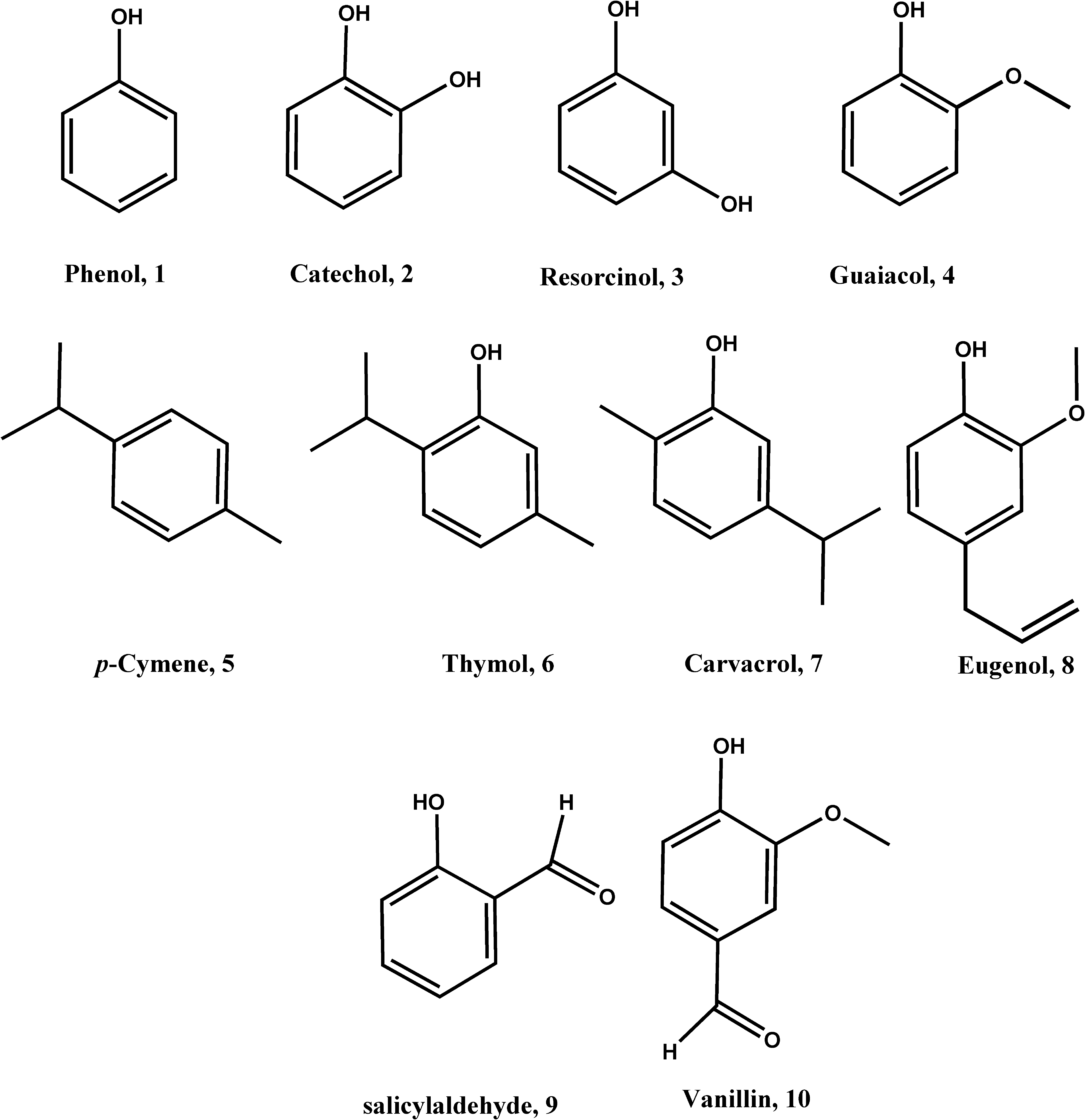
Structures of aromatic compounds.

Structures of aliphatic compounds.
Toxic effects
Compounds listed in Figures 1 and 2 were tested for their in vivo larvicidal activities against A. aegypti and were able to induce larvae mortality to a higher or lower degree. The set of 20 compounds and their evaluated activities, along with 95% confidence intervals expressed as ppm, are presented in Table 1. At higher concentrations, the larvae showed restless movement for some time and then settled at the bottom of the cups with abnormal wagging and died. The rates of mortality were directly proportional to the concentration. As may be seen from Table 1, the LC50 values of aromatic compounds resorcinol (3), guaiacol (4), p-cymene (5), salicylaldehyde (9), and vanillin (10) were significantly different from each other (p < 0.05). Phenol (1) and catechol (2) as well as thymol (6), carvacrol (7), and eugenol (8) did not significantly differ from each other (p > 0.05). p-Cymene induced 100% mortality of A. aegypti larvae after 24 h at 130 ppm, exhibiting the highest larvicidal potency LC50 = 51 ppm (48 to 56), followed by carvacrol LC50 = 69 ppm (65 to 72), thymol LC50 = 81 ppm (76 to 86), and eugenol LC50 = 88 ppm (81 to 96), p < 0.05, whereas resorcinol exhibited the lowest potency value of the aromatic subset LC50 = 577 ppm (519 to 629), inducing 100% mortality of A. aegypti at 2000 ppm.
In general, the aliphatic subset exhibited lower potency profiles than the aromatic subset. The LC50 values of (+)-camphene (11), camphor (13), and 5-norbornene-2-ol (21) were significantly different from each other (p < 0.05). (−)-Camphene (12) exhibited the highest larvicidal potency of the aliphatic subset LC50 = 220 ppm (163 to 301) followed by (+)-camphene LC50 = 406 ppm (317 to 526), isoborneol (15) LC50 = 598 ppm (522 to 665), and borneol (14) LC50 = 610 ppm (530 to 671), whereas 1,8-cineole (16) exhibited the lowest overall larvicidal potency LC50 = 1419 ppm (1307 to 1540) followed by 5-Norbornene-2-endo,3-endo-dimethanol (18) LC50 = 1407 ppm (1258 to 1574). 1,4-Cineole (17) and norbornenes 19 and 20 exhibited intermediate potencies. Temephos exhibited LC50 = 0.030 ppm (0.025 to 0.035), which indicates resistance of this strain to organophosphates.
Discussion
The chemical structures of aromatic compounds with the exception of p-cymene used to induce the structure–toxicity relationships have phenol as a common template. p-Cymene was tested with the goal to evaluate the effects of removing hydroxyl groups of the aromatic ring. Phenol exhibited LC50 = 194 ppm. The addition of lipophilic groups in the aromatic ring of phenol resulted in a more than three orders of magnitude increase of potency (thymol LC50 = 81 ppm and carvacrol LC50 = 69 ppm). Removal of the hydroxyl from carvacrol or thymol, resulting in p-cymene, significantly increased potency. Shifting the hydroxyl from C1 in thymol to C2, resulting in carvacrol, did not significantly change the potency. In contrast, an additional hydroxyl in the meta position of phenol resulted in more than two-fold decrease of potency (resorcinol LC50 = 577 ppm). The same hydroxyl at the ortho position, resulting in catechol (LC50 = 243 ppm), did not significantly increase the potency. Replacing the ortho hydroxyl group of catechol with a methoxy group (guaiacol) resulted in a significant increase in potency. Similarly, replacing the ortho hydroxyl group of catechol with an aldehyde (salicylaldehyde) resulted in a two orders of magnitude increase in potency. However, the presence of the aldehyde group in para position of guaiacol resulted in a more than two-fold decrease of potency (vanillin, LC50 = 513 ppm), whereas the addition of a lipophilic group at the same position led to a more than 3.5-fold increase of potency (eugenol, 8, LC50 = 88 ppm). In general, the presence of hydroxyl in the aromatic ring resulted in less potent compounds. A reasonable explanation for this result may be an increased number of hydroxyl groups preventing the substance penetration in the larvae cuticle and reaching its targets (Lopez et al. 2005). However, methylation of such hydroxyls led to an overall increase in potency, which may be related to the obstruction of the acidic hydroxyl.
The most potent compounds such as 5, 6, 7, and 8 exhibited larvicidal activity in A. aegypti larvae comparable to other terpenes, which we assume to be the result of increased lipophilicity. Similar results were found by Simas et al. (2004), in which more lipophilic sesquiterpenes exhibited higher larvicidal activities than monoterpenes. Additionally, the presence of an aliphatic aldehyde conjugated with an aromatic ring led to more potent cinnamaldehyde, whereas the presence of an aliphatic aldehyde in citronellal exhibited no activity (Simas et al. 2004). Our results substantiate these findings by comparing phenol (1) with salicylaldehyde (9), but do not explain the decrease in potency by the addition of an aldehyde to the para position of guaiacol, resulting in less potent vanillin.
Similar to the results found in the aromatic subset, the addition of hydroxyls to the structures of the aliphatic subset resulted in less potent compounds. Therefore, lack of hydroxyls have probably contributed to (+)- and (−)-camphene observed activities (LC50 = 406 ppm and 220 ppm, respectively). Additionally, biological activities of enantiomeric (+)- and (−)-camphene were significantly different. Indeed, chiral recognition by receptors and enzymes is well demonstrated in biochemical, pharmaceutical, and chemosensory research, as well as the biological differences between enantiomers. The chiral influence of other optically active monoterpenes on experimental models also was demonstrated (De Sousa et al. 2007a, 2007b, Do Amaral et al. 2007). However, the diastereoisomers borneol (LC50 = 610 ppm) and isoborneol (LC50 = 598 ppm) exhibited similar potency profiles. Replacement of the hydroxyl from borneol or isoborneol to carbonyl, resulting on camphor (LC50 = 657 ppm), did not modify the potency.
The structurally related norbornenes exhibited different potency profiles, ranging from 717 to 1407 ppm. Within the norbornene derivatives, 5-norbornene-2-exo, 3-exo-dimethanol (LC50 = 717 ppm) exhibited the highest larvicidal potency. However, its endo isomer resulted in approximately two-fold less potency, whereas 5-norbornene-2-ol (LC50 = 759 ppm) and 5-norbornene-2,2-dimethanol (LC50 = 785 ppm) exhibited intermediate potencies. Interestingly, ether-bearing compounds, 1,8- and 1,4-cineole, did not exhibit related potencies. As a result, 1,8-cineole was less toxic than 1,4-cineole. Unlike in the aromatic subset, the presence of ether groups, instead of hydroxyls, did not lead to an overall increase in potency. Aromatic compounds have exhibited higher larvicidal potency than aliphatic ones.
Waliwitiya et al. (2009) have reported the larvicidal activity of 15 monoterpenoids. The aromatic compounds trans-anethole (LC50 = 67.1 ppm), thymol (LC50 = 27.3 ppm), and eugenol (LC50 = 82.2 ppm) exhibited potent larvicidal activities compared with the remaining set. Similarly, Simas et al. (2004) evaluated the larvicidal activity of eugenol (LC50 = 44.5 ppm), among other compounds against A. aegypti. The linear unsaturated alcohols E,E-farnesol and E-nerolidol exhibited the highest activities, LC50 = 13 and 17 ppm, respectively. Some of the present LC50 values differ from reported data (Kim et al. 2008), which may be the result of different methodologies and analysis. Additionally, different species, from different ecological niches, appear to be more susceptible or resistant to specific compounds (Waliwitiya et al. 2009). Evaluated compounds were less toxic than temephos (LC50 = 0.030 ppm), pyriproxyfen (LC50 = 0.000048 ppm), or diflubenzuron (LC50 = 0.00159 ppm) (Seccacini et al. 2008). However, additional knowledge about structure–toxicity relationships may lead to more potent compounds.
Using traditional medicinal chemistry approaches, we identified structural characteristics that may contribute to the understanding of the larvicidal activity of phenylpropanoids, terpenes, and their derivatives. The presence of lipophilic groups in the aromatic ring or in the hydroxyl resulted on increased potency. The presence of hydroxyls to the aromatic ring resulted on decreased potency. Similar to the results found in the aromatic subset, the addition of hydroxyls to the structures of the aliphatic subset resulted on less potent compounds. The stereochemistry of selected compounds play an important role on modulating the potency. Additionally, lipophylicity seems to play a significant role on larvicidal activity. The present study may aid future work on the search for larvicidal compounds.
Footnotes
Acknowledgments
The authors wish to acknowledge DECIT/SCTIE/MS, CNPq, SES/SE, and FAPITEC-SE for supporting funds.
Disclosure Statement
No competing financial interests exist.