




Abstract
We investigated the seroprevalence of five tick- or mite-borne zoonoses, scrub typhus (Orientia tsutsugamushi), Japanese spotted fever (Rickettsia japonica), tularemia (Francisella tularensis), Lyme disease (Borrelia afzelii and Borrelia garinii), and Q fever (Coxiella burnetii), in feral raccoons (Procyon lotor) captured in Hokkaido and Kanagawa Prefectures in Japan. Of the 559 raccoons captured in Hokkaido, 8 (1.4%), 3 (0.5%), 1 (0.2%), and 1 (0.2%) carried antibodies against O. tsutsugamushi (Gilliam type), F. tularensis, B. afzelii, and B. garinii, respectively. Of the 193 animals investigated in Kanagawa, 31 (16.1%) and 14 (7.3%) carried antibodies against O. tsutsugamushi and R. japonica, respectively, and the major serotype (27/31) of O. tsutsugamushi was Kuroki. No antibodies against C. burnetii were detected in either area examined. Therefore, feral raccoons could be an indicator of the prevalence of these four tick- or mite-borne zoonoses in the peridomestic environment in Japan.
Introduction
Wild raccoons are infected with several causative agents of zoonoses, such as rabies in North America (Rupprecht et al. 2002), tularemia (Berrada et al. 2006), toxoplasmosis (Hill et al. 2005), and raccoon ascarid in the United States (Gavin et al. 2005), and the raccoon has also been used as a sentinel animal for tularemia (Berrada et al. 2006). Because feral raccoons in Japan have been infested with Ixodes and Haemaphysalis ticks (Jinnai et al. 2009), which are the vectors of Rickettsia japonica (Katayama et al. 2001), Francisella tularensis (Zhang et al. 2008), Borrelia afzelii, Borrelia garinii (Masuzawa 2004), Coxiella burnetii (Lee et al. 2004), and Ehrlichia chaffeensis (Dumler and Bakken 1995), the animals are suspected to be exposed to these pathogens. In Japan, feral raccoons were shown to be serologically infected with E. chaffeensis and Anaplasma phagocytophilum, which are causative agents of human monocytic ehrlichiosis and granulocytic anaplasmosis (Inokuma et al. 2007). However, no information is available about the prevalence of other tick- or mite-borne zoonoses in feral raccoons in Japan.
In this study, we investigated the seroprevalence of five tick- or mite-borne zoonoses, scrub typhus (Orientia tsutsugamushi), Japanese spotted fever (R. japonica), tularemia (F. tularensis), Lyme disease (B. afzelii and B. garinii), and Q fever (C. burnetii), in feral raccoons captured in two different prefectures in Japan.
Materials and Methods
Raccoon and serum sampling
From July 2000 to September 2002, 559 (184 adults and 375 juveniles) and 193 (144 adults and 49 juveniles) feral raccoons were captured using live cage traps for the purpose of alien animal control at nine peridomestic areas in the central part of Hokkaido (41°47′ N to 43°14′ N, 140°43′ E to 141°52′ E) and four peridomestic areas in the eastern part of Kanagawa (24°30′ N to 35°20′ N, 121°30′ E to 139°37′ E) Prefectures in Japan, respectively (Fig. 1). The ages of the raccoons were estimated by the appearance and the level of erosion of the teeth to classify the animals as adults or juveniles. Blood samples were collected from the jugular or saphenous vein after immobilizing the animals by intramuscular injection of ketamine hydrochloride and xylazine. The blood samples were clotted for 1 to 2 h at room temperature, and centrifuged at 500 g for 15 min. The separated sera were collected and stored at −20°C until examined.
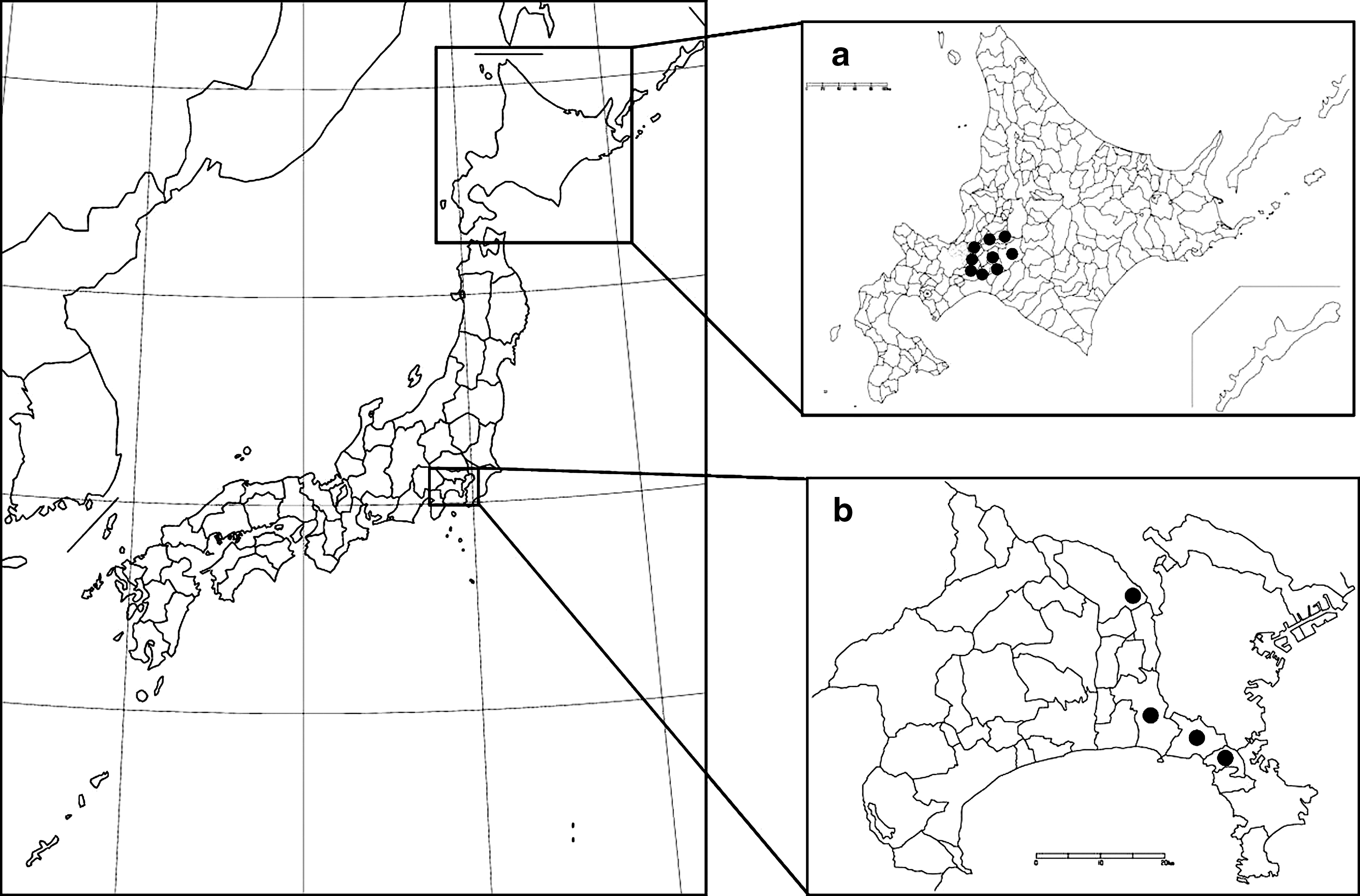
Geographical locations in Japan where feral raccoons were captured in this study. The areas are indicated by closed circles on the map of (
Serological analysis
Indirect immunoperoxidase assay for scrub typhus, Japanese spotted fever, Lyme disease, and Q fever
Indirect immunoperoxidase assay antigen slides for each agent were prepared using L929 cells infected with the strains KarpT (ATCC VR-150), Gilliam, Kawasaki, and Kuroki for O. tsutsugamushi; strain Aoki for R. japonica; strain IPF for B. afzelii; strain ASF for B. garinii; and strain Nine MileT (ATCC VR-615) for C. burnetii phase II. The sera of feral raccoons were serially diluted from 1:20 to 1:1260 with 0.01 M phosphate buffered saline (PBS; pH 7.2), containing 0.3% bovine serum albumin. Ten micro liters of the diluted sera was added to each antigen spot on a slide, incubated at 37°C for 30 min, washed twice with PBS for 5 min, and air-dried. About ten micro liters of peroxidase-labeled protein G (Zymed Laboratories Inc, San Francisco, CA) diluted 1:1000 in PBS was added to each spot and incubated at 37°C for 30 min. Slides were washed two times with 0.01M PBS for 5 min. The substrates (4-chloro-1-naphthol and H2O2) were added to the slides, which were incubated at room temperature for 5 min in the dark, washed thrice with distilled water, and air-dried. The slides were examined at × 400 magnification under a light microscope.
Slide agglutination test for tularemia
The antibody against F. tularensis was detected by the slide agglutination test (Sato et al. 1992). In brief, the antigen was prepared using F. tularensis strain Ebina
Statistical analysis
The results were analyzed by 2 × 2 tables, and chi-square tests were used to determine statistical significance. A p-value <0.05 was considered statistically significant.
Results
The overall seroprevalence to O. tsutsugamushi in feral raccoons in Japan was 5.2% (39/752) in this study. The seroprevalence (11.3%; 37/328) in adults was significantly higher than that (0.5%; 2/424) in juveniles (p < 0.001) (Table 1). In Hokkaido, only eight (1.4%) animals carried antibodies against strain Gilliam with titers from 1:40 to 1:160, and none of these animals carried antibodies to the other strains tested. On the contrary, 31 (16.1%) of 193 feral raccoons in Kanagawa carried antibodies against O. tsutsugamushi, and the seroprevalence was significantly higher than that (1.4%, 8/559) in Hokkaido (p < 0.001). Twenty-seven (87.1%) of the 31 raccoons in Kanagawa carried antibodies against strain Kuroki with titers from 1:40 to 1:1280. Antibodies against two different O. tsutsugamushi strains were found in four animals; that is, three reacted with strains Karp and Kuroki with titers from 1:40 to 1:80, and the remaining reacted with strains Kawasaki and Kuroki at a titer of 1:80 (Tables 2 and 3).
p < 0.001.
p < 0.02.
p < 0.001.
p < 0.001.
The overall seroprevalence for R. japonica was 1.9% (14/752) in the raccoons examined. The seroprevalence (3.7%; 12/328) in adults was significantly higher than that (0.5%; 2/424) in juveniles (p < 0.02) (Table 1). All 14 (7.1%) raccoons with the antibodies against R. japonica were captured in Kanagawa, whereas no raccoons with antibodies were detected in Hokkaido (p < 0.001) (Table 2). The antibody titers against R. japonica ranged from 1:40 to 1:1280 (Table 3).
Only 0.4% (3/752) of the feral raccoons carried antibodies against F. tularensis at a titer of 1:40. The raccoons with antibodies against F. tularensis were captured in Hokkaido and were all juveniles (Tables 1 –3). The three samples showed no cross-reaction with F. novicida and F. philomiragia.
Of the 752 feral raccoons that were tested for Lyme disease, only one juvenile raccoon captured in Hokkaido (0.1%, 1/752) carried antibodies against both B. afzelii and B. garinii at a titer of 1:40 (Tables 1 –3).
No animals carried antibodies against C. burnetii in either area (Table 1).
Discussion
Scrub typhus is diagnosed in more than 300 patients per year in Japan (Hashimoto et al. 2007). About 1.4% (8/559) of the feral raccoons in Hokkaido were found to carry antibodies against O. tsutsugamushi for the first time. Although no scrub typhus patients have been reported in the prefecture to date, the result suggests the possibility that there is a focus of scrub typhus in the area investigated. The seroprevalence (16.1%; 31/193) of O. tsutsugamushi in Kanagawa was significantly higher (p < 0.001) than that (1.4%; 8/559) in Hokkaido, suggesting wide distribution of O. tsutsugamushi in Kanagawa.
The serotypes of O. tsutsugamushi in Japan are reported as Gilliam, Karp, Kato, Kawasaki, Kuroki, and Shimokoshi (Tamura et al. 2001). Only the Gilliam type was found in the raccoons from Hokkaido. On the other hand, the predominant serotype in raccoons from Kanagawa was Kuroki (87.1%; 27/31) and other serotypes were rarely found in the animals. In Kanagawa, 54 human cases of scrub typhus were reported in the western part from 2001 to 2005, and the majority of serotypes in the patients were Kawasaki (68.5%; 37/54), followed by Kuroki (24.1%; 13/54) and Karp (7.4%; 4/54) (Katayama et al. 2006). The raccoons examined in this study were captured in the eastern part of Kanagawa. These results indicate that the prevalence of the serotypes may be different in the eastern and western parts of Kanagawa.
Approximately 50 cases of Japanese spotted fever are reported per year in Japan (Hashimoto et al. 2007). In the present study, no feral raccoons captured in Hokkaido carried antibodies against R. japonica; however, antibodies were previously detected from Apodemus speciosus mice and Myodes rufocanus voles in the prefecture (Okabayashi et al. 1996). Because the investigated areas in Hokkaido were limited, further studies are needed to elucidate the presence of R. japonica infection among raccoons in the prefecture. In Kanagawa, two human cases of Japanese spotted fever were reported in 1996 (Katayama et al. 1996). In the present study, we firstly showed that 14 (7.1%) feral raccoons carried antibodies against R. japonica in Kanagawa. The data indicate that R. japonica may be widely distributed in the peridomestic area in the prefecture.
A total of 1372 human cases of tularemia were recorded in Japan until 1994 (Ohara et al. 1996). In the record, less than nine cases were observed in Hokkaido, and none were reported in Kanagawa. In the present study, we showed that three raccoons captured in Hokkaido carried antibodies against F. tularensis without cross reaction of F. novicida and F. philomiragia, suggesting the presence of F. tularensis among the raccoon populations in peridomestic areas in Hokkaido. In the United States, a high seroprevalence of F. tularensis was reported among wild raccoons in Nebraska (38.3%; 23/60) (Bischof and Rogers 2005) and in Massachusetts (52.4%; 11/21) (Berrada et al. 2006). Therefore, we need to pay attention to the spread of the disease among feral raccoons, because the animals are a potential source of the disease in Japan.
There have been 61 confirmed cases of Lyme disease between 1999 and 2003 in Japan (the data were cited from Historical Statistics of Japan in the Ministry of Internal Affairs and Communications). In the present study, we found that only one juvenile raccoon captured in Hokkaido carried antibodies against both B. afzelii and B. garinii. It was reported that feral raccoons in Hokkaido have been infested with Ixodes persulcatus (Jinnai et al. 2009), which is the vector of Lyme disease in Japan. Previous serological studies in humans, dogs, deer, and cattle have revealed that Lyme disease is endemic in Hokkaido (Isogai et al. 1990, 1991, 1992, Kimura et al. 1995). Although ixodid tick infestation of raccoons was not examined in this study, our results also support the possibility that the area under investigation is one of the endemic areas of Lyme disease in Hokkaido.
In the present study, no animals carried antibodies against C. burnetii. In Canada, it has been reported that the seroprevalence of wild raccoons was 7.1% by indirect immunofluorescent assay (IFA) and that they play a role as a reservoir of Q fever (Marrie et al. 1993). Because the presence of Q fever has been serologically shown by IFA in humans in Hokkaido (Numazaki et al. 2000), further epidemiological studies using more sensitive diagnosis methods such as IFA or enzyme-linked immunosorbent assay will be necessary to find the infection in feral raccoons in the prefecture.
The seroprevalence of O. tsutsugamushi and R. japonica in adult raccoons was significantly higher than those of juveniles. This result reflected the finding that raccoons were more frequently infected with ticks and were exposed to these pathogens with age. On the other hand, antibodies against F. tularensis, B. afzelii, and B. garinii were detected only in juveniles, although the seroprevalence for these agents was quite low. More raccoons will be examined to clarify the difference in seroprevalence of these agents between adults and juveniles.
In conclusion, we found that feral raccoons may serve as an indicator of the prevalence of five tick- or mite-borne zoonotic agents, O. tsutsugamushi, R. japonica, F. tularensis, B. afzelii, and B. garinii, in peridomestic environments in Japan.
Footnotes
Acknowledgment
This work was supported by Grant for Academic Frontier Project, Surveillance and Control for Zoonoses, from the Ministry of Education, Culture, Sports, Science and Technology.
Disclosure Statement
No competing financial interests exist.