




Abstract
Our objectives were to investigate the presence of Anaplasma spp. infection in red deer, wild boars, and Ixodes ricinus removed from deer surveyed in La Rioja, as well as to analyze the presence of Anaplasma spp. in I. ricinus from different Spanish regions—ours included. A total of 21 deer and 13 wild boar blood samples as well as 295 I. ricinus removed from deer, vegetation, or asymptomatic people were tested by polymerase chain reaction targeting Anaplasma spp. 16S rRNA gene and groESL heat shock operon. Twelve deer blood samples were found to be infected with Anaplasma centrale (n = 7) or Anaplasma phagocytophilum (n = 5). No wild boar blood samples gave positive polymerase chain reaction results. Further, A. phagocytophilum was detected in 12 out of 89 I. ricinus removed from deer and in 18 out of 168 I. ricinus collected over vegetation in the North of Spain. Anaplasma spp. was not detected in any of the 38 I. ricinus removed from people. Nucleotide sequences for 16S rRNA gene showed substancial heterogeneity. The etiological agent of human anaplasmosis was found in two deer blood samples, an adult tick from deer, and a nymph from vegetation. The 16S rRNA sequences for 12 out of 35 samples matched the sequence of the Ap-variant 1 strain previously described in the United States, and the remaining 19 positive samples (deer blood and I. ricinus) showed variations with unknown significance. Although the groEL DNA sequences varied among analyzed strains, the deduced amino acid sequences did not change for any of them. This study suggests that deer population from La Rioja harbors strains of A. phagocytophilum similar to that pathogen for humans and other of unknown pathogenicity. Further, it seems that the Ap-variant 1 is circulating among I. ricinus ticks from the North of Spain more frequently than the A. phagocytophilum strain associated to human anaplasmosis.
Introduction
Materials and Methods
Ethylenediaminetetraacetic-acid-treated (EDTA-treated) blood samples from 21 deer and 13 wild boars were collected during the 2005–2006 hunting season in La Rioja (North of Spain). In total, 89 feeding adult I. ricinus obtained from the same deer from which the deer blood was collected, 168 I. ricinus recovered over vegetation in different provinces of Spain (Álava, Burgos, Cantabria, Guipúzcoa, Jaén, Navarra, and La Rioja) (Fig. 1), and 38 I. ricinus (30 nymphs and 8 adults) removed from people who sought medical attention in La Rioja and remained asymptomatic were included in the study. No I. ricinus were found over wild boars. Specimens were stored at −70°C until DNA extraction. DNA was extracted from animal blood and ticks using a QIAamp DNA Blood Mini Kit (Qiagen, Hilden, Alemania) according to the manufacturer's instruction. Deer and wild boar blood samples were processed individually. However, tick DNA samples were pooled for initial polymerase chain reaction (PCR) screening. Fragments of the 16S rRNA gene (546 bp) from A. phagocytophilum were amplified using nested PCR, with primers previously reported (Chen et al. 1994, Massung et al. 1998). Individual I. ricinus samples corresponding to vials that yielded positive PCR results were additionally tested with the same primers. For further characterization, DNA samples positive for the 16S rRNA gene were tested by nested PCR assays with primers designed to amplify the groESL heat shock operon of Anaplasma spp. (Liz et al. 2002).
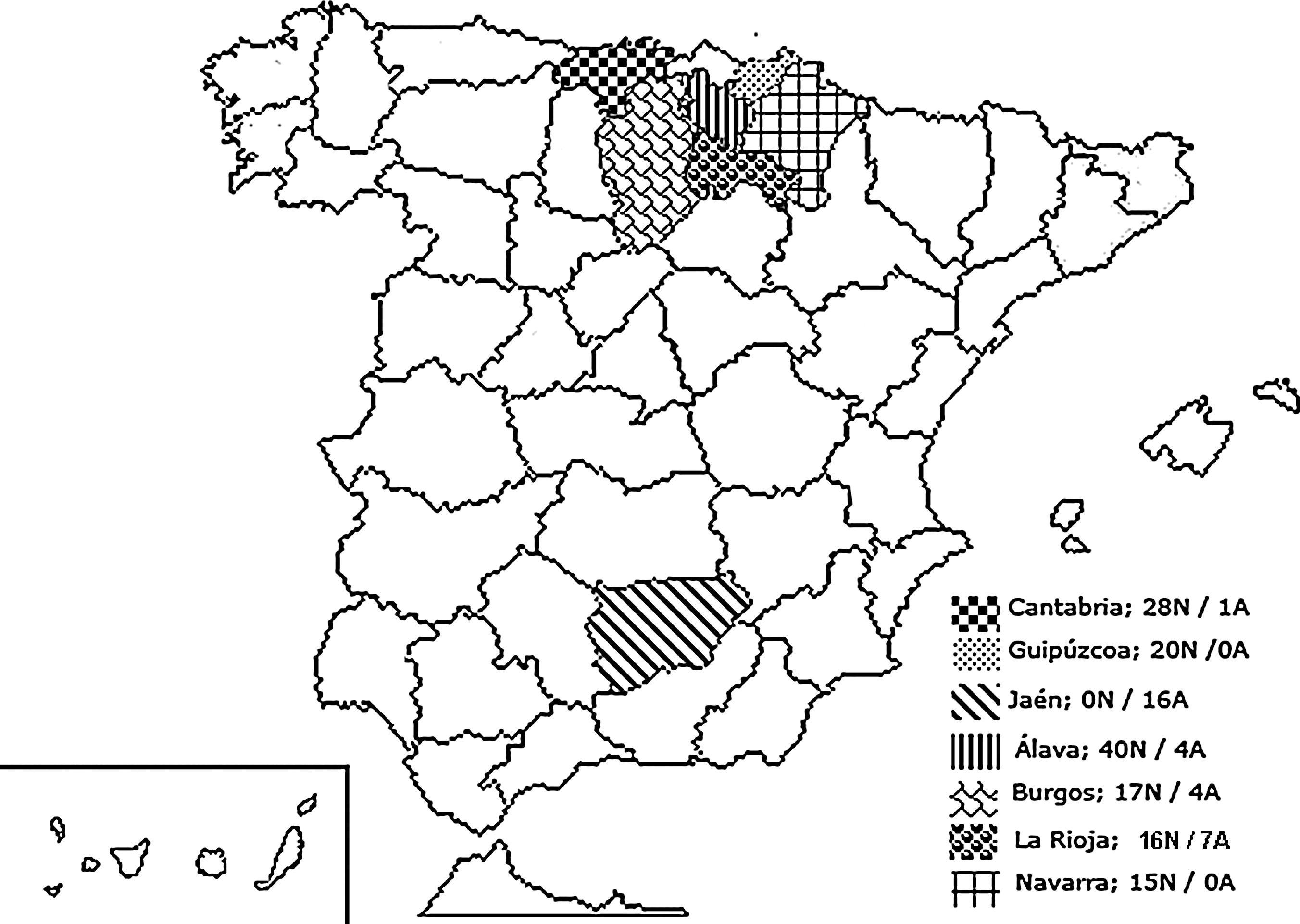
Map of Spain showing the localities of tick capture over vegetation. N, nymphs; A, adult ticks.
Quality control measures included negative controls (water) that were amplified in parallel with all specimens. To minimize the potential for DNA contamination, three separate, designated areas were used for extraction of DNA and preparation of PCRs. All positive PCR products for the 16S rRNA gene were tested twice and sequenced in both directions. Selected DNA samples positive for the 16S rRNA gene were checked using PCR primers specific for Anaplasma centrale (AC1f-AC1r) (Kawahara et al. 2006). Sequences of every PCR amplicon of groESL heat shock operon were also determined. A nucleotide–nucleotide Basic Local Alignment Search Tool nucleotides (blastnts) search was performed to determine the most similar sequences of the target genes published in GenBank (
Results
Blood from 12 out of 21 deer yielded positive 16S rRNA PCR results. Nucleotide sequences of seven blood samples showed >99%–100% identity with a fragment of 16S rRNA of A. centrale (GenBank accession no. AB211164)—not included in the A. phagocytophilum group. These results were confirmed with positive amplification of the 16S rRNA fragment gene (426 bp) specific for A. centrale. Sequence analysis corroborated that A. centrale could be amplified from deer blood. The five remaining 16S rRNA nucleotide sequences showed 98.9%–100% similarity with A. phagocytophilum (GenBank accession no. U02521). No positive PCR results for the presence of Anaplasma species were obtained from wild boar blood samples with any of the primer pairs used in this study.
A total of 12 out of 89 I. ricinus (13.48%) collected over deer from La Rioja were found to be infected with A. phagocytophilum according to the 16S rRNA gene. Sequencing of these amplicons showed 99.6%–100% identity with the partial nucleotide sequence of A. phagocytophilum (GenBank accession no. U02521). Further, 18 out of 168 questing I. ricinus found on vegetation in La Rioja and Álava (Basque Country) were infected with A. phagocytophilum when PCR-based analysis of the 16S rRNA gene was performed. On the contrary, this microorganism was not detected in any of the 38 I. ricinus removed from asymptomatic people in La Rioja.
Sequence homology searches of the 16S rRNA gene revealed that four sequences (corresponding to two deer blood specimens, an adult tick from deer, and a nymph from La Rioja vegetation) showed the same nucleotide sequence as the one reported as human A. phagocytophilum strain (GenBank accession no. U02521). Twelve sequences (11 obtained from tick sampling vegetation in La Rioja and 1 from a deer adult tick) were identical, and all of them differed from the human pathogenic strain by only two nucleotides: G and A in positions 76 and 84, respectively. These changes correspond to the Ap-V1 strain of A. phagocytophilum (GenBank accession no. AY193887). The remaining 19 sequences (3 from deer blood, 10 from I. ricinus removed from deer, and 6 from vegetation ticks) had point mutations represented by A/G substitutions in different positions, most of them included in a short variable region between nucleotides. 75 and 85 (Table 1). The groEL DNA sequences of Anaplasma spp. strains varied by up to 12 bases, but the deduced amino acid sequences did not change for any of the studied strains (Tables 2 and 3). All new Anaplasma GenBank accessions are listed in Table 4.
The number corresponds to the positions of nucleotide substitutions respect to the sequence of human pathogenic A. phagocytophilum strain (GenBank accession no. U02521). Corresponding base substitutions for other variants are shown.
Positive tick collected in Álava (Basque country). The remaining positive samples (deer and ticks) were collected in La Rioja.
The number corresponds to the positions of nucleotide substitutions respect to the sequence of human pathogenic A. phagocytophilum strain (GenBank accession no. U96728). Corresponding base substitutions are shown.
The number corresponds to the positions of nucleotide substitutions respect to the sequence of human pathogenic A. phagocytophilum strain (GenBank accession no. U96728). Corresponding base substitutions are shown.
DB, deer blood; ATD, adult ticks from deer; NV, nymphs from vegetation.
Eleven groEL sequences from vegetation nymphs corresponding to strains with 16S rRNA sequences identical to Ap-variant 1 strain (GenBank accession no. AY193887) are missing (ND).
ND, not done.
Discussion
Finding DNA in A. centrale and A. phagocytophilum from deer suggests that deer are infected with these agents in La Rioja (Spain). Seroprevalence of Anaplasma in red deer had been previously reported in Spain and Anaplasma marginale strains had been detected in Hyalomma marginatum ticks removed from these animals (de la Fuente et al. 2004). Same authors had found Anaplasma 16S rRNA genotypes identical to A. marginale and A. phagocytophilum in cattle and deer samples (de la Fuente et al. 2005). However, to our knowledge, this is the first report of naturally infected deer with A. centrale in Europe. This microorganism has been recently identified as the etiological agent of bovine anaplasmosis in Italy (Carelli et al. 2008). However, infection of deer with A. centrale has only been previously documented in Japan (Kawahara et al. 2006). A. phagocytophilum has been found in deer blood as well as in I. ricinus ticks collected from deer and over vegetation in the North of Spain. On the contrary, none of I. ricinus collected from humans showed A. phagocytophilum, maybe because most ticks attached to people were removed at Emergency Units, or even by the potential patients who used substances as alcohol or nail varnish to remove them, and the arthropods were not well preserved before the arrival to our lab.
Further genetic characterization of the strains of A. phagocytophilum, based on information contained in 16S rRNA gene sequences, showed substantial heterogeneity among sequences analyzed. The etiological agent of HA was found in two deer blood samples, an adult tick from deer, and a nymph from vegetation. Strains that infect humans have been previously detected in European I. ricinus ticks (Pusterla et al. 1999, Liz et al. 2002, von Loewenich et al. 2003, Polin et al. 2004, Portillo et al. 2005), but to our knowledge this is the first evidence of the presence of A. phagocytophilum strains associated with human disease obtained from deer. However, the majority of the sequences (12 out of 35) corresponded to the Ap-V1, previously found in our region and reported as nonhuman pathogenic (Portillo et al. 2005). It is difficult to judge the significance of the sequence variations observed for the remaining sequences obtained from deer blood and I. ricinus.
This study also presents the results of a comparison of the sequences of the groESL operon fragment, which is used to detect DNA of Anaplasma spp. Although different nucleotide sequences were found within the analyzed region of the groEL gene, these changes were neutral. This diversity is an expression of the bacterial population diversity within the marker region of groESL. For this reason, it seems that these changes at the DNA level are not linked with the pathogenicity of A. phagocytophilum variants.
In our study, Anaplasma spp. was not detected in wild boar blood, maybe due to the low number of samples analyzed. On the contrary, A. phagocytophilum sequences detected in S. scrofa from Slovenia were identical to those found in HA patients from the same country (Petrovec et al. 2003).
In La Rioja, deer are abundant in diverse biotopes and serve as hosts for large numbers of all stages of I. ricinus, which may become infected with Anaplasma spp. These animals and potentially humans are exposed to infected ticks in nature.
This study suggests that the deer population in La Rioja harbors strains of A. phagocytophilum similar to that pathogen for humans and the other of unknown pathogenicity for humans. Strains with 16S rRNA sequences identical to the nonhuman pathogenic Ap-V1 strain found in the United States are prevalent in I. ricinus ticks in Northern Spain, whereas strains with A. phagocytophilum 16S rRNA sequences associated with HA are rare.
Footnotes
Acknowledgments
We thank Juan Herrera and his team from the Consejería de Turismo, Medio Ambiente y Política Territorial-Gobierno de La Rioja (Spain), for their contributions to this study. We are also very grateful to Pilar Maya, from the Área de Prevención y Control de Epizootías, Tragsega S.A. in Madrid (Spain), for providing deer samples for analysis. We gratefully acknowledge Dr. Francisco J. Márquez from the University of Jaén (Spain) for supplying ticks from the South of Spain.
Financial support was provided in part by grants from Fondo de Investigación Sanitaria (PI051460) and Instituto de Salud Carlos III (EMER 07/033), Ministerio de Ciencia e Innovación (Spain).
Disclosure Statement
No competing financial interests exist.
This study was presented in part at the XII Reuniþn SEIMC held in La Coruña (Spain) in May 2007, and at the GEPE Scientific Meeting from the XIII Reuniþn SEIMC held in Sevilla (Spain) in June 2009.