




Abstract
This study evaluated the use of house sparrow (Passer domesticus) nestlings as sentinels of West Nile virus (WNV) in the prairie grasslands of Saskatchewan. In the summer of 2006, 600 house sparrow nestlings were collected and pooled tissues tested by reverse transcriptase–polymerase chain reaction. All tested negative for WNV. During the same period, no WNV was detected by mosquito surveillance in the study area and 15 WNV-infected pools were collected from the nearby city of Estevan. Six percent of avian carcasses collected from Regina, a city 100 km from the study area in the same ecozone, were infected with WNV. In 2007, 200 house sparrow nestlings were collected and 4 tested positive for WNV, a prevalence of 2%. Ninety-seven house sparrow eggs were also collected and WNV antibodies were measured in the yolk. Seven eggs had measurable titers, a prevalence of 7.2%. Combined WNV surveillance showed high levels of WNV transmission in 2007; 112 WNV-infected mosquito pools were collected from nearby cities of Estevan and Weyburn, and the proportion of WNV infected avian carcasses from Regina was 78%. There were 1456 human cases of WNV in Saskatchewan in 2007, compared to 19 cases in 2006. The study concluded that house sparrow nestlings are not useful as an early warning of WNV circulation, or as a measure of the intensity of WNV activity in the prairie grasslands. Also, the study determined that maternally derived antibody did not have a significant limiting effect on WNV transmission to house sparrow nestlings in 2007, a year of epidemic WNV activity in the study area.
Introduction
The public health and economic consequences of WNV can be severe. Although most cases of WNV infection do not result in disease, around 20% of infections lead to WNV fever and 1% result in WNV neurological syndrome (Mostashari et al. 2001). Saskatchewan Ministry of Health coordinates a surveillance and response program for WNV, integrating results from the collection and testing of dead birds and mosquitoes, and passive surveillance for human and equine cases. This program aims to detect virus activity early, thus allowing finite public health resources to be targeted effectively toward prevention of human infections.
Elsewhere in North America, dead bird surveillance has provided the most sensitive method for early detection of WNV activity (Eidson et al. 2001) and has also defined areas of WNV activity and human risk (Cooke et al. 2006, Johnson et al. 2006). The main species used for WNV avian carcass surveillance in North America have been American Crows (Corvus brachyrhynchos) and other members of the corvid family. These species are highly susceptible to lethal WNV infection (Komar et al. 2003) and are large visible birds that may easily be detected. However, dead bird surveillance schemes are largely reliant on sightings of dead birds by the public. In rural areas with low human population density, detection rates can be low, decreasing the effectiveness of this method of surveillance (Ward et al. 2006).
Saskatchewan faces a significant challenge in providing WNV surveillance and prediction of human risk of infection over a wide geographical area. A large proportion of the population lives in rural areas of the province, within numerous communities distributed across 300,000 km2. The population at highest risk from WNV lives within the southern prairie grassland ecoregions, areas dominated by broadacre mixed grain and livestock farming. Within the province, these ecoregions have the highest numbers of human cases per unit population, earliest recorded infections during the summer WNV cycle (Saskatchewan Health, unpublished data), and highest exposure rates (Schellenberg et al. 2006). Surveillance data are limited from rural areas of these ecoregions as submissions of dead wild birds have been low and mosquito surveillance has been carried out mainly in urban centers.
To try and improve the early detection of WNV in the rural southern prairie grasslands, we evaluated the use of house sparrow (Passer domesticus) nestlings as sentinels. The house sparrow is a locally abundant resident species and has been shown to be a competent host in experimental infections (Komar et al. 2003), and seroprevalence studies of adult birds from similar ecological regions (Bell et al. 2006) indicate regular virus exposure. Nestling house sparrows have been shown to be important amplifiers in the ecology of other mosquito-transmitted arboviruses in North America and have been useful in surveillance (Hayes et al. 1967, Holden et al. 1973). The study site in the Souris River Valley is an area that has consistently shown high levels of WNV activity from mosquito surveillance (Table 2) and human sero-surveillance (Schellenberg et al. 2006). A pilot study using house sparrow nestlings in Outlook, Saskatchewan, in 2005 detected WNV 2 weeks earlier than the first WNV-infected crow from the province. Blood samples from nestlings were tested by one-step reverse transcriptase (RT) WNV polymerase chain reaction (PCR); a prevalence of 6.5% in July (n = 61) and 30% in August (n = 11) was measured (Zimmer 2005). On the basis of the promising results of the pilot study, this study set out to test the use of house sparrow nestlings as sentinels for WNV activity in the prairie grasslands of southeastern Saskatchewan in 2006 and 2007.
Data collected by Saskatchewan Ministry of Health.
Materials and Methods
Nestling house sparrows were collected from the Souris River Valley area, between Weyburn and Estevan in southeast Saskatchewan (Fig. 1). This area is in a moist, mixed grassland ecoregion within the prairie ecozone (Environment Canada 2005). In 2006, 60 birds were collected weekly for 10 weeks, from May 30 to July 31, 2006. Sixty birds per week were chosen as a sample size to ensure a 95% probability that at least one infected bird would be collected if the prevalence of WNV in the house sparrow population was 5% or greater (Win Episcope 2.0). In 2007, 200 nestling house sparrows were collected during June and July, no set weekly quota was targeted and all suitable nestlings were collected as soon as found. University of Saskatchewan Committee on Animal Care and Supply approval was granted for house sparrow collection and laboratory testing.
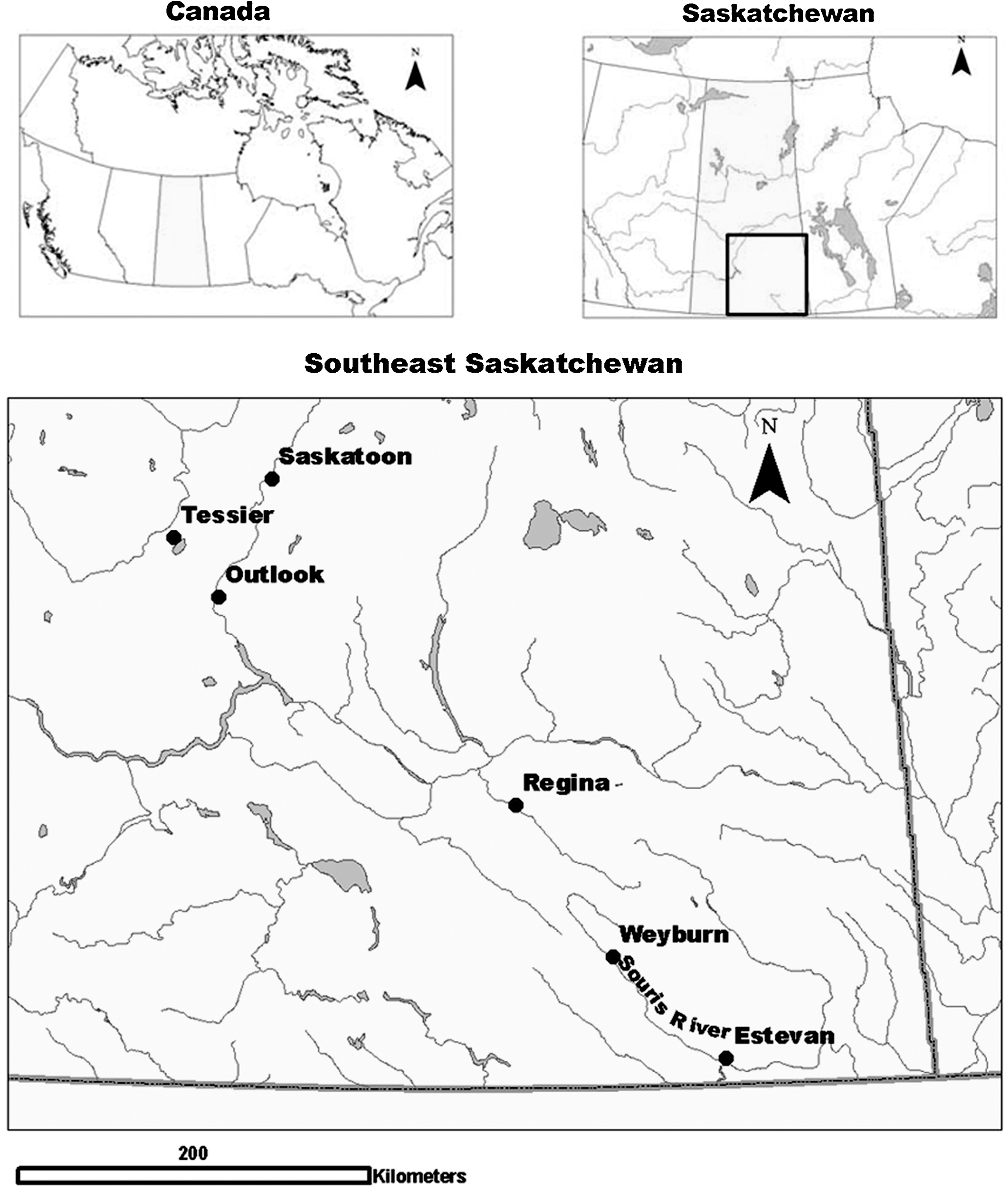
Locations of selected towns and cities in southeast Saskatchewan referred to in this report.
House sparrow nests were located in the supports of grain storage bins, eaves of farm buildings, and in trees. Nests were checked every week and birds were sampled when they were at least 7 days old, based on morphology and study field records. One to seven birds were sampled from each nest, dependent on brood size and estimated bird age. House sparrow nestlings were removed from the nest, euthanized by cervical dislocation, and stored on ice in an insulated cooler and then processed in bio-containment facilities. The maximum length of time of storage from death to laboratory processing was 72 h, on average <48 h. Liver, kidney, heart, and brain were collected and pooled from each bird within a Level 2A Biological Safety Cabinet. Pooled tissues were tested for WNV by a one-step RT-PCR described by Himsworth et al. 2009.
In 2007, one unincubated egg was collected from each house sparrow nest and stored at 4°C. To avoid sampling embryonated eggs, last-laid eggs were selected based on their spotting pattern (Loewther 1988), and egg candling (Weller 1956, Lokemoen and Koford 1996) was used to determine viability and stage of incubation using poultry guides as a reference. House sparrow eggs were processed by separating the yolk and making a 1:6 solution with saline, pH 7.4. Diluted yolk solutions were frozen to −80°C and then shipped on dry ice to the National Microbiology Laboratory in Winnipeg, Manitoba, for WNV plaque reduction neutralization assay. The plaque reduction neutralization assay was performed as previously described (Beaty et al. 1989, Levett et al. 2005). A 90% neutralization endpoint titer of 1:20 or greater was considered significant.
Dead corvids collected by the public and civil employees in the city of Regina, Saskatchewan, were accepted for WNV testing during the summers of 2006 and 2007. Regina has a human population of ∼190,000 and is located ∼100 km northwest of Weyburn (Fig. 1). Corvids were tested by the Canadian Cooperative of Wildlife Health Centre at the Western College of Veterinary Medicine, University of Saskatchewan by VecTest™ (Medical Analysis Systems, Fremont, CA), and positive tests were confirmed with WNV RT-PCR.
Mosquitoes were trapped using CO2-baited miniature light traps (Model 1012-CO2; John W. Hock Company, Gainesville, FL), suspended at a height of 2 m from a tree branch. Five traps were set in Estevan and two traps were set in Weyburn, each trap in a separate location, for two nights a week. In 2006, two traps were set at house sparrow sampling locations in McTaggart for two nights a week, for 5 weeks at location 1 (June 25–July 29) and for 4 weeks at location 2 (June 25–July 22). Traps were collected in the morning, and mosquitoes were placed on dry ice and transported to the TDTS Identification Laboratory in Regina. Mosquitoes were identified and placed into preparation pools of the same species trapped from a single trap on a single night and frozen before testing. Pool sizes ranged from 1 to 50 mosquitoes. Pools of female Culex tarsalis or Culex restuans mosquitoes were homogenized, and the supernatant was extracted and tested for WNV by a real-time TaqMan RT-PCR (Lanciotti et al. 2000) at the Saskatchewan Disease Control Laboratory in Regina.
Results
In 2006, 60 birds a week were collected apart from the third week of sampling when only 52 birds were sampled. The estimated age of nestlings collected ranged from 7 to 12 days. All house sparrow samples tested negative for WNV by WNV RT-PCR (Table 3). Thus, the weekly apparent prevalence of WNV in the nestling house sparrow population in the Souris River Valley during the study period was <5% (95% confidence).
WNV, West Nile virus.
In 2007, from 200 nestlings collected in the entire study area, 4 birds tested positive for WNV, an overall prevalence of 2%. Three of the positive nestlings were collected July 17, and one was collected July 24. All positive nestlings were 12 to 14 days of age. A total of 97 eggs were collected from the study area, 7 of which had a measurable antibody titer, the antibody prevalence was 7.2%.
In 2006, from May 1 to the end of the house sparrow nestling study (August 5), 16 dead American crows (Co. brachyrhynchos) were submitted from the city of Regina, of which one, found on July 4, tested positive for WNV. Of 14 American crows found dead elsewhere in Saskatchewan, one from Tessier, ∼350 km northwest of the study area, tested positive for WNV. Also, one American white pelican (Pelecanus erythrorhynchos) tested positive for WNV. In 2007, during the same period as 2006, 32 dead American crows were submitted from the city of Regina, of which 25 tested positive for WNV, with the first collected on July 2. Elsewhere in Saskatchewan, 36 crows were submitted and 19 were positive for WNV; the first collected on July 4. As well, 17 merlins (Falco columbarius), 7 black-billed magpies (Pica hudsonia), a great horned owl (Bubo virginianus), a northern harrier (Circus cyaneus), and a snowy owl (Bubo scandiacus) were found to have WNV infection during the study period, all from cities within the moist, mixed grassland ecoregion, the same ecoregion as the study site.
In 2006, 300 mosquito pools were tested in the province during the study period and 18 positive mosquito pools were identified; 15 of these positive pools were from Estevan. All positive pools were Cx. tarsalis. No positive pools were identified from Weyburn, McTaggart, or Regina. In 2007, 941 mosquito pools were tested and 207 positive mosquito pools were identified during the study period, 106 from Estevan, 6 from Weyburn, and 3 from Regina.
Discussion
The results of this study indicate that house sparrow nestlings are not useful sentinels of WNV amplification in Saskatchewan. The study years of 2006 and 2007 were years with contrasting WNV activity based on integrated surveillance results (Table 3). In 2006, there was very low WNV activity in the study area and no WNV-infected house sparrow nestlings were detected. In 2007, a year of high WNV activity, house sparrow nestlings did not provide either an early warning or a measure of the intensity of WNV transmission.
In summer 2006, combined surveillance data indicated sharp variations in WNV activity on a local scale in rural Saskatchewan. Estevan is only 85 km southeast of Weyburn, where our study was based; although WNV was not detected in the city of Weyburn or at house sparrow sampling sites, 15 WNV-positive mosquito pools originated in and around Estevan. Broad-scale surveillance may not be sensitive enough to detect these localized foci, which are at high risk for WNV spill over into humans.
In 2007, high WNV activity was detected over a wide area of southern Saskatchewan. Environmental conditions, including high precipitation, high humidity, and high temperatures, were ideal for early and abundant development of the main WNV mosquito vector species in the region, Cx. tarsalis. A record number of 1456 human WNV cases, including 113 neurological cases and 6 deaths, were diagnosed in Saskatchewan (Table 1). High levels of WNV transmission occurred in the study area, with positive mosquito pools trapped from both Weyburn and Estevan, and the proportion of WNV-infected corvid carcasses from the nearby city of Regina was 78% (25/32) compared with just 6% (1/16) in 2006 (Table 3). The low apparent WNV prevalence among house sparrow nestlings of 2% during an epidemic year is strong evidence that this species is not a useful indicator of either the onset or the intensity of WNV activity in the study region.
Low detection of WNV in these house sparrows is unlikely to be due to methodological error. Degradation of WNV RNA should have been minimal, and considering the tissue viral loads of experimentally inoculated house sparrows (Komar et al. 2003) and the sensitivity of the RT-PCR (Lanciotti et al. 2000), recently infected house sparrows should have been readily detected.
The reasons for why the results of the pilot study differed from the results of the study in subsequent years are not known. The pilot study was carried out ∼300 km northwest of the study area used in 2006 and 2007, in the same general ecoregion of moist, mixed grasslands dominated by agriculture. The studies sampled birds of similar age, and thus exposure period. House sparrow nestlings were sampled from a minimum age of 7 days, up until just before fledging at around 14 days. The four infected house sparrow nestlings in 2007 were all relatively mature nestlings, aged 12–14 days. Older nestlings may be at greater risk of infection due to increased time for exposure in the nest, increased attractiveness to mosquitoes due to increased body size (Scott et al. 1990), or changes in behavior such as early test flights. However, it is difficult to judge the significance of nestling age from such a small number of infected birds. Nest-site locations were comparable in all 3 years, and included supports of grain bins and sheds in farmyards and spruce trees planted as wind breaks on farm properties. There is little information on host feeding patterns and how landscape affects the distribution of Cx. tarsalis in the Canadian prairie. Studies in California suggest that Cx. tarsalis feeds preferentially in elevated vegetation such as orchards (Lothrop and Reisen 2002), and birds tested from these areas had had greater arbovirus seroprevalence rates than birds associated with other habitats (Reisen et al. 2000). All of the nest sites we sampled were elevated above 1.5 m; however, grain bins were often situated in gravel yards with no immediate surrounding vegetation.
In 2007, we measured anti-WNV antibody titers in eggs as a surrogate for adult female house sparrow exposure to WNV and to quantify the effect of maternally derived immunity on WNV transmission. Humoral immunity in the house sparrow has been found to be long-lasting and protective, covering multiple transmission seasons (Nemeth et al. 2009). Also, a high proportion of seropositive female house sparrows have been shown to produce seropositive eggs by Plaque reduction neutralization test (PRNT) (Nemeth et al. 2008). A low percentage of eggs in the current study contained antibodies to WNV, likely ruling out passive maternal antibody transfer as a cause of low WNV transmission to house sparrow nestlings in 2007. Considering the short lifespan of adult birds and the restricted breeding season from late May to August, the low apparent seroprevalence in adult female house sparrows in 2007 most likely represents negligible local WNV transmission in 2006.
Nestling house sparrows have been found to be important amplifiers of other mosquito-transmitted arboviruses (Hayes et al. 1967, Holden et al. 1973); however, in the prairie grasslands, they do not appear to be contributing significantly to WNV amplification. Similarly, nestling passerine birds were not found to be significant in WNV amplification in the Chicago area (Loss et al. 2009). The avian species most important in WNV amplification in the prairie grassland ecosystem are not known. Future studies should investigate this by carrying out seroprevalence studies in locally abundant, resident avian species, genetic analysis of blood meals taken by Cx. tarsalis, adult resting and biting habitat preferences of Cx. tarsalis, and laboratory reservoir competence data. These studies may reveal alternate species that would be useful sentinels in this region.
Footnotes
Acknowledgments
Funding was provided by Saskatchewan Health, Public Health Agency of Canada, Western College of Veterinary Medicine Interprovincial Summer Student Scholarship Program, and the Canadian Cooperative of Wildlife Health Centre. Thanks to Noemie Jenni and Celeste Levesque of Saskatchewan Ministry of Health for coordinating the mosquito surveillance. Anju Tumber of Prairie Diagnostic Services, and Toni Hansen, Tara Maksymiw, and Ryan McDonald of Saskatchewan Disease Control Laboratory in Regina carried out PCR testing of samples. Patrick Zimmer coordinated the house sparrow fieldwork and Marnie Zimmer assisted with creating the maps in this article. Wade Morrow and Russell Eirich of the City of Regina coordinated the dead corvid pick-up program in that city.
Disclosure Statement
No competing financial interests exist.