




Abstract
Since 1997, highly pathogenic avian influenza subtype H5N1 has emerged to cause severe disease in humans in over 15 countries. Humans who have regular contact with poultry or wild birds may be at greater risk of infection with highly pathogenic avian influenza and other zoonotic avian diseases. To develop preventative measures for transmission of avian influenza to high-risk human populations in the United States, we examined human–bird interactions in the upland gamebird industry. Upland gamebird permit holders were surveyed for information on human–bird contact, biosecurity practices, facility management practices, flock/release environment, and bird health. Results suggest that some upland gamebird facilities provide an environment for extensive and intimate human–bird interaction such that humans associated with these facilities may be at greater risk for zoonotic disease transmission.
Introduction
One human population that may be at high risk for infection by zoonotic avian pathogens, including avian influenza viruses, is people involved in the upland gamebird industry in the United States. Upland gamebirds are gallinaceous birds that are hunted for sport or meat for consumption, and encompass birds such as pheasants, partridge, and quail. Land-based gallinaceous birds, particularly quail, may be able to act as intermediate hosts for avian influenza viruses and may play a role in the adaptation of influenza A viruses to humans (Makarova et al. 2003, Perez et al. 2003, Humberd et al. 2006, Wan and Perez 2006, Sorrell and Perez 2007, Xu et al. 2007). In the United States, upland gamebirds birds are often raised in large numbers in a commercial setting and then released onto shooting preserves for commercial hunting purposes. Humans who have contact with these birds may have an occupational or recreational risk of exposure to birds infected with avian influenza viruses.
The interspecies transmission of infectious agents depends upon both pathogen and host characteristics, as well as the types and intensity of contacts between the donor and recipient species. Although the emergence of HPAI H5N1 has spurred intense research in the fields of virus and host characterization, few studies in the United States have described interactions between humans and birds. Occupational studies in the United States have suggested the need for such characterization as they have provided evidence for the transmission of zoonotic pathogens such as Chlamydophia psittaci and Campylobacter jejuni from poultry to poultry workers (Hedberg et al. 1989, Price et al. 2007, Gregory et al. 2008) and zoonotic transmission of avian influenza A viruses to wildlife professionals, waterfowl hunters, and veterinarians (Gill et al. 2006, Myers et al. 2007, Gregory et al. 2008).
To examine the potential for an avian zoonotic disease event in the United States, it is important to understand the interactions between humans and birds and to identify human populations that may be at high risk for disease transmission. The purpose of this study was to describe human–bird interactions, biosecurity practices, and bird health parameters in the upland gamebird industry. A secondary objective was to identify populations within this industry that may be at greater risk for human infection with zoonotic avian disease agents by comparing frequencies of high-risk activities among different types of upland gamebird facilities.
Materials and Methods
The definition of an upland gamebird used in this study included galliformes, such as pheasant, partridge, quail, grouse, guinea fowl, and wild-type turkey, and was extended to anseriformes, such as wild-type ducks, geese, and swans.
State wildlife agency records were used to construct a database of persons who held a permit to keep, breed, or release upland gamebirds or wild-type waterfowl in the United States. Membership directories from the 2007–2008 National Poultry Improvement Plan, 2007 North American Gamebird Association, and 2002–2003 Texas Gamebird Association were used to supplement records from 19 states that could not provide complete records, including Alaska, Alabama, California, Hawaii, Iowa, Idaho, Illinois, Louisiana, Maryland, Mississippi, New Jersey, New York, Oklahoma, Rhode Island, South Dakota, Tennessee, Texas, Vermont, and West Virginia. Location data were mapped for all persons included in the database for which accurate spatial data were available.
Of 10,081 persons identified for inclusion in the database, 500 were randomly selected for participation in a telephone survey that was administered by a single researcher from June through September 2008. Selected subjects were sent recruitment material through the mail and then contacted via telephone to determine participation status. Up to five attempts were made to contact selected subjects before a subject was considered a nonparticipant. Interviews were administered at the time of primary contact or were scheduled for a later date at the convenience of the subject. In addition, permit holders who had not kept or released upland gamebirds in the past 12 months were not eligible for participation. All procedures involving the use of human subjects were approved by the Institutional Review Board of Colorado State University, and all participants gave informed consent.
Surveys were piloted with upland gamebird producers before being administered to study participants. The survey consisted of 61 questions and addressed topics such as human contact with upland gamebirds, biosecurity practices, facility management practices, flock/release environment, and bird health. Close-ended questions included yes/no or Likert-scale frequency (always/usually/sometimes/rarely/never) responses, whereas open-ended questions included quantitative variables, such as the number of birds kept or released.
On the basis of self-reported purposes for holding an upland gamebird permit, subjects were poststratified among three different facility types: release, commercial, and hobby. Release facilities consisted of permit holders who released birds from captivity onto public or private land in the past 12 months for any purpose, including hunting or repopulation. Permit holders who operated a commercial facility sold birds to release facilities, for meat consumption, or in a retail setting. Hobby facilities neither released birds nor sold them for reasons listed under commercial facility criteria.
All data were statistically analyzed using SPSS 16.0. Differences among facility types for categorical variables were identified using the Pearson's chi-squared test of association. The Kruskal–Wallis test and the Mann–Whitney tests were used to identify differences between facility types for continuous and ordinal variables. Probability values (p) ≤0.05 were considered significant.
Results
Of the states from which complete lists of permit holders were available, Ohio (11%), Wisconsin (9%), and Pennsylvania (8.5%), respectively, represented states with the most permit holders (Fig. 1). Of 500 randomly selected upland gamebird permit holders (UGPHs), data were mapped for 217 respondents and analyzed from 218 respondents (44% response rate) from 36 states (Fig. 1). Respondents included 48 commercial facilities (22%), 118 release facilities (54%), and 52 hobby facilities (24%). Of those facilities that released birds, 47% released birds as they were obtained and did not keep birds confined on their property before release. Among sampled permit holders, 27% reported breeding birds, and 50% reported growing birds. Membership in the North American Gamebird Association was reported by 16% of respondents, and the median number of years that permit holders had been involved in the upland gamebird industry was 10 (interquartile range [IQR] 5–20).

Distribution of upland gamebird permit holders (n = 9588) and survey respondents (n = 217) in the United States for whom location data were available.
Respondents were relatively evenly divided between commercial, release, and hobby facility types (Table 1). The median number of birds kept in the past 12 months was 600 (IQR 113-2500), and the median number of different species kept was 3 (IQR 1-4). The median number of people with regular bird contact was 2 (IQR 2-4). Commercial facilities were more likely to keep a greater number of birds than other types of facilities (p < 0.001), whereas release and commercial facilities were more likely to have a greater number of different people with regular bird contact (p = 0.004). Pheasants were the most common species kept (Fig. 2), but quail was the most abundant species kept with a median number of 800 (IQR 115-3000).
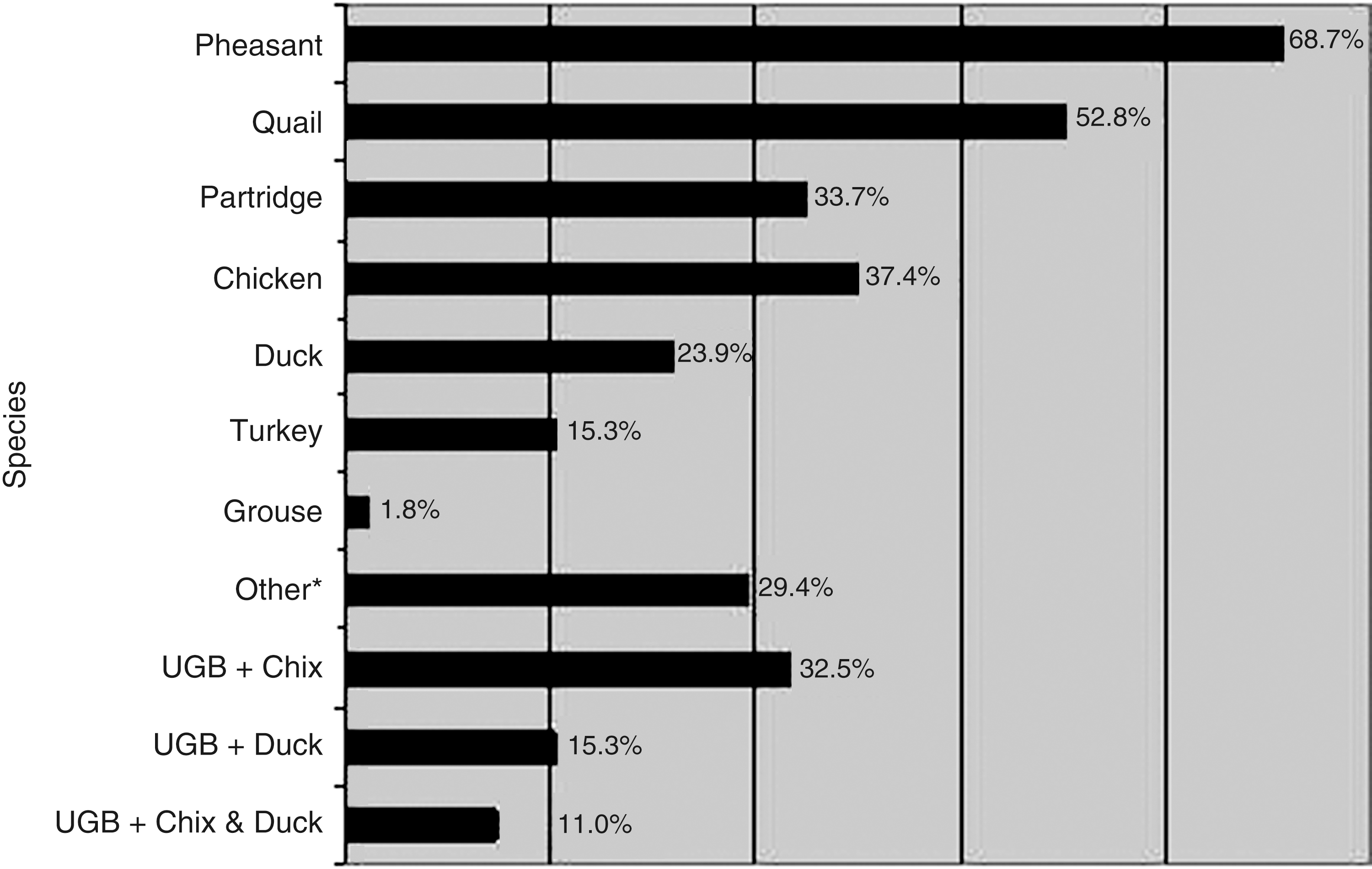
Proportion of upland gamebird permit holders who kept each type of bird on their premise in the past 12 months (n = 163). UGB: pheasant, partridge, or quail; Chix: chickens; *peafowl, guineafowl, goose, emu, pet exotic, swan, falcon, or pigeon.
Value from Kruskal–Wallis test.
Restricted to those who kept birds on their premise.
Significant differences were found between commercial and release facilities (p = 0.008), commercial and hobby facilities (p < 0.001), and release and hobby facilities (p < 0.001).
Significant differences were found between commercial and release facilities (p = 0.011) and release and hobby facilities (p < 0.001).
Significant differences were found between commercial and hobby facilities (p = 0.001) and release and hobby facilities (p = 0.017).
Significant differences were found between commercial and release facilities (p = 0.005).
Significant differences were found between commercial and hobby facilities (p = 0.007) and release and hobby facilities (p < 0.001).
Biosecurity measures varied greatly among UGPHs but did not vary greatly between facility types (Table 2). With the exception of hand washing after bird contact, most respondents employed few personal precautions to limit their contact with birds/bird excrements. Most permit holders housed birds outdoors (90%), and hobby facilities were more likely to keep their birds unconfined (p = 0.001). Many permit holders regularly observed wild mammals (45%) and wild birds (76%) in or near their flock area and this included wild waterfowl (19%). Almost 40% also kept livestock, including pigs (2% of permit holders) on the premises where their flock was kept. The majority of permit holders kept more than one type of bird (75%) and kept birds of multiple ages (66%) on their premises. Hobby facilities were more likely to keep multiple species, including ducks and chickens, in addition to traditional upland gamebirds (pheasant, partridge, or quail) (p = 0.004) and co-mingle different species in the same pen (p < 0.001), whereas commercial facilities were more likely to keep birds of different ages on their premises (p < 0.001). Release facilities were less likely to employ proper onsite disposal of dead birds (p = 0.035), whereas 15% of permit holders disposed of birds off site (taken to landfill or put out with trash).
Analysis confined to permit holders who kept birds on their property.
Affirmative responses pooled (Always and Usually), p from the Kruskal–Wallis test.
Significant differences found between commercial and release facilities (p = 0.02) and between commercial and hobby facilities (p = 0.044).
Compost, bury, burn, or pit disposal.
Fed to other animals, manure pile, woods, other disposal.
Taken to landfill or putout with trash.
Eighteen percent of permit holders who kept birds on their premises experienced a disease-related morbidity or mortality event in the 12 months before their interview, and 55% reported administering medication to their flocks (Table 3). Among those who experienced a morbidity or mortality event, depression was the most frequently observed clinical sign of disease (35%) followed by evidence of internal parasites (24%) and respiratory illness (21%); however, 28% percent reported that they did not observe any clinical signs before a mortality event. Quail was the most frequently affected species (45%). In addition, few permit holders regularly contacted a veterinarian when ill birds were observed (15%) or participated in any type of disease surveillance program (15%).
Analysis confined to permit holders who kept birds on their property.
Significant differences found between both release and hobby (p = 0.011) and release and commercial facilities (p > 0.001).
Significant differences found between commercial and release facilities (p = 0.002).
Affirmative responses pooled (Always and Usually), p from the Kruskal–Wallis test, significant difference found between commercial and release facilities (p < 0.001).
Release facilities appeared to offer more opportunities for human–bird interactions (Table 4). The median number of hunters per season among shooting preserves was 84 (IQR 14-300), and 23% of release facilities reported giving or selling live birds from their facility to persons for purposes other than hunting, such as releasing for repopulation or meat for consumption. More quail were released than any other type of bird (median 450, IQR 98-2000), followed by pheasant (median 350, IQR 100-1200) and partridge (median 225, IQR 58-800).
Other facilities were swine.
Other includes small game (mammals) hunting, hog hunting, field trials, and falconry.
IQR, interquartile range.
Release facilities provide increased opportunity for both human and pen reared upland gamebird interaction with wild birds. Twenty-eight percent of facilities offered wild bird hunting, which included wild turkey and wild duck hunts, and 14% offered pigeon hunting. Most upland gamebird release facilities reported a body of water within a mile of their release land (97%) and regularly observed wild waterfowl on this water (87%). The most common types of wild birds observed on release land were raptors (95%) followed by ducks (92%) and geese (86%) (Fig. 3). Not all birds that were released onto shooting preserves were actually harvested. Permit holders reported a median of 65% of released quail and pheasant harvested, whereas the median percent reported for partridge was slightly greater at 70%. In addition, 44% reported putting feeders or waterers on their release land for released birds, and 34% reported returning birds to their pens that were released but not shot.
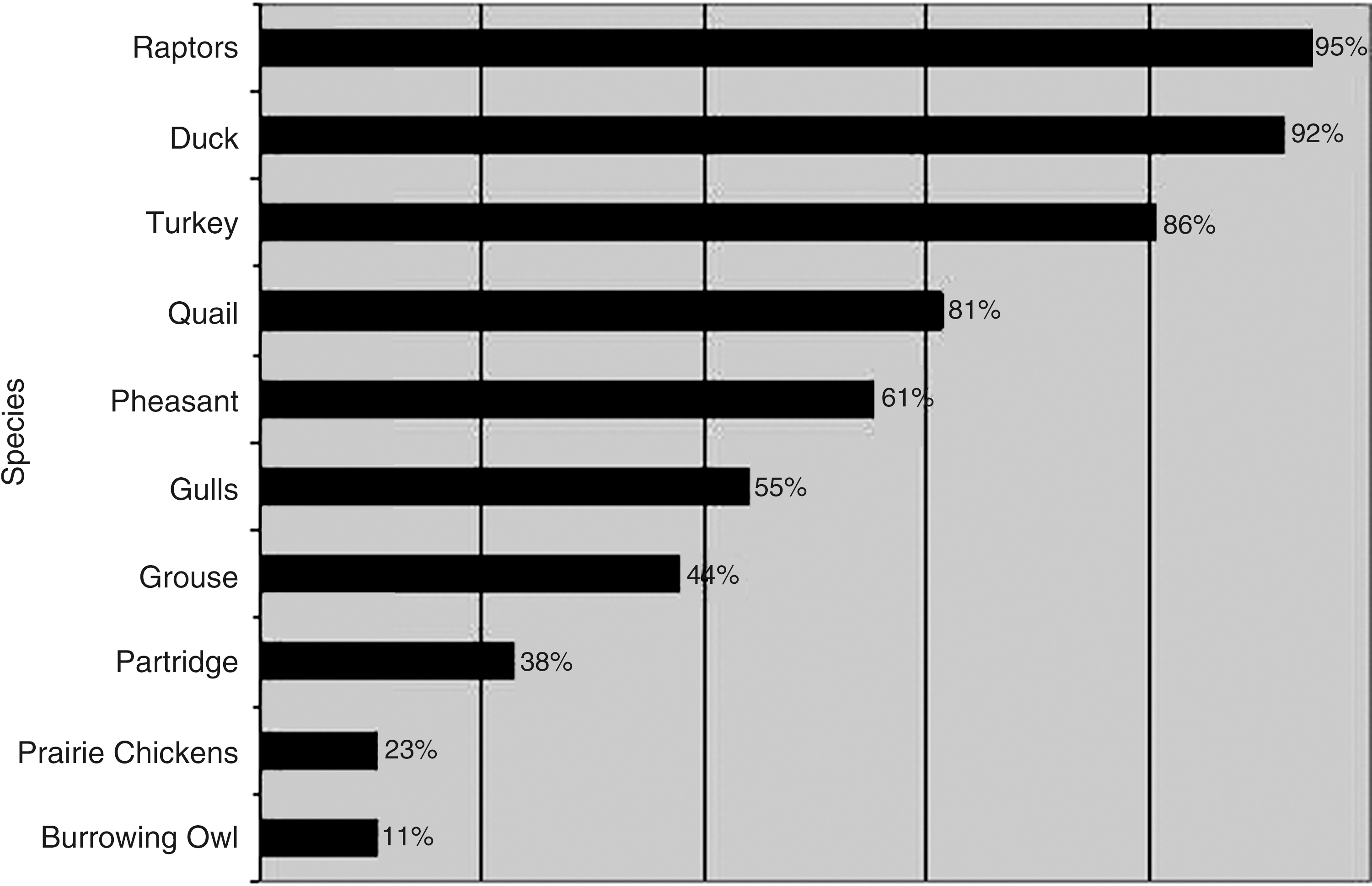
Proportion of upland gamebird release facilities that observed wild birds within 1 mile of their release land (n = 114).
Many upland gamebird shooting areas also offer other hunting opportunities to their clients on their release land. These opportunities may include game such as deer, elk, wild pig, raccoon, and fox.
Discussion
To our knowledge, interactions between humans and birds within the upland gamebird industry in the United States have not been previously characterized. In addition, although other studies have characterized biosecurity practices and bird health parameters for other high risk populations, such as backyard and exhibition poultry flocks, this study represents the first attempt to obtain these parameters for the upland gamebird industry in the United States.
Results of the current study suggest that release facilities provide an environment for extensive human–bird interaction. In addition to regular occupational exposure to birds from different sources, these facilities also serve as a source of recreational exposure for hunters. Many facilities offer hunting opportunities for both pen-reared and wild-type birds, including wild waterfowl. Contact with bird fluids is common as birds are often field dressed onsite and prepared for consumption. In a recent study of agricultural workers in Iowa, Gregory and colleagues reported an association between hunting wild waterfowl and serological evidence of exposure to avian influenza viruses (Gregory et al. 2008). Wild waterfowl are the reservoir host for many subtypes of avian influenza viruses and are believed to play a role in the introduction of the virus in domestic poultry (Webster et al. 1992, Saif 2003). Practices commonly employed by upland gamebird release facilities, such as placing feeders and waterers on release land for released birds, planting feed plots, and using call back pens, encourage interactions between wild birds and pen-reared birds, which in turn may increase the risk of disease in both types of hunted populations.
In addition, the current study identified other potential routes for zoonotic infection with avian pathogens in humans associated with upland gamebird release facilities. Recent studies have shown that both wild and domestic mammals can become infected with avian influenza viruses (Kuiken et al. 2004, Giese et al. 2008, Hall et al. 2008, Reperant et al. 2008). Carnivorous species such as cats, dogs, and fox are believed to become infected with the virus through consumption of infected meat (Kuiken et al. 2004, Giese et al. 2008, Reperant et al. 2008), whereas researchers have postulated that infection in other mammals, such as raccoons, may occur through environmental exposures (Hall et al. 2008). Anecdotally, many permit holders reported mortality events due to predation and believe that some released birds that are not harvested may fall prey to wild carnivores. Domestic dogs are commonly used at release facilities for retrieval of both pen-reared and wild bird hunting, and many facilities offer hunting opportunities for large and small mammals, including pigs, raccoon, and fox. Although transmission of avian influenza from domestic or wild mammals to humans has not been documented, release facilities may provide an ideal environment for intimate interaction between humans and other mammals that may be at risk for infection with avian diseases. We did not collect information about personal precautions taken by clients of upland gamebird release facilities that would serve to limit contact with bird and/or animal fluids while field dressing, but it may be an important factor when assessing direct and indirect human–bird interactions within this population.
Transmission of avian influenza viruses to humans can occur by both direct and indirect contact with birds or bird secretions, and persons with regular contact with birds such as poultry workers, veterinarians, and wildlife professionals may be at greater risk for infection than populations that do not have regular contact with birds. Epidemiological studies have identified factors associated with contraction of the virus such as contact with sick or dead poultry, preparation of sick or dead poultry for consumption, consuming raw or undercooked poultry, and defeathering of wild birds (Buxton et al. 2000, Puzelli et al. 2005, Areechokchai et al. 2006, Dinh et al. 2006, Meijer et al. 2006, Sedyaningsih et al. 2007, WHO 2006, Gregory et al. 2008, Lu et al. 2008). Data from the current study suggest that relatively few persons who have regular contact with birds at upland gamebird facilities employ personal protection measures to limit direct contact between themselves and birds or bird excrement. These findings may indicate that humans with regular contact with birds from these facilities may be at an increased risk for avian zoonotic disease infection, including avian influenza viruses.
This direct contact between humans and birds at upland gamebird facilities may also be of particular concern when considering the potential of an AIV to cross the species barrier and infect humans. Recent studies have shown that quail, a type of bird commonly reared at upland gamebird facilities, carry both α-2,6-galactose and α-2,3-galactose sialic acid receptors in their trachea and intestines. A host with both receptor types may support co-infection with both avian and mammalian viruses (Wan and Perez 2006); therefore, quail may have the ability to act as a mixing vessel for the generation of human-adapted avian influenza viruses, and humans who have regular, direct contact with these bird types may be at greater risk of infection with avian influenza viruses.
In addition, the current study identified characteristics of upland gamebird facilities that may increase the risk of such a viral reassortment event occurring within this industry. Previous studies have shown that upland gamebirds are susceptible to many different subtypes of avian influenza viruses (Makarova et al. 2003, Humberd et al. 2006) and both quail and pheasants have been shown to asymptomatically shed virus for prolonged periods (Tashiro et al. 1987, Webster et al. 2002, Humberd et al. 2006). Studies from Asia have suggested that the undetected circulation of low pathogenic avian influenza viruses among multiple species of birds may allow for the generation of novel strains of reassortant viruses capable of crossing the species barrier (Guan et al. 2002, Li et al. 2003, Xu et al. 2007). The current study found that many permit holders kept multiple species of birds and did not practice all in/all out management techniques. In addition, despite the efforts of federal and state disease awareness programs, very few UGPHs participated in any type of disease surveillance program or contacted a veterinarian when sick birds were observed. Combined, these practices may create an ideal environment for a novel reassortment event, and humans who have regular contact with upland gamebirds may provide an entry point for avian influenza viruses to enter the human population.
The results of the current study are in concordance with these previous studies of bird health practices (McBride et al. 1991, Garber et al. 2007), in which few participants reported the use of veterinary services. Anecdotally, many respondents in the current study expressed frustrations with what they felt was limited access to knowledgeable poultry veterinarians in their area, and this in turn may be reflected in these results.
Response bias and nonresponder bias may have been contributing sources of error in our results. The response rate may have reflected recent opposition to government regulations on noncommercial livestock, and consequently, it may be speculated that respondents over-reported and under-reported the use of biosecurity practices and adverse bird health events, respectively. In addition, due to variations in state confidentiality laws, we were unable to obtain complete lists of UGPHs from all 50 states; thus, as upland gamebird permitting is regulated at a state level, our results can only be extended to permit holders that reside in states from which complete permit information was obtainable. Finally, our power to detect differences among facility types was potentially limited by the relatively small sample size; however, our results still capture the variability of human–bird interactions, biosecurity practices, and bird health within the upland gamebird industry.
The current study was able to describe human interactions with upland gamebirds and was able to identify potential routes of human infection with avian influenza viruses in a high risk population. Study results suggest that education efforts for zoonotic disease awareness should target humans with occupational and recreational exposure to upland gamebirds associated with release facilities. These efforts should stress the use of effective personal protective measures to minimize human exposure to potential pathogens when contacting birds and encourage upland gamebird release facility managers to obtain birds from disease monitored flocks. In addition, this study identified opportunities posed by upland gamebird facilities for interactions between humans, pen-reared birds, and wildlife. Future research investigating disease transmission at this interface is warranted.
Footnotes
Acknowledgments
This work was supported by cooperative agreement 5 U19 CI000419-02 from the Centers for Disease Control and Prevention. We thank staff members of both the Colorado State University Veterinary Diagnostic Laboratory and the Colorado Avian Disease Surveillance Program for their support.
Disclosure Statement
No competing financial interests exist.