




Abstract
Introduction:
Tick-borne diseases such as Lyme disease, Rocky Mountain spotted fever, and ehrlichiosis are a significant concern for many thousands of workers who have frequent and unavoidable exposure to tick-infested habitats. Many North Carolina state employees with outdoor occupations report multiple tick bites each year, indicating that existing tick preventive strategies may be underutilized or ineffective. Treatment of clothing with permethrin, a nontoxic chemical with insecticidal, knockdown, and repellent properties, is highly effective against ticks. However, most permethrin products must be reapplied after several washings to maintain insecticidal activity. Recently, a factory-based method for long-lasting permethrin impregnation of clothing has been developed by Insect Shield, Inc., that allows clothing to retain insecticidal activity for over 70 washes.
Methods:
A nonrandomized open label pilot study was conducted to determine the effectiveness of Insect Shield–treated clothing for the prevention of tick bites among 16 outdoor workers from the North Carolina Division of Water Quality under actual field conditions. Participants completed questionnaires at the start of follow-up (March, 2008) and at the end of follow-up (September, 2008), and tick bites and outdoor work hours were reported on weekly tick bite logs for the entire follow-up period.
Results:
Subjects wearing Insect Shield–treated clothing had a 93% reduction (p < 0.0001) in the total incidence of tick bites compared to subjects using standard tick bite prevention measures.
Conclusion:
This study provides preliminary evidence that long-lasting permethrin-impregnated clothing may be highly effective against tick bites.
Introduction
There is a large body of literature that documents the increased risk of acquiring tick-borne diseases among outdoor workers, primarily among forestry workers, farmers, and park rangers (Munchhoff et al. 1987, Smith et al. 1988, Baird et al. 1989, Guy et al. 1989, Nadal et al. 1989, Goldstein et al. 1990, Schwartz and Goldstein 1990, Fahrer et al. 1991, 1998, Kuiper et al. 1991, 1993, Gustafson et al. 1993, Schwartz et al. 1993, 1994, Nakama et al. 1994, Yevich et al. 1995, Rath et al. 1996, Fingerle et al. 1997, Zhioua et al. 1997, Cisak et al. 1998, 1999, 2005, Pancewicz et al. 1998, Zhioua et al. 1998, Cisak et al. 2001, Covert and Langley 2002, Piacentino and Schwartz 2002, Niscigorska et al. 2003, Santino et al. 2004, Zwolinski et al. 2004, Tomao et al. 2005, Adamek et al. 2006, Cinco et al. 2006, Dybowska et al. 2007, Kaya et al. 2008). The methods of tick bite prevention recommended by the National Institute for Occupational Safety and Health (NIOSH 2008) for outdoor workers include the following: wearing light-colored protective clothing, tucking pants into socks or boots, regular application of insect repellant to exposed skin, spraying work clothing with permethrin, and daily tick checks. Consistent use of these tick bite prevention methods has been proven effective in preventing tick-borne disease (Vazquez et al. 2008), but studies have shown poor adherence to these recommendations (Smith et al. 1988, Goldstein et al. 1990). The need for reapplication of insect repellents combined with concerns about the toxicity of the chemicals in the repellents is likely to account for much of the underuse of these preventive measures, indicating that safer and more user-friendly tick-bite prevention strategies are needed.
Permethrin is a synthetic chemical that is approved by the U.S. Environmental Protection Agency (USEPA) for use as a contact repellent/insecticide for agricultural, residential, and for personal use on clothing. Permethrin is labeled to repel, knockdown, and kill many arthropod vectors, including, but not limited to, ticks, mosquitoes, sand flies, fleas, and chiggers (Young and Evans 1998). Extensive studies on the toxicity of permethrin have shown that permethrin is safe for humans at exposure levels consistent with proper use of permethrin products (Young and Evans 1998). Current products available for consumer self-application of permethrin may require repeated reapplication after laundering and are burdensome for the user.
Recently, a factory-based method for long-lasting permethrin impregnation of clothing has been developed by Insect Shield, a company based in Greensboro, NC. This process combines factory-based coating technology with a proprietary formulation of permethrin that allows clothing to retain effective repellent activity for over 70 washes (typically longer than the effective lifetime of a garment). Clothing treated by Insect Shield has undergone extensive safety testing and has been registered by the USEPA for use among people of all ages, with no exclusion for pregnant women and children (Insect Shield, USEPA 2009). Insect Shield–treated clothing is sold by well-known outdoor marketers such as LL Bean and Orvis, and is a key component of the Department of Defense Insect Repellent System (U.S. Army Public Health Command [Provisional] 2010). Binders used in the factory treatment minimize contamination of waste water during laundering and dermal absorption of permethrin as compared to clothing treated using self-application methods (Faulde and Uedelhoven 2006, Faulde et al. 2006, Insect Shield 2009). The use of permethrin-impregnated uniforms for high-risk outdoor workers could be a simple, safe, and cost-effective method to reduce tick bites and exposure to tick-borne pathogens. A pilot study was conducted to determine the effectiveness of Insect Shield–treated clothing for the prevention of tick bites among North Carolina outdoor workers under field conditions.
Methods
An open-label, nonrandomized intervention pilot study was conducted to determine whether wearing long-lasting permethrin-impregnated clothing is associated with fewer tick bites among outdoor workers. Employees from the Wetlands and Permitting Unit of the North Carolina Division of Water Quality (NCDWQ) were selected as the study population for the pilot study based on a high number of reported work-related tick bites in previous years. Employees in these units conduct field visits to proposed wetland and stream impact sites and to proposed and constructed wetland and stream mitigation sites. The majority of these sites are forested areas.
Subject recruitment
All employees of the Wetlands Program Development and Permitting Units from the NCDWQ were invited to participate in the study. Initial contact was made by e-mail and an informational meeting was held to describe the permethrin treatment, study design, and participation requirements. A roster of all employees within the Wetlands Program Development and Permitting Units who spent at least part of their work duties in the field was provided by the unit director and was used to contact employees for study recruitment. Of the 20 employees, 19 were successfully contacted by telephone, and 17 expressed interest in participation. Sixteen subjects completed informed consent and were enrolled in the study.
Clothing treatment
Treatment status was self-selected: all subjects chose whether to have their clothing treated with permethrin or to serve as controls. Clothing treatment was completed in two rounds over a 2-week period in March 2009. Subjects who chose to be in the treatment group were asked to submit all items of clothing normally worn while performing field work, including shirts, pants, socks, hats, and boots. All items were treated at the Insect Shield facility in Greensboro, NC, according to the Insect Shield proprietary process for permethrin impregnation, and were marked with a tag indicating that they had been treated. All subjects were instructed to launder their clothing as they normally would and to continue with their normal tick bite prevention measures, regardless of their treatment status.
Data collection
After completion of informed consent, participants completed a baseline questionnaire. In addition to general demographic and occupational information, subjects were asked to report occupational and nonoccupational tick exposure, tick bite history, usage of tick bite prevention practices, lifetime history of tick-borne disease, and participation in outdoor recreational activities.
All subjects were asked to maintain weekly tick bite logs for the duration of the study period. A tick bite was defined as a tick found attached to or embedded in the skin. For each entry in the log, subjects recorded the date of the tick bite, the number of tick bite, the location of the tick bite on the body, the county where the tick bite were most likely to have been acquired, whether they had been using insect repellent at the time of the bite, the type of repellent used (any type of self-applied repellent or permethrin treated clothing), and whether the bite were acquired while on the job. For weeks in which the subject did not have any tick bites, they were asked to confirm this by checking a box marked, “No tick bites this week.” Subjects also recorded the number of work hours and nonwork hours spent outdoors each week on thier weekly tick bite logs.
At the end of the follow-up period, subjects completed a second questionnaire. Questions pertained to tick exposure, tick bites, and tick bite prevention practices during the study period. Subjects in the treatment group were also asked about frequency of usage of the treated clothing and adverse reactions.
Statistical methods
Baseline characteristics of the treatment and control groups were compared using the Pearson chi-square test for dichotomous variables, Mantel-Haenszel chi-square test for ordinal variables, and Student's t-test for continuous variables. p-Values < 0.05 were considered statistically significant. Crude incidence rates and incidence rate ratios were computed using negative binomial regression. The incidence of total tick bites was calculated as the total number of reported tick bites per 100 outdoor hours (including work-related and nonwork-related outdoor hours). The incidence of work-related tick bites and nonwork-related tick bites was calculated as the reported number of work-related or nonwork-related tick bites per 100 work-related or nonwork-related outdoor hours, respectively. All analyses were performed using SAS (version 9.2; SAS Institute Inc., Cary, NC).
Results
Demographics and history of tick bites and tick-borne illness
Sixteen subjects were enrolled in the study: nine subjects in the treatment group and seven subjects in the control group. All subjects completed the baseline and follow-up questionnaires, and 418 (96.8%) weekly tick logs were received during the 27-week follow-up period. Subjects in the control group were slightly younger than subjects in the treatment group, and also had worked fewer years in their current job the NCDWQ (Table 1). Overall, 9 of 16 (56.2%) subjects were men, with a higher proportion of men in the treatment group (66.7%) than in the control group (42.9%). When asked about the number of tick bites acquired in the previous year (2008), the mean number of tick bites reported was not significantly different for subjects in the control group (4.3) and the treatment group (3.9), p = 0.84. When asked about lifetime history of tick-borne illnesses or symptoms after a tick bite, five subjects (31.2%) reported having had a rash after a tick bite and two subjects (12.5%) reported having had a fever after a tick bite. Two subjects (one in each group) reported having been diagnosed with Lyme disease, and one subject (in the treatment group) reported having been diagnosed with babesiosis.
Usage of tick bite prevention measures
The frequency of usage of the tick bite prevention measures recommended by NIOSH was assessed by questionnaire at the end of the follow-up period. All subjects in both groups reported “always” or “usually” wearing long pants while working outdoors, whereas long sleeves were worn infrequently by subjects in both groups (Fig. 1). Wearing a hat, tucking pants into boots or socks, or taping pants to boots while working outdoors were methods employed regularly by most subjects, although subjects in the treatment group had slightly higher usage. Subjects reporting “always” or “usually” wearing insect repellent on skin and clothing ranged from 63% to 86%, with slightly higher usage among subjects in the control group. Subjects in the control group were more vigilant about checking for ticks during and after working outdoors than subjects in the treatment group, although there were no significant differences in usage of any of the tick bite prevention measures between groups.
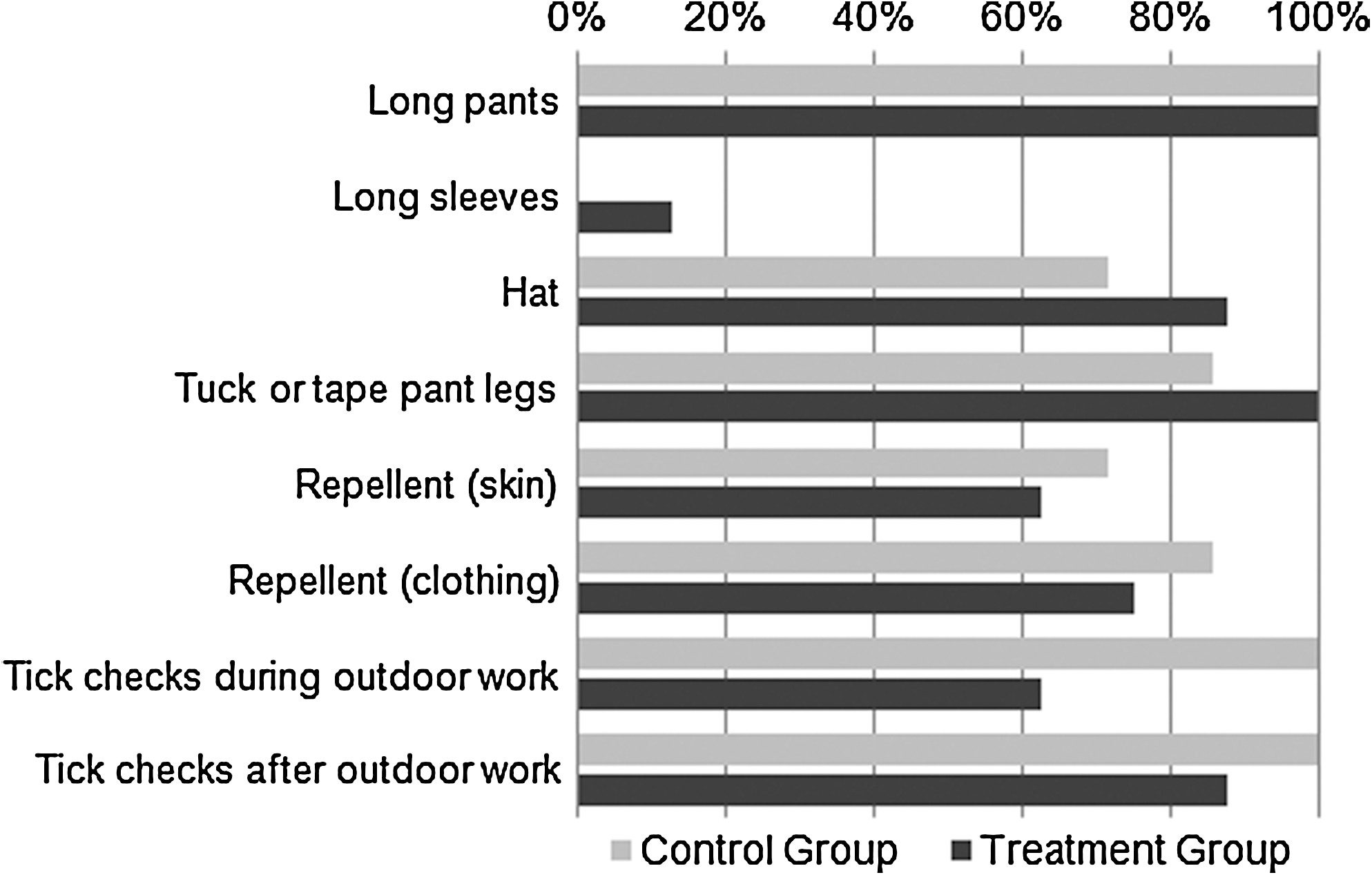
Percent of subjects who reported “always” or “usually” using recommended tick bite prevention measures during follow-up, by treatment group.
Reported tick bites
During the follow-up period there were 68 tick bites reported by the subjects in the control group (mean = 9.7 bites per subject), and 6 tick bites reported by the subjects in the treatment group (mean = 0.7 bites per subject). Fifty-seven (83.8%) of the bites were reported to be work related among the control group subjects, whereas only one tick bite (16.7%) was reported to be work related among the treatment group subjects (Fig. 2). Among all tick bites reported by subjects in the control group, 62 (91.2%) were acquired while the subject was wearing self-applied repellent. Of the six tick bites in the treatment group, one was acquired while wearing Insect Shield–treated clothing, whereas the other five occurred while wearing either self-applied repellent only, or no repellent.
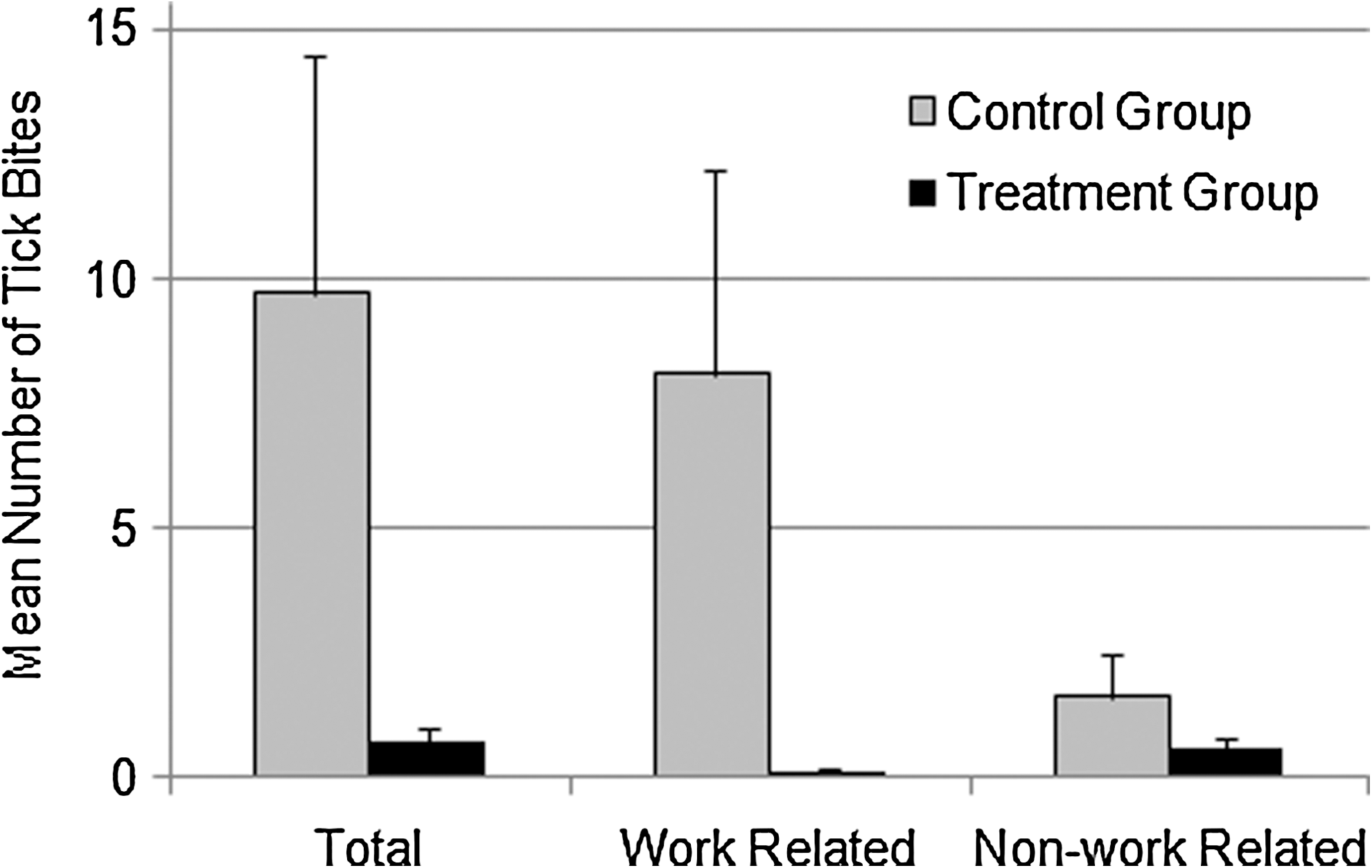
Mean number of tick bites by treatment group, including total, work-related, or nonwork-related tick bites. Error bars represent the standard error.
Exposure to outdoor environments
Subjects also listed the number of hours spent outdoors that were either work related or nonwork related on their weekly tick bite logs. This information was used to compare the amount of potential exposure to tick habitats during follow-up. Subjects in the control group spent a total of 1164 outdoor work hours during the study period (mean = 166.3), compared to 1732.5 outdoor work hours spent by subjects in the treatment group (mean = 192.5). For nonwork-related outdoor hours, subjects in the control group spent a total of 1463.5 outdoor nonwork hours during the study period (mean = 209.1), compared to 1801.5 outdoor nonwork hours spent by subjects in the treatment group (mean = 200.2). The mean number of work-related and nonwork-related outdoor hours was not significantly different for the two groups: p = 0.73 and p = 0.85, respectively.
Tick bite incidence rates
The crude incidence rate ratio of total tick bites per 100 outdoor hours in the treatment group compared to the control group was 0.07 (95% confidence interval [CI]: 0.02, 0.24) (Table 2). The rate of work-related tick bites among subjects in the treatment group was 1% of the rate compared to control subjects (incidence rate ratio: 0.01, 95% CI: 0.001, 0.11). Nonwork-related tick bites were also less frequent among subjects in the treatment group compared to the control group (incidence rate ratio: 0.42, 95% CI: 0.10, 1.79), although this comparison did not achieve statistical significance (p = 0.24).
Discussion
In this study we found that subjects wearing Insect Shield–treated clothing had a 93% reduction (p < 0.0001) in the total incidence of tick bites compared to subjects using standard tick bite prevention measures. The rate of tick bites acquired during work hours was reduced by ∼99% (p < 0.0001) among subjects wearing Insect Shield–treated clothing. The rate of nonwork-related tick bites was ∼58% less among subjects in the treatment group compared subjects in the control group. It is likely that the lower effectiveness observed for nonwork-related tick bites was due to the low overall number of tick bites in this category.
Field trials evaluating the effectiveness of permethrin-treated clothing using pressurized sprays and dipping methods have shown that permethrin can provide nearly 100% protection against questing ticks, including Amblyomma americanum (Schreck et al. 1982a, Mount and Snoddy 1983, Evans et al. 1990), Dermacentor variabilis (Mount and Snoddy 1983, Evans et al. 1990), Ixodes dammini (Schreck et al. 1986, Evans et al. 1990), and Ixodes pacificus (Lane 1989), although the high rate of protection is not sustained over long periods of wear or after multiple washings (Schreck et al. 1982b, Lane 1989). Long-lasting permethrin-impregnated clothing showed 95.5% protection against questing Ixodes ricinus ticks in six subjects exposed to a tick-infested habitat for 36 h (Faulde et al. 2008). Knockdown testing, which measures the sublethal incapacitation of insects upon exposure to treated fabric in a laboratory setting, has shown that fabric treated using the polymer coating method can knockdown 100% of I. ricinus ticks within 15 min, even after 100 launderings (Faulde et al. 2003, Faulde and Uedelhoven 2006). Our findings support these results, and suggest that the high level of protection provided by permethrin-impregnated clothing seen in both laboratory tests and field trials is sustained under field conditions over an extended period of time after regular use and laundering.
It is worth noting that the majority of the tick bites reported by the control group were acquired while the subject had been wearing a self-applied repellent (including but not limited to permethrin). This finding suggests that self-applied repellents may not provide adequate protection against tick bites among persons with frequent and intense exposure to tick-infested habitats. Another point of interest is that the one tick bite that was acquired while a subject was wearing Insect Shield–treated clothing occurred on the subject's wrist. This was an uncommon location for a tick bite in this study, as the majority of ticks were found on the trunk and legs (data not shown). We speculate that the treated clothing acted as a barrier, preventing the tick from crawling further up the body.
Study limitations
Due to the nonrandomized nature of this pilot study, it is possible that subjects who elected to be in the treatment group may be different than subjects who elected to be in the control group. If there are any differences between groups related to the probability of acquiring tick bites, confounding bias may be introduced. We expected that subjects who chose to be in the treatment group may have had more exposure to ticks and a higher probability of being bitten. The mean number of tick bites per subject in the previous year, which we felt provided a good estimate of the likelihood of being bitten by a tick, was actually slightly higher in the control group (although the difference was not statistically significant).
Since this study was not blinded, subjects may have altered their behavior regarding tick bite prevention measures based on their clothing treatment status. Overall, when we compared usage of tick bite prevention measures during the study period, there were some small (but nonsignificant) differences between groups. Controls were less likely to wear long sleeves or a hat, and to tuck or tape the bottoms of pant legs. Subjects in the treatment group were somewhat less likely to apply self-applied repellent to their clothing or skin when working outdoors, most likely due to the knowledge that they were wearing clothing treated with a repellent. The increased frequency of tick checks by members of the control group during the study period may have resulted in better detection of tick bites in this group, which could have resulted in a slight overestimation of the effectiveness of the Insect Shield–treated clothing.
Because the subjects do not wear uniforms it was not possible to know whether subjects in the treatment group wore treated clothing every time they performed outdoor field work. We asked subjects in the treatment group how often they wore treated clothing while working outdoors on the follow-up questionnaire, and the majority of subjects reported that they wore treated clothing 75% to 100% of the time while working outdoors. Two subjects who had both reported wearing treated clothing <25% of the time also reported that they had performed very little or no outdoor field work during the study period. Therefore, we conclude that overall adherence to the treatment was high, and is unlikely to have biased study results. While no data were collected on the frequency of laundering clothing items due to the difficulty in keeping detailed records, the high level of protection observed over the 27 weeks of follow-up suggests that there was little to no loss in treatment effectiveness, regardless of the frequency of laundering.
This study provides preliminary evidence that long-lasting permethrin-impregnated clothing may be highly effective against tick bites. Future studies in a larger population with randomized treatment assignment are needed to determine whether permethrin-impregnated clothing can prevent tick bites and tick-borne diseases. A double-blind randomized effectiveness study is currently being planned to test this hypothesis among uniformed employees of the North Carolina Division of Forest Resources and the North Carolina Division of Parks and Recreation.
Footnotes
Acknowledgments
The authors would like to thank Steve Kaasa, John Dorney, and the employees of the Wetlands and Permitting Unit of the North Carolina Division of Water Quality, without whose enthusiastic support this project would not have been possible. We would also like to thank Insect Shield, Inc., for providing the clothing treatment.
Disclosure Statement
No competing financial interests exist.