




Abstract
Dengue epidemics in Cuba have repeatedly demonstrated a month-to-month increase in clinical severity during secondary infections. The dengue 2 outbreak that occurred in Santiago de Cuba in 1997 was accompanied by the most severe intraepidemic increase in disease severity reported to date. It was initially proposed that the appearance of neutralization escape mutants during the course of the epidemic might explain this phenomenon. Recent studies have revealed that during the course of this epidemic, nucleotide substitutions appeared only in nonstructural (NS) genes, most of which were silent, except for one change in the NS1 gene. To study whether or not variation in the NS1 gene might be associated with increased disease severity during the epidemic, this gene was partially sequenced from 15 isolates obtained at different times during the 1997 epidemic. Early epidemic isolates differed from those obtained later by replacement only of threonine with serine at position 164 in the NS1 protein, an amino acid rarely found in any genotype of dengue 2 virus. All viruses isolated from patients located in Health Districts, where dengue 2 transmissions occurred late in the epidemic, contained Serine at position 164, indicating that this change was fixed within a few months. Here we argue that this single mutation contributes to viral survival or replication efficiency, resulting in enhanced infection in the presence of enhancing antibodies, a phenomenon that we term increased virus “fitness” in contrast to “virulence,” an intrinsic property of the virus.
Introduction
For the past 30 years or more, our laboratory has studied the epidemiological characteristics of dengue fever (DF) in Cuba. In 1977, a nationwide DENV-1 epidemic, involving DF but not DHF or DSS, occurred in a largely susceptible population. Four years later, an Asian strain of DENV-2 was introduced producing a large DHF epidemic (Kouri et al. 1989). Subsequently, an intensive mosquito eradication program resulted in a prolonged period without dengue transmission. However, in 1997, a DENV-2 American Asian strain was introduced into the Municipality of Santiago de Cuba (Kouri et al. 1998). This resulted in an epidemic involving 3012 cases of dengue serologically confirmed cases. However, applying the proportion of positives among those tested, to all reported cases, it was estimated that 5208 clinically overt febrile illnesses were caused by DENV-2 infection in 1997. Among these were 205 DHF/DSS cases with 12 deaths, all in adults (Guzman et al. 1999, 2000b). Afterward, in 2001–2002 DENV-3 was inadvertently introduced into Cuba, causing another severe epidemic (Pelaez et al. 2004). Each of the three latter epidemics was notable for three similar phenomena (1) the association of DHF/DSS with secondary infection in the sequence DENV-1/DENV-2 or DENV-1/DENV-3 (Guzman et al. 1990, 1991, 2000b, Alvarez et al. 2006), (2) the presence of Asian origin strains with the potential to produce DHF/DSS (Guzman et al. 1995, Rodriguez-Roche et al. 2005b, 2005c), and (3) rapid month to month increases in clinical severity expressed by an increasing proportion of severe cases as the epidemics progressed (Guzman et al. 2000a).
On the basis of the hypothesis that neutralization escape mutants might emerge during the course of dengue epidemics in partially immune individuals (Guzman et al. 2000a), E gene sequences of 20 DENV-2 strains isolated at different times during the 1997 epidemic were studied. However, no sequence changes were detected in the E genes of these strains (Rodriguez-Roche et al. 2005b). Subsequently, the complete gene sequences of six of these isolates were determined. Analysis revealed strong conservation of structural genes and proteins and of the noncoding regions (5′ NCR and 3′ NCR). However, nucleotide substitutions were observed in NS genes, notably NS1 and NS5 (Rodriguez-Roche et al. 2005a). A pattern consistent with virus evolution during the epidemic was observed; the earliest isolates sampled differed from those sampled later by five nucleotide changes, one of which produced an amino acid replacement in the NS1 protein (Rodriguez-Roche et al. 2005a). From these results, we considered it appropriate to sequence the NS1 fragment containing the observed changes in a larger number of isolates covering the entire 1997 epidemic period to confirm if this was a consistent evolutionary change.
Materials and Methods
Clinical classification
All cases were classified clinically as DF or DHF/DSS according to the Guidelines for Control and Prevention of Dengue and Dengue Hemorrhagic Fever in the Americas (PAHO 1994).
Samples
Sera from dengue suspected cases collected through the national surveillance system, established by the Cuban Ministry of Public Health, were sent to the National Reference Laboratory at “Pedro Kouri” Tropical Medicine Institute for dengue diagnosis. Verbal informed consent was obtained from all patients at the health units and hospitals in Santiago de Cuba Municipality at the moment of sample collection, and it was registered in their clinical records. The present study has been approved by the Institutional Ethical Review Committees of the Institute of Tropical Medicine “Pedro Kourí” and the Cuban National Academy of Sciences.
Type of infection
Sera from patients in the convalescent phase of the infection were analyzed for neutralizing antibodies to all DENV serotypes using the 50% endpoint plaque reduction neutralization test described (Morens et al. 1985), with some modifications (Alvarez et al. 2005). According to criteria previously established (Guzman et al. 1991), patients with neutralizing antibody titers ≥1:30 to only one DENV serotype were considered to have experienced a primary dengue infection. Patients with neutralizing antibody titers ≥1:30 against two or more serotypes were considered to have experienced a second or third infection.
Viruses
The NS1 protein-encoding gene of 15 DENV-2 viruses isolated during the 1997 Cuban outbreak was partially sequenced. Each of these viruses was recovered from acute phase serum samples by inoculation onto C6/36 mosquito cells (ATCC CRL 1660) using the rapid centrifugation assay (Rodriguez-Roche et al. 2000). DENV serotype was identified by immunofluorescence assay using type-specific monoclonal antibodies (Henchal et al. 1985). Included in the analysis were data from six DENV-2 (AY702034-AY702040), sequenced previously (Rodriguez-Roche et al. 2005a) and another two DENV-2 obtained from the same epidemic, completely sequenced directly from serum samples (M.G. Guzman, pers. comm.).
RNA extraction and RT-polymerase chain reaction
Viral RNA was extracted from 200 μL of supernatant medium of virus-infected cells using Trizol (Invitrogen). First-strand cDNA synthesis was carried out in a volume of 30 μL. Eleven microliters of RNA and 5 μL of primer DENV-2-RT-3′UTR (AGAACCTGTTGATTC) 10 pmol μL−1 were mixed and heated at 95°C for 2 min. The mixture was then chilled and 3 μL of dNTP (10 mM), 3 μL of DTT(0.1 mM), 1 μL of RNAsin (40 units), 6 μL of 5 × buffer, and 1 μL of reverse transcriptase Superscript II (Invitrogen) were added. The mixture was incubated at 43°C for 2 h and 65°C for 10 min.
Nucleotides from position 379–601 in the NS1 protein-encoding gene were amplified using the polymerase chain reaction (PCR) protocol described previously (Rodriguez-Roche et al. 2005a). A sample of 3 μL of the cDNA from the RT reaction forward primer (den2s-2801: GTCTCACAATCAGACCTTT) and reverse primer den2s-3024: CCAATAACCCATATCGGC) were used for PCR amplification by 30 cycles of denaturation at 94°C (40 s), annealing at 55°C (1 min), and extension at 72°C (1 min). A final extension step was carried out at 72°C for 10 min.
PCR products were directly sequenced after purification using QIAquick PCR Purification Kit (QIAGEN). Double-stranded sequencing using the PCR primers was performed on an ALF express II sequencer using the manufacture's protocol (Amersham Pharmacia Biotech). The sequencing reactions were purified by precipitation.
All sequences determined in this study have been deposited in GenBank ID: FJ159136-FJ159150.
Basic reproductive ratio (R0) estimation
R0 was estimated from the initial growth phase of the epidemic using the model utilized previously for dengue (Marques et al. 1994). All Health districts corresponding to the Santiago de Cuba Municipality with dengue reported cases were analyzed independently. Therefore, R0 was estimated for each of the districts considering that the epidemic started in January, but some districts reported the first cases later on. Plot of the daily number of case declarations against the cumulative number of cases for each Health district were done and the growing linear parts of the plots corresponding to the initial exponential growth of the epidemic were used for R0 calculation.
Statistical analysis
The proportions of DHF/DSS per dengue case, deaths per case of DHF/DSS, and deaths per dengue cases were compared monthly during the epidemic as an expression of increasing clinical severity using previously published data (Valdes et al. 1999). Analysis for linear trend in proportion was done by the chi-square test using Epinfo version 3.2. Odds ratios were calculated taking May as the reference because no DHF/DSS cases were observed in preceding months.
Results
As shown in Table 1, five viruses isolated at the beginning of the 1997 epidemic (13/97, 58a/97, 40a/97, 68a/97, and 70a/97) differed by one nucleotide, at position 490 in the NS1 gene, from the 17 viruses collected 4 months later. The nonsynonymous substitution at this NS1 gene location generated an amino acid change in the NS1 protein, Threonine/Serine (Thr/Ser) at residue 164. Notably, this amino acid change was detected in May when the first DHF/DSS cases were reported. Table 2 shows a significant increase in the proportion of dengue cases with DHF/DSS, deaths per case of DHF/DSS, and deaths per dengue case during the epidemic. The risk of severe dengue was augmented ostensibly from May to July. Specifically, the risk of death resulting from a clinically overt febrile illnesses during dengue infection was increased by 14.73-fold.
Amino acid position in the NS1 protein based on the complete sequence of the Jamaica 1409/83 strain. Highlighted in bold are the isolates previously studied by Rodriguez-Roche et al. (2005a) and two sequences obtained from polymerase chain reaction products using serum samples (M.G. Guzman, unpublished data). Viral isolates had two passages in C6/36 cell line.
DF, dengue fever; DHF, dengue hemorrhagic fever; DSS, dengue shock syndrome; ND, not done; NS, nonstructural; (s), serum.
Some of these data have been published elsewhere (Valdes et al. 1999).
Chi-square for linear trend from May to July, p = 0.0009.
Chi-square for linear trend from May to July, p = 0.02.
Chi-square for linear trend from May to July, p = 0.002.
Additionally, the R0 was estimated for each Health District during the epidemic in the Santiago de Cuba Municipality. As shown in Figure 1 the Health districts that reported the first cases in May had the highest R0 value. Remarkably, with the exception of the Health District Frank País, the R0 augmented through May from one Health District to another in correspondence with the date of the first reported case.
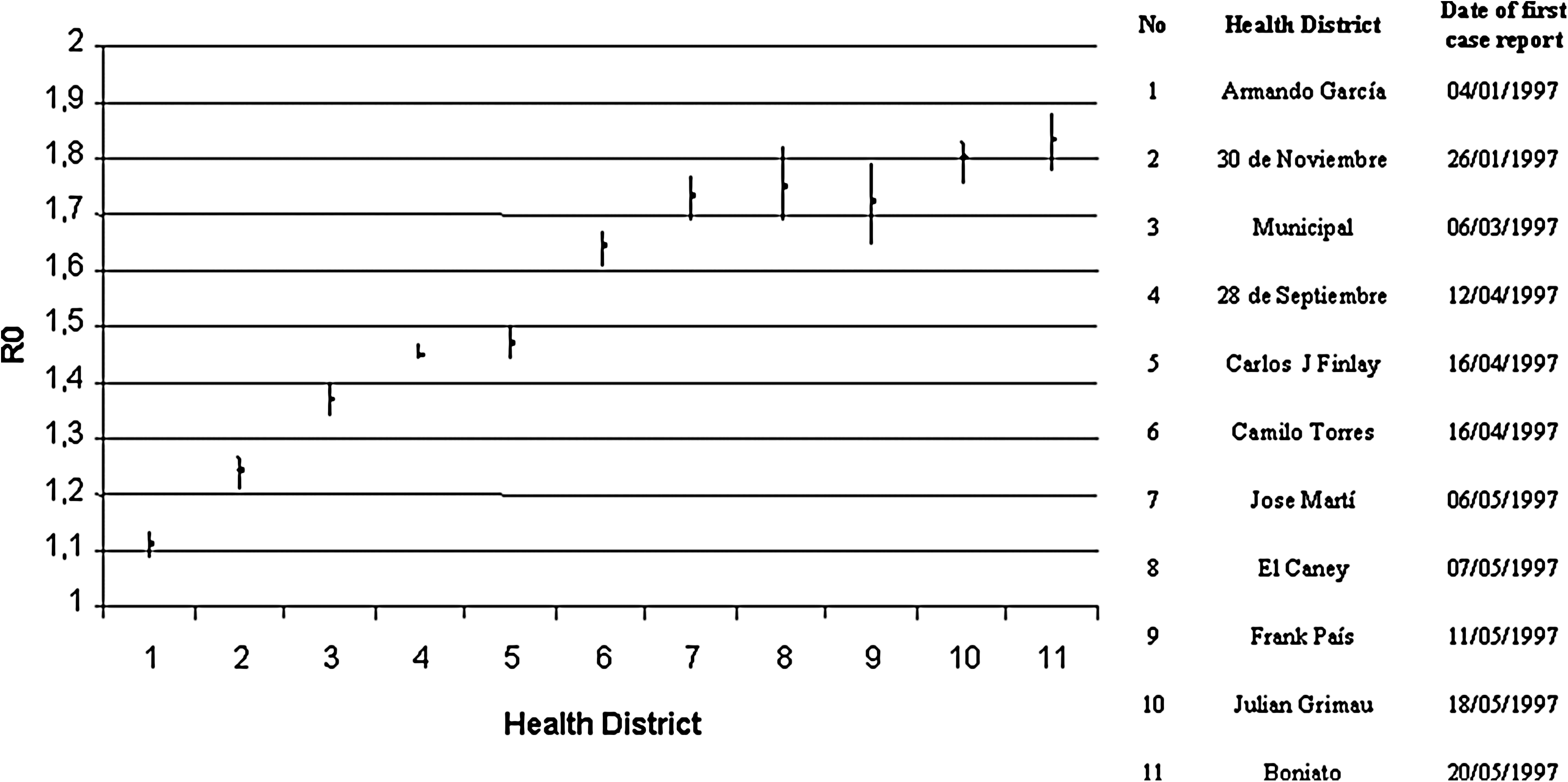
Basic reproductive ratio (R0) estimated for Health District during the Santiago de Cuba epidemic, 1997. Confidence interval (CI 95%) is shown for each R0 value using vertical lines.
Eight isolates included in the present study were obtained from patients resident in the Health Districts Boniato, Julian Grimau, and José Martí; all contained Ser at position 164. In these Health Districts, first dengue cases were reported late during the epidemic. Additionally, these areas had the highest DHF/DSS attack rates (88.4, 81.6, and 74.5 per 100 000 inhabitants, respectively) compared with the attack rates (43.1 per 100 000 inhabitants) observed in the areas where the cases were reported early (Valdes et al. 1999).
When these deduced amino acid sequences were aligned and compared with those of a wide collection of DENV-2 within all genotypes, it was remarkable that Thr at position 164 was highly conserved among the DENV-2 genotypes. The analysis carried out in 2005 (Rodriguez-Roche et al. 2005a) revealed that strikingly only the strain PUO-280 isolated in Thailand 1980 (Blok et al. 1991) and the strain SL1050 isolated in Sri Lanka in 1985 (Blok et al. 1991), which belongs to Asian genotypes I and II, respectively, had Ser at position 164. Data from GenBank retrieved on November 17, 2009, reveal that from 1986 to 1993, 97% of the published DENV-2 Puerto Rican strains, classified as American-Asian genotype, had Thr at position 164. However, from 1994 to 2007, 78% of the Puerto Rican strains had Ser at this position. The GenBank accession numbers of the 125 DENV-2 Puerto Rican sequences analyzed are available from the corresponding author on request. DENV-2 variants with Ser at position 164 also circulated in Venezuela 1996 GenBank ID: EU687220, and 1998 GenBank ID: FJ898465; Saint Kitts and Nevis 2001 GenBank ID: FJ898460; Dominican Republic 2003 GenBank ID: FJ898451; and Virgin Islands 2005 GenBank ID: FJ898453.
Discussion
To our knowledge we are the only laboratory that has recovered DENV strains during the course of the evolution of an outbreak of severe dengue disease in which mortality rates increased month to month. These cases all occurred during DENV-2 infections in individuals who were immune to DENV-1. Thus, the presence of DENV-1 antibodies was a necessary pre-existing etiological factor. As reported here, we found changes in the NS1 gene that correlated with the observed rapid increase in disease severity. Our observations are limited because of the small number of DENV strains available, the limitations in our ability to perform full-length genome sequences and the absence of any in vitro tests to substantiate our hypothesis. Nonetheless, we wish to communicate our findings to the dengue research community to frame this important research challenge.
It is not possible to discuss our findings without explaining a semantic problem that, we believe, has confused research hypothesis making in studies on dengue pathogenesis. The terms “virulent” and “avirulent” have been used quite loosely among the dengue community to describe viruses that have been simply associated with or without a DHF epidemic. The best example of an avirulent virus is the American genotype DENV-2 that circulated in Iquitos, Peru, 4 years after the introduction of DENV-1. This latter epidemic resulted in a large number of secondary DENV 2 infections but no DHF cases (Watts et al. 1999). Other workers have described as virulent those DENV-2 viruses associated with endemic DHF either in Asia or the Americas (Rico-Hesse 2003). In microbiology, virulence refers to the innate disease-producing properties of a microorganism. However, in keeping with contemporary understanding of dengue pathogenesis, studies on the causes of severe dengue disease require an investigator to search for genetic changes expressed during infections in partially dengue-immune individuals. As discussed below, enhanced disease severity operates in the context of the requirement for the circulation of dengue antibodies before infection and as illustrated in this report; changes in the nucleotides of the NS1 gene have been associated temporally with changes in disease severity. However, these changes are not intuitively associated with the appearance of a virulent DENV-2 that was solely responsible for severe disease in susceptible individuals. Indeed, only 3% of an estimated 13,116 individuals experiencing primary DENV-2 infections in Santiago de Cuba developed even mild dengue symptoms; the majority were asymptomatic (Guzman et al. 2000b). Importantly, it was estimated that of all 4810 persons infected in the sequence DENV-1 then DENV-2, all became ill (Guzman et al. 2000b, 2002). It was this group of patients among whom month-to-month increases in the ratio of DHF/DF cases and case fatality rates were observed (Guzman et al. 2000a).
It is our hypothesis that during the 1997 DHF epidemic DENV-2 acquired a genetic change that increased virus fitness. Using this definition, individuals with greater fitness are more likely to contribute offspring to the next generation. Therefore, the genotypes with higher fitness become more common through the natural selection process. In our study, the T 164NS1 S substitution appeared to be sufficiently fit, to change in frequency of detection from 0/5 to 17/17. Similar results were observed among Puerto Rican DENV-2 strains. The T 164NS1 S substitution ratio changed from 1/33 before 1994 to 71/91 after 1994. It is known that the American-Asian genotype circulated in Puerto Rico from 1987, and coincidentally in 1994 the largest dengue outbreak in Puerto Rico's history occurred with record numbers of hospitalizations, DHF cases, and deaths (Rigau-Perez et al. 2001). The adaptive phenotype associated with this fitter genotype is unknown but could include any or all of the following possibilities: increased replication, transmissibility, or the ability to respond to antibody-dependent enhancement following secondary infections (Halstead et al. 1970, Halstead 1994).
How might changes in dengue viral fitness result in increased disease severity during secondary dengue infections? One possibility that has been observed is the phenotypic change in neutralization of DENV-2 by heterotypic dengue antibodies. In the Iquitos outbreak, it was shown that polyclonal DENV-1 immune human sera neutralized American but not Asian-American genotype DENV-2 viruses in vitro (Kochel et al. 2002). It is postulated that heterotypic neutralization of American DENV-2 might be expressed in vivo as reduced viremia and disease severity, as suggested by observations in an animal model (Kochel et al. 2005). The specific genomic changes resulting in this phenotypic property of American DENV-2, while possibly attributable to changes in structural genes, have not been identified here.
However, differences in dengue NS genes may also generate phenotypic changes that could affect replication efficiency and hence disease severity. Although the rise in Ro values observed in Health Districts infected later during the epidemic could be due to changes such as temperature, rainfall, and mosquito abundance. A second explanation is that increased replication efficiency is implied by the observed increase in the basic reproductive ratio during the course of the 1997 outbreak, through higher levels of virus in the blood. Ligation of the Fcγ receptors on human monocytic cell lines (THP-1 cells) by infectious dengue antibody–DENV complexes at antibody-dependent enhancement concentrations, suppressed one or more elements of innate immunity, resulting in enhanced production of virus (Chareonsirisuthigul et al. 2007, Ubol et al. 2008). Moreover, genetic differences at loci 621–646 within the NS5 gene of Asian DENV-2 correlated with viral resistance to destruction by nitric oxide (Charnsilpa et al. 2005, Ubol et al. 2008).
Here, we have identified a stable amino acid substitution in the NS1 protein that was detected in viruses obtained during the late period of the 1997 Cuban epidemic. This substitution Thr/Ser is a conservative change because both amino acids are neutral and polar, having similar hydropathy indices of −0.7 and −0.8, respectively. Nevertheless, there are differences between them concerning their role in structure and function. Serine is a smaller amino acid that can reside both within the interior of a protein, or on the protein surface. Its small size means that it is relatively common within tight turns on the protein surface, where it is possible for the Serine side-chain hydroxyl oxygen to form a hydrogen bond with the protein backbone, effectively mimicking Proline. The hydroxyl group is fairly reactive, being able to form hydrogen bonds with a variety of polar substrates. Whereas most amino acids contain only one nonhydrogen substituent attached to their C-beta carbon, C-beta branched amino acids like Threonine contain two. This increases their size in the vicinity of the protein backbone. Thus, these amino acids are more restricted in the conformations that can be adopted by the main-chain (Betts and Russell 2003).
Another possibility of fitness change might be related to the unique biological role of the NS1 protein in dengue disease pathogenesis. NS1 protein secretion is a hallmark of DENV infection in humans and the soluble form of NS1 (sNS1) protein forms hexamers (Gritsun et al. 1990), which have been detected in sera from DENV-infected patients throughout the overt disease (Young et al. 2000, Alcon et al. 2002). Concentrations of sNS1 protein in sera circulate at higher levels in DHF than in DF patients (Libraty et al. 2002). In a laboratory mouse model, the liver was identified as a major site of dengue sNS1 accumulation and intracellular accumulation of sNS1 was shown to enhance DENV production during a secondary dengue infection, implying an important role for sNS1 protein in viral multiplication (Alcon-LePoder et al. 2005).
Thus, specific changes in NS genes could enhance viral fitness under the unique circumstances governing DENV infections in the presence of enhancing antibodies. This is further supported by other studies of DENV evolution that have demonstrated strong conservation of the structural genes but variation in NS genes (dos Santos et al. 2002, Bennett et al. 2003, Klungthong et al. 2004). Clearly, more studies are required to explore the phenotypic attributes of DENV-2 virus NS1 protein that correspond with the observed amino acid change.
Footnotes
Acknowledgments
The authors would like to thank Emidalys Santana for her essential technical assistance. This research was supported by The Wellcome Trust grant No. 062752/Z/00/Z. E.A.G. is supported by EU grants, EVA FP7 GA no. 22829 and SILVER FP7 GA no. 260644.
Disclosure Statement
No competing financial interests exist.