




Abstract
West Nile virus (WNV), the most widely distributed flavivirus worldwide, has lately reemerged in Europe, causing worrisome outbreaks in humans and horses. Serological analysis by enzyme-linked immunoassay and plaque reduction neutralization test showed for the first time in Serbia that 12% of 349 horses presented specific neutralizing WNV antibodies, which in one case also cross-neutralized Usutu virus (USUV). This is the first time that anti-USUV high neutralizing antibody titers are reported in horses. All these data indicate that WNV and USUV are circulating in the region and advise on the convenience of implementing surveillance programs.
Introduction
In Europe, until the 1990s, WNV had caused sporadic outbreaks with rare reports of encephalitis, but its epidemiological behavior changed when it reemerged with virulence in Romania, Russia, and the Mediterranean basin, causing dozens of humans and horses deaths (Komar 2000, Kramer et al. 2007, Blitvich 2008, Calistri et al. 2010). In North America, since its first detection in 1999, WNV has already caused in humans over 1100 fatalities, over 12,000 cases of meningitis/encephalitis, and more than 30,000 diagnosed infections, and over 25,000 accumulated cases have been reported in horses (
Materials and Methods
Samples
Sera from 349 horses were randomly collected during 2009–2010 (29.5%, 39.2%, 28.4%, and 2.9% during winter, spring, summer, and autumn, respectively) in stables of the Belgrade district area, of the municipality of Sabac and of 26 municipalities of the Vojvodina province of northern Serbia, which is bordered to Croatia, Hungary, and Romania (Fig. 1). Vojvodina presents more than 50% of Serbian water surfaces and raises more than one-third of the country's horses (
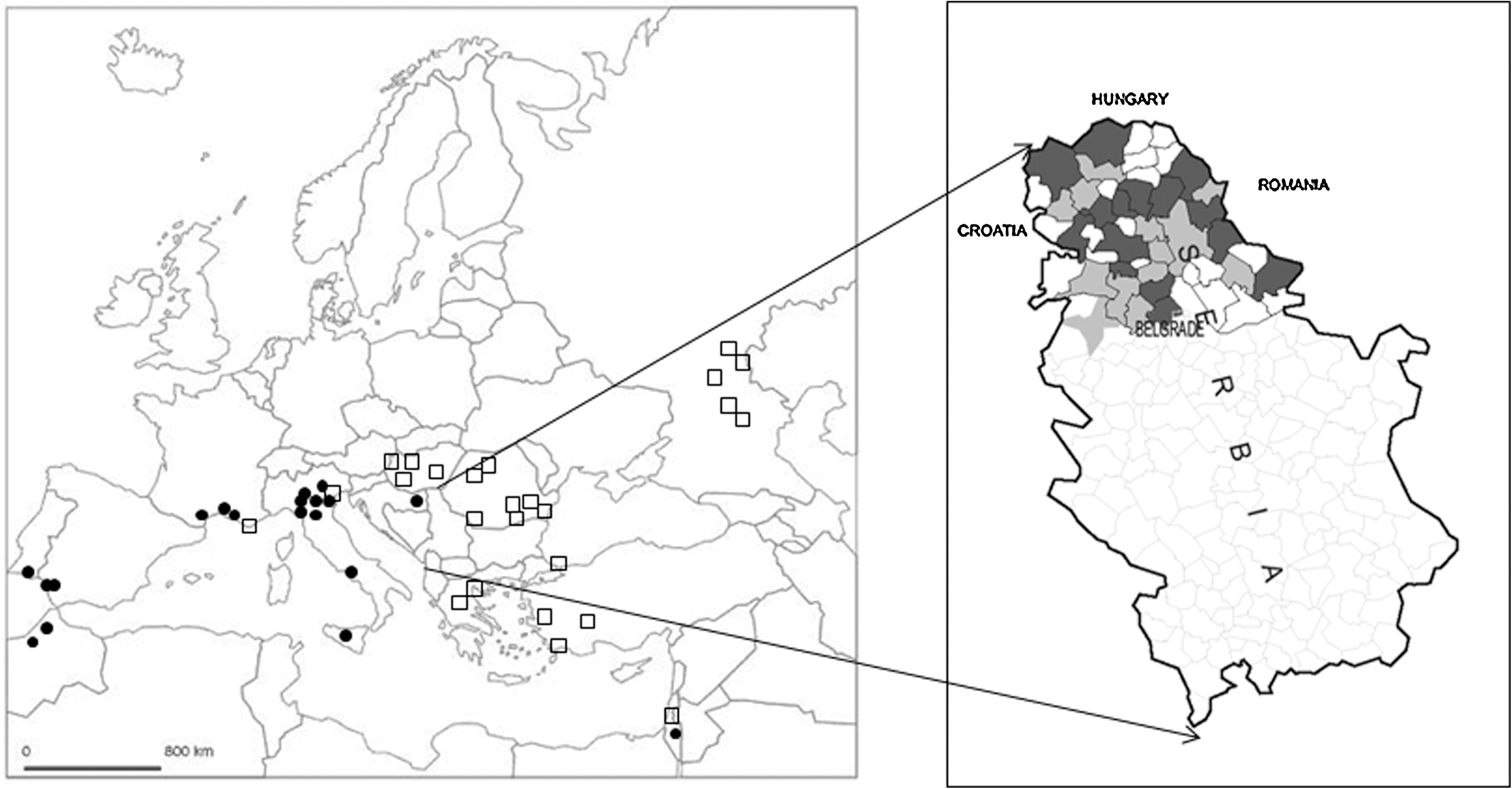
WNV activity in Serbia. Left panel shows recently reported WNV activity in Europe and the Mediterranean basin in humans (empty squares) and horses (black circles). Right panel displays the municipalities (in gray) from Serbian Vojvodina province, Sabac municipality, and Belgrade district area sampled in this study, including those where WNV immunoglobulin G-positive horses were detected (in black). WNV, West Nile virus.
Antibody and viral detection
Heat-inactivated sera were assayed for anti-WNV immunoglobulin G (IgG) antibodies by an enzyme-linked immunosorbent assay based on WNV recombinant envelope E (rE) protein (Alonso-Padilla et al. 2010). Briefly, plates were coated with 0.5 μg/well of partially purified rE, blocked, washed, and incubated with horse sera (diluted 1/100) before the horseradish peroxidase-conjugated secondary antibody was added. After addition of the substrate, the reaction was stopped and the absorbance was read at 495 nm. The positive cutoff value was assigned using a positive/negative (P/N) ratio of ≥2, calculated by dividing the mean absorbance of the test serum reacted on viral antigen by the absorbance of the negative control serum on viral antigen (Alonso-Padilla et al. 2010).
Plaque reduction neutralization tests (PRNTs) were conducted under biosafety level 3 conditions on Vero cells using twofold serial (from 1/40 to 1/1280) sera dilutions (Alonso-Padilla et al. 2009) with the WNV NY-99 strain. In parallel, PRNT was similarly performed with Usutu virus (USUV) strain SAAR 1776 as control of flaviviral specific reactivity. Titers were calculated as the reciprocal of the serum dilution, diluted at least 1:40, which reduced plaque formation ≥90% (PRNT90).
To detect WNV, samples were assayed by culture on Vero cells (up to three consecutive passages) and by real-time reverse transcriptase–polymerase chain reaction as described elsewhere (Lanciotti et al. 2000).
Results
Our results showed that 42 (12%) of the sera were IgG positive (average P/N=4.2, range: 2–10.6). All 42 serum neutralized WNV infectivity (average PRNT90=120, range: 42–650), but, with one exception, none of them neutralized USUV (PRNT90<40). The only sera that neutralized USUV (PRNT90=90) also presented high PRNT and enzyme-linked immunosorbent assay titers against WNV (PRNT90=140 and P/N=10.5, respectively). On the other hand, none of the 30 randomly selected IgG-negative sera tested were PRNT positive for either virus. No virus could be detected by cell culture or real-time reverse transcriptase–polymerase chain reaction in any of the samples analyzed. No differences were observed among the proportion of positive animals detected in the different seasons and a similar proportion of positive animals were observed among mare (13%) and stallions (9.8%). Serum neutralizing antibodies were present in 26.6% of the mixed breed horses, 12.8% of Lipizzaner breed horses, 12.6% of sport animals, and 2.8% of the ponies tested. Positive horses were found in 14 of the 28 municipalities studied, which are up to 200 km distant (Fig. 1). Two of the positive horses were imported from Hungary and Croatia, respectively, and were bled while in quarantine.
Discussion
To date, the only available data about WNV activity in the different republics of the former Yugoslavia are the early results from 1970 to 1980 describing a 0.5%–7.9% seroprevalence among its inhabitants (Vesenjak-Hirjan et al. 1991) and a study reporting a low (0.4%) prevalence of anti-WNV antibodies in horses in Croatia in 2002 (Madic et al. 2007). The four positive animals found there were from Djakovo region, bordered to the Vojvodina province, sampled in the present study. Our results support that WNV is circulating in the region, as 12% of the horses tested presented specific neutralizing antibodies and were not restricted to any specific region. Two of the seropositive animals had preexisting WNV serum antibody at the time they were imported from neighboring countries.
One horse presented PRNT90 titers against USUV and WNV. USUV is the only WNV-related flavivirus of the Japanese encephalitis serocomplex detected in Europe until now, and neutralizing antibodies against both viruses have been reported in birds (Weissenbock et al. 2002) and sentinel chickens (Lelli et al. 2008). To our knowledge, this is the first time that USUV neutralizing antibodies are reported in horses. However, as PRNT90 titers were similar for WNV and USUV (120 and 90, respectively) and no infectious virus or specific RNA were detected in this serum, we cannot conclude whether this animal presented cross-reactive neutralizing antibodies or was exposed to both viruses. This finding, together with the recent description of coinfection of birds with both viruses (Tamba et al. 2010) and the first human case of USUV neuroinvasive infection in northern Italy (Pecorari et al. 2009), suggests that measures should be taken to monitor USUV activity in Europe and that this should not be restricted to avian species. It should be remarked that presence of WNV seropositive horses does not necessarily mean risk for humans, and in fact, no cases of WND have been reported in the region investigated in the present study. In any case, the results presented here and the worrisome data of WND cases in humans and horses across southern Europe during 2010 (
Footnotes
Acknowledgments
This work was supported by grants FIS-PI71310, SAF2008-04232, FAU2008-00006, and AIB2010SE-00316 from the Spanish Ministerio de Ciencia e Innovación (MICINN); by grant NADIR-UE-228394 from the EU; and by grant TR 31084 and bilateral project “Assessment of zoonotic viral activity in Serbia” from the Serbian Ministry of Science and Technological Development. J.A.P. has been supported by a scholarship from MICINN. The research groups thank the veterinarians from the veterinary clinics of Novi Sad, Srbobran, Kać, and from the Scientific Veterinary Institute of Serbia for providing with some of the horses' samples and data.
Disclosure Statement
No competing financial interest exists.