




Abstract
The susceptibility of Aedes aegypti adults of three places in Abidjan city selected for an entomological surveillance of potential arbovirus vectors to permethrin, deltamethrin, lambdacyhalothrin, and propoxur was determined using WHO standard procedures. The wild populations of A. aegypti were susceptible to permethrin, deltamethirn, and lambdacyhalothin. Resistance to propoxur was detected in strains collected at the Autonomous Port of Abidjan and at Koumassi (mortality rate: 77%) but possibly resistance to this insecticide at the national zoological park (mortality rate: 90.8%). Populations of the national zoological park were possibly resistant to propoxur whereas those of the Autonomous port of Abidjan and of Koumassi were resistant.
Introduction
Several episodes of yellow fever have been reported in Côte d'Ivoire since 1999, and A. aegypti has been constantly found in each of the infected zones in the country (Akoua-koffi et al. 2001, 2002, InVS 2008, WHO 2008a, 2008b, Attoh-Touré et al. 2010). In Abidjan the economic capital, three outbreaks have been reported between 2001 and 2008. In the 2001 outbreak with 73 suspected cases, 16 cases were confirmed and the total death toll was just one (Akoua-Koffi et al. 2002). In 2008, reports from the Institut de Veille Sanitaire in Paris drew our attention to the increase in imported cases of dengue three among travelers returning from Côte d'Ivoire. The report mentions 12 cases between January 1, 2006, and August 31, 2008, 1 in 2006, 3 in 2007, and 8 in 2008. Effectively in 2008 there were two simultaneous outbreaks of yellow fever and dengue 3 in Abidjan (InVS 2008, Konan et al. 2009, WHO 2009). Facing this situation, the Ministry of Health decided to strengthen its warning system and an entomological surveillance of potential arbovirus vectors were initiated in some specific areas of Abidjan.
Vaccination is one of the ideal methods to control yellow fever and dengue, and it is interesting to note progress in the development of vaccins for dengue viruses. However, their trials have been slow (Sornpeng et al. 2009). Since there is no treatment for both diseases and no vaccine against dengue fever, control and prevention programs must be implemented to stop the development chain of the vector. Although permanent control of A. aegypti must aim at the destruction of breeding sites, for control cases of local outbreaks, it is important to carefully plan vector control strategies by using insecticides against adult mosquitoes. Moreover, a control program cannot succeed without adequate information on insecticide susceptibility to the vectors. The aim of this study was to provide information on the susceptibility of A. aegypti to four of the most common insecticides used in mosquito vector controls in Côte d'Ivoire, particularly in Abidjan, where most of the yellow fever/dengue epidemics have been reported. It was to characterize the susceptibility of A. aegypti to these insecticides to help define proper future control strategies against this medically important mosquito.
Materials and Methods
Field site
The study was conducted at three sites in Abidjan previously earmarked for entomological survey activities: Site 1: a zone dominated by the storage and sale of used tires imported from Europe; Site 2: the National Zoological Park; Site 3: the container terminal at the Autonomous Port of Abidjan.
The city of Abidjan, with over 5 million inhabitants, is located in the Southern part of Côte d'Ivoire and lies within (05°19′ latitude N; 04°01′ longitude W). The climate is tropical with 2 rainy seasons separated from each other by a dry season (Brou 1997). The annual average rainfall is between 1300 and 1600 mm. According to SODEXAM (Ivorian firm for the Development and Exploitation of Meteorological Parameters), the mean annual temperature is around 26.5°C with a maximum of 28.7°C and a minimum of 24.6°C. The annual relative humidity is around 80%.
Mosquito collection
The standard WHO layer-traps were used to collect larvae and eggs of Aedes mosquitoes from March to June. These layer-traps are black empty cans in which small plates are immersed. These were installed at 1.5 meters above the ground. After 10 days, the plates were collected in different rubber plastic bags, pooled according to the study site, and carried to the laboratory.
Laboratory generation of F1 mosquitoes from field populations
Plates were dried on a table using mosquito nets to prevent the adult mosquitoes from flying. After drying, the plates were immersed in dechlorinated water with yeast tablets to induce larval hatching. After 24 to 48 h, the larvae were transferred to basins containing dechlorinated water. Cat food (Purina, Friskies) was supplied to feed the larvae. Pupae were transferred to plastic cups (25 cc) and the resulting adults (A. aegypti or other Aedes mosquitoes) were identified using the morphological identification keys (Edwards 1941) and morphological descriptions of African Aedes species (Huang 2004). Larvae collected in water of the traps were reared and treated in the same way as those obtained from hatching eggs. Only A. aegypti mosquitoes were kept for further analysis.
These were transferred to square metal cages (30 cm per side) and first fed on anesthetized guinea pigs 2 days after the emergence of the adults. Two days after the blood meal, eggs were collected during 3 days in small plastic cups containing wet filter paper. The paper strips containing the eggs were then allowed to dry in an insectarium and served as the source of F1 mosquitoes for the bioassays.
Insecticides
Insecticides used were 0.05% deltamethrin, 4% dichlorodiphenyltrichloroethane (DDT), 1% permethrin, 0.1% propoxur, and 0.05% lambdacyhalothrin. They were obtained from the Institut Pierre Richet of Côte d'Ivoire in the form of insecticide impregnated paper.
Insecticide susceptibility test
The adults of F1 from the 3 sites were used for bioassay by determining their susceptibility to 0.05% deltamethrin, 4% DDT, 1% permethrin, 0.1% propoxur, and 0.05% lambdacyalothrin-impregnated paper and compared with laboratory-reared, susceptible strain (Bora Bora) (WHO 1981).
These impregnated papers were inserted into WHO standard tubes. Non-blood-fed, 3–5-day-old female mosquitoes were introduced into each holding tube, 25 mosquitoes per tube, and observed for viability after 1 h. Each set of four replicate holding tubes per concentration was then connected with the test tubes, in which the mosquitoes were exposed to the impregnated papers for 5, 10, 15, 20, 25, 30, 40, 50, and 60 min. After returning to the holding tubes, the mosquitoes were provided with sugar pad and kept at 27°C–28°C to determine the mortality rate after 24 h.
Data analysis
Interpretation of results of the bioassay tests were based on WHO recommendations (WHO 1998). Mosquitoes were considered susceptible if the percentage of mortality was 98%–100%, resistant if mortality was 80%, and possibility of incipient resistance if mortality was 80%–98%. Percentage of mortality was adjusted by Abbott's formula if control mortality exceeded 4%, but <20%. When mortality in the controls was over 20%, the tests were discarded. Data of the tested samples were pooled if no mortality was observed in the controls.
Knockdown data were analyzed using WIN DL software, version 2.0 (Giner et al. 1999), according to the Finney model (Finney 1971). The knockdown times for 50% and 95% (kdT50 and KdT95, respectively) tested mosquitoes were determined. Resistance ratio (RR50) was calculated by comparing KdT50 of each population with KdT50 of susceptible strain.
Results
The reference strain showed 100% mortality for deltamethrin, permethrin, and lambdacyhalothrin, and 98% for propoxur. With 4% DDT, the mortality rate was 36.8%. Consequently, batches of impregnated papers with DDT were discarded from later use. With insecticides of the pyrethroid group, KdT50 of the susceptible strain were around 8, 10, and 30 min, respectively, with permethrin, deltamethrin, and lambdacyhalothrin.
Mortality of A. aegypti of surveillance sites observed with permethrin and deltamethrin was 100% but between 96% and 97% with the lambdacyhalothrin. These results reveal the susceptibility of A. aegypti to pemethrin and deltamethrin and possibly a resistance to lambdacyhalothrin. With propoxur, mortality rate was 90.8% for A. aegypti from the national zoological park (Zoo) and 77% for those of Koumassi and the Port. Thus, A. aegypti from Koumassi and the Port was founded to be resistant to propoxur, whereas those of the Zoo were probably resistant to propoxur (Fig. 1).
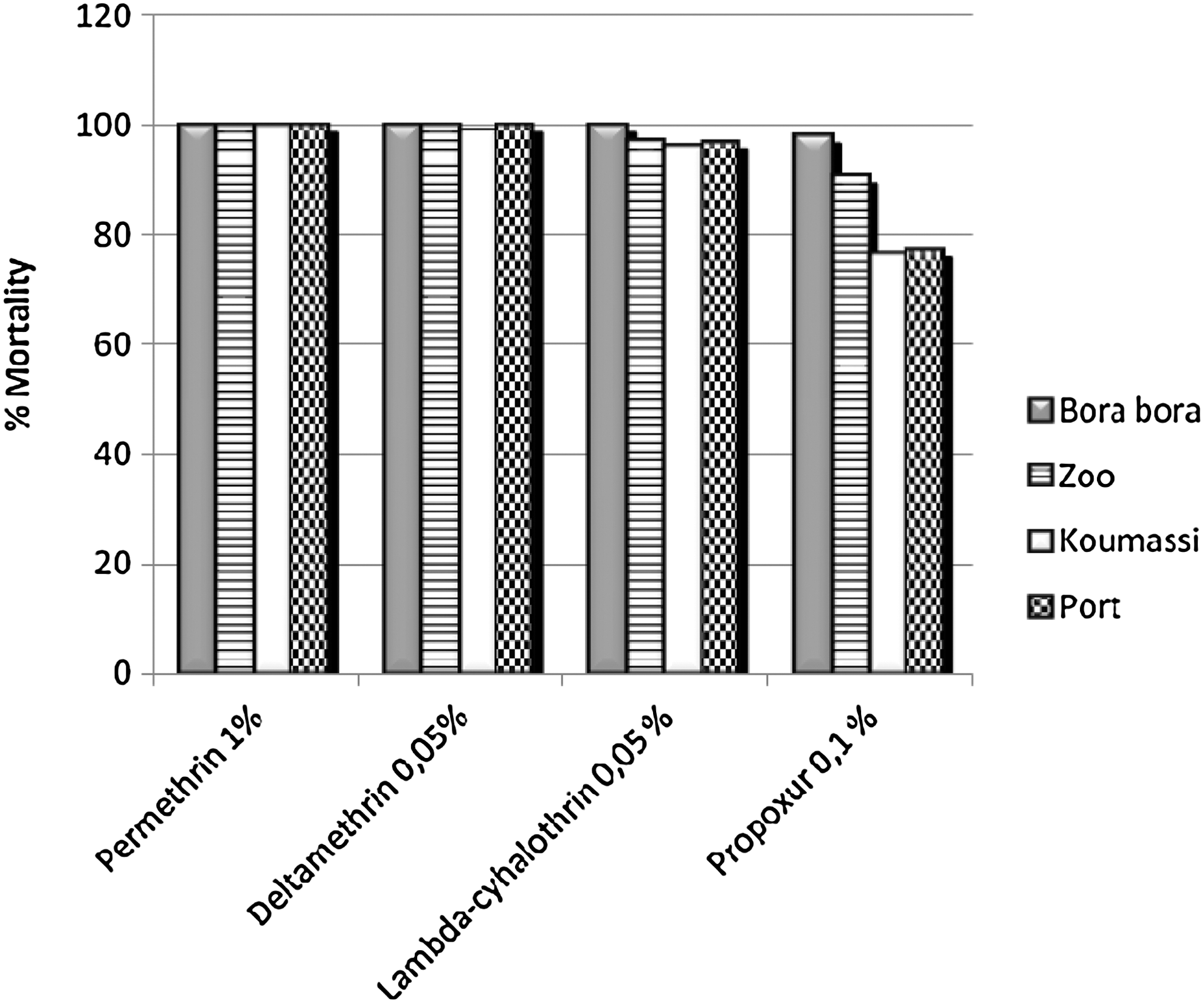
Mortality of Aedes aegypti to different insecticides.
KdT50 obtained with natural populations of A. aegypti ranged from 9 to 13 min with permethrin, 17 to 22 min with deltamethrin, and 41 to 50 min with lambdacyhalothrin. It confirmed the susceptibility of these wild populations to pyrethroid insecticides tested with RR50<2.3 (Table 1).
KdT50 knockdown times for 50%; RR, resistance ratio.
Discussion
This study was conducted to measure the susceptibility of A. aegypti adults to permethrin, deltamethrin, lambdacyhalothrin, and propoxur. Mosquitoes were exposed to the diagnostic dose of WHO standard insecticide paper with the recommended exposure time (WHO 1981) except for DDT. However, to establish log dose–probit mortality curves, the tests were performed for the same contact times of 1 h. In addition to mortality, knock down time was recognized for a long time as an indicator of susceptibility (Kang et al. 1995, Prapanthadara et al. 1995) because this parameter provides the first information on the possible involvement of knockdown resistance (kdr) gene.
The widespread use of insecticide has generally led to selective insecticide resistance in Mosquitoes. In Thailand, A. aegypti exhibit various levels of resistance to permethrin and deltamethrin, the commonly used insecticide for routine control of adults (Somboon et al. 2003, Huong et al. 2004, Paeporn et al. 2005, Jirakanjanakit et al. 2007). This resistance of A. aegypti in Thailand can also be attributed to DDT, the first insecticide used for the control this mosquito species where cases of dengue hemorrhagic fever had been reported. Cross resistance to DDT and pyrethroids has been reported in most species of mosquitoes of public health importance resulting from the kdr gene (Hemingway and Ranson 2000, Brengues et al. 2003). In VietNam and Indonesia, A. aegypti was found susceptible to pyrethroids in some parts of the country, but resistant in other regions (Huong et al. 2004, Ahmad et al. 2007). This discrepancy in different regions in VietNam has been attributed to the longer and the lasting use of insecticides of pyrethroid group in malaria and dengue hemorrhagic fever control programs and in agriculture particularly in the Southern and Central Highlands in the country.
In the present study in Côte d'Ivoire, the wild populations of A. aegypti were found to be sensitive to permethrin, deltamethrin, and lambdacyhalothrin after 1 h of contact with impregnated paper. According to Valles et al. (1997), a population is considered resistant if RR is >10. In our study, RR50, ranged from 1.2 to 2.2. This sensitivity was confirmed by the mortality rate of 100% observed with permethrin and deltamethrin and 97% with lambdacyhalothrin. According to WHO protocol, a population is considered resistant if >20% of the population survives the diagnostic dose compared to the susceptible strains (WHO 1981).
The results obtained in the present study are quite striking because different pyrethroids have been used and continue to be used in quite massive quantities in the country.
Since 1996, there is an increasing of the use of treated nets in the strategy against malaria. Further, pyrethroids especially deltamethrin and lambdacyhalothrin were used in bednet retreatment centers in all the regions in the country and household insecticide products containing synthetic pyrethroids have been commonly used, against mosquitoes' nuisance (Doannio et al. 2004). For these reasons, any form of resistant to the tested chemicals would not have been a surprise. The results can therefore be explained by the fact that despite the widespread use of pyrethroids, natural habitats of Aedes have probably not been sufficiently exposed to chemicals to make them resistant.
The same results were observed with these pyrethroids in 2003 with A. aegypti populations in Bouake (Côte d'Ivoire) (Konan 2003) a city situated at 400 km from Abidjan is surrounded by an important agriculture zone.
Concerning knockdown activity, KdT50 observed with lambdacyhalothrin at different sites are statistically higher than those of permethrin and deltamethrin (χ 2>12.86; p<0.0003). On the other hand, KdT50 of permethrin and deltamethrin did not differ significantly on the sites of Koumassi and the Port (χ 2>0.99; p<0.31). Permethrin and deltamethrin induced a more significant knock-down effect against A. aegypti populations from Abidjan than lambdacyhalothrin.
Another striking observation of this study is the resistance of A. aegypti populations from Abidjan to propoxur although it is not a popular chemical for mosquito control in Côte d'Ivoire.
Conclusion
This study appears to be the first published report of pyrethroid resistant of A. aegypti in Côte d'Ivoire. Our results reveal the susceptibility of A. aegypti populations of Abidjan to permethrin, deltamethrin, and lambdacyhalothrin despite their apparently massive presence in household insecticide products and in impregnated nets used against mosquito nuisance and also their use in centers for impregnation of mosquito nets. It is interesting to note that permethrin had a high knock down rate. This study shows that the use of pyrethroid to control A. aegypti species should be carefully managed with a particular attention to the monitoring of pyrethroid resistance.
Footnotes
Acknowledgments
We thank the Head and staff of the Zoo, the company operating the container terminal (Society of the Exploitation of Vridi container Terminal [SETV]) of the Autonomous Port of Abidjan and the place of sale of imported used tires. Dr Kouadio Kouamé (Institute Pasteur of Côte d'Ivoire) and Segbo John (Stop Malaria International) for proof reading this article.
Disclosure Statement
No competing financial interests exist.