




Abstract
Coxiella burnetii is a gram-negative bacterium that causes the zoonotic disease Q fever. Traditionally considered an obligate intracellular agent, the requirement to be grown in tissue culture cells, embryonated eggs, or animal hosts has made it difficult to isolate strains and perform genetic studies on C. burnetii. However, it was recently demonstrated that the attenuated Nine Mile Phase 2 (NM2) C. burnetii strain will grow axenically in acidified citrate cysteine medium (ACCM) in a 2.5% oxygen environment. The current study was undertaken to determine whether more virulent C. burnetii strains could be grown in ACCM, and whether virulence would be maintained after passage. The ACCM medium supported an ∼1000-fold expansion of Nine Mile Phase 1 (NM1), NM2, M44, and Henzerling strains of C. burnetii, whereas the Priscilla (Q177) strain expanded only 100-fold, and the K strain (Q154) grew poorly in ACCM. To determine if passage in ACCM would maintain the virulence of C. burnetii, the NM1 strain was grown for up to 26 weekly passages in ACCM. C. burnetii maintained in ACCM for 5 or 8 passages maintained full virulence in a mouse model, but NM1 passaged for 23 or 26 times was somewhat attenuated. These data demonstrate that virulent strains of C. burnetii can be successfully passaged in ACCM; however, some strains can lose virulence after extended passage, and other strains grow poorly in this medium. The loss of virulence in axenic culture was associated with some truncation of lipopolysaccharide chains, suggesting a possible mechanism for attenuation.
Introduction
C. burnetii is a gram-negative gamma-proteobacteria that grows within the acidic phagolysosomal compartments of the endocytic pathway of eukaryotic host cells (Voth and Heinzen 2007). C. burnetii does not normally grow outside of these acidic intracellular compartments and is considered an obligate intracellular organism. This limits laboratory growth of C. burnetii to tissue culture cell lines, animal hosts, or embryonated eggs. The obligate intracellular nature of C. burnetii has been an impediment to isolation and genetic studies. Despite the strict growth requirements of C. burnetii, a culture medium has recently been developed that allows growth in axenic media in the absence of host cells (Omsland et al. 2009). This medium (acidified citrate cysteine medium [ACCM]) contains specific nutrients that support C. burnetii metabolic activities, and is at pH 4.75, mimicking the acidic environment of phagolysosomal compartments. Growth of C. burnetii in ACCM requires a 2.5% oxygen atmosphere (Omsland et al. 2009).
Isolates of C. burnetii have been described as existing in one of two phases that have differences in lipopolysaccharide (LPS) structure and virulence in animals. Phase 1 variants of C. burnetii have a complete LPS structure and are virulent in animals (Russell-Lodrigue et al. 2009). In contrast, phase 2 variants have a truncated form of LPS, usually due to loss of one or more of the three sugars that comprise the LPS O-antigen (virenose, dihydrohydroxystreptose, and galactosaminuronyl-α(1.6)-glucosamine) (Amano et al. 1987). These variants grow very well in tissue culture within host cells, but have impaired growth and reduced pathology when inoculated into animals (Moos and Hackstadt 1987, Andoh et al. 2007).
The Nine Mile strain of C. burnetii offers the classic example of C. burnetii phase variation. The Nine Mile phase 1 (NM1) strain was one of the original isolates of C. burnetii, taken from a Montana tick in 1935 (Maurin and Raoult 1999). This is a virulent strain that can cause Q fever in humans (Benenson and Tigertt 1956) and grows very well in mouse models (Russell-Lodrigue et al. 2009). After repeated passage of the NM1 strain through embryonated eggs, a new antigenic variant emerged that was called Nine Mile Phase 2 (NM2) (Stoker and Fiset 1956). This phase 2 strain has lost all three sugars contained in the LPS O-antigen of NM1 due to a large genomic deletion that encompasses many of the genes involved in O-antigen biosynthesis (Denison et al. 2007). The phase 2 variant of NM was subsequently shown to have low virulence in animal infection models (Moos and Hackstadt 1987, Andoh et al. 2007).
The previous report of C. burnetii growth in host cell-free media demonstrated growth of the NM2 strain (Omsland et al. 2009), but not the growth of virulent phase 1 strains. Here, we report axenic growth of multiple strains of C. burnetii including NM1. To determine if virulence of NM1 is maintained after long-term culture, it was passaged weekly in ACCM for 26 weeks and then injected into mice. The results show that some virulence is lost after long-term axenic culture, with concomitant truncation of LPS.
Materials and Methods
Coxiella burnetii strains
Strains used for this study were NM1 (clone 7, RSA493), NM2 (clone 4, RSA439) (Stoker and Fiset 1956), M44 (Phase 2 human blood isolate), Henzerling (Phase 1 human blood isolate), K strain (Phase 1 human heart valve isolate), and Priscilla (Phase 1 goat isolate, Q177). Nine Mile and M44 strains were used as purified stocks obtained by sucrose gradient centrifugation after growth in chicken eggs as previously described (Miller and Thompson 2002). The Henzerling, Priscilla, and K strain stocks were partially purified after growth on monolayers of the rabbit kidney cell line RK13 in tissue culture. Stocks were kept frozen in sucrose-phosphate-glutamate buffer (SPG) until use. SPG consists of 0.7 M sucrose, 0.15 M KCl, 5 mM glutamate, 7.8 mM K2HPO4, and 3.7 mM KH2PO4.
Culture of C. burnetii
ACCM was prepared as described previously (Omsland et al. 2009). Seven milliliters of media were added to T-25 flasks, which were then inoculated with different doses of purified strains of C. burnetii. Flasks were incubated in a Heracell 150i incubator with 2.5% oxygen, 5% CO2, 37°C. Genome equivalents (GE) of C. burnetii in the cultures were determined by purifying DNA from 200 μL of the culture using the QIAamp DNA mini kit tissue protocol (Qiagen, Valencia, CA). Purified DNA was then analyzed by quantitative PCR targeting the IS1111a insertion sequence (for Nine Mile strains), or the com1 gene (for other strains). These PCR assays have been described elsewhere (Kersh et al. 2010). Long-term weekly passage was accomplished by taking 10 μL from a T-25 flask at the end of a 7-day culture and inoculating a fresh T-25 containing 7 mL ACCM. For intracellular growth, RK13 cells in Dulbecco's modified Eagle's medium, 10% fetal bovine serum, and 2 mM glutamine were plated on wells of a 24-well plate and C. burnetii were then added to the cultures and harvested after 1 or 9 days of incubation at 37°C, 5% CO2. DNA was isolated using the QIAamp DNA mini kit tissue protocol and quantitative PCR for the com1 gene was used to determine the number of GE.
Mouse infections
Male Balb/c mice were injected intraperitoneally with 100,000 C. burnetii organisms. To prevent cross-contamination, mice were housed in a Tecniplast Isocage system employing HEPA filters for air entering and exiting the cages (Tecniplast, Exton, PA). Mice were euthanized 3 weeks after infection, and sera and spleens were harvested. To quantify the C. burnetii in the spleens, single-cell suspensions were made, DNA purified, and quantitative PCR for IS1111a performed. Serum titers of IgG antibody against phase 1 and phase 2 C. burnetii were determined by indirect fluorescent antibody test as described previously (Anderson et al. 2009).
Analysis of LPS
To analyze LPS structure, ∼2×10⁹ GE of purified C. burnetii were resuspended in 0.5 mL water and then mixed with an equal volume of buffer-saturated phenol (pH 7.6) and boiled for 10 min. The mixture was centrifuged, the aqueous phase was saved, and 0.5 mL water was added to the remaining phenol. This mixture was mixed, boiled for 5 min, and centrifuged, and then the aqueous phase was removed and added to the previously extracted aqueous phase. The aqueous phase was then lyophilized and the resulting pellet solubilized in 50 μL sodium dodecyl sulphate–polyacrylamide gel electrophoresis (SDS-PAGE) sample buffer (50 mM Tris-Cl, 2% SDS, 0.1% bromophenol blue, and 10% glycerol). Ten microliters was then analyzed by SDS-PAGE using a 15% acrylamide gel. The gel banding pattern was observed by silver staining.
Results
Growth of pathogenic strains in ACCM
Flasks containing ACCM were inoculated with 105–106 GE per mL of 6 strains of C. burnetii (NM2, NM1, M44, Henzerling, Priscilla, and K strain). The flasks were incubated for 7 days in ACCM, and the number of GE at the beginning and end of the culture was determined. NM2, NM1, M44, and Henzerling strains of C. burnetii all replicated well under these conditions, with an ∼1000-fold expansion for each strain (Fig. 1A). The Priscilla strain (Q177) also grew in ACCM, but with only about a 100-fold expansion. However, the K strain (Q154) of C. burnetii grew very poorly (twofold expansion) under these conditions. Incubation of K strain in ACCM for 12 days did not improve yields (data not shown). Growth of this K strain stock in the rabbit cell line RK13 demonstrated viability of this strain in host cells (Fig. 1B). These data demonstrate that ACCM culture in a low-oxygen environment can support growth of multiple strains of C. burnetii, but there may be considerable variation in growth among different C. burnetii strains in host cell-free culture.
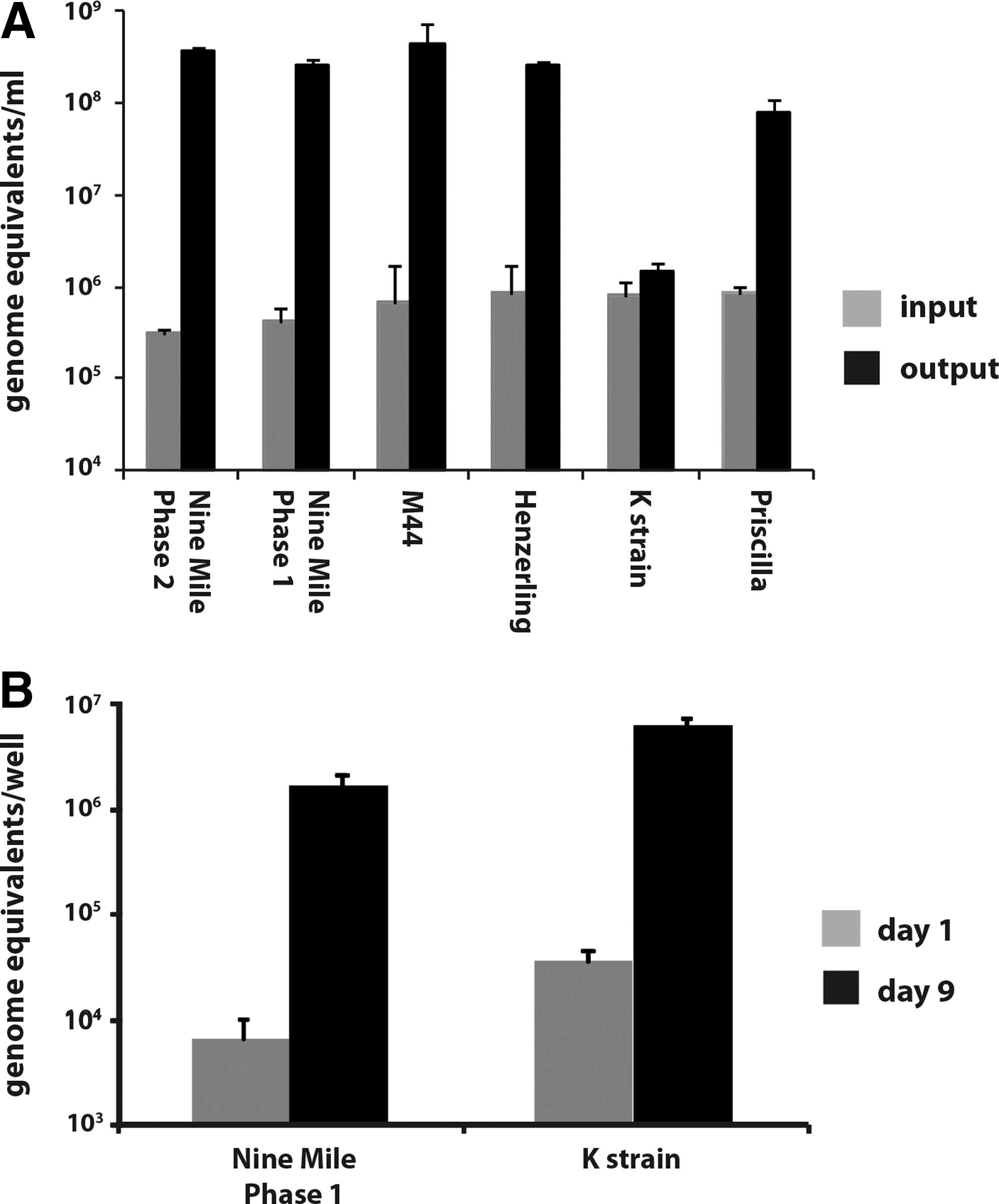
Growth of selected Coxiella burnetii strains in host cell-free and RK13 culture. For host cell-free growth
More frequent sampling of cultures containing NM1, NM2, and M44 strains of C. burnetii showed that C. burnetii grows exponentially for ∼6 days in axenic culture and then enters a stationary phase (Fig. 2). Incubation of these strains beyond 7 days did not result in further expansion of the strains. It appears that this media cannot support densities greater than 108–109 GE per/mL.

Extended growth curves for NM Phase 2, NM Phase 1, and M44 strains of C. burnetii. T-25 flasks containing 7 mL ACCM were inoculated with the indicated strains of C. burnetii. Samples were taken at days 1, 4, 6, 8, 11, 12, and 15. DNA was extracted and quantitative PCR was performed to determine the GE present at each time point. Similar results were obtained in two separate experiments for each strain.
Inoculation of the cultures with different amounts of C. burnetii did not change the ability of the cells to expand ∼1000-fold in 7 days. Figure 3 shows data for different doses of NM2 and NM1 added to ACCM and incubated for 7 days. At low input doses, the cells are able to expand 1000-fold independent of the starting concentration. At higher input concentrations, the cells still only expand to a density of ∼109 GE per mL. The medium is not capable of supporting higher densities of growth even if the culture starts out with 107 or 108 GE per mL. Inoculation of cultures with higher densities of Priscilla and K strain also did not improve the expansion of these strains (data not shown).

Effect of input concentration on growth of C. burnetii in ACCM. T-25 flasks containing 7 mL ACCM were inoculated with the indicated concentrations of NM Phase 2
Maintenance of virulence
To evaluate whether C. burnetii strains could maintain virulence after long-term culture in ACCM, NM1 was cultured in ACCM for 26 weeks with weekly passage. Aliquots of host cell-free grown NM1 were saved after 5, 8, 23, and 26 passages. The host cell-free grown NM1 was injected into mice and compared to mice injected with NM1 or NM2 purified from chicken eggs. Three weeks after infection, the mice were euthanized and the spleens removed and weighed. Splenomegaly is a hallmark pathologic feature of C. burnetii infection in mice (Scott et al. 1987). Egg-grown NM1 induced spleen sizes that were about 5 to 7 times larger than spleens in uninfected mice (Fig. 4A). Egg-grown NM2 was not effective at inducing splenomegaly, as spleen sizes in NM2-infected mice were similar to uninfected mice. When mice infected with host cell-free NM1 grown for 5 or 8 passages were examined, splenomegaly was reduced in some experiments compared to purified, egg-grown NM1, but overall spleen sizes were similar (Fig. 4A). However, spleen sizes in mice infected with host cell-free passage 23 or 26 was reduced approximately fourfold compared to egg-grown NM1. The NM1 passaged for 23 and 26 weeks in ACCM behaved more like NM2 than the egg-grown NM1.

Infection of mice with egg-grown versus axenically cultured C. burnetii. Mice received an intraperitoneal injection of 105 GE of the indicated strains of C. burnetii and animals were euthanized at 21 days postinfection. Mice and spleen weights were determined and the ratio of spleen weight to body weight±SD is shown
To determine the growth of these different C. burnetii strains in mice, genomic DNA was purified from each mouse spleen and the GE of C. burnetii determined. As shown in Figure 4B, at 3 weeks postinfection high amounts of C. burnetii DNA were contained in the spleens of mice infected with NM1. Three to four logs fewer GE were contained in the spleens of mice infected with NM2. Infection with NM1 grown for 5 or 8 passages in ACCM resulted in spleen loads similar to the egg-grown NM1. Bacterial loads were reduced in mice infected with NM1 grown for 23 or 26 passages in ACCM. However, the reduction is only about one log compared to egg-grown NM1. Thus, growth of NM1 in vivo appears to be attenuated after long-term passage of NM1 in ACCM; however, the attenuation is not nearly as great as that seen with NM2.
Infection of mice with purified NM1 also induces a robust antibody response to NM2. For the experiment shown in Figure 5, mice infected with egg-grown NM1 had anti-phase 2 IgG titers eightfold greater than mice infected with NM2. Axenically grown NM1 also induced strong anti-phase 2 IgG responses in vivo. NM1 grown in ACCM for 5 passages had antibody responses similar to egg-grown NM1, but NM1 passaged for 23 or 26 times had anti-phase 2 IgG titers two and fourfold lower than egg-grown material, respectively.

Serum antibody titers against NM2 C. burnetii in mice infected with egg-grown versus axenically cultured C. burnetii. Mice received an intraperitoneal injection of 105 GE of the indicated strains of C. burnetii and animals were euthanized at 21 days postinfection. Sera were collected at the time of euthanasia and anti-phase 2 IgG antibody titers were determined by indirect fluorescent antibody test. Each bar represents the geometric mean titer±SD from four mice. Similar results were obtained in three separate experiments.
Truncation of LPS chains
The NM1 passaged for 23 or 26 weeks in axenic culture underwent some degree of attenuation. It was possible that the attenuation was due to loss of LPS O-antigen sugars. To determine the status of LPS chains in the axenically grown NM1 samples, LPS was extracted from these bacteria and analyzed by SDS-PAGE. As shown in Figure 6, the majority of LPS from NM2 runs at a smaller molecular weight than LPS from NM1. This difference in LPS migration on SDS-PAGE has previously been attributed to the loss of O-antigen sugars (Hackstadt et al. 1985). For NM1 grown in host cell-free culture, the full-length LPS is visible in all of the passages, but a truncated LPS is also plainly seen in the 23 and 26 passage samples. The truncated form was never seen in the passage 8 NM1, and for NM1 passage 5, it was detected in only 1 of the 4 samples analyzed. These data show that C. burnetii can lose LPS side chains during long-term culture in ACCM.
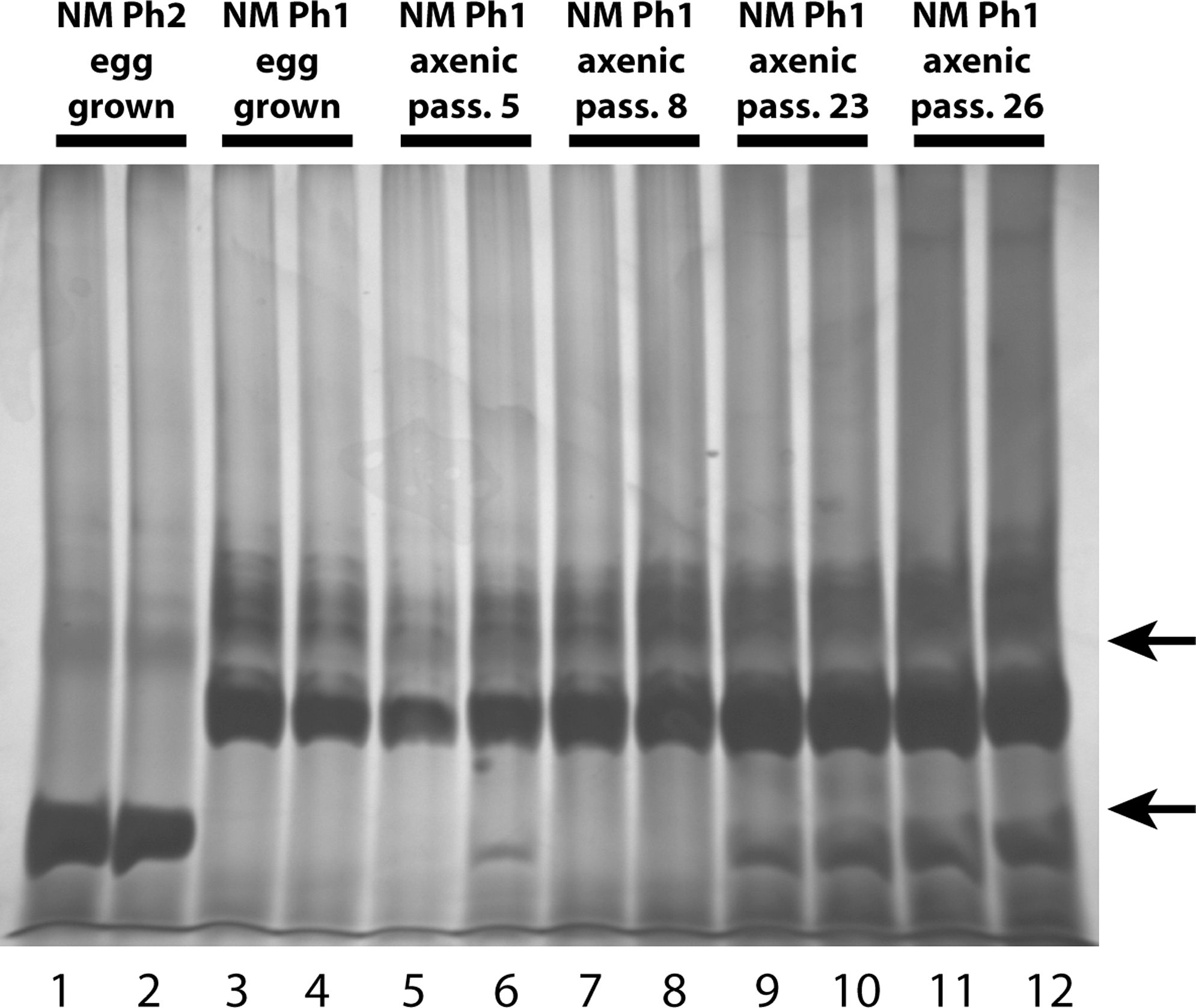
Analysis of C. burnetii LPS after long-term host cell-free passage. LPS was extracted from purified egg-grown NM Phase 1 and NM Phase 2, as well as NM Phase 1 grown for the indicated passages in ACCM. Extracts were separated by sodium dodecyl sulphate–polyacrylamide gel electrophoresis and observed by silver staining. The upper and lower arrows indicate LPS structures of 10–14 kDa and 2.5–4 kDa, respectively. LPS, lipopolysaccharide.
Discussion
The results reported here demonstrate that multiple C. burnetii strains grow well in the absence of host cells, but there is considerable strain variability. Two strains were identified in this study (K strain and Priscilla) that grew considerably less well than NM2 in ACCM. Interestingly, these two strains are closely related phylogenetically based on genome sequence analysis (Beare et al. 2009).
Multiple strains of C. burnetii were able to grow to densities of nearly 109 GE per mL. This density could not be exceeded either by allowing the culture to grow for up to 15 days, or by inoculating the culture with higher densities of C. burnetii. That C. burnetii has a ceiling on growth suggests that it can sense limitations in its environment. Many gram-negative bacteria employ quorum-sensing circuits in which each bacterium produces an autoinducer that can alter gene expression in the entire population when the concentration of the autoinducer reaches a threshold (Miller and Bassler 2001). These circuits can function to limit the density bacterial cultures. Although quorum-sensing circuits have never been described for C. burnetii, the genome sequences of C. burnetii isolates do show the presence of potential two-component regulatory systems that could function in response to autoinducers and limit growth (Beare et al. 2009). Characterization of these pathways in C. burnetii awaits further investigation. Intervening in putative signaling pathways that limit density could be a means to enhance axenic growth of C. burnetii. It may also be possible to increase the density of axenic C. burnetii cultures by adding more of certain nutrients that are exhausted as the cells enter stationary phase. However, spiking cultures with fresh media after 6 days of growth did not increase expansion (data not shown).
NM1 grown in ACCM underwent attenuation after long-term passage. The ability of NM1 passaged for 23 or 26 weeks to induce splenomegaly was reduced nearly to the level of NM2. That passage 5 and passage 8 NM1 did not show a significant reduction in splenomegaly suggests that the attenuation is acquired over time in the host cell-free culture. Future studies could determine if the attenuation becomes more pronounced with further passage. The growth of C. burnetii passaged for 23 or 26 weeks was also reduced in a mouse infection. However, in the case of in vivo growth, the growth was only reduced one log compared to fully virulent NM1, whereas for NM2, growth was reduced by 3–4 logs. The different effects on splenomegaly and bacteremia suggest that separate mechanisms may regulate these processes in murine C. burnetii infection.
To date, only LPS has been described as a virulence factor for C. burnetii. Phase 2 strains have a truncated form of LPS on the surface and low virulence in animal models, and presumably also in humans. It has been proposed that phase 2 strains have low virulence because they activate complement receptor 3 (CR3) on host cells when they are internalized. Activation of CR3 allows for better endocytosis of the bacterium, but also initiates signals that cause them to be more easily eliminated in vivo (Capo et al. 1999). The full-length LPS chains on phase 1 strains mediate redistribution of CR3 on host cells and promote virulence by allowing entry without involvement of CR3 (Capo et al. 2003). The ease with which phase 2 strains are endocytosed is thought to give them a growth advantage in vitro that allows them to emerge and become predominant during long-term culture. Based on this model, emergence of C. burnetii with truncated LPS would not necessarily be expected in axenic culture because better entry into host cells would not provide an advantage. However, emergence of small forms of LPS after long-term passage in host cell-free media was observed in this study. This suggests that the loss of LPS chains in culture does not need to be related to improved host cell entry. It may be that the production of full-length LPS is inherently detrimental to in vitro replication, due to energy demands or other reasons.
This study has demonstrated an attenuation of the virulent NM1 strain after long-term passage and also observed the emergence of truncated LPS in the attenuated strains. Is shortening of the LPS chains responsible for the attenuation of virulence in this case? Although there is a clear emergence of shorter LPS chains consistent with a phase 2 chemotype, it still appears as if the majority of the cells in the culture are retaining the full-length LPS. The percentage with the shortened LPS does increase with increased passage and it could be that eventually the entire population would convert to the shortened LPS form. However, the attenuation observed in strains that were only passaged long enough to truncate a portion of the LPS chains suggests that there could be additional factors that have been modified in culture passage that play a role in the reduction in virulence.
The results presented here demonstrate that a variety of strains of the obligate intracellular bacterium C. burnetii can be grown in host cell-free culture. That some strains grow poorly in ACCM suggests that this medium in its current formulation may not be universally applicable to C. burnetii and may not be a suitable initial growth medium for attempts to isolate certain new strains. The loss of virulence in a mouse model after long-term culture also indicates that C. burnetii should not be grown long-term in ACCM and that periodic passages in animals are advisable for strains for which maintenance of virulence is a desired trait.
Footnotes
Acknowledgments
The authors would like to thank Anders Omsland and Robert Heinzen for advice and helpful suggestions. The findings and conclusions in this report are those of the authors and do not necessarily represent the views of the CDC or the Department of Health and Human Services.
Disclosure Statement
No competing financial interests exist.