




Abstract
Universal primers and probes were selected on the basis of the 16S rRNA gene sequence of Borrelia burgdorferi in GenBank®, and a real-time polymerase chain reaction (PCR) method for detection of B. burgdorferi was established. The results showed that this method could specifically detect the B31 strain (Borrelia burgdorferi sensu stricto), the BO23 strain (Borrelia afzelii), and the SZ strain (Borrelia garinii), without cross-reaction with genome DNA of Theileria (T. luwenshuni, T. uilenbergi, T. sinensis, T. annulata, T. sergenti, T. annulata), Babesia (B. bigemina, B. ovate, B. sp. (Xinjiang)), Anaplasma (A. marginale, A. ovis), Mycoplasma mycoides subsp. capri, and Chlamydia psittaci, which are the infective pathogens to yak and/or sheep. The sensitivity of this real-time PCR is 104 times greater than that of a conventional PCR. The real-time PCR was able to amplify 16S rRNA gene from as few as 22.88 fg genomic DNA of B. burgdorferi sensu lato. Tick DNAs from 369 field samples collected from Shangzhi City of Heilongjiang Province were tested, resulting in an infection rate of 42.80%, and a total of 332 genomic DNAs from the blood of 186 yaks and 146 sheep in the Gannan Tibetan Autonomous Prefecture of Gansu Province were tested, resulting in 24.19% positive rate for the yaks and 39.04% positive rate for the sheep.
Introduction
Hard ticks are natural biological vectors of B. burgdorferi. Ticks most frequently acquire spirochetes from infected rodents during the larval feeding (Donahue et al. 1987, Mather et al. 1989). After molting to the nymphal stage, infected ticks feed on animals, including rodents, which become a new reservoir, and the cycles perpetuate (Lane et al. 1991). After the nymphs molt to the adult stage, they exclusively feed on larger mammals (Lane et al. 1991). Thus, because ticks and animals play an important role in the life cycle of B. burgdorferi, to prevent and control Lyme disease, development of reliable and fast methods is necessary in the epidemiological investigation of B. burgdorferi in ticks and animals.
Currently, several methods are available for detection of B. burgdorferi, including dark-field microscopic examination, conventional polymerase chain reaction (PCR), in vitro culture (Gaumond et al. 2006), and others. However, in the detection of B. burgdorferi, as a rapid test, real-time PCR has the advantage of rapidity, high efficiency, high sensitivity, (Pahl et al. 1999, Barthold et al. 2010) and instant readout of the results.
In this study, a new real-time PCR was developed on the basis of the 16S rRNA gene of B. burgdorferi. The usefulness of the method was evaluated by testing genomic DNA from 369 ticks of Dermacentor spp. and 332 blood samples from yaks and sheep.
Materials and Methods
Bacterial strains
Borrelia burgdorferi sensu stricto (B31) and B. afzelii (BO23) were purchased from the American Type Culture Collection (ATCC) center. B. garinii (SZ) was isolated from Dermacentor ticks as previously described (Niu et al. 2010b). These strains were cultured in BSK-H medium at 33°C in an incubator and observed with a dark-field microscope every other day. The bacteria were harvested by centrifugation at a speed of 13,000 g when they grew to logarithmic phase. The precipitations were washed three times with phosphate-buffered saline by centrifugation at a speed of 5000 g and preserved at –20°C for the extraction of DNA.
Ticks and blood samples
Dermacentor ticks (369) were collected from Shangzhi city in Heilongjiang Province and 332 blood samples of yaks and sheep were from the Gannan Tibetan Autonomous Region of Gansu Province in August 2010.
DNA preparation
Genomic DNA of B. burgdorferi strains was extracted using a TIANamp Bacteria DNA Kit (Tiangen Biotech [Beijing] Co. Ltd.) according to the manufacturer's instructions. Extraction of tick genomic DNA was carried out using the protocol as previously described (Niu et al. 2011). DNA of yak and sheep was extracted from blood samples using a DNeasy Blood and Tissue Kit (Qiagen) according to the manufacturer's instructions. Genomic DNAs of Theileria (T. luwenshuni, T. uilenbergi, T. sinensis, T. annulata, T. sergenti, T. annulata), Babesia (B. bigemina, B. ovate, B. sp. (Xinjiang)), and Anaplasma (A. marginale, A. ovis) were provided by our laboratory; those of Mycoplasma mycoides subsp. capri and Chlamydia psittaci were gifted by the Department of Animal Infectious Disease of Lanzhou Veterinary Research Institute, CAAS.
Primers and probe
On the basis of the 16S rRNA gene sequences of B. burgdorferi sensu lato in GenBank®, universal primers (upstream primer: 5′-GCTTCGCTTGTAGATGAGTCTG-3′; downstream primer: 5′-GCGGAAGATTCTTAGCTGCTG-3′) and probe (TaqMan probe: 5′-(FAM) CCGTATCTCAGTTCCAGTGTGACCG (Eclipse)-3′) were designed using Primer Express 3.0 software (Applied Biosystems). The primers and probe were synthesized by TaKaRa Company.
Reaction of real-time PCR
The PCR mixture (25 μL total volume) consisted of 12.5 μL Premix Ex Taq™, 0.25 μL each of primers (50 μM), 0.3 μL probe (50 μM), 0.5 μL ROX Reference Dye II (50×), 4 μL template DNA, and 7.2 μL double-distilled water. Amplification and detection were performed with a real-time PCR machine (MX3000 P system; Stratagene) with the following program: denaturation at 95°C for 30 s, followed by 40 cycles of 95°C for 5 s, 60°C for 20 s, and 72°C for 10 s. The template DNA of B. burgdorferi sensu stricto (B31) was fourfold diluted (57.5 ng/μL, 14.38 ng/μL, 3.59 ng/μL, 0.9 ng/μL, 0.225 ng/μL) and used for the establishment of the assay.
Specificity and sensitivity of the real-time PCR
Specificity of real-time PCR was evaluated by testing genomic DNA of B. burgdorferi sensu stricto (B31), B. afzelii (BO23), B. garinii (SZ), and genomic DNA of Theileria (T. luwenshuni, T. uilenbergi, T. sinensis, T. annulata, T. sergenti, T. annulata), Babesia (B. bigemina, B. ovate, B. sp. (Xinjiang)), Anaplasma (A. marginale, A. ovis), Mycoplasma mycoides subsp. capri, and Chlamydia psittaci were used as controls.
Sensitivity of the real-time PCR and a conventional PCR (Niu et al. 2010a) was evaluated by testing 10-fold diluted genomic DNA from B31 strain, BO23 strain, and SZ strain.
Evaluation of real-time PCR with field-collected samples
Genomic DNA of 369 adult ticks and 332 blood samples (186 from yaks and 146 from sheep) was detected using real-time PCR. Comparison of reverse-line blotting (RLB) (Niu et al. 2011) and the real-time PCR was performed using 154 tick DNA samples. Ten positive real-time PCR products that were negative in the RLB were subjected to sequencing by Sangon Biotech.
Results
Establishment of real-time PCR method
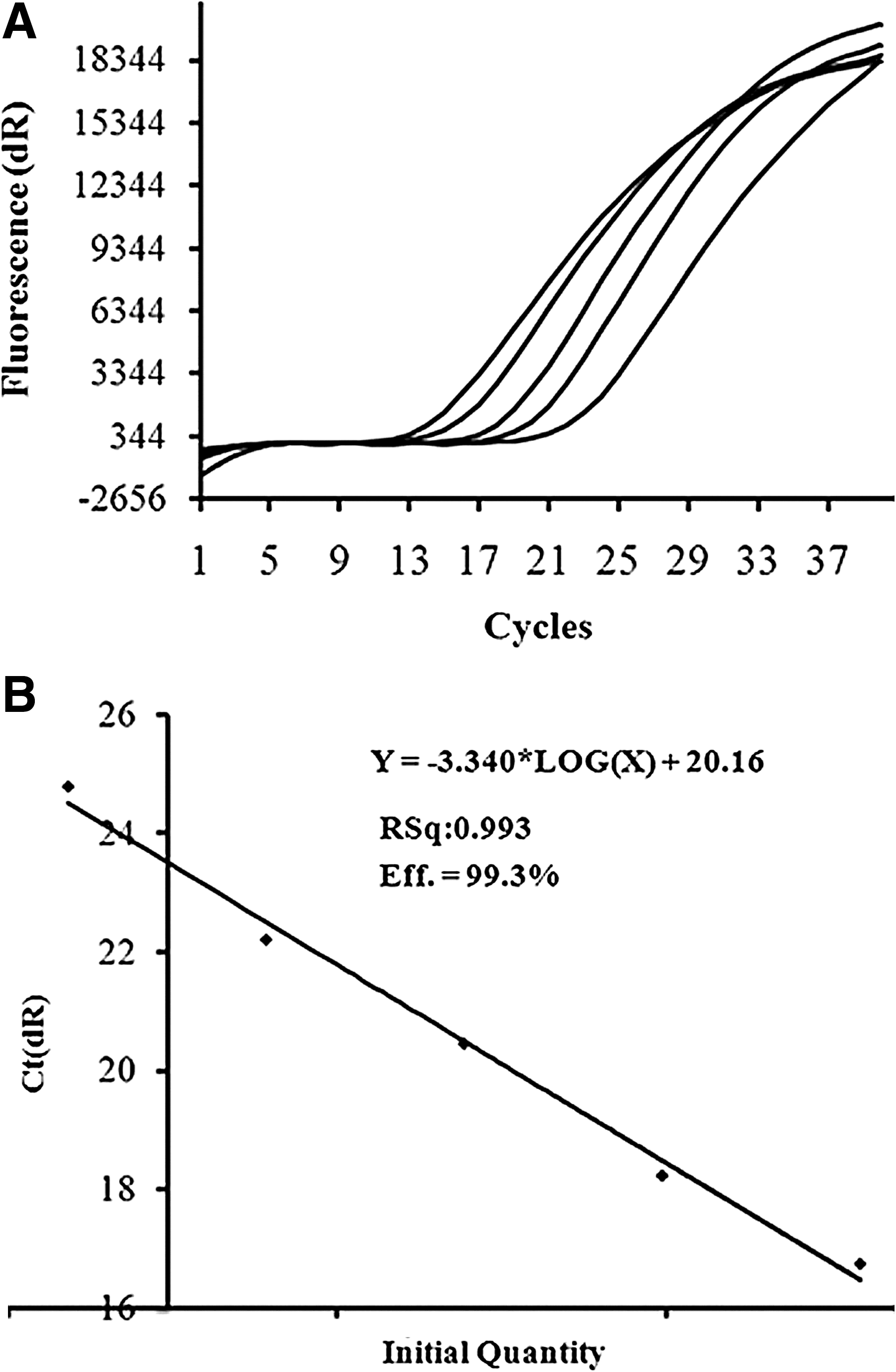
The amplification curve was good, and the Ct value was distributed equally (Fig. 1A). The RSq value and Eff value of the standard curve were 0.933% and 99.3%, respectively, and the Ct value of five genomic DNA dilutions was in a straight line (Fig. 1B). These results indicated that the real-time PCR was established successfully.
Specificity of the real-time PCR
The results showed that the real-time PCR could specifically detect DNA from B. burgdorferi sensu stricto (B31), B. afzelii (BO23), and B. garinii (SZ), and no cross-reaction with the genomic DNA of control samples from Theileria, Babesia, Anaplasma, Chlamydia, Mycoplasma, yak, sheep, tick DNA, and double-distilled water (Fig. 2).
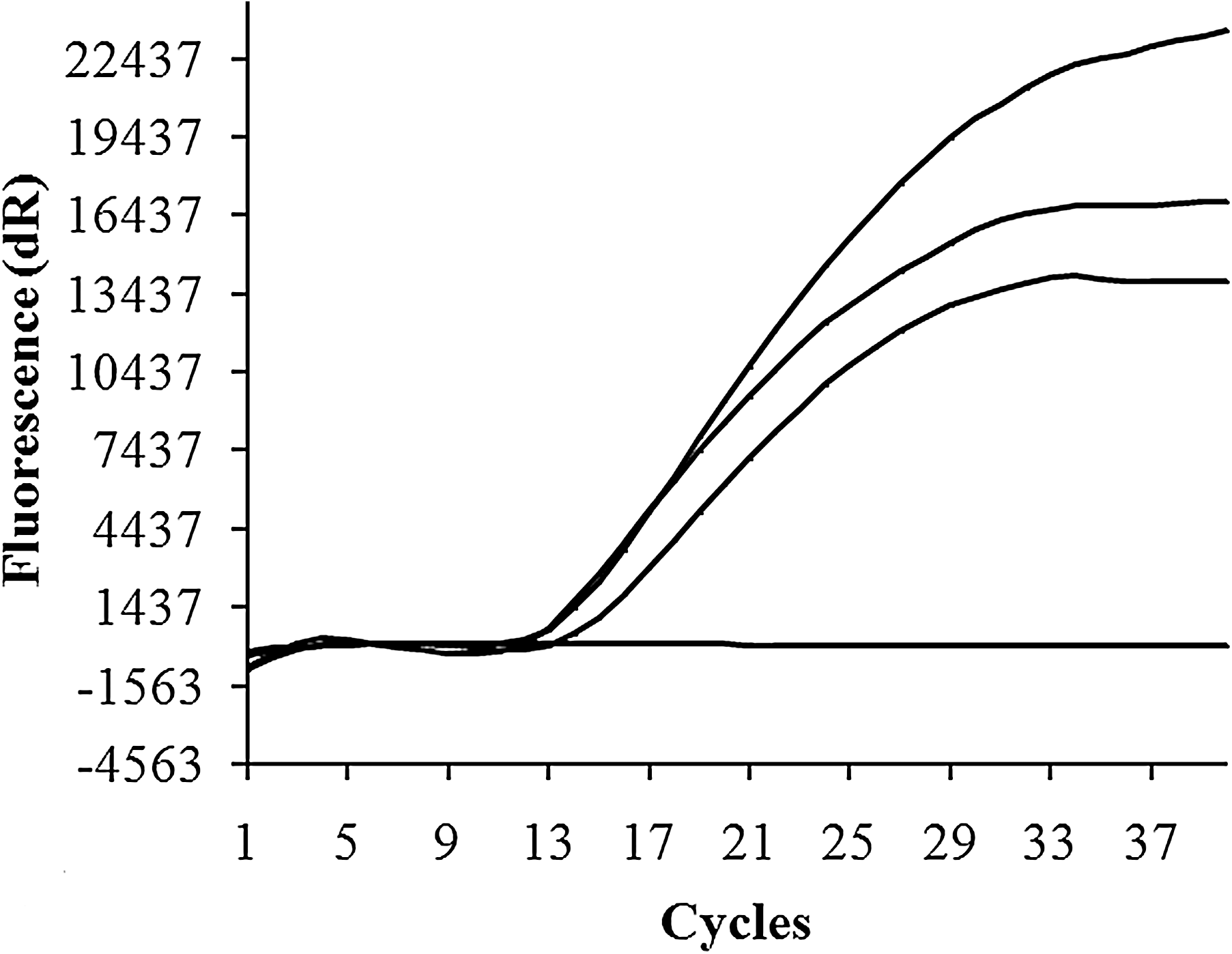
The specificity of the real-time PCR. The template DNA was genomic DNA of Borrelia burgdorferi sensu stricto (B31), Borrelia afzelii (BO23), Borrelia garinii (SZ), and genomic DNA of Theileria (T. luwenshuni, T. uilenbergi, T. sinensis, T. annulata, T. sergenti, T. annulata), Babesia (B. bigemina, B. ovata, B. sp. (Xinjiang)), Anaplasma (A. marginale, A. ovis), Mycoplasma Mycoides subsp. capri, Chlamydia psittaci, sheep, yak, tick, and water as blank control.
Sensitivity of the real-time PCR
The results showed that the real-time PCR could detect pathogen from minimal 10−7 diluted positive samples (Fig. 3A–C). In contrast, the conventional PCR could only detect minimal 10−3 diluted positive samples (Fig. 4A–C).
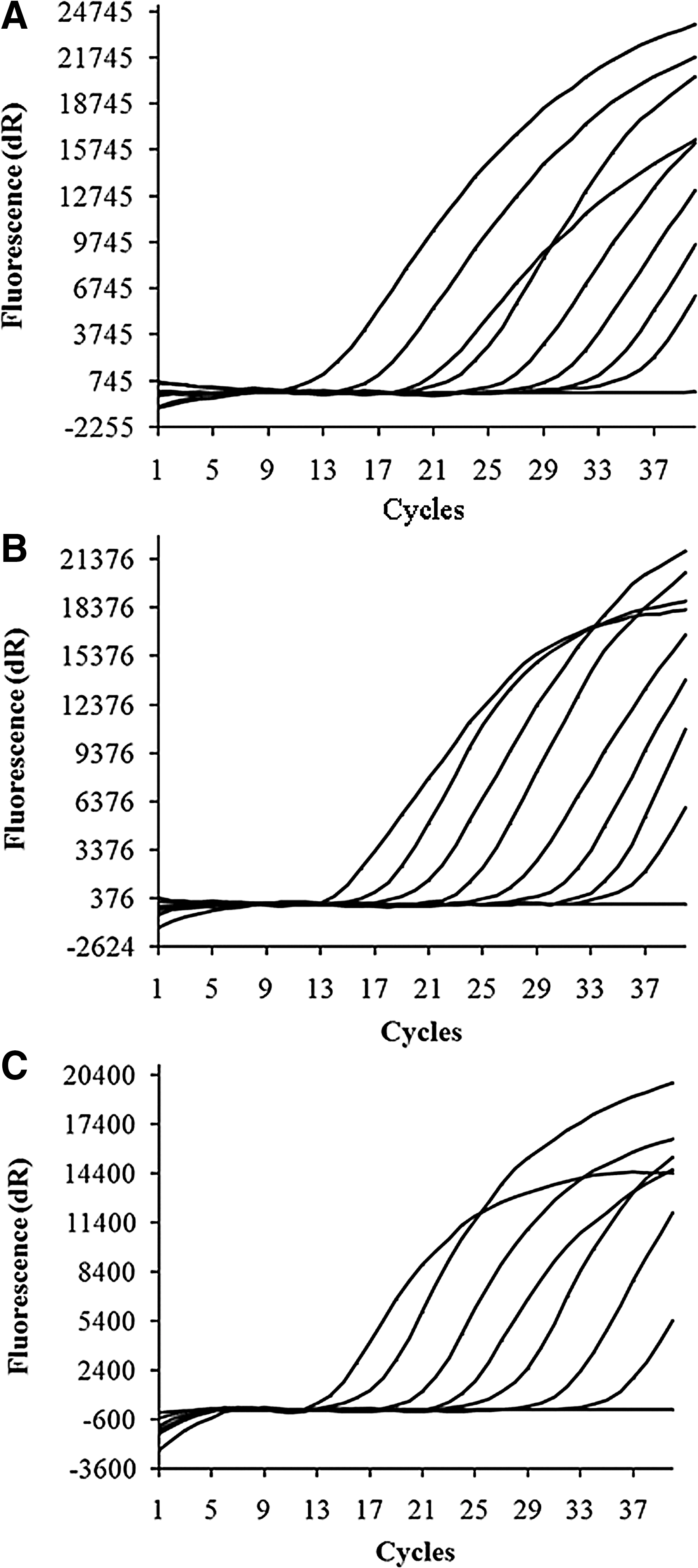
The sensitivity of the real-time PCR. Amplification curve of the real-time PCR with detection of 10-fold diluted genomic from strain B31
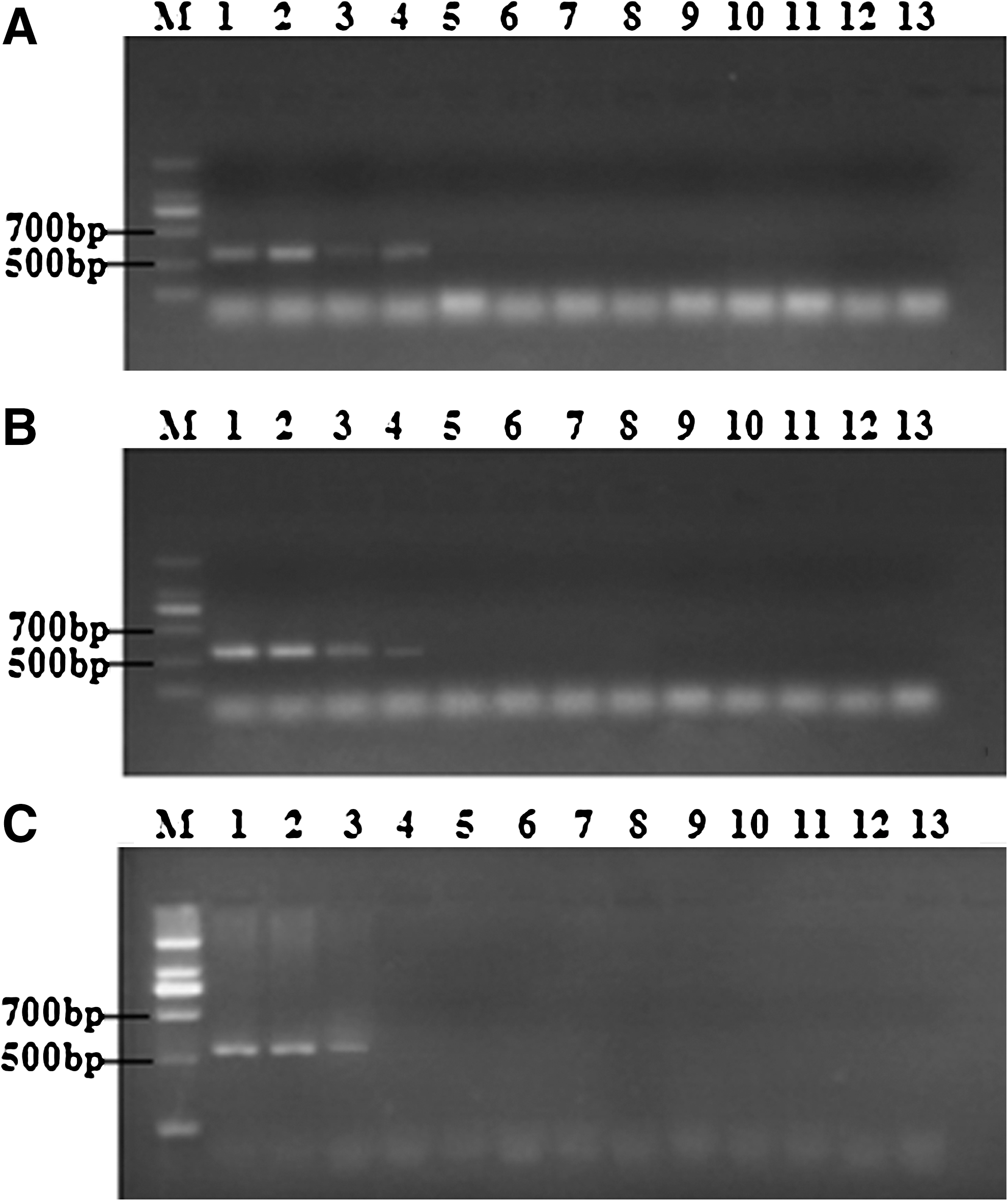
Electrophoresis results of the conventional PCR with detection of 10-fold diluted genomic DNA from standard strain B31
Detection of field samples using real-time PCR and RLB
Analysis of the real-time PCR results showed that the infection rate of 369 ticks was 42.8%. Among the samples, 154 samples from Maoershan tested by RLB showed 72.73% (112/154) positivity. In comparison, the positive rate using real-time PCR was 82.47% (127/154). The sequences of the real-time PCR-positive samples that were negative in RLB were subjected to BLASTn search in the NCBI database, and the result showed that all the obtained sequences were of Borrelia pathogen origin, confirming the high sensitivity of the real-time PCR over the RLB method. In addition, the positive rate of 215 ticks from Yangpao town, 186 yaks, and 146 sheep were 13.49%, 24.19%, and 39.04%, respectively (Table 1).
PCR, polymerase chain reaction; RLB, reverse-line blotting.
Discussion
In a previous study, a reverse transcriptase–PCR assay of B. burgdorferi 16S rRNA was more sensitive for detecting B. burgdorferi than an assay based on plasmid gene ospA and gene p66. However, there are drawbacks to using RNA as a template for PCR, such as high susceptibility of RNA degradation and nuclease contamination during extraction and storage, as well as the effect of additional reagents during the reverse transcription step (Ornstein and Barbour 2006). Therefore, genomic DNA was chosen as the template in our study to guarantee the stability of the methods.
In this study, we described a real-time PCR for the detection of B. burgdorferi in ticks and blood samples based on 16S rRNA gene, in which the RSq and Eff values of the standard curve were 0.933% and 99.3%, respectively. This method could detect B. garinii (SZ strain) from as few as 22.88 fg genomic DNA, and its sensitivity was 104 times greater than the conventional PCR. Moreover, when both the real-time PCR and RLB were used for detection of field samples, the real-time PCR detected more positive samples (Table 1), indicating high sensitivity of the real-time PCR. As real-time PCR relies on the release of a fluorescence signal of the reporter to detect samples, the sensitivity can be dramatically enhanced. Regarding the specificity of the assay, amplification of the target gene requires both primers and probe binding to the target gene, which potentially enhances the specificity of the assay. Because of the advantages of rapidity and easy-to-read results, real-time PCR can be used to detect a large number of samples and applied in epidemiological investigation. In addition, the assay can not only detect B. burgdorferi but also quantify its spirochete.
In detection of field tick samples, the assay detected 127 positive samples from 154 ticks collected in the Maoershan region, with a positive rate of 82.47%, and detected 29 positive samples from 215 samples collected in Yangpao Town, with a positive rate of 13.49% (Table 1). A high positive rate of the samples from Maoershan was also demonstrated by detection of the same samples using RLB (Table 1), providing further evidence that ticks in this region have a higher infection rate. It was not possible to ascertain why there was a much higher positive rate of ticks in Maoershan than that in its neighboring region Yangpao. However, it is generally known that the tick-borne pathogen is restricted by many factors, for instance, changes in the environment can affect the biological characters of ticks (Barandika et al. 2006). In addition, successful isolation of B. garinii (SZ) isolates from Maoershan in our laboratory proved that Maoershan is a natural epidemic focus of B. burgdorferi (Niu et al. 2010b).
Detection of blood samples from yaks and sheep in the Gannan region of Gansu Province showed that the infection rate is 39.04% (57/146) in sheep and 24.19% (45/186) in yak (Table 1). The results demonstrated that Lyme disease may have been prevalent in animals in these regions, residents who are living there have an infection risk, the reservoir hosts of B. burgdorferi in these regions are yak and sheep, and the investigated region is a natural epidemic focus of B. burgdorferi.
In conclusion, we developed a real-time PCR suitable for epidemiological studies on field samples of ticks and animal blood, and this method is a powerful tool for the detection of B. burgdorferi. The detection results of this study enriched our knowledge of epidemiology of B. burgdorferi in ticks and animals and the natural epidemic foci of B. burgdorferi in China.
Footnotes
Acknowledgments
This study was financially supported by the 973 Program (2010CB530206), NSFC (No. 30800820; No. 30972182, No. 31072130, No. 31001061), “948” (2010-S04), Key Project of Gansu Province (1002NKDA035 and 0801NKDA033), Beef and Yak Production System Program, MOA, Specific Fund for Sino-Europe Cooperation, MOST, China, and the State Key Laboratory of Veterinary Etiological Biology Project (SKLVEB2008ZZKT019). This research was also facilitated by EPIZONE (FOOD-CT-2006-016236), ASFRISK (No. 211691), ARBOZOONET (No. 211757), and PIROVAC (KBBE-3-245145) of European Commission, Brussels, Belgium.
Disclosure Statement
No competing financial interests exist.