




Abstract
In Brazil, although the domestic dog is a major target for the control actions for visceral leishmaniasis, knowledge gaps of the Leishmania species present in those animals still exist in many endemic areas. The objective of this study was the use of parasitological culture as a diagnosis tool and identification of species of Leishmania and other trypanosomatids in the canine population in the city of Cuiaba/Mato Grosso. Biological samples such as blood, intact skin fragments, cutaneous ulcers, and bone marrow were collected during a cross-sectional study and cultured on biphasic medium (Novy-MacNeil-Nicolle [NNN]/Schneider's). Leishmania isolates were characterized through isoenzyme electrophoresis. Isolates were obtained from 11.2% (n=54) of the 482 animals studied considering the different anatomical sites investigated. Leishmania chagasi was confirmed in 8.3% (n=40) dogs and Trypanosoma caninum in 2.9% (n=14). The sample of intact skin presented a higher chance of isolation of L. chagasi in symptomatic dogs and bone marrow in asymptomatic dogs (p<0.05). The results presented in this study emphasize the value of culture and confirm, for the first time, the circulation of L. chagasi in the canine population in different neighborhoods of the city of Cuiaba and broaden the knowledge of the geographical distribution of T. caninum in Brazil.
Introduction
One of the control measures for VL recommended in Brazil includes a canine serological survey followed by euthanasia of the seropositive dogs. Such a measure, although applied in endemic areas, has been questioned in view of possible cross-reactions obtained in serological tests (Coutinho et al. 1985, Vexenat et al. 1996), mainly in areas of overlapping with other trypanosomatids agents (Madeira et al. 2006, 2009b, Silva et al. 2011).
In the state of Mato Grosso (MT), located in central-western Brazil, the first human case of VL was reported in 1973 in the south-central region (Baruffa and Cury 1973); and since then, the disease is spreading mainly associated with migratory process and uncontrolled urban occupation (Mestre and Fontes 2007, Missawa and Borba 2009), as already described for other Brazilian regions (Marzochi et al. 1985, Antonialli et al. 2007). Although the disease has been reported in about 34 municipalities, including the capital (Cuiaba), little is known about the species of Leishmania parasites circulating in different hosts and environments, information that is essential both for control actions and epidemiological surveillance.
In this context, considering the importance of the domestic dog in the transmission chain of VL and the lack of information on different aspects of leishmaniasis in Cuiaba/MT, the current study aims at using culture as a diagnostic tool and identification of species of Leishmania and other trypanosomatids that may be circulating in the canine population.
Materials and Methods
Area and survey design
A cross-sectional study was conducted in the city of Cuiaba (15°35′56.10′′S and 56°05′41.62′′W), MT, located in central-western Brazil, comprising the neighborhoods Barreiro Branco, Coxipó do Ouro, Osmar Cabral, Bela Vista, and Jardim União, where cases of human VL were reported (data to be published).
The study was conducted in the canine population, sampling was defined by the Epi info 3.3.2 program (CDC, Atlanta, GA), considering canine VL (CVL) prevalence of 8.4% (Mestre and Fontes 2007), 99% confidence interval, and acceptable error of 2%, with the population based on canine census held in 2007. The minimum size was estimated at 430 animals, with dogs of both sexes and aged 6 months or more in the period between 2009 and 2010 being sampled. The exclusion of puppies aged <6 months is due to the risks to sedation procedure in this group. The survey was conducted through home visits, considering a residence for every five. In parallel, dogs that were attended at the Veterinary Hospital (HOVET) of the Federal University of MT with suspected leishmaniasis were also included in the study.
All procedures performed during this study were approved by the Ethics Committee for Animal Use of the Oswaldo Cruz Foundation, under the protocol number LW-01/10.
Animals and biological sample collection
After obtaining informed consent from the owners, the dogs were mechanically restrained and subjected to sedation with ketamine (10 mg/kg) associated with acepromazine (0.2 mg/kg) and grouped in asymptomatic, oligosymptomatic, and symptomatic groups, according to Mancianti et al. (1988) criteria. Blood was collected by cephalic or jugular venipuncture and bone marrow through aspiration of the sternum, after local anesthesia with lidocaine 2%, both with anticoagulants. Intact skin tissue samples (scapular region) and samples from cutaneous ulcers, when present, were obtained by biopsy, after a procedure that included trichotomy, antisepsis, and local anesthesia, collecting fragments of about 3 mm.
Parasitological culture and characterization by multilocus enzyme electrophoresis
The tissue fragments (skin and cutaneous ulcers) were kept in saline containing 1000 U penicillin, 200 μg streptomycin, and 100 μg 5′-fluorocytocine per milliliter and stored at 4°C for 24 h. Then, the samples were seeded in biphasic medium (NNN/Schneider's) plus 10% fetal bovine serum. Bone marrow and blood (200–300 μL) were seeded directly in the culture medium after collection. All samples were analyzed in duplicates, incubated at 26°C–28°C, and freshly examined, weekly, during 30 days.
Positive cultures (flagellate trypanosomatid found) were grown to obtain parasite mass and cryopreserved at −196°C under liquid nitrogen. Cultures with promastigote isolates were characterized by isoenzyme electrophoresis (Cupolillo et al. 1994), using five enzymatic loci: 6-phosphogluconate dehydrogenase (EC.1.1.1.43); phosphoglucose isomerase (EC.5.3.1.9); nucleoside hydrolase (2 loci, EC.3.2.2.1); glucose-6-phosphate dehydrogenase (EC.1.1.1.49), and phosphoglucomutase (EC.1.4.1.9). Reference samples of Leishmania braziliensis (MHOM/BR/75/M2903), Leishmania amazonensis (IFLA/BR/67/PH8), and L. chagasi (MHOM/BR/1974/PP75) were used in all the electrophoretic runs. Samples with isolates of Trypanosoma sp. were analyzed by nested polymerase chain reaction with targets for the region 18S rRNA whose molecular analysis of the amplified products identified all isolates as Trypanosoma caninum, as shown by Almeida et al. (2011).
Data analysis
Data obtained were analyzed by the Epi Info 3.3.2 program (CDC/Atlanta), using the Chi-square test (χ 2) or Fisher Exact Test, when any expected value was ≤5, and the odds ratios determined with 95% confidence interval. Correlation with age and clinical characteristics of the animal was made between the different sites where parasite isolation was obtained.
Results
Four hundred thirty dogs were evaluated during home visits in the neighborhoods of Barreiro Branco (n=68) and Coxipó do Ouro (n=53), both located in the North region formed by small properties with rural characteristics and in the neighborhoods of Osmar Cabral (n=107), Bela Vista (n=110), and Jardim União (n=92), located in South, East, and North regions with urban characteristics. Fifty-two dogs attended to at HOVET, under spontaneous demand, coming from thirty-four neighborhoods, located in Cuiaba and seven from neighboring municipalities, were studied (Fig. 1).
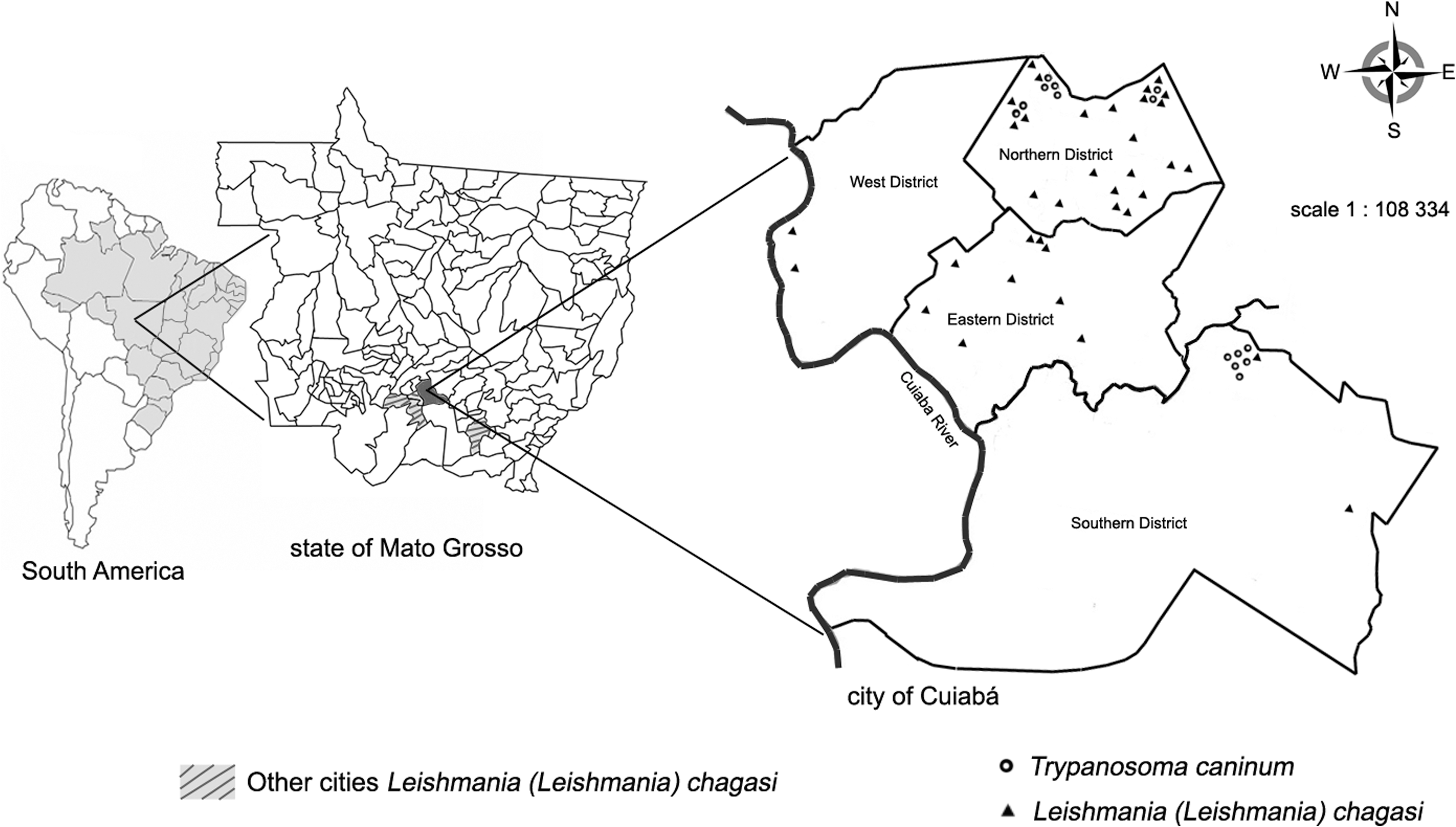
Spacial distribution of isolates of Leishmania (Leishmania) chagasi and Trypanosoma caninum detected in dogs in the city of Cuiaba, Mato Grosso, Brazil.
The average age of the 430 dogs assessed in the survey was 4½ years, ranging from 6 months to 14 years. One hundred fifty dogs of this group were considered oligosymptomatic and 42 symptomatic with clinical manifestations of CVL such as dermatologic (119/62%), being the most common alopecia (69/58%), furfuraceous dermatitis (20/16.8%), cutaneous ulcers (11/9.2%), besides lymphadenopathy (118/61.4%), weight loss (78/40.6%), ophtalmopathy (46/23.9%), splenomegaly (43/22.4%), and onychogryphosis (35/18.2%). The age of the dogs attended to at HOVET ranged from 7 months to 14 years (average=4 years and 9 months), 17 of them were oligosymptomatic and 29 symptomatic, and their manifestations were as follows: dermopathy (34/73.9%), as furfuraceous dermatitis (19/55.9%), cutaneous ulcers (10/29.4%), ophtalmopathy (26/56.5%), onychogryphosis (24/52.2%), lymphadenopathy (20/43.5%), weight loss (12/26.1%), and splenomegaly (10/21.7%). The presence of cutaneous ulcers was observed in 27 (5.6%) animals, considering the total group of animals studied.
Parasite isolation was obtained from 54 (11.2%) of the 482 dogs assessed, promastigote and epimastigote forms of which were retrieved from 40 and 14 dogs, respectively. Leishmania parasites were isolated from blood in 10 cases, bone marrow in 25, intact skin in 28, and cutaneous ulcers in 4. Simultaneous isolations in two or three sites were obtained in 19 cases. Epimastigote forms, identified as T. caninum, were exclusively isolated from intact skin from 14 dogs (Table 1). Thirteen (24.1%) animals of this group were oligosymptomatic, and 27 (50%) were symptomatic at the time of the collection. At least 1 isolate per animal from the 81 samples where promastigote forms were isolated was characterized by isoenzyme. All isolates from cutaneous ulcers were identified. L. chagasi was identified in 82.7% (n=67) samples, from 40 dogs from the differents neighborhoods at city of Cuiaba. Seven (17.5%) of those animals lived in neighborhoods located in rural areas and 33 (82.5%) in urban areas. Four of the 28 dogs attended to at HOVET and positive for CVL were from other municipalities such as Nossa Senhora do Livramento (2), Várzea Grande (1), and Rondonópolis (1). Thirty-three (82.5%) dogs were born in the city of Cuiaba, and three (7.5%) in adjacent municipalities, but with permanent residence for over a year (Fig. 1).
Fourteen isolates of T. caninum were obtained from dogs living in Cuiaba, of which 11 (78.57%) were reported to have born in the household (Fig. 1).
The intact skin showed numerically higher in parasite isolation in relation to other sites surveyed. Positivity at different sites associated with clinical manifestations and age of the dogs is shown in Table 2.
05 samples identified as T. caninum.
03 samples identified as T. caninum.
06 samples identified as T. caninum.
n, number of samples tested;+, number of positive samples.
When the different sites of isolation of L. chagasi were compared with the clinical categories studied, we found that in symptomatic dogs, parasite isolation was achieved in all sites examined, the sample of intact skin being statistically superior to blood samples (p=0.02; odds ratio 4.02, 1.55–10.76) and lesion (p=0.005; odds ratio 5.11, 1.5–19.06); and this difference was not observed for bone marrow (p=0.25). The different isolation sites did not present a statistically significant difference (p=0.64) in oligosymptomatic dogs. In the group of asymptomatic dogs, L. chagasi was isolated only in bone marrow samples, which is statistically significant (p=0.02) compared with other sites. High positive correlation (r=1) was observed in the different sites related to age and clinical category, thus observing an increase in the number of isolates in adult dogs (>1 year) compared with young dogs (<1 year).
Discussion
In Brazil, VL is a growing disease and coordinated actions, thus involving different segments of the epidemiological chain becoming fundamental for its control. Although cases of human VL have been described in Cuiaba, information about the canine disease is based on the results of serological surveys (Mestre and Fontes 2007, Almeida et al. 2009), with a large parasitological knowledge gap of these animals (Almeida et al. 2010).
Parasitological approaches are not used in epidemiologic studies, mainly due to the large volume of work produced by this activity. However, this practice is essential for knowing and monitoring the agents that may be circulating in endemic areas. In this context, we used the parasitological culture as a diagnostic tool in 482 dogs and we confirmed the presence of L. chagasi and T. caninum for the first time in the city of Cuiaba.
Forty dogs with different clinical conditions were found to be naturally infected by L. chagasi, thus demonstrating the CVL prevalence of 8.3%, a similar result to that found by Mestre and Fontes (2007), using serological data. Parasite isolation in culture is considered a reference standard for diagnosis of leishmaniasis, thus showing high specificity and variable sensitivity, according to culture conditions. One drawback of this technique is the possibility of bacterial or fungal contamination, which in our study was low, found in 23 (1.6%) of the 1462 samples processed for this method.
The use of different biological samples for the diagnosis of CVL has been investigated through different techniques (Madeira et al. 2006, Maia et al. 2009, Assis et al. 2010). Manna et al. (2004) describe the use of aspirates or biopsies of lymph node, spleen, bone marrow, and liver in the detection of DNA of Leishmania sp., although they describe samples of blood, skin, and conjunctiva as less invasive and with good results. In this study, the use of skin fragments, blood, and aspirate of bone marrow occurred in 100% and 97.7% of the animals assessed, thus showing good results in relation to the ease of obtaining these clinical samples.
Authors point out the skin as an important site for Leishmania detection due to its high parasite load in both asymptomatic and symptomatic animals (Lima et al. 2010, Queiroz et al. 2011). In the study conducted by Madeira et al. (2009a), where 394 dogs seropositive for leishmaniasis were investigated, L. chagasi was isolated from the skin in 78% of the animals studied. In the current study, 70% of the isolates with L. chagasi were from the skin, thus reinforcing this site as a good target for parasitological investigation of CVL.
Bone marrow was the best site for isolation in asymptomatic dogs, whereas skin was for oligosymptomatic and symptomatic ones. The chance to isolate the agent from the skin of the latter was four or five times greater than from samples of blood or cutaneous ulcer, respectively. According to Tafuri et al. (2001), L. chagasi seems to spread initially to organs of the reticulo endothelial system, such as bone marrow, to be found later on the skin, which could explain the fact of L. chagasi being isolated only from bone marrow in asymptomatic dogs.
The isolation of L. chagasi from different sites in symptomatic dogs proves that the agent spread to various organs of the animal (Madeira et al. 2006, Maia et al. 2009). This fact may be related to the parasite load in symptomatic animals (Lima et al. 2010), thus making it easier to diagnose in this group of animals as proved by Queiroz et al. (2010) when using several methodologies for VL diagnosis in dogs with and without clinical symptoms. For Maia et al. (2009), the infection difference of diverse organs of the same animal may be associated to the potential parasite load and related with the local immune response of the organ. These data show that parasite isolation on a particular site is conditioned to the clinical status of the animal. On the other hand, the long incubation period in VL has been associated with the predisposition of adult dogs to develop the disease (Arias et al. 1996), an aspect that could explain the high correlation found in the isolation of L. chagasi in adults dogs evaluated in this study.
Euthanasia of seropositive dogs, with titers equal to or above 1:40 for immunofluorescence tests, is one of the control measures used for VL in Brazil (MS, 2006). However, the possibility of cross-reactions should be considered mainly in areas of overlapping with other agents. The state of MT is considered endemic both for VL and tegumentary leishmaniasis (TL) forms. Although L. braziliensis was not isolated from the dogs studied, the circulation of this species should not be disregarded given the small number of dogs with ulcers suggestive of TL evaluated, besides the proved circulation of this agent in the state and the occurrence of TL cases in the municipality of Cuiaba (Carvalho et al. 2006).
Parasite isolation is important for several studies besides confirmation of diagnosis, mainly those involving epidemiological surveillance, thus making it possible, through the characterization of the parasites found, the mapping of the species and/or parasite variants circulating in endemic areas. A fact revealed by this study, obtained by the use of culture method, was the isolation of T. caninum for the first time in the city of Cuiaba. This parasite was found in fourteen dogs from four of the five neighborhoods surveyed, from which eleven were born in the house visited. This species was initially described in the municipality of Rio de Janeiro (Madeira et al. 2009b), and these new reports suggest that the parasite may be circulating in different Brazilian regions and emphasize the importance of identifying the species infecting seropositive dogs in endemic areas.
In this study, the 14 samples in which T. caninum was isolated were all from intact skin reinforcing a biological characteristic of this species as already mentioned in other studies (Madeira et al. 2009b, Pinto et al. 2010). In none of these animals, Leishmania was isolated in the other sites evaluated. Overlapping in endemic areas for leishmaniasis, occurrence of coinfection (Madeira et al. 2009b), and isolation of T. caninum in dogs seropositive for leishmaniasis as observed by Pinto et al. (2010) suggest that surveillance actions should be implemented, considering the interference of such aspects in the prevalence of CVL.
The spatial distribution of L. chagasi in Cuiaba demonstrates the circulation of this agent in all administrative districts of the municipality, thus allowing to safely define the transmission areas for VL (Missawa and Borba 2009). The largest number of isolates was obtained in the North district, where human and canine cases have been diagnosed as described by Almeida et al. (2010).
The use of culture in this study confirmed the autochthony CVL cases, and proved the circulation of L. chagasi in the canine population in different neighborhoods of Cuiaba as well as in neighboring municipalities. In addition, it provided relevant epidemiological information, thus highlighting the finding of T. caninum, first described in the city of Cuiaba.
Footnotes
Acknowledgments
The authors thank Eduardo da Silva Machado for his technical support in preparation of culture media and isoenzyme technique. This work was supported, in part, by grants from the Fundação de Amparo a Pesquisa do estado de Mato Grosso and CNPq (process n° 474894/2010-0).
Disclosure Statement
No competing financial interest exist.