




Abstract
A field study on the distribution of phlebotomine sandflies was carried out during summer months of 2009 and 2010 in eight sites in two Ionian islands and in northern Greece. A total of 490 sandflies (74.5% females) were collected. Six species of the Phlebotomus genus and two of the Sergentomyia genus were identified. The species with the widest distribution in the islands were Phlebotomus neglectus (32.8%), Phlebotomus similis (30.3%), Phlebotomus tobbi (16.7%), and P. perfiliewi (15.9%), whereas P. simici (50%), P. neglectus (24.5%), and P. tobbi (9.6%) predominated in the mainland. As most of these species are proven or suspected vectors of human and animal pathogens, prevention measures have to be taken in these areas during the summer months when sandflies are active.
Introduction
In Greece, the scientific interest on sandflies initiated at the beginning of 20th century when they were considered as vectors for the sandfly fever outbreak that occurred in military troops in Crete (Birt 1910). Later, Corfu phlebovirus was isolated from a pool of Phlebotomus (Larroussius) neglectus (former P. major), collected in Lakones village in Corfu island (Rodhain et al. 1985). Up to now, Corfu virus has not been related to disease in humans. A recent serosurvey in two Ionian islands showed that 51.7% and 39% of the human population in Corfu and Cephalonia islands, respectively, have antibodies against TOSV (Papa et al. 2010). Recently, human phlebovirus infection was serologically diagnosed in a young boy with febrile syndrome in Thessaloniki (northern Greece) (Anagnostou et al. 2011b), whereas a novel phlebovirus, Adria virus, was detected in the blood of a child with seizure in Thessaloniki (Anagnostou et al. 2011a). In the nearby Cyprus, CYPV, a phlebovirus genetically close to SFSV, was isolated in 2002 during a major outbreak among the Greek Army forces (Papa et al. 2006).
Leishmania tropica causing cutaneous leishmaniasis occurs sporadically in Greece, whereas Leishmania infantum, the causative agent for visceral leishmaniasis, is distributed throughout the Mediterranean region (Frank 1993, Ready 2010). A seroprevalence of 30%–40% is observed among dogs in Crete island, which is among the highest ones reported in Europe (Antoniou et al. 2009).
Materials and Methods
To gain an insight into the distribution of sandflies in Greece, especially in regions related to phlebovirus activity, sandflies were collected during July and August of 2009 and 2010 in two Ionian Greek islands, Corfu and Lefkas, and the area of greater Thessaloniki. Three regions in each island and two regions in Thessaloniki prefecture were investigated (Table 1). During the time of collection the temperature at the collection sites varied from 21°C to 31°C and the relative humidity was ∼55%.
Sandflies were collected using CDC miniature light traps and mechanical aspirator. Light traps were set inside or nearby to animal barns with cattle, goats, sheep, or poultry. The traps were operated all night and the sandflies were collected early in the morning, sorted, and kept dry at −70°C.
The head and the rear part of the abdomen of all collected sandflies were mounted on permanent microscope slides and species identification was carried out according to morphology-based keys (Perfiliev 1966, Lewis 1982, Artemiev and Neronov 1984).
Results
A total of 490 sandflies (74.5% females) were collected. Eight species were identified, six belonging to genus Phlebotomus (98% of the sandflies) and two to genus Sergentomyia (2% of the sandflies) (Table 2). The species with the widest distribution was P. neglectus (31.2%), followed by P. (Paraphlebotomus) similis (25.1%) and Phlebotomus (L.) tobbi (15.3%), and the less abundant was Sergentomyia dentata (0.2%), captured only in the mainland.
M, male; F, female.
The species with the widest distribution in the islands were P. neglectus (32.8%), P. similis (30.3%), P. tobbi (16.7%), and Phlebotomus (L.) perfiliewi (15.9%). In Lefkas island, 254 sandflies (80.7% females) were collected, belonging into five species, with the most abundant being P. similis (46.4%) and P. perfiliewi (24.8%); P. tobbi (20.9%) was the only species captured in all three sites (Fig. 1). In Corfu island, 142 sandflies (54.2% females) were collected. The most abundant was P. neglectus (78.2%), present in all three investigated sites, followed by P. tobbi (9.1%), present in two of the three sites. Sandflies of the genus Sergentomyia (3.5%) were also present in two of the three sites (Fig. 1). The total number of sandflies collected in Thessaloniki prefecture was 94 (88.3% females), belonging to seven species, with Phlebotomus (Adlerius) simici (50%) being the most abundant species detected in both collection sites (Fig. 1).
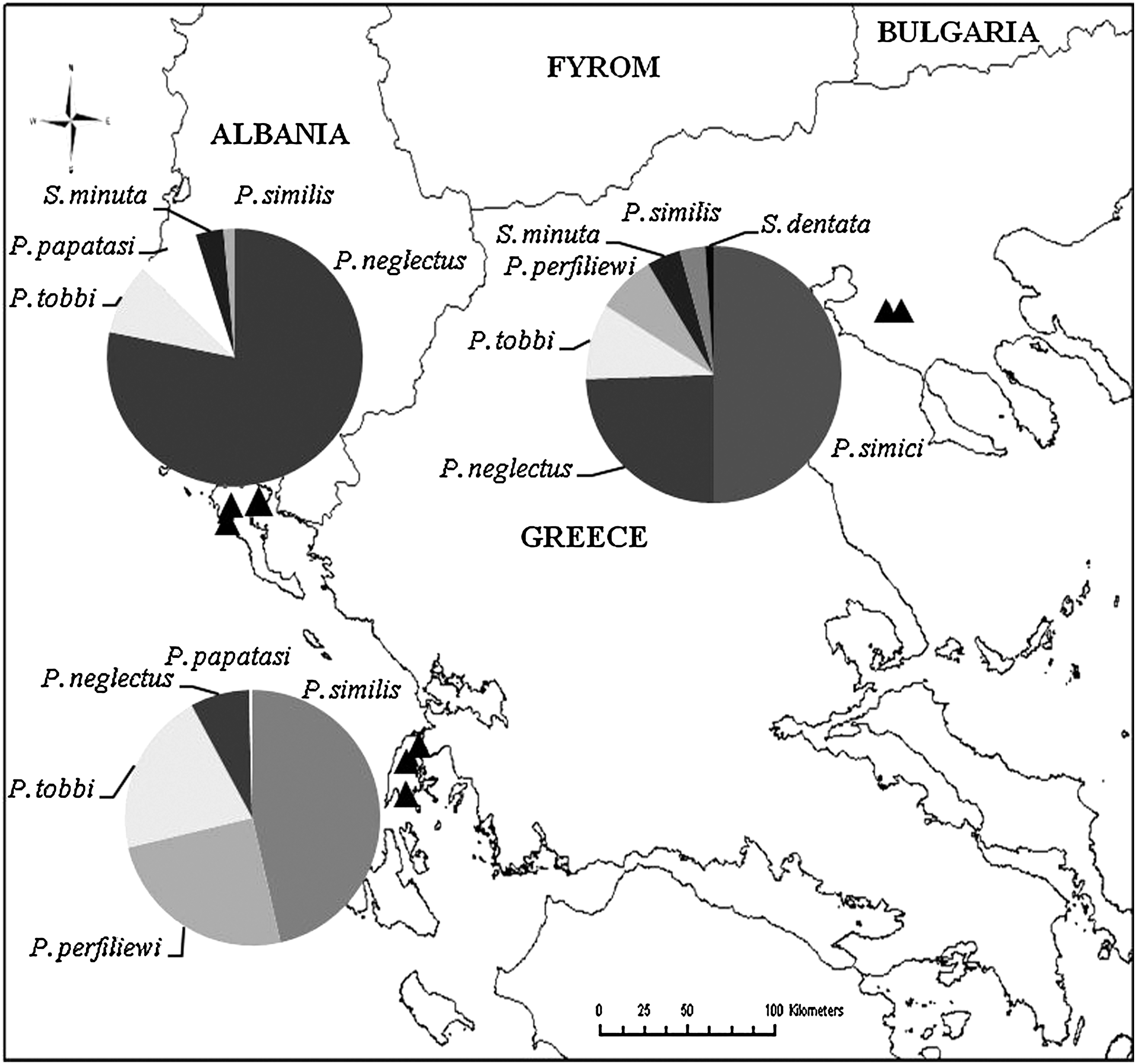
Map of Greece showing the distribution of sandflies in the sites where collection was performed.
Discussion
Of all collected sandflies the species with the widest distribution were P. neglectus, P. similis, P. tobbi, and P. perfiliewi in the islands and P. simici, P. neglectus, and P. tobbi in the mainland. The highest biodiversity of sandflies was observed in the continental Greece, where seven species were recorded, five belonging to Phlebotomus and two to Sergentomyia genera.
P. neglectus was the most abundant species of this survey, as it was found in seven of the eight collection sites with a prevalence of up to 90%. The highest proportion was found in Lakones village, in Corfu island, where Corfu virus has been isolated from P. neglectus in the early 1980s (Rodhain et al. 1985). In addition, L. infantum was isolated from P. neglectus in Corfu island (Leger et al. 1988).
P. similis was the second abundant species, captured in six out of eight collection sites, with a prevalence of up to 85.9%, which was observed in Kariotes village in Lefkas. In this island, P. similis was the predominant species (46.4%). In general, higher presence of P. similis was observed in the islands rather than in the mainland; similar distribution pattern was recorded in other studies (Tesh et al. 1977, Watts et al. 1988, Ivovic et al. 2007). P. simici was found only in the mainland and represented 50% of all collected sandflies. P. simici (formerly P. chinensis) was also found during a previous study in the district of Thessaloniki (Hadjinicolaou 1958), suggesting its constant presence in the region. Vectorial status of P. simici and P. similis remains uncertified regarding the sandfly-borne viruses.
Showing wide geographical distribution, although small abundance, P. tobbi was trapped in seven of eight collection sites, with the highest prevalence (20.9%) in Lefkas island. As this species is a putative vector of TOSV (Charrel et al. 2005), it may play a significant role in the epidemiology of TOSV infections in the region.
Another species of the subgenus Larroussius, P. perfiliewi, is related to TOSV and SFNV (Gligic et al. 1982, Charrel et al. 2005). Present in both island and continental region, P. perfiliewi is a potential vector of these phleboviruses. Phlebotomus papatasi, although collected occasionally and only in the islands, is generally abundant species and it is a proven or putative vector of SFSV (Tesh et al. 1977, Jennings and Boorman 1983, Watts et al. 1988). P. papatasi is an abundant species also in Cyprus (Depaquit et al. 2001). As a particularly anthropophilic, and already proven as a vector of several sandfly viruses, P. papatasi has an important role in the epidemiology of sandfly fever viruses in the Mediterranean region.
The two species belonging to the genus Sergentomyia were found occasionally and only in small numbers. A previous study in Corfu island has shown dominancy of genus Sergentomyia, difference being probably due to the different trapping methods (castor-oil paper traps) (Papadopoulos and Tselentis 1998). The detection of TOSV in Sergentomyia minuta (Charrel et al. 2006), a species considered as feeding exclusively on lizards and geckos, points toward the possible vectorial capacity.
In conclusion, a variety of sandflies are circulating in Greece. Testing of the collected sandflies for the presence and, eventually, for the characterization of phleboviruses is in progress. At present, as most of the collected species are proven or suspected vectors of human and animal pathogens, prevention measures have to be taken during the summer months when sandflies are active, and clinicians should include the sandfly-borne diseases in the differential diagnosis of summer febrile syndromes.
Footnotes
Acknowledgments
The authors thank N. Tzanidakis and A. Saratsis, Ph.D. students in VRI-NAGREF, for helping in the collection of sandflies. This study was in part financially supported by the COST Action FA0805 (CAPARA) (V. Ivovic STSM).
Disclosure Statement
No conflicts of interest exist.