




Abstract
Crimean-Congo hemorrhagic fever (CCHF) has long been a disease of concern in Kosova; however, little is known about the enzootic cycles of the virus in this country. Since the first documented case in 1954, sporadic cases and occasional outbreaks have been recorded with cases more consistently reported following the conflict in 1999. CCHF virus exists in enzootic cycles between wild animal species and ticks. The infection rates within ticks and hence the exposure to humans is determined by both the biology and seasonal dynamics of ticks, and the population dynamics and structure of the wild animals. These, in turn, are affected by complex interactions between climatic variables, changes in agricultural practices, land management, and wild animal density. If we are to understand the spatial and temporal occurrence of human disease, we must understand the ecology of the virus in nature. This article discusses the possible ecological, societal, political, and economic drivers that may impact the enzootic cycle of the virus and contribute to an increase in virus amplification and/or human exposure to infected ticks in Kosova.
Introduction
Kosova is a landlocked country with a surface area of 10,877 km2 in the center of the Balkan Peninsula, and is bordered by Macedonia, Albania, Serbia, and Montenegro. The country has varied terrain ranging in elevation from 265 to 2656 meters above sea level (a.s.l.), with the vast majority of the country between 500 and 1500 meters a.s.l. (ARD-USAID 2003). It has a continental climate with warm summers, cold winters (UNMIK 2002), and an average annual rainfall of 729 mm (ARD-USAID 2003).
The first cases of CCHF in Kosova were registered in 1954 in Nishor village, three of which were fatal (Vesenjak-Hirjan et al. 1991). Between 1954 and 1989 there were no official reports of CCHF. Cases were again detected in 1989 (7 cases), 1991 (9 cases), and since 1992 the disease has been considered to be present in sporadic or epidemic form, notably with an outbreak in 1995 (46 cases) (Ahmeti and Raka 2006). Since the conflict in 1999, cases have been consistently reported every year in increasing numbers compared to the 1990s (with exception of 1995). Numbers of confirmed cases of CCHF in Kosova since 1999 are detailed in Table 1, with highest numbers of confirmed cases reported in 2001 (31), 2004–2005 (11–16), and 2009 (12). It is likely that the actual number of cases of CCHF each year is higher, as not all suspected cases are submitted for laboratory confirmation. CCHF risk areas are considered to cover approximately 50% of municipalities in Kosova (Fig. 1). Hyalomma marginatum has been identified as the principal vector (Humolli et al. 2010), although Ixodes, Dermacentor, and Rhipicephalus spp. are also present in high-risk areas. Cases occur between March and September, with June and July being the peak months (Ahmeti and Raka 2006). Farmers and those living in rural areas have been identified as being at highest risk for tick-borne transmission of the virus (Humolli et al. 2010).
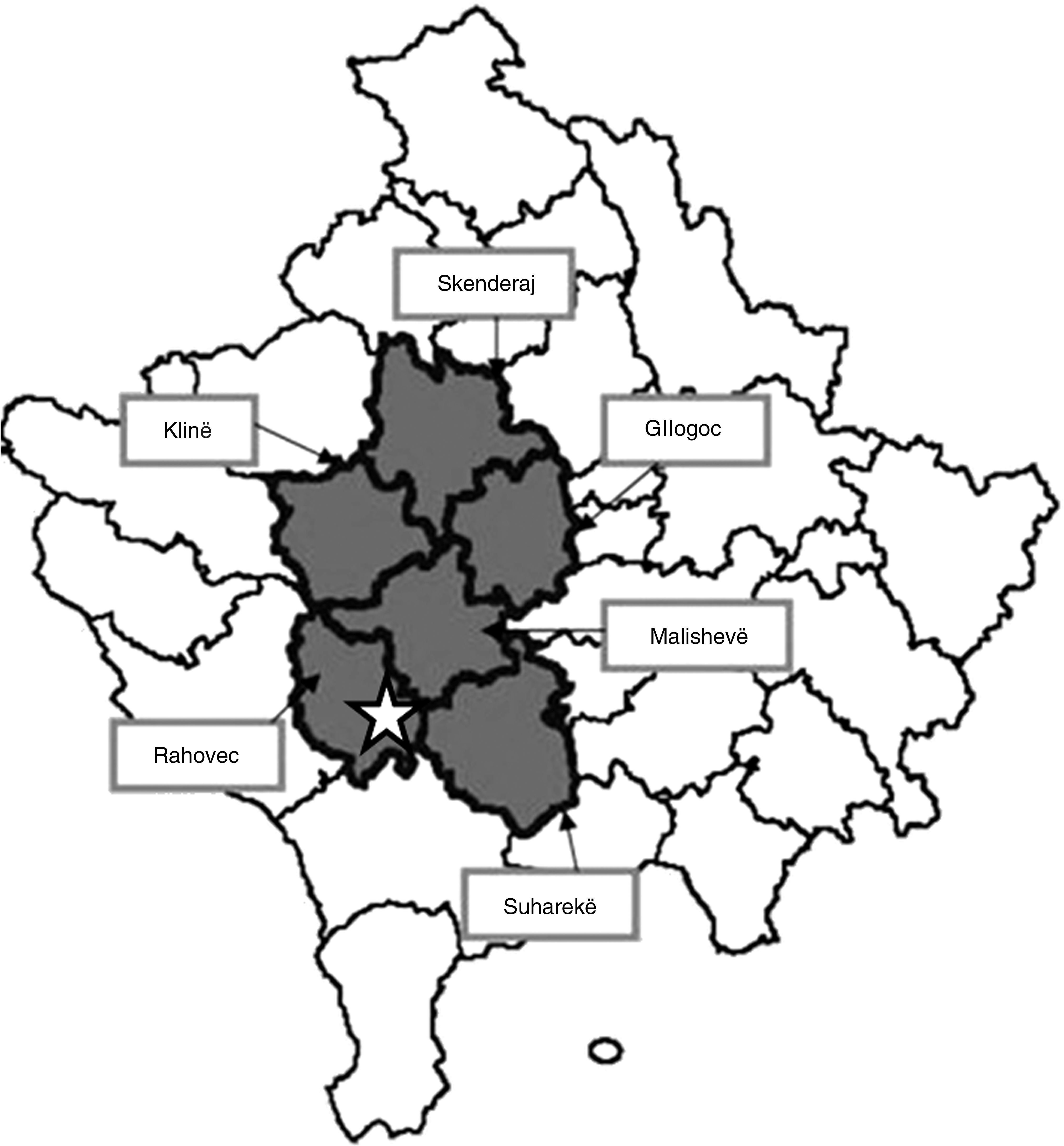
Hyper-endemic areas in Kosova for Crimean-Congo hemorrhagic fever virus. (✩) Star indicates the location of Nishor village. Adapted from ESK-WebGIS 2010.
Health Protection Agency (HPA) entomologists visited Kosova during June 2008 and 2009 at the request of the National Institute of Public Health of Kosova (NIPHK) to perform field investigations. The aim was to better understand the eco-epidemiological driving forces that first, might explain the recent upsurge in CCHFV transmission in animals and to humans, and second, the seemingly focalized geographical distribution of cases in the center of the country. During these visits discussions were held with the Director of Public Health, Directors of District Health in Malishevë, the President of the Hunting society in Malishevë, local farmers in the regions of Malishevë and Rahovec, and specific visits were made to villages where CCHF cases in humans had recently been reported. In addition, a systematic literature review was performed by searching the following electronic databases: ISI Web of Knowledge, MEDLINE, PubMed, and Google. The MeSH terms or keywords included were: “agriculture,” “change,” “Crimean-Congo hemorrhagic fever,” “decline,” “environment,” “habitat,” “hunting,” “Hyalomma marginatum,” “Kosovo,” “Kosova,” “livestock,” “policy,” “population,” “tick,” and “wildlife.”
Results
During and since the conflict, there appear to have been a number of changes that might have combined to stimulate a change in the ecology of CCHFV in ticks and wild animals, an enhancement of ticks feeding on cattle, and an increased exposure to humans. These driving forces broadly include a decline in agriculture, an expansion of grazed grassland, scrub encroachment close to villages, and an imbalance in the local predator-prey cycles, with consequent impact on the tick and virus hosts, and a change in the local breeds of cattle.
Rise and decline of agriculture
During the early 20th century the plains of Kosova were predominantly covered by oak forests; since the 1960s the majority were cleared for agriculture. Currently agricultural land comprises 53% of country's total land area, with forests occupying 41% (U.S. Department of State 2010). The remaining forested areas continue to be cleared with illegal logging and collection of firewood raised as ongoing concerns (ARD-USAID 2003). Clearance of forest, the domain of Ixodes and Dermacentor ticks, in favor of grazed grassland/pasture, is beneficial to Hyalomma ticks. By providing increased grassland and grazed habitats, this may have allowed Hyalomma to exploit new habitats. High land fragmentation is typical across the country, and is a potential contributor to CCHFV transmission in Turkey, as recently reported by Estrada-Peña and associates (2010).
The agricultural land is largely composed of crops (51%), pasture and meadows (45%), with some areas of vineyards and groves (3%) (UNMIK 2002). Agriculture within Kosova is characterized by small farm sizes with an average holding of 2.2 ha spread over 8 plots (JICA 2008) with only 10% of farms larger than 5 ha (The World Bank 2007). The economic and political crisis in the 1990s led to the near complete destruction of agriculture in Kosova (REC 2000). Damage to land, infrastructure, residual land, and a lack of work force exacerbated by lack of investment led to no crops being maintained in 1998, with 70% of agricultural land considered wasteland by 1999 (UNMIK 2003a). With low herbicide use heavy weed infestations of arable land occurred (REC 2000). Currently a quarter of all farm households do not maintain the entirety of their plots (The World Bank 2007), with estimates of 6–7% of agricultural land in Kosova left fallow, mostly in response to low economic profitability (Kastrati, 2009).
This reported decline in agriculture was evident from visits to local villages and farms in CCHF endemic areas. Previously, arable land was worked in areas at both lower and higher altitudes of the villages. However, with less land now being adopted for agriculture, the more productive land in the valleys has been favored. This has led to the removal of a buffer zone between the village and the grazed grasslands and scrubland. Houses now abut grazed areas, and this led to an increase in exposure of Hyalomma to humans, both in fields adjacent to dwellings, but also in gardens.
Influence of livestock
Before 1990 livestock production was a defined industry in Kosova. However, prior to NATO involvement many animals were exported and those remaining were either killed or fled (AEI 2007). It is estimated that 54% of cattle, 75% of goats, and 80% of horses were lost (AEI 2007). A lack of large hosts for adult ticks, which also act as dilution hosts for the virus, for such a prolonged period may have resulted in more adult ticks feeding on the wildlife that are implicated in amplifying the virus.
Furthermore, following the end of the conflict, large numbers of cattle naïve to CCHFV were imported from Europe to replenish stocks (JICA 2008). Eighty percent of cattle in Kosova are now considered to be cross-breeds or imported breeds, including Simmental, Tyrolean Grey, Danish Red, Holstein Frisian, and Montafon (Faukal 2004; AEI 2007). The indigenous cattle breed in Kosova is the Busha (Bos primigenius f. taurus), a hardy breed known for its resistance to internal and external parasites (Faukal 2004). After World War II cross-breeding increased dramatically (Faukal 2004). It is proposed that cross-breeds with lowered resistance to external parasites may have contributed to a rise in the Hyalomma population in the 1950s, leading to the first reported human cases of CCHF, as well as further tick amplification in the 1990s following mass importation of cattle after the war. It is speculated that these new populations of cattle may have contributed to increased numbers of Hyalomma being able to complete engorgement, thus sustaining an increased population of ticks to feed on wild animals and also humans.
The role of imported cattle is further supported by areas of high risk for CCHFV having the highest proportion of imported cattle: Malishevë (65%) and Gllogoc (64%) compared to Prizren (46%), where some cases are reported, and Dragas (27%), where cases are rarely reported. It is likely that the trend toward greater numbers of imported cattle will continue according to a recent survey of farmer's attitudes in the 21st century, indicating a preference for imported cattle or cross-breeds due to higher milk yields and the resulting higher market price (CARITAS-UBO 2004). Further studies should be carried out to determine what effect a further shift towards cross-breeds and imported breeds will have on CCHFV transmission, not only in Kosova but also other CCHF-endemic countries.
Of further note from field observations is that local herdsmen do not remove ticks from their animals, and that these animals roam through the village, presumably dropping ticks within the village centers (thus increasing human exposure). Owing to the clustered feeding sites of H. marginatum on the perineum and on the udder, it is possible to remove feeding ticks as part of ongoing animal husbandry. In the absence of other large hosts that might be feeding the adult stages of the tick, routine tick removal could impact significantly on the local tick populations and reduce subsequent infestation of the habitat. Care would need to be taken in removing ticks safely to avoid accidental exposure to tick-borne viruses, and their disposal coordinated as part of a national tick surveillance program, with specific viral testing to monitor viral prevalence rates and to understand spatio-temporal drivers of CCHFV.
Influence of wildlife
Hoogstraal (1979) previously highlighted the impact that changes in wildlife hunting practices can have on the amplification of CCHFV and/or ticks. Hunting in Kosova was heavy in the early 1990s and was then banned from 1993, with little illegal hunting occurring subsequently (ARD-USAID 2003). NATO continued to enforce the hunting ban throughout their presence there, with hunting only recently allowed again under certain conditions. As a result the numbers of hares, wolves, and wild boar increased dramatically in the early 2000s (UNMIK 2003b).
Hares are considered to be important hosts for both Hyalomma ticks and the virus (Hoogstraal 1979). Discussions with local hunters in certain CCHFV-endemic areas suggested that there had been a noticeable increase in tick numbers on local hare populations, as well as a local increase in hare numbers. The latter was attributed to a decline in the hare's main predator, the red fox. It is possible that fox-associated infections (possibly rabies, as clinical signs were reported in local dog populations) could be contributing to an imbalance in the predator-prey cycles, leading to a significant increase in tick and virus hosts. Further field surveys that investigate the infestation rates of different wild animals (mammals and birds) and CCHFV infection rates within the animals and their ticks would facilitate a better understanding of transmission cycles. It would also facilitate a better understanding of the impact that hunting might have in keeping important amplifier species at threshold levels within endemic areas, so as to impact transmission cycles and R0 of the virus.
Human factors
Before 1989, Kosova was undergoing a transformation from a mainly rural society to a more urban one. The proportion of active population working in agriculture had fallen to 26%. Due to the economic and political crises in the 1990s the rural population increased again, and up to 60% of employment was provided by agricultural activities (REC 2000). This has since fallen again to 16.5% (U.S. Department of State 2010); however, the majority of the estimated 1.8–2.4 million inhabitants continue to live in rural towns and tend to cattle on an informal basis (UNMIK 2002). Data from the Statistical Office of Kosova show in the six municipalities where most CCHF cases are recorded that the population density (Fig. 1) has increased three- to fourfold since the 1950s (197–503 inhabitants per km2) compared to the 1990s and 2000s (768–1368 inhabitants per km2). As with many tick-borne infections, large-scale social mobilization and public health awareness of the risks from ticks (which is already being instituted by NIPH Kosova), and guidance on proper tick removal and disposal, in concert with other factors, is an integral part of any vector-borne disease campaign. District public health centers already have a good understanding of tick-bite prevalence, and these data are now being used to monitor tick presence (and implicate specific species as human-biting species) on a nationwide scale.
Discussion
Several social, political, environmental, and economic factors have dramatically changed in Kosova in the past century. It is possible that these have all come together coincidentally alongside an increase in Hyalomma ticks and subsequent CCHFV transmission. However, it is more likely that such factors have together resulted in more suitable ecological conditions that have promoted an increase in virus amplification and subsequent exposure to humans. As with many theories of vector-borne disease ecology, it is difficult to distinguish causality from coincidence. Nevertheless, further study and a better understanding of the complete picture of CCHFV transmission cycles is required that acknowledges the potential role that agriculture, deforestation, wildlife, livestock movements, animal husbandry, and human behavior might have on the CCHFV burden. This is crucial if we are to understand, predict, and prevent human cases of CCHF in Kosova, and across its geographic range.
To ensure that we can prepare for outbreaks of CCHFV and begin to develop new interventions that limit transmission cycles and prevent human cases, there is a great urgency to understand these ecological cycles through evidence-based field studies. Understanding the virus and developing new treatments are important, but they should be addressed as part of an integrated system of disease control and prevention, with eco-epidemiology a central tenet of continental and global approaches to halting the rise in CCHFV transmission, in Kosova, the Balkans, and other CCHFV-endemic regions.
Footnotes
Acknowledgments
The authors would like to acknowledge the funding of ArboZoonet, an International Network for Capacity Building for the Control of Emerging Viral Vector-Borne Zoonotic Diseases, project number 211757 under the European Union FP7 framework; MedVetNet, a European Network of Excellence for Zoonoses research, project number 506122 under the European Union FP6 framework; and HPA Government Grant-in-Aid.
Author Disclosure Statement
No competing financial interests exist.