




Abstract
Gray foxes (Urocyon cinereoargenteus) were shown to be naturally infected with Bartonella rochalimae, a Bartonella species similar to Bartonella clarridgeiae (B.c.), and Bartonella vinsonii subspecies berkhoffii (B.v.berkhoffii) in northern California. A serological survey was performed to investigate the presence of Bartonella infection in 132 gray foxes from West/Central Texas. Using an immunofluorescence antibody test directed against B.v.berkhoffii and B.c., the antibody prevalence was 50% (66/132), with 22 (33.3%) individuals seropositive for B.c. only, 8 (12.2%) for B.v.berkhoffii, and 36 (54.5%) seroreactive for both B.c. and B.v.berkhoffii. The foxes had 3.63 more odds (95% confidence interval [CI]=1.38, 10.25) to be seropositive for B.c. than for B.v.berkhoffii. Female foxes were more likely to be seropositive for B.c. (odds ratio [OR]=2.90, 95% CI=1.33, 6.36) and also for both antigens (OR=2.50, 95% CI=1.06, 5.90) than males.
Introduction
Materials and Methods
Sample collection
Serum (1 to 2 mL) was collected during rabies oral vaccination postdrop field surveillance of free-ranging gray foxes from 21 counties of central and western Texas in March and April 2004 as part of the Texas Oral Rabies Vaccination Program conducted by the Texas Department of State Health Services/Zoonosis Control Branch. Foxes were harvested by lethal means, and sample collection included various tissues and blood collected from heart puncture (Sidwa et al. 2005).
Counties where foxes had been trapped were grouped into four regions based on geography (
Serology
Specific antibodies against B.v.berkhoffii and Bartonella clarridgeiae (B.c.) antigens were detected using an indirect immunofluorescence assay (IFA), as previously described (Henn et al. 2007, Namekata et al. 2009). The B.c. antigen is a suitable antigen marker for B. rochalimae detection (Namekata et al. 2009). Grading of bacillus-specific immunofluorescence was conducted on a scale of 1–4 using the subjective scoring done by the same two individuals in a double-blind manner. Averaged scores of ≥2 at a dilution of 1:64 were considered positive for Bartonella sp.–specific antibodies. Negative and positive dog control samples were included on each slide.
Statistical tests
Fisher exact test was performed to calculate any difference in prevalence by geographical region, using Epi-Info version 3.5.1.
Results
Sixty-six (50%) of the 132 gray foxes tested had reciprocal IFA titers of ≥64 for either Bartonella spp., including 22 (33.3%) individuals positive for B.c. only, 8 (12.2%) for B.v. berkhoffii, and 36 (54.5%) for both antigens. Overall, 58 (88%) foxes were seropositive for B.c. and 44 (66.6%) for B.v.berkhoffii. Therefore, the foxes had 3.63 more odds (95% confidence interval [CI]=1.38, 10.25) to be seropositive for B.c. than for B.v.berkhoffii. All foxes were classified as adults (≥1 year old) at the time of capture and males accounted for 60.6% (80/132) of the animals. Among the male foxes, 27 (33.7%) were seropositive for B.c. and 23 (28.7%) for B.v.berkhoffii. Thirty-one (59.6%) females were seropositive for B.c. and 21 (40.4%) were seropositive for B.v.berkhoffii. Female foxes were also more frequently seropositive for both antigens (38.5%) than male foxes (20%). Female foxes were more likely to be seropositive for B.c. (odds ratio [OR]=2.90, 95% CI=1.33, 6.36) and for both antigens (OR=2.50, 95% CI=1.06, 5.90) than male foxes. However, such a statistically significant difference was not detected for B.v.berkhoffii (OR=1.68; 95% CI=0.75, 3.73).
Seroprevalence for the four geographical regions was, respectively, 53% (n=49) for the Rio Grande/Permian Basin, 51.2% (n=41) for Concho valley, 27.3% (n=11) for West Central Texas, and 54.8% (n=31) for the Middle Rio Grande/Alamo Area. No difference in prevalence was detected between these geographic regions.
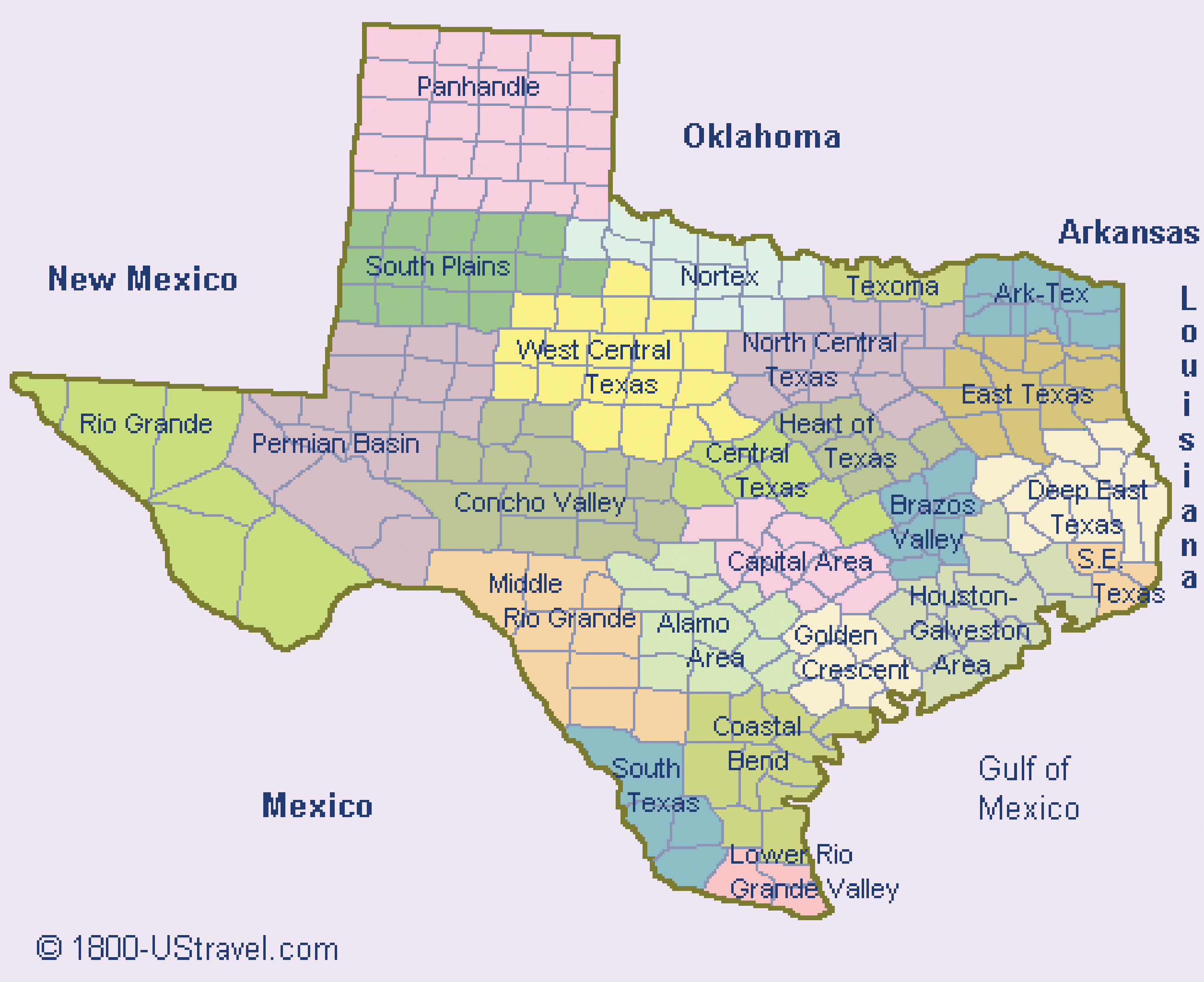
Map of Texas based on geographical features. (Color images available at:
Discussion
We report the first detection of Bartonella infection in gray foxes from Texas. Our data suggest that Bartonella infection is likely to be widespread among gray fox populations in North America, as it was detected in half of the tested animals. The overall seroprevalence was lower than the 89% (n=53) observed in gray foxes from Northern California (Henn et al. 2007) and the 62.7% prevalence reported in island foxes from Santa Rosa Island (Schaefer et al. 2011), but higher than the overall percentage reported in island foxes from four of the Channel Islands (Namekata et al. 2009). A larger percentage of foxes were seropositive for B.c. than for B.v.berkhoffii. Despite the limitation of this serological study and the possibility of some cross-reactivity between antigens, such data are suggestive that gray foxes in Texas could also be a major reservoir for B. rochalimae, as observed in California (Henn et al. 2007) and are less commonly infected with B.v.berkhoffii. Further studies will be necessary to confirm this observation based on bacterial isolation or detection by molecular techniques. The higher antibody prevalence in female foxes observed in our study may be an artifact related to convenience sampling or the limited sample size of animals tested. Such an observation will need to be validated through further studies. By comparison, no sex differences were observed in island foxes (female=36/133 [27%], male=32/130 [24.6%]) (Namekata et al. 2009) or in coyotes (female=155/407 [38%], male=152/455 [33%]) from California (Chang et al. 2000). Unfortunately, no information regarding ectoparasite prevalence among these Texan foxes was available. However, it was reported that 10% of fox tails collected for bounties in Texas had ectoparasites on them, mainly fleas (Pulex irritans), but also ticks (Eads and Menzies 1950). The cause of the observed difference in seroprevalence between California and Texas could not be determined. Possible factors include lower numbers of competent vectors, lower fox population density in Texas, dryer climatic conditions not as favorable for ectoparasite survival, as well as differing geographic distributions of Bartonella spp. between Northern California and Texas. Interpretation of serological results may be complicated by antigen cross-reactivity, as B.c. is known to cross react with antibodies specific to other Bartonella spp., including B. rochalimae and possibly B.v.berkhoffii. Given the low number of samples that were only seroreactive to B.v.berkhoffii (10.5%), it is plausible to suggest that the antibodies specific to B.v.berkhoffii exhibited some cross-reactivity to the B.c. antigen or that individuals may have experienced co-infection or sequential infection by both Bartonella species. In the wild, gray foxes may live up to 6 to 10 years and therefore will have plenty of opportunities to be exposed to ectoparasites and the pathogens they carry with them during their lifespan (
Bartonellae are emerging zoonotic agents, including B. rochalimae and B.v.berkhoffii. The detection of infection by these pathogens in gray foxes supports the role of wildlife as a widespread reservoir of zoonotic agents in many parts of the United States, including Texas.
Footnotes
Acknowledgments
The authors would like to thank Eric Fonken for providing contact with the Texas Department of State Health Services, Zoonosis Control Branch. Funding for this research project was partially provided by the Morris Animal Foundation (Grant no. D07Z0-011).
Disclosure Statement
No competing financial interests exist.