




Abstract
Public health programs that control mosquitoes and other disease vectors have the added benefit of reducing residents' exposure to pest insects. We surveyed homeowners in Madison, Wisconsin, and used an economic valuation method, stated-choice experiments, to measure willingness to pay (WTP) for control of West Nile virus (WNV)-transmitting and nuisance mosquitoes under current and increased levels of WNV risk. Under current WNV risk levels (approximately 1 in 250,000), the average Madison survey respondent was not willing to pay for programs that targeted West Nile-transmitting mosquitoes only (WTP=−$21, 95% [CI −$63, $20]), while WTP for a reduction in nuisance mosquitoes was substantial (WTP=$147, 95% [CI $109, $186]). As the risk of WNV was increased, WTP for control of disease-carrying mosquitoes also increased (WTP=$158; 95% CI [$111, $206] at the highest risk level), but WTP for nuisance control remained high (WTP=$108; 95% CI [$78, $138]). Among homeowners in our sample, the “nuisance factor” was more important than the “disease factor” in terms of respondents' demand for mosquito control.
Introduction
In this context, we measured willingness to pay (WTP) for reductions in mosquito exposure among homeowners in Madison, Wisconsin. Currently, infection with West Nile virus (WNV) is a low-level risk in this area. While rates vary from year to year, the average risk is about one case per year in the city of Madison, which has a population of about 250,000. The virus is transmitted by mosquitoes of the genus Culex, which exhibit dramatic interannual variations in population density in the city, depending largely on variations in precipitation and temperature. Meanwhile, during the summer months Madison is home to abundant populations of other types of mosquitoes, such as Aedes vexans and Ochlerotatus trivittatus, which readily feed on humans and can present a significant nuisance to the public, but have not been found to transmit WNV in this area.
We applied an economic framework and empirical methodology to assess WTP for both WNV vector and nuisance mosquito control in Madison. For a selected sample of homeowners in six neighborhoods across the city, we aimed to assess WTP for hypothetical programs that would control either West Nile-transmitting mosquitoes, nuisance mosquitoes, or all types of mosquitoes. We measured these mosquito-related values under current West Nile risk levels, as well as under hypothetically-increased risk levels (10 in 250,000 and 100 in 250,000).
Materials and Methods
To investigate WTP for mosquito control in Madison, we conducted a web-based survey of homeowners in six Madison neighborhoods during the summer of 2009. These neighborhoods were selected to capture variations in exposure to mosquito populations within the city. All households in each target area were recruited to take the online survey via mailed postcards. By including a unique ID code on each postcard, we were able to link responses to the appropriate neighborhoods.
To measure WTP for mosquito control among survey respondents, we used an economic valuation method called stated-choice experiments or conjoint analysis. Essentially, this method involves providing respondents with a series of tasks in which they are asked to choose between pairs of hypothetical products or programs defined by different attributes. By observing how respondents trade off between program cost and the levels of different attributes, researchers can derive a marginal WTP for each attribute. Similar stated-choice methods have been used extensively in environmental contexts, such as the management of the Lake Champlain watershed (Smyth et al. 2009), recycling programs in London (Karousakis and Birol 2008), and wildlife management in Finland (Horne and Petajisto 2003), as well as public health applications, such as patient preferences for the management of asthma (King et al. 2007) and prostate cancer (Sculpher et al. 2004; see Ryan et al. 2008 for a review of health applications). To our knowledge, however, we are the first to apply this particular method to vector-borne disease management.
The format of our choice experiments was as follows. At the beginning of this section of the survey, respondents read a short background section informing them of the fact that there are multiple types of mosquitoes in Madison, some of which are simply a nuisance while others are capable of transmitting West Nile virus. We explained that a hypothetical citywide mosquito control program, which would use environmentally-friendly methods to control mosquito larvae, could target nuisance mosquitoes, West Nile-carrying mosquitoes, or all mosquitoes, and that the cost of the program would be funded through an increase in property taxes. We also told respondents the level of West Nile disease risk (set at the current level of 1 in 250,000 for the first three choice tasks, then increased to 10 in 250,000 and then 100 in 250,000), and then asked respondents to choose between pairs of hypothetical control programs. That is, each respondent completed a total of nine choice tasks, and the specific programs making up those tasks were varied across respondents using a modified fractional factorial design (Johnson et al. 2010) to ensure adequate variation to identify WTP. Figure 1 summarizes the program attributes and shows a sample choice task.
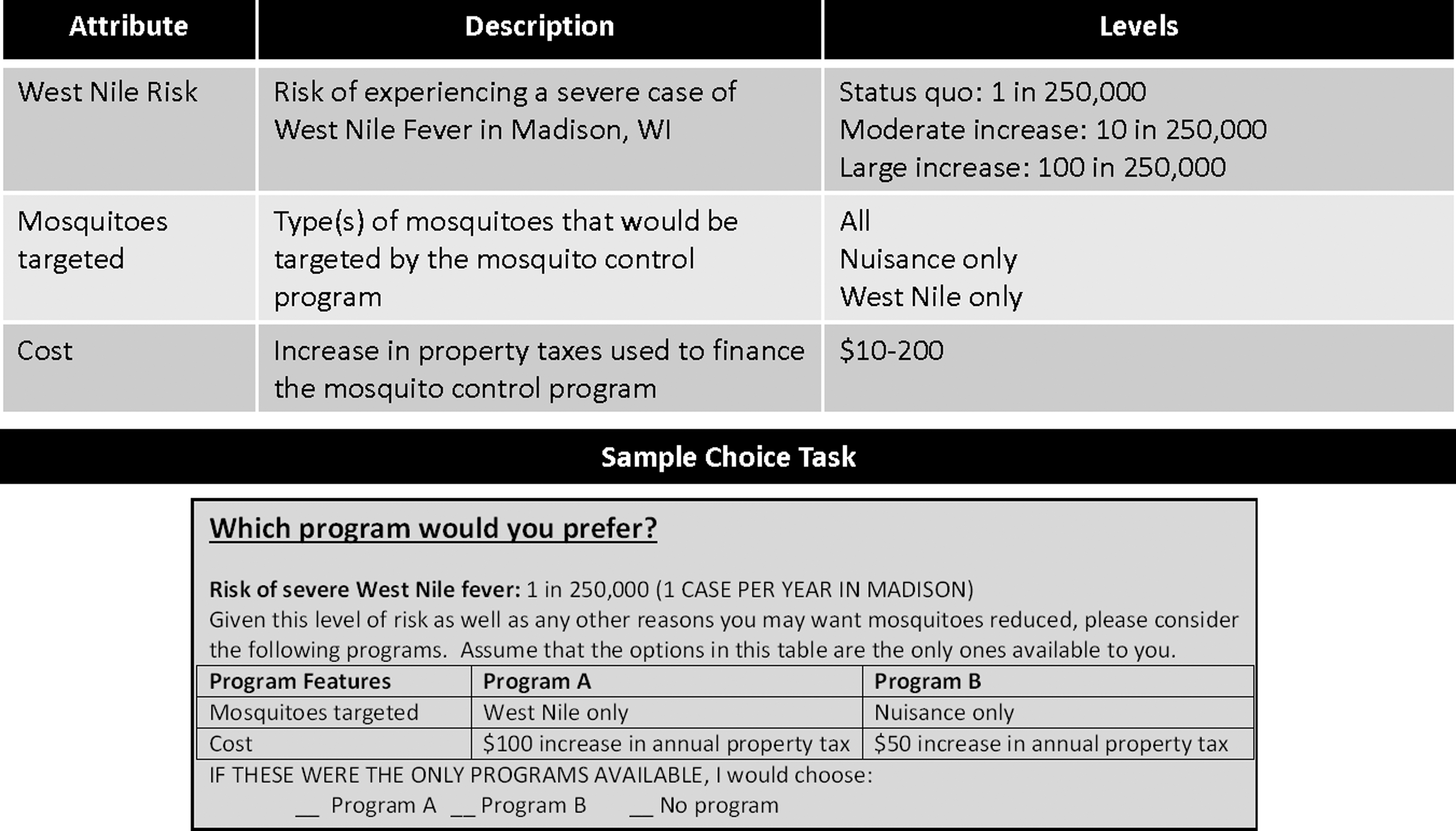
Description of attributes of mosquito control programs and sample choice task.
We analyzed the data generated by our choice experiments using a conditional logit model. This model can be derived from an economic model in which households derive value, or “utility,” from the different attributes of the program (Alberini et al. 2010). That is, this model assumes that individuals' utility functions take the form:
where i indexes individuals, j indexes mosquito control policy alternatives, WN is an indicator for whether the program controls West Nile mosquitoes, Nuis records whether the program controls nuisance mosquitoes, y is income, and C is the program's cost. (Note that “No Program” choices were included in the analysis; in this case, WN, Nuis, and C are all equal to zero.) In addition to these deterministic components, individuals' utility also has a random component (ɛij
) that is unobservable to the researcher. In this framework, selection of program k means that the utility from k is higher than the utility from any alternative. That is,
Rearranging, we get:
Assuming that
where
The coefficients from the conditional logit model provide the marginal utility from each program attribute. We use these coefficients to derive a willingness to pay for specific types of mosquito control by dividing the appropriate coefficients by the coefficient of cost (i.e., the marginal utility of income; Alberini et al. 2010). That is, we can derive:
Within this framework, we are also interested in measuring how background levels of West Nile disease risk (R) affect willingness to pay. Because these risk levels do not vary within a choice task, we must interact these variables with attributes that do vary (i.e., mosquito type), in order to assess their effects on choice probabilities. Our full model is thus:
Estimating willingness to pay in this model requires adding up relevant coefficients and again dividing by the coefficient of cost. For example, estimates for WTP for West Nile mosquito control under the three different risk levels are estimated as:
The resulting WTP point estimates are ratios of estimated parameters. To derive 95% confidence intervals for these estimates, we implement a bootstrapping routine that re-samples from the observed data, and re-estimates coefficients to derive the sample distribution of the estimated parameter. All statistical analyses were conducted using Stata 11 (StataCorp 2009).
Results
Of the 1556 households that were invited to participate in the household survey, we received 282 responses, for a response rate of 18%. Socioeconomic and demographic characteristics of the survey respondents are presented in Table 1, along with Madison population characteristics for a subset of variables. On average, survey respondents were about 55 years old and had lived in Madison for about 27 years. A somewhat higher proportion of respondents were female (55%), while 40% were male and 5% did not provide their gender. Most respondents (68%) were married, and most households consisted of two adults. Only 30% of households had children living at home; of these, 11% had one child and 14% had two or more children. Compared to Madison as a whole, the most striking differences are in terms of education and wealth. Our sample is very highly educated, with over 80% of respondents having a bachelor's degree or higher (compared to just under 50% in the Madison population), and more than half of respondents holding a graduate or professional degree. Estimated per-capita income and property values are also substantially higher in our sample compared to the city as a whole. Given these differences, we are careful to note that our results are not representative of Madison as a whole, but rather capture the views and preferences of a particular subset of the population.
Survey respondents provided ranges for total annual household income (e.g., less than $20,000, $20,000 to $39,999, …, more than $200,000). Average per-capita income in the sample was calculated using the midpoints of each range (or the cut-off value of $200,000 for the highest group), and dividing by reported household size.
To take a first look at the data generated by the choice experiments, Figure 2 shows the percentage of respondents who were willing to pay different amounts for mosquito control programs. Recall that each respondent completed three choice tasks at each of the three West Nile risk levels. In each task, the respondent saw two programs that varied in cost and type of mosquito controlled. If a respondent chose “No program” in all three choice tasks, this indicates that his or her WTP for mosquito control at the given risk level was $0. If the respondent chose a program with a cost of $50 in one of these three tasks, then she indicated that she was willing to pay at least $50 for some type of mosquito control. Thus, Figure 2 plots the percentages of respondents who chose at least one program with a cost of $0, $10, $50, $100, and $200, under the three different risk levels.
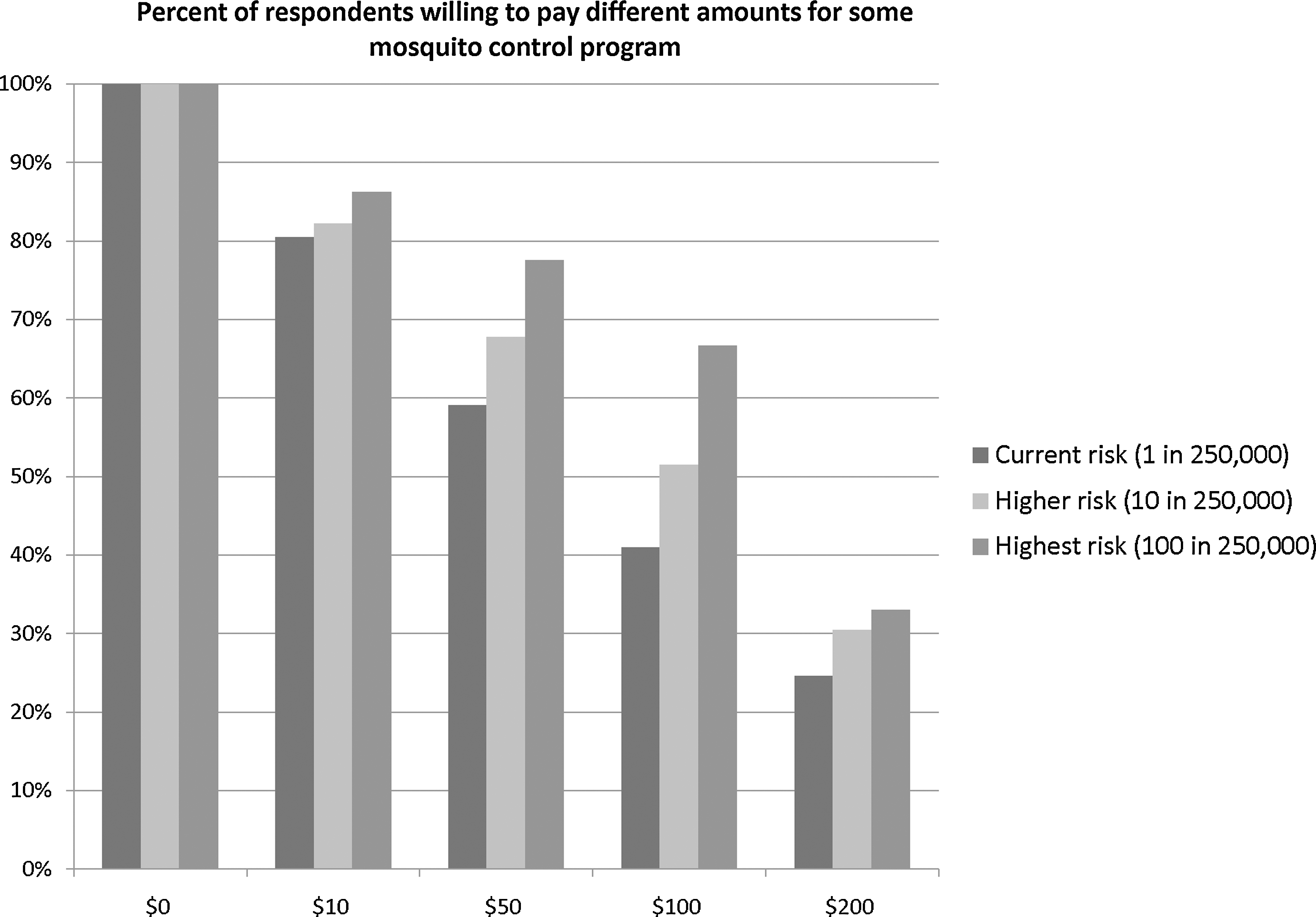
Percent of respondents willing to pay different amounts for some mosquito control program.
A few results are worth highlighting. First, at each risk level, the proportion of respondents saying “yes” to a program decreases as program cost increases. In economic terms, this is evidence of a downward-sloping demand curve, which we expect to observe for most goods and services. While over 80% of respondents were willing to pay at least $10 for mosquito control, the proportion of respondents who were willing to pay the highest amount, $200, falls to between 25% and 33%, depending on risk level. Second, WTP increases as disease risk increases. For example, the proportion of respondents who chose a program costing $100 increases from 40% at the current risk level to 67% at the highest risk level. A third observation is that overall WTP appears quite high, even at the lowest risk level: the fact that 25% of respondents chose a $200 program under currently low-risk conditions indicates that several respondents place significant value on mosquito reductions. On the other end of the spectrum, it is apparent that some individuals are not willing to pay anything for mosquito control, even under the highest risk level: while 86% of respondents were willing to pay at least $10 for some program when West Nile risk was increased to 100 in 250,000, the remaining 14% said “no” to every program, even at this risk level.
While Figure 2 provides a useful overview of the choice task responses, it does not specifically tell us what types of mosquitoes respondents were choosing to control. Using the conditional logit methods described in the previous section, we estimated means and 95% confidence intervals of WTP for West Nile and nuisance mosquitoes under the three different risk levels. The results are presented graphically in Figure 3. Under the current low-risk conditions, WTP for West Nile mosquito control is actually negative and statistically indistinguishable from zero, while average WTP for nuisance control is $147 (95% [CI $109, $186]). Meanwhile, under the highest-risk scenario, WTP for West Nile mosquito control is estimated at $158 per household (95% CI [$111, $206]), while WTP for nuisance control is $108 (95% CI [$78, 138]).
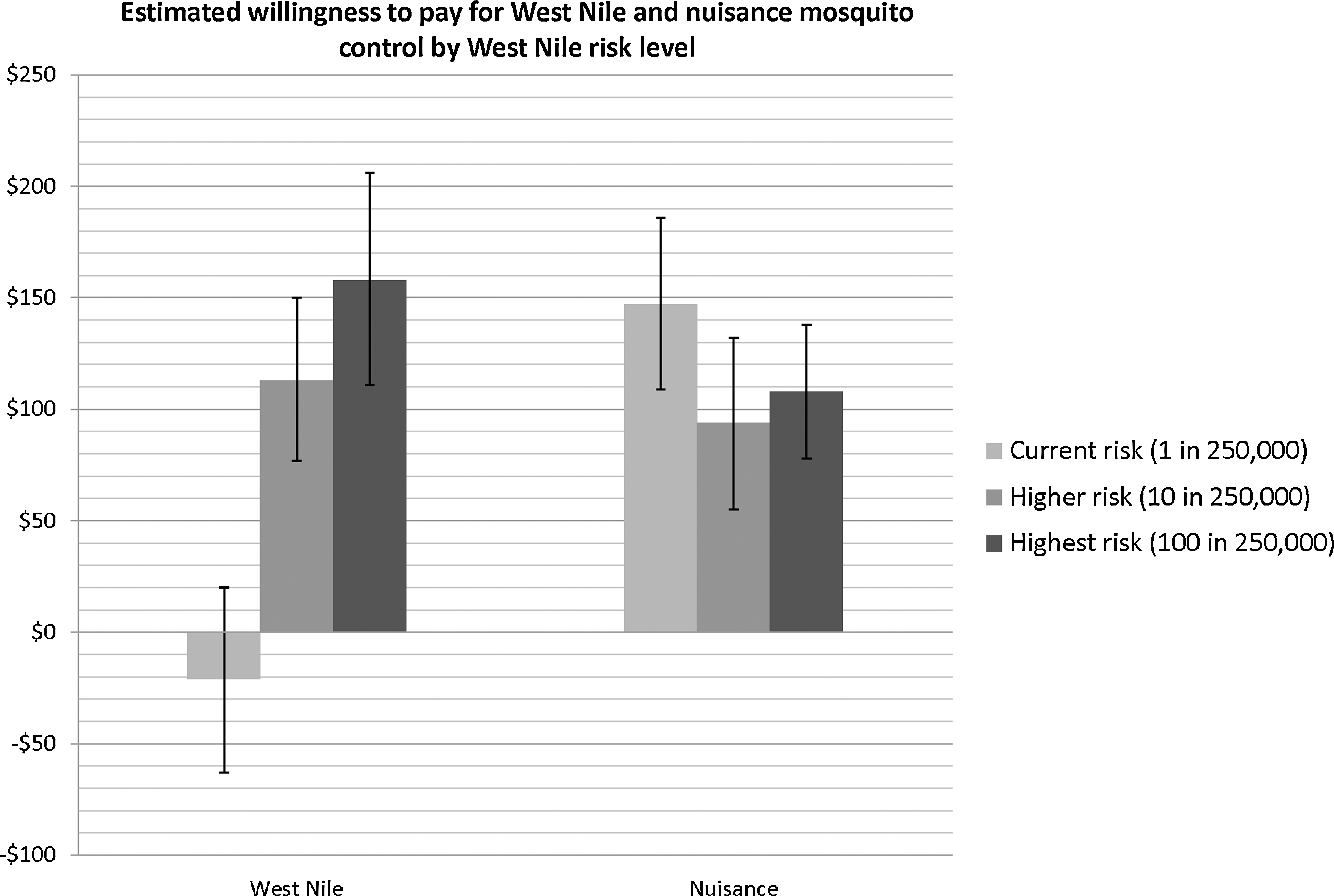
Estimated willingness to pay for West Nile and nuisance mosquito control by West Nile risk level.
Discussion
Our results indicate that survey respondents place a high value on mosquito control. Using choice experiments, we estimate that the average survey respondent would be willing to pay more than $100 per year to reduce mosquito populations by 90% relative to current levels. Our methodology also allows us to tease apart demand for nuisance control and disease risk reduction; we find that current WTP values within the sample are entirely driven by the nuisance generated by mosquitoes. While respondents did indicate that they would be willing to pay more for disease risk reduction if the West Nile risk levels increased, fear of disease does not significantly contribute to demand for mosquito control under current conditions.
Meanwhile, current city- and county-level control efforts in Madison are exclusively targeted toward WNV mosquitoes. Surveillance and control of mosquitoes ceased during the 1970s, but was reinstated following the first occurrence of WNV in Wisconsin in 2002. Because the program is directed through the Dane County Public Health Department, control is targeted solely toward the primary West Nile vectors, Culex spp., which breed primarily in man-made ditches and underground catch basin systems (Irwin et al. 2008). By contrast, the major nuisance species (Aedes vexans and Ochlerotatus trivittatus) inhabit different niches and are not controlled through the current program. The total current annual mosquito control budget for Dane County (in which Madison is located) is $29,000. Since the population of Dane County is roughly 500,000, this amounts to less than $0.06 per person per year.
While the non-random nature of our sample prevents us from neatly extrapolating our findings to the city of Madison as a whole, we can conduct some thought experiments to explore the possible implications of these results. First, within our sampled neighborhoods, we face the possibility that those who responded to the survey did so because they cared more about mosquitoes than non-respondents, and thus non-respondents' WTP for mosquito control would be lower. While we do not know how much lower, we can use our results to estimate a lower boundary on the total WTP for mosquito control in these six neighborhoods by assuming that non-respondents place no value on mosquito avoidance. That is, we assume that WTP is $0 for both West Nile and nuisance mosquito control for the 1274 households that reside in our study neighborhoods, but chose not to respond to the survey. Under current conditions, we saw that average WTP for West Nile control among the 282 respondents was roughly $0, while WTP for nuisance control was over $100. Thus we estimate that overall WTP among respondents and non-respondents would be $0 or less for West Nile control alone, while total WTP for nuisance control would be at least $28,200, or $18 per household.
Based on these results, our first conclusion is that there is likely to be little public demand for scaling up the current West Nile-only mosquito control efforts in the city and county. On the other hand, since respondents did express an increasing WTP for disease control as West Nile risk levels increased, the current strategy of investing a modest amount of money in disease surveillance and control efforts seems wise and justified given public values.
Turning to nuisance mosquito control, do our results suggest that a new program of the type described in our survey should be initiated? Clearly, the answer to this question is more complicated. Officials from Dane County Public Health and a mosquito control company, Clark, estimate that the total annual cost for a scaled-up program resembling the hypothetical programs we described in our study would be about $750,000–$1,000,000, or less than $4 per person for the city of Madison. Even though we cannot provide an overall estimate of WTP for mosquito control in Madison, our results do lead us to conclude that the benefits of mosquito control, in terms of reduced nuisance values, would exceed the implementation costs for some level of nuisance control.
However, it is clearly important to examine the full range of health, environmental, and other impacts that would result from increased control of nuisance mosquitoes. On the one hand, it is possible that targeting non-disease mosquitoes could have public health benefits to the extent that high mosquito populations limit time spent outdoors, and thus affect levels of physical activity. On the other hand, environmental impacts of mosquito control are clearly a concern. Indeed, several survey respondents included comments that expressed concerns about the effects of a mosquito control program on species other than mosquitoes. For example, one respondent wrote that, “I'm skeptical that any mosquito control program is really ‘environmentally safe,’ and would be concerned about impacts on non-target invertebrate species, as well as unknown effects on humans and other animals.” In addition to concerns about the effects of chemicals used in mosquito control, other respondents worried about the ecological or food chain effects of substantially reducing mosquito populations. As one respondent put it, “Many birds and bats feed on adult mosquitoes. I am concerned that these animals would suffer from a mosquito control program.” Similarly, Tedesco and colleagues (2010) found that environmental concerns played a central role in the local politics of mosquito control during the 2002 WNV outbreak in the Chicago region, although these concerns were related more to spraying of adult mosquitoes than larviciding. In the case of larviciding, studies tend to show that impacts on non-target organisms can largely be avoided through use of appropriate biological agents like Bacillus sphaericus (Merritt et al. 2005). However, what is clear is that environmental concerns loom large for much of the public, and addressing these concerns through educational efforts would entail its own costs.
In light of this discussion, our purpose in this article is not to argue for more aggressive mosquito control efforts in Madison. Rather, we present evidence that within a subset of the population, nuisance values play a larger role than disease risk per se in driving demand for mosquito control. Further assessment of the broader public's demand for control, the financial and environmental costs, and political and institutional barriers, is required to determine whether expanded control is cost-beneficial in this context.
Footnotes
Acknowledgments
This project was supported by a grant from the Robert Wood Johnson Health and Society Scholars program at the University of Wisconsin, to whom K.D. is grateful for its support of her research. We also acknowledge Helen Yu and Patrick Irwin for their research assistance, and we thank focus group participants in the Monroe neighborhood who provided valuable feedback on the survey instrument and study design. The National Center for Atmospheric Research is sponsored by the National Science Foundation.
Author Disclosure Statement
No competing financial interests exist.