




Abstract
Information about spotted fever group (SFG) rickettsiae in southern China remains sparse. A specific and sensitive real-time PCR assay for detection of SFG rickettsiae was established and used to detect the prevalence rate of SFG rickettsiae in Yunnan Province, China. The limit of detection (LOD) of our real-time PCR was 200 copies per reaction, which is more sensitive than the previously developed nested PCR assays for Rickettsia. We tested 265 blood samples (127 goats, 78 dogs, and 60 cattle) collected from Yunnan Province using the real-time PCR assay and revealed that the prevalence of SFG rickettsiae among dogs, cattle, and goats were 14.10%, 23.33%, and 24.41%, respectively. The SFG rickettsiae detected in animals in Yunnan Province were classified into two genotypes: a unique group that is different from all known SFG rickettsiae species, and R. heilongjiangensis.
Introduction
In this study, we developed a TaqMan real-time PCR assay based on the SFG rickettsiae ompA gene for rapid detection of the SFG rickettsiae. This assay was used to investigate the prevalence and the distribution pattern of the SFG rickettsiae loads in domestic animals from the agricultural regions of Yunnan Province in southern China. The results of the real-time PCR were also compared with a previously developed nested PCR assay.
Materials and Methods
Study design
A real-time PCR assay detecting SFG rickettsiae DNA was developed and evaluated for its sensitivity, specificity, and reproducibility. Two-hundred and sixty five animal blood samples collected from the Yunnan Province of China were tested with the real-time PCR assay to reveal the prevalence of SFG rickettsiae, and the concentration of target DNA (ompA gene) in each positive animal sample. OmpA concentration was applied to represent the SFG rickettsiae load among these animals, as they had a positive correlation with each other. A previously developed nested PCR(Luan et al. 2008) was also performed on the same blood samples to compare the agreement of the two assays.
Study areas and sample collection
Yunnan Province is located in southwest China and covers 390,000 square kilometers. This area has reported cases of murine typhus, scrub typhus, and Q fever (Zhang. 2001), but not spotted fever. Three sites, including Xundian County in the northeast, Yulong County in the northwest, and Simao County in the south of Yunnan were selected according to their geographic features (comprised of mountainous region, hilly areas, and forest lands). Epidemiological surveys were carried out by the professional staff of our department and the CDC in the local counties. A total of 265 blood samples from domestic animals (78 dogs, 60 cattle, and 127 goats) were collected from March 13 to 28, 2009. Approval for the study was obtained from the Yunnan Provincial Institutional Review Board.
Sample preparation
Sera were separated from clots by centrifugation and stored at −20°C, and DNA was extracted from blood clots with the DNeasy Blood & Tissue Kit (Qiagen, Hilden, Germany) following the manufacturer's instructions. Briefly, purified DNA exacted from 200 μL of serum was eluted with 100 μL of elution buffer and the eluate was stored at −20°C until use. Sterile phosphate-buffered saline (PBS) was used as a negative control during the process of extraction. The target DNA (ompA) concentration in the DNA eluate was quantified with the real-time PCR assay, and then converted to the concentration by dividing by 2 (due to the twofold increase in concentration during DNA extraction, in copies/μL).
Rickettsia strains and rickettsial DNA extraction
Rickettsia prowazekii Breinl, R. typhi Wilmington, Orientia tsutsugamushi serotype Karp and Kato, R. heilongjiangenesis 054, and Coxiella burnetii were from our laboratory. Rickettsia sibirica, R. conorii, R. honei, R. akari, R. rickettsii, R. africa, R. parkeri, R. canada, Bartenella henselae, and B. quintana were kindly provided by Dr. Raoult D. (The WHO Rickettsial Diseases Collaborating Center, Marseille, France). Anaplasma phagocytophilium and Borrelia burgdorferi were kindly provided by Dr. J. Stephen Dumler (The School of Medicine of the Johns Hopkins University), and Ehrlichia chaffeensis was from the U.S. Centers for Disease Control and Prevention. Other common pathogenic bacterial DNA were obtained from laboratories in the Chinese center for Communicable Disease Control and Prevention, China CDC, including Escherichia coli, Vibrio cholerae, Bacillus anthracis, Y. pestis, Haemophilus influenzae, Listeria and Legionella.
Genomic DNA was extracted from bacteria as described above. Conventional PCR was performed with the universal primers for the bacterial 16S rRNA gene (Weisburg et al. 1991) to confirm the presence of the aforementioned bacterial DNA before performing real-time PCR. The specificity of the real-time PCR assay was determined by performing the assay on these bacterial DNA and DNA from uninfected sources (cattle and goat), and the latter was also spiked into reaction mixtures to determine the effect of the eukaryotic DNA background on PCR amplification.
Probe and primer design
Probes and primers for the real-time PCR assay were designed using ABI primer Express 2.0 software based on the alignment of the ompA gene of 14 species of SFG rickettsiae from the GenBank (Table 1). Specific primer pairs consisted of Rh-F (5′- TTCAAAAAGCAATACAACAARGTCTTA) and Rh-R (5′- CCGCTACTACTCAGCATTATCGC) that generated a 79-bp fragment, and the TaqMan probe was Rh-P (5′-AGCCGCTTTATTCACCACYTCAACCG), and it was labeled at the 5′ and 3′ ends with 6-carboxyfluorescein (6-FAM) and 6-carboxyl-tetramethylrhodamine (TAMRA) (Gene Core BioTechnologies, Shanghai, China). The selected regions for the probe and primers are highly conserved in most SFG rickettsiae species, with a maximum of four nucleotide substitutions. Therefore theoretically this real-time PCR assay can amplify most SFGR species. All primers used in this study are shown in Table 2.
No nucleotide substitutions were observed in the other 8 SFG rickettsial species, including R. honei (U43809), R. conorii (U43806), R. montanensis (U43801), R. rhipicephali (U43803), R. sibirica (U43807), R. slovaca (U43808), R. africae (U43790), and R. aeschlimannii (U43800).
Wobble positions used: Y=C or T, R=A or C.
Wobble positions used: Y=C or T, R=A or C. Outer primer Rh-F and Rh-Rr were used for standard plasmid construction.
Standard curve for quantification
To construct a standard curve, a 305-bp fragment of the ompA gene containing the 79-bp target sequence for the real-time PCR assay was amplified from R. heilongjiangenesis strain 054 (a Chinese strain isolated in 1984) with outer primers Rh-F and Rh-Rr. The PCR products were purified using an EZ-10 Spin Column PCR Products Purification Kit (Bio Basic, Markham, Ontario, Canada), and ligated into a PGM-T cloning vector (Beijing TransGen Biotech Co., Ltd., Beijing, China). Subsequently the vector was transferred into DH5α-competent Escherichia coli. The plasmids were extracted with a QIAprep Spin Miniprep Kit (Qiagen, Hilden, Germany) and sequenced to confirm the presence of the ompA sequence from R. heilongjiangensis. The concentration of the plasmid solution (126.5 ng/μL) was quantified using a NanoDrop ND-1000 spectrophotometer (NanoDrop Technologies, Wilmington, Delaware), and then adjusted to 3.71×10¹⁰ copies/μL by calculating the weight of a single copy of a plasmid (Brennan and Samuel 2003). A serial 10-fold dilution from 101 to 109 copies/μL was made to enable the sensitivity test.
Real-time PCR assay conditions
Real-time PCR was performed with a Line-Gene K device (Bioer Technology, Hangzhou, China) according to the manufacturer's instructions. A total of 25 μL reaction volume contained 12.5 μL 2× TaqMan Universal PCR Master Mix (Applied Biosystems, Foster City, CA), 800 nM of each primer, 400 nM probes, 5.5 μL of sterile water, and 2 μL DNA template. Amplification conditions were as follows: 95°C pre-denaturation for 10 min followed by 45 cycles at 95°C for 40 sec and 60°C for 1 min. To test the samples, a series of 108−102 copies/μL recombinant plasmid solutions were used for quantification. Sterile water and DNA from uninfected sources were used as negative controls.
Quality control of the real-time PCR assay
Intra- and inter-assay analyses were performed to define the reproducibility of the real-time PCR assays. Intra-assay variability was determined by calculating the coefficient of variation (CV) of three replicate Ct values from each dilution of plasmid from 108−102 copies/μL within the same experiment. Inter-assay variability was measured by calculating the CV of the mean Ct value of each dilution in three separate tests performed on different days. During each test, the identities of the sample and positive or negative control were blind to the operator. To eliminate false-positives, each sample was tested in triplicate within the same run. Only if all three tested positive was the sample considered true-positive.
Nested PCR assay
Nested PCR was performed with primer pairs based on the groEL gene of R. rickettsii (GenBank accession no. U96733). Briefly, two pairs of primers Gro-1/Gro-2 and SF1/SR2 (genus-specific) were used in the first and second rounds of amplification, respectively, to produce a final 217-bp fragment (Luan et al. 2008). Twenty-five microliters of the reaction mixture contained 10-μL DNA templates in the first round, or 1 μL of the first round PCR products as the template for the second round, 0.2 mM dNTPs, 200 nM of each primer, 2.5 μL of 10× Taq buffer, and 2.5 U of Taq DNA polymerase (SBS Genetech, Beijing, China). Positive results were confirmed by sequencing and comparison to sequences available in the GenBank.
Statistical analysis
Comparison of the infection rates among different animals was performed using the chi-square test and Fisher's exact test. The geometric means and range of ompA concentration in the positive samples were calculated, and the distribution patterns of SFG rickettsial loads among animals were compared using the Kruskal-Wallis test. Significance for these analyses was set at p<0.05. The kappa test was used to determine the agreement between the real-time PCR and the nested PCR assays. Statistical analysis was conducted using SAS software (version 9.1).
Results
Sensitivity, specificity, and reproducibility of the real-time PCR
The sensitivity was shown to be 200 copies per reaction (Fig. 1). The correlation coefficient between the Ct values and initial DNA concentration reached −0.999, demonstrating a high accuracy for quantification. The real-time PCR assay amplified all of the SFG rickettsiae species tested, including R. sibirica, R. conorii, R. honei, R. rickettsii, R. africa, R. parkeri, R. canada, and R. heilongjiangensis, but not R. akari. Genomic DNA from other members of the order Rickettsiales, common pathogenic bacteria, and the uninfected cells showed negative results. The mean (range) CV values for intra-assay and inter-assay variation were 1.15% (1.01–2.35%) and 2.59% (1.99–3.15%), respectively. Undiluted DNA extracted from uninfected cattle and goats were spiked into the reaction mixtures, and CT values remained relatively consistent with the negative control of water, and no significant differences were observed based on two-way classification ANOVA (data not shown).
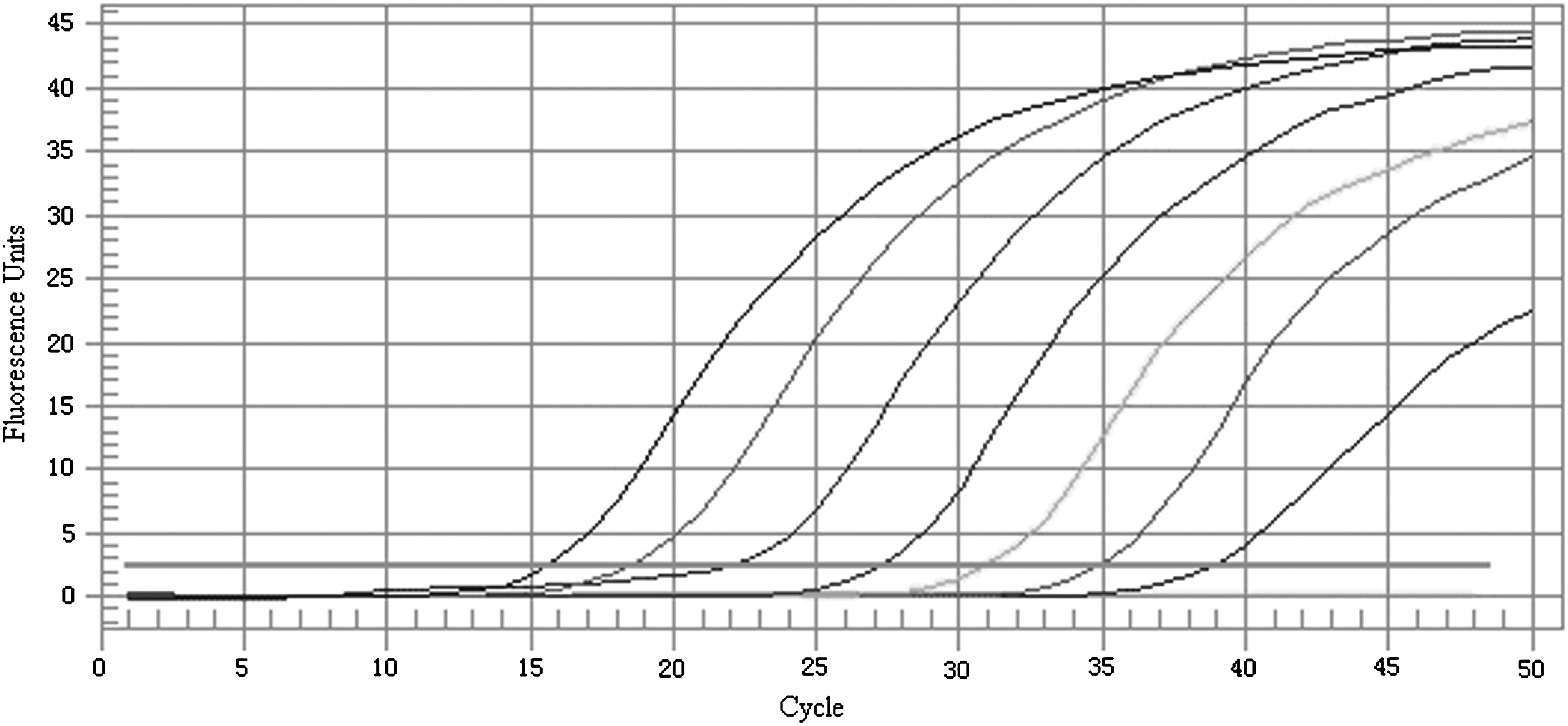
Amplification plots showing the sensitivity of the real-time PCR assay. Two microliters of 10-fold serial dilutions of plasmid (108–101 copies/μL) were used as the template, sterile water was negative control, and the corresponding Ct values were 15.79, 18.75, 22.53, 27.76, 31.05, 34.87, and 38.39 negative (101 copies/μL plasmid solution and sterile water showed negative results).
Prevalence of SFG rickettsiae in domestic animals determined with real-time PCR
Of the 265 blood samples collected from domestic animals in Yunnan Province, 56 (21.13%) tested positive (Table 3). The prevalence among dogs, cattle, and goats, were 14.10%, 23.33%, and 24.41%, respectively. No statistically significant differences were observed using the chi-square test (χ2=3.3055, p=0.1915). The ompA concentrations in the 56 positive samples ranged from 1.05×10³ to 3.56×10⁷ copies/μL. A statistically significant difference was found in the distribution patterns of SFG rickettsial loads among domestic animals using the Kruskal-Wallis test (χ2 CMH=10.2631, p=0.0059; Table 3). It was remarkable that 23.33% of the cattle were found to have an ompA concentration higher than 104 copies/μL, and 8.33% were higher than 105 copies/μL. In contrast, all dogs were lower than 104 copies/μL, and only 0.79% of the goats were higher than 105 copies/μL.
There were no statistically significant differences in prevalence among the different animals using the chi-square test (χ2=3.3055, p=0.1915).
Distribution patterns of SFG rickettsial loads among different animals showed a statistically significant difference using the Kruskal-Wallis test (χ2 CMH=10.2631, p=0.0059).
Real-time PCR compared to nested PCR
Briefly, 3 (3.85%) dogs, 5 (8.33%) cattle, and 16 (12.60%) goats tested positive by nested PCR, and the overall SFG rickettsial infection rate was 9.06% (Table 4). The prevalence was significantly lower than that determined with real-time PCR (p<0.0001 by McNemar test; Table 5). A fair agreement between the two assays was detected based on the kappa coefficient (kappa=0.4560, 95% CI 0.3181,0.5940; Table 5). Twenty-four nested PCR products with specific bands (217 bp) were sequenced (Tsingke Biotechnology, Beijing, China) and compared with sequences available in the GenBank using BLAST (
Distribution of the two rickettsial species (R. conorii and R. heilongjiangensis) among the different animals showed no statistically significant difference based on Fisher's exact test (p=0.2564 and p=0.3218, respectively).
Prevalence determined by real-time PCR was significantly higher than that by nested PCR (p<0.0001 by McNemar test).
Kappa coefficient revealed a low agreement of the two assays (kappa=0.1362, 95% CI 0.0478,0.2246).
Discussion
Our study established a sensitive and specific TaqMan real-time PCR assay for the diagnosis of SFG rickettsiae, and we found two genotypes of SFG rickettsia present in Yunnan Province. Our TaqMan real-time PCR assay using the ompA gene can specifically amplify most SFG rickettsiae, and is more sensitive than any known PCR assay. The relatively high sensitivity enabled this assay to detect 200 copies of target DNA per reaction, and thus it is possible to use this assay as a rapid diagnostic test in the early stage of illness. High specificity was seen when we performed the real-time PCR assay on several members of the order Rickettsiales and other common pathogenic bacteria. All of the SFG rickettsial strains tested showed a positive result except for R. akari, because its ompA gene is highly divergent from other SFG ricketttsiae (Roux et al. 1996; Fournier et al. 1998).
Yunnan Province is located in southwest China where scrub typhus and endemic typhus have been observed (Zhang 2001). To our knowledge, this is the first molecular survey using a real-time PCR assay in this region of China. A high infection rate with SFG rickettsiae was found among the 265 domestic animals (21.13%) with the real-time PCR assay. Frequent contact with these animals may increase the risk of tick bites and subsequent infection, a serious situation making farmers, herdsmen, and livestock breeding workers a high-risk population. This sentinel survey in Yunnan Province suggests that residents in this area need to be informed about possible SFG rickettsial infection. As no vaccine available for rickettsial disease (Chapman et al. 2006), it is advisable to avoid tick bites with protective clothing and insecticides, and it is also necessary to keep livestock away from tick-bearing environments. Goats were shown to have the highest infection rate among all animals (Tables 3 and 4). Kovacova and associates reported a similar prevalence of SFG rickettsiae (27.5%) among goats in Iran using an IFA test (Kovacova et al. 1996). Dogs can bring infected ticks into the home environment and increase the risk of infection for family members (Paddock et al. 2002; Elchos and Goddard 2003). We found a high prevalence among dogs (14.10%), corresponding with results of a previous study in Australia (11.2%; Sexton et al. 1991), but was lower than the 31.3% reported in Brazil (Horta et al. 2004).
Several real-time PCR assays for the detection of SFGR have previously been developed (Stenos et al. 2005; Henry et al. 2007; Kidd et al. 2008); however, the SFG rickettsial loads in different animals have seldom been studied. In this study, we found a statistically significant difference in the distribution patterns of bacterial loads among domestic animals. According to our results, cattle were more likely to have a higher bacterial load after they were infected, while dogs maintained relatively low bacterial loads (Table 3). Sonthayanon and colleagues demonstrated a relationship between bacterial load and disease severity in adults with scrub typhus (Sonthayanon et al. 2009); however, in our research it was impossible to clarify the association between SFGR load and disease severity using a cross-sectional investigation. A fair agreement between the real-time assay and nested PCR assay was observed (kappa=0.4560, 95% CI 0.3181,0.5940). The disagreement of the test results may be due to the sensitivity of the two assays, or may be because they were designed based on different genes.
In conclusion, we described a real-time PCR test to detect SFG rickettsiae rapidly and quantitatively. This technique provides faster results than traditional PCR testing, and it can be used to determine the infectivity load in hosts, vectors, and to detect potential carriers in epidemic and epizootic surveys.
Footnotes
Acknowledgments
This study was supported by the National Basic Research Program of China (973 Program) 2010CB530200 (2010CB530206), and the China-U.S. Collaborative Program on Emerging and Re-emerging Infectious Diseases (no. 1U2GGH000018-01).
Chang-wei Liang is a graduate student at the Department of Rickettsiology and Anaplasmosis, China ICDC. His research area is the surveillance of rickettsioses.
Author Disclosure Statement
No competing financial interests exist.